Archive for June, 2011

In case today’s slow posting schedule wasn’t a dead giveaway, I’ve decamped from the city for a nice long Fourth of July weekend out of town. I’ll be back on Tuesday to round up any news I might have missed. In the meantime, here are the weekend’s service advisories. The MTA sends along the following note about Monday subway service:

On Monday, July 4, the New York City Subway will operate on a Saturday schedule with increased service following the Macy’s fireworks celebration. The fireworks display will originate from six barges located on the Hudson River between 20th and 55th Streets from 9:20 to 9:50 p.m. After the fireworks, there will be increased subway service on the 1, 2, 3, A, C, E, L and 42nd Street S Shuttle.

As a reminder, on Saturdays, B and Z trains do not operate. The M train runs between Middle Village-Metropolitan Av. and Myrtle Av. The Q terminates and 57th St. in Manhattan and the J terminates at Chambers St. in Manhattan.

Have a great weekend, and be safe.


From 3:30 a.m. Saturday, July 2 to 6 p.m. Monday, July 4, free shuttle buses replace 2 train service between East 180th Street and 149th Street-Grand Concourse due to track panel installation between Jackson Avenue and Freeman Street. 2 trains will operate in two sections:

  • Between 241st Street and East 180th Street
  • Between 149th Street-Grand Concourse and Flatbush Avenue


From 12:01 a.m. Saturday, July 2 to 5 a.m. Monday, July 4, 3 service is extended to New Lots Avenue during the overnight hours due to the suspension of 4 service south of Brooklyn Bridge.


From 12:01 a.m. Saturday, July 2 to 5 a.m. Monday, July 4, there is no 4 service between Brooklyn Bridge and Utica Avenue due to work at the Fulton Street Transit Center. The 3, N, and Q trains provide alternate service. Note: During this time, 4 trains run local in both directions between 125th Street and Brooklyn Bridge.


From 3:30 a.m. Saturday, July 2 to 6 p.m. Monday, July 4, 5 service is suspended between East 180th Street and Bowling Green due to track panel installation between Jackson Avenue and Freeman Street. A free shuttle bus is available between East 180th Street and 149th Street-Grand Concourse. Customers between 149th Street-Grand Concourse and Brooklyn Bridge may take the 4 instead. Customers at Brooklyn Bridge and Bowling Green may use the R (N overnight) at nearby stations.


From 8 a.m. to 4 p.m., Saturday, July 2 and Sunday, July 3, Bronx-bound 6 trains run express from Parkchester to Pelham Bay Park due to rail and plate renewal at Middletown Road.


From 11 p.m. to 5 a.m., Friday, July 1, Saturday, July 2 and Sunday, July 3, uptown A trains operate express between 59th Street-Columbus Circle and 125th Street. There is no uptown C local service at 72nd, 81st, 86th, 96th, 103rd, 110th, and 116th Streets this weekend. This is due to track work south of 110th Street. Customers traveling to these stations may take an uptown train to 125th Street and transfer to a downtown train. Customers heading to stations above 125th Street from these stations may take the downtown train to 59th Street and transfer to an uptown train.


From 12:01 a.m. Saturday, July 2 to 5 a.m. Monday, July 4 uptown C trains operate express between Canal Street and 59th Street-Columbus Circle due to work on the Broadway/Lafayette-to-Bleecker Street transfer connection. (Train traffic would be too congested to operate three services – A, F and C – between Jay Street and West 4th Street, so C will operate express.)


From 12:01 a.m. Saturday, July 2 to 5 a.m. Monday, July 4, Queens-bound F trains run local on the A line from Jay Street-MetroTech to West 4th Street due to work on the Broadway/Lafayette-to-Bleecker Street transfer connection.


From 12:01 a.m. Saturday, July 2 to 5 a.m. Monday, July 4, downtown F trains skip 23rd Street and 14th Street due to platform edge rehabilitation at 34th Street.


From 11 p.m. Friday, July 1 to 5 a.m. Tuesday, July 5, there are no G trains between Hoyt-Schermerhorn Sts. and Church Avenue due to track work north of Hoyt-Schermerhorn Sts. G trains operate in two sections:

  • Between Court Square and Bedford-Nostrand Avs and
  • Between Bedford-Nostrand Avs and Hoyt-Schermerhorn Sts. (every 20 minutes)

Note: The A provides connecting service between Hoyt-Schermerhorn Sts. and Jay Street-MetroTech.


From 12:01 a.m. Saturday, July 2 to 5 a.m. Monday, July 4, Brooklyn-bound N trains operate on the D line between 36th Street and Coney Island-Stillwell Avenue, in Brooklyn due to installation of track panels.


From 4 a.m. Saturday, July 2 to 10 p.m., Sunday, July 3, Brooklyn-bound N trains skip 30th Avenue, Broadway, 36th Avenue and 39th Avenue due to structural overcoat painting along the Astoria Line.


From 6:30 a.m. to 10 p.m., Saturday, July 2 and Sunday, July 3, Brooklyn-bound N trains run local on the R line from DeKalb Avenue to 36th Street (Brooklyn) and Queens-bound N trains run local on the R line from 59th Street (Brooklyn) to DeKalb Avenue due to structural overcoat painting along the Astoria Line.
Categories : Service Advisories
Comments (2)

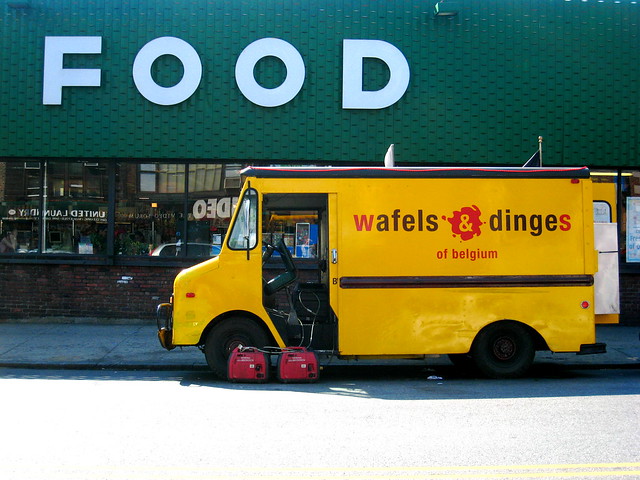
The Wafels and Dinges truck, my personal favorite, parks outside of Key Food in Park Slope on Saturdays. (Photo by flickr user Adam Kuban)

I am an unabashed fan of New York’s burgeoning food truck scene. From the Wafels & Dinges stalwart to the cookies from the Treats Truck to Mexicue’s sliders and beyond, I find the food trucks to be a breath of fresh air amidst New York’s stagnant lunch scene, and I eye Los Angeles, Portland and the Bay Area enviously for their vibrant food truck and food cart offerings.

Unfortunately, though, while many New Yorkers agree with me, those with power — the restaurant and food services industry — don’t feel the same way. To them, the food trucks represent a threat. While no longer a novelty, they have remained popular by offering good, cheap food, and from Midtown to Park Slope, bricks-and-mortar stores feel threatened. They don’t want to lose their customers to better options and think that food trucks, which do pay taxes and do adhere to DOH standards, are leeching off of their businesses. Competition, of course, is good for everyone, but try telling that to someone with an insane rent on a mediocre deli on 48th Street.

To that end, restaurants and delis have often tried to get food trucks to move. They’ve complained to the cops and to City Council members; they try to get parking regulations changed or old laws enforced. It is, as The Times noted earlier this week, working:

In the last 10 days, the Treats Truck, which has sold cookies and brownies for four years during lunchtime at West 45th Street near Avenue of the Americas, has been told by police officers that it is no longer welcome there, nor at its late-afternoon 38th Street and Fifth Avenue location. The Rickshaw Dumpling truck, a presence for three years at West 45th Street near the Treats Truck, has been shooed away as well.

The police “have told us they no longer want food trucks in Midtown,” said Kim Ima, the owner of the Treats Truck, a pioneer of the city’s new-wave food-truck movement, who began cultivating customers on West 45th Street in 2007.

Also ejected from their customary Midtown locations recently were the Comme Ci, Comme Ça Truck at 38th Street and Broadway; the Desi Truck at West 50th Street between Seventh Avenue and Avenue of the Americas; the Eddie’s Pizza Truck, the Kimchi Taco Truck and the Wafels & Dinges Truck, all at West 52nd Street and the Avenue of the Americas; the Crisp on Wheels truck at West 51st Street and Seventh Avenue. Members of the ragtag fleet of generic soft ice cream trucks in the area have been cast out, too.

Few if any of these trucks have been ticketed, and few towed. Nevertheless, some vendors who tried to return have been shooed away again. Many, including the Treats Truck, consider themselves permanently displaced and are trying to find other locations. In some cases, they have been turned out of their new neighborhoods, too.

According to The Times, this drive to push food carts out of midtown stems from a recent New York State Supreme Court case that turned to an old law “believed to date from the 1950s.” The law bars any “vendor, hawker or huckster shall park a vehicle at a metered parking space” from offering “merchandise for sale from the vehicle.” In May, Judge Geoffrey Wright decided this law applied to food trucks, and cops in certain Midtown precincts where delis feel most threatened have ramped up the pressure to get food trucks to move.

Now, the problem here isn’t just one of a limited culinary palate. It’s one of street prioritization. Food trucks inherently encourage pedestrians to use the sidewalk space they have, and they turn road space otherwise taken up by either idle and empty parked cars or moving traffic into an economically beneficial activity. Food trucks should be encouraged, and laws leftover from the 1950s when no one had even heard of the Rickshaw Dumpling Truck should be discarded. Of course, that would require a City Council willing to face down the food services lobby, and that won’t happen. Somehow, food services are louder and more vocal than pedestrians.

One day, the city will better allocate street space based on use. Then, we’ll be able to enjoy our waffles, our cookies and our overpriced lobster rolls in peace. For now, the food trucks will be marginalized to neighborhoods that actually want them.

Comments (43)

The MTA’s love/hate relationship with its escalators and elevators has continued, according to a report from the MTA Inspector General. The Daily News provides the details:

Straphangers stuck in elevators may have been trapped longer than necessary because a new monitoring system was plagued by false alarms, the Daily News has learned. Instead, staffers on a control desk in the MTA’s Elevator and Escalator department waited for notification from trapped riders or other transit workers before sending mechanics to the scene… “Despite public concern, media attention and demands for improvement by the MTA Board, elevators and escalators remain a problem,” the report said…

Other findings include:

  • Some inspection and maintenance work reported as having been done may not have been performed.
  • In addition to the many false alarms, the automated monitoring and alert system sometimes failed to send a warning during true entrapments. There were 208 entrapments in the first six months of last year.
  • Managers didn’t know false alarms were a problem and wrongly thought staff was immediately dispatched. They weren’t aware that monitoring equipment was disconnected at some elevators – including some with the highest number of entrapments.

For its part, the MTA says it will create a position in charge of escalator and elevator oversight who can spearhead “maintenance and reliability.” “We know we have to,” Caremn Bianco, senior vice president of subways, said. “We know this is a huge source of frustration for our customers.” I think I’ll take the stairs.

Categories : MTA Technology
Comments (2)

Remember the story of Edward Meehan? He’s the bus driver who has been suspended 15 times by the MTA for a series of infractions including speeding and running red lights. The MTA finally moved to fire him two weeks ago after he was caught using a Staten Island express bus for less-than-wholesome meetings with local women, and of course, his union filed an appeal.

Well, the story ends well: Meehan’s firing has been upheld by an arbitrator. Meehan, says the arbitrator, engaged in “outrageous behavior.” “Discharge is the only appropriate penalty,” the decision says. Justice, after 15 suspensions. Seems like a sound process to me.

Categories : Asides, Transit Labor
Comments (4)

An example of NYCDOT's proposed neighborhood map. (NYC Department of Transportation)

Few New Yorkers would ever admit it, but now and then, a map comes in handy. Sure, most neighborhoods throughout large stretches of the Bronx, Brooklyn, Queens and, of course, Manhattan are laid out on a grid, but maps can be useful. Perhaps one is bound for a new neighborhood; perhaps one doesn’t know where they are at the top of an unfamiliar subway staircase; perhaps one finds oneself in Chinatown and just can’t figure out where Pell St. is anyway.

And then of course, there are the tourists who get lost trying to figure out which way’s 8th Ave. and which way is 6th Ave. when they’re standing on 7th Ave. Forget trying to guide them through neighborhoods where the streets have no numbers. That’s hopeless.

Other cities have solved this problem through an innovation called a map. In Philadelphia, for instance, the city has taken the initiative to encourage walking by posting signs directing pedestrians to nearby attractions (PDF) while hanging up neighborhood maps that guide the way. These maps show an entire neighborhood with distance-based circles showing how far away the walker may be from his or her destination. Talk about convenience.

Now, New York wants to get in on the game. On Monday, NYC’s Department of Transportation has issued an Request for Proposals for surface-based maps. The initial contract for five years would cover four neighborhoods with an additional option on the deal for another five years and another five neighborhoods. It seems like a slow process for something that could help with city life, but that’s New York’s bureaucracy for you.

“New Yorkers seem to know it all, except how to get around town sometimes,” Transportation Commissioner Janette Sadik-Khan said. “We’ve got great signage for cars, but we don’t have great directional signage for pedestrians.”

For now, DOT would like to test out signs in the following neighborhoods: Long Island City, Queens; Prospect Heights/Crown Heights, Brooklyn; and Chinatown and parts of Midtown in Manhattan. The Times reports that this initiative will cost $1.5 million with federal and business dollars accounting for $1.2 million of that total. The Wall Street Journal noted that the city is willing to spend up to $9.5 million on the project.

The impetus for the project, NYC DOT says, came from a recent intercept survey conducted citywide. Five hundred pedestrians were stopped and peppered with questions, and the findings were not too comforting. Nine percent of city residents and 27 percent of visitors said they had been lost within the past seven days while 13 percent of New Yorkers were unfamiliar with the area they were in. A whopping 27 percent of visitors couldn’t even name the borough in which they were surveyed, and 33 percent of city residents couldn’t point north. It’s seemingly a wonder anyone gets around.

As The Journal noted, this effort is part of a larger initiative to better unify city neighborhoods and help New Yorkers navigate. For instance, the area between the Manhattan and Brooklyn Bridges in Manhattan has suffered through an identity crisis. “In different spaces, according to the Department of Transportation,” The Journal said, “that space has been labeled as Chinatown, Two Bridges, Knickerbocker Village and the Seaport Historic District.” And of course, there’s Queens with its various Roads, Streets, Drives and Avenues all with the same numbers.

It might, as The Times says, be a badge of pride to know the way around, but getting lost too seems to be a hallmark of a New Yorker. Why not solve that problem too?

Comments (23)

While complaints over construction dust and debris fill the air along Second Ave., the MTA has asked Upper East Siders for help. With the current authorization for the authority’s five-year capital plan set to expire at the end of the year, the MTA will not be able to continue apace with its big-ticket items — including the Second Ave. Subway — without legislative action. To that end, the authority is urging Upper East Siders who do not want to deluged with a construction slowdown to push their elected representatives to find a solution.

“I would encourage all of you to contact elected officials, particularly the state elected officials who represent you, to encourage them to appropriate the money,” MTA Senior Vice President for Capital Construction William Goodrich said to CB8 last week. “Without additional funding, we won’t have the ability to procure and award the remaining three contracts.” Those three remaining contracts are for the SAS stations at 72nd, 86th and 96th Streets.

Meanwhile, as of the June 22 meeting, the Tunnel Boring Machine had reached south of 77th St. during its east bore, and the MTA has been working to overhaul the 63rd St. station for service on both tracks. The authority also anticipates adding the so-called model block wrap to construction sites up and down the avenue by Labor Day. For more on those beautification efforts, check out my previous coverage.

Comments (18)

Updated (1:13 p.m.): As New York City copes with its limited transportation budget and the state of its roads after a very rough winter, the way the MTA allocates funds has come under a small microscope. Yesterday’s Post featured a piece on the state of MTA bridges, and the results were not pretty. “One-fifth of the agency’s spans or their approaches scored below the middle point on the state’s bridge-maintenance rating system,” the paper reported. A more recent assessment of the MTA’s crossings, however, found that all MTA Bridges & Tunnels crossings rated between a 4 and a 6, well within safety parameters.

With that in mind, The Post questioned whether or not enough of the $60 million the bridges and tunnels generate per month are being reinvested into MTA crossing maintenance. “You want to keep the bridges from a point where it forces you to change their use, whether it’s changing their load limit or closing them for an extended period of time,” Bill Henderson of the Permanent Citizens Advisory Committee to the MTA, said. Bridge maintenance is covered in the authority’s five-year capital plan, and the MTA will spend over $1 billion on the RFK and Verrazano Bridges alone during the current five-year stint — provided that Albany comes through with the funding.

The MTA, meanwhile, disputed The Posts charges. In statement, the authority said, “All MTA Bridges and Tunnels crossings are safe and well-maintained , with no weight restrictions due to structural deficiencies or safety issues identified at any facility. In the last and current capital budgets we will have spent $3.7 billion on capital improvements, and we continually invest in the maintenance of bridges and tunnels that range in age from 46 to 75 years old. Toll revenues are used first and foremost for this purpose, and only go to support public transit after maintenance needs are addressed.”

Meanwhile, today, The Post tells us that bridge and tunnel traffic is down by nearly 1 million cars this year. In percentages, that’s a 3.9 percent decline in passenger cars and a 6.6 percent decline in travel by trucks and buses. The MTA — which is short $6.4 million due to the decline — seems willing to blame the fare hike, but I think extremely high gas prices and fewer overall auto trips can’t be dismissed quite so easily. As the MTA has urged more drivers to use E-ZPass, though, trips by cars with transponders has increased by 3.5 percent through April of 2011 as compared with the same time period last year while the numbers of those paying with cash fell by over 17 percent.

Comments (7)

Once upon a time, cities reached only as far as people could walk and horses could ride. In the early days of New York City, Washington Square Park was for the rich while Washington Heights was the country, far out of town. Slowly, the arrival of railroads changed that perspective.

At first, in the late 1880s, the elevated lines allowed folks to commute to downtown from 14th Street and beyond. By the dawn of the Twentieth Century, the subways started to open up even more frontiers. The Upper East and West Sides were no longer 90-minute elevated rides away from downtown. Instead, they were 25-minute subway rides away. As the subway expanded, the neighborhoods filled with people sprang up all over town. The jobs were concentrated in certain areas in Manhattan, but one could live a life by walking around the area near subway stops.

Cars, of course, changed the city landscape as well. Now, even the areas with no subway access weren’t that far away, and the suburbs become the idealized American Dream: two cars, a garage and a backyard. Those living in Westchester and Long Island and New Jersey could make it into the city. Slowly, the city had to accomodate cars. Highways tore apart neighborhoods, and sidewalk widths decreased to make room for parking. Urban population decreased.

Today, the pendulum has seemingly swung back the other way. Urban life is more desirable than ever, and more of the U.S. population than ever before resides in cities. Still, the battle goes on between cars and pedestrians. The livable streets crowd say that cars are a drain on urban resources. They take up space and cause pollution and congestion. Our investment priorities should be in mass transit in order to free up road space for vital trips and discourage auto use. Others say the car is a personal choice and one that should not be taken away from Americans. Where I fall on this divide is obvious.

Over the weekend, The Times looked at the new focus on pedestrians in cities except they do so through the lens of Europe. Elisabeth Rosenthal wrote:

While American cities are synchronizing green lights to improve traffic flow and offering apps to help drivers find parking, many European cities are doing the opposite: creating environments openly hostile to cars. The methods vary, but the mission is clear — to make car use expensive and just plain miserable enough to tilt drivers toward more environmentally friendly modes of transportation.

Cities including Vienna to Munich and Copenhagen have closed vast swaths of streets to car traffic. Barcelona and Paris have had car lanes eroded by popular bike-sharing programs. Drivers in London and Stockholm pay hefty congestion charges just for entering the heart of the city. And over the past two years, dozens of German cities have joined a national network of “environmental zones” where only cars with low carbon dioxide emissions may enter…

While some American cities — notably San Francisco, which has “pedestrianized” parts of Market Street — have made similar efforts, they are still the exception in the United States, where it has been difficult to get people to imagine a life where cars are not entrenched, [Stanford's Lee] Schipper said.

I found this article to be a strange one because of the way it almost fetishizes “pedestrianization.” Those kooky Europeans in Zurich where 90 percent of elected officials ride public transit might be deprioritizing cars, but that’s just a European thing, says the article. In fact, Rosenthal seems to miss a major component of congestion alleviation efforts: It’s all about economics.

As cars sit in traffic, they impact the environment around them. I waste time inching across Canal Street or up 6th Ave., and time, as we know, is money. Meanwhile, my car isn’t operating at optimal speeds, and I have to spend more on gas while my emissions increase. Furthermore, constant overuse leads to disrepair, and the money invested in roads could be better utilized by promoting vibrant urban life. It’s more than just about the crazy ideas.

Ultimately, road development has been driving American transportation policy for six decades, and that likely won’t slow down. We can’t get high-speed rail off the ground, and transit agencies throughout the country struggle for money. Until Americans embrace city life and recognize what that means for our transportation policies, efforts at curtailing car use in dense urban environments not initially designed for cars will be met with skepticism. It’s too European for us.

Comments (28)

Just last week, I highlighted the tale of a Bronx woman who assaulted a bus driver when her dog was refused entry to the Bx9. Today, another video of rider rage directed toward a bus driver is making the rounds. This one originated on FiPS and features some graphic language. Be forewarned.

According to FiPS, the bus driver had asked the lady to turn down her music after she started playing it through her phone’s speaker. We’ve all been subjected to loud music on trains, and this is why few people ever ask rude and inconsiderate passengers to turn down the volume. Take a look:

The bus driver probably shouldn’t engage in an insult match with passengers, but there is absolutely no excusing this lady’s behavior.

Comments (13)

Photo courtesy of Jeffrey Omura

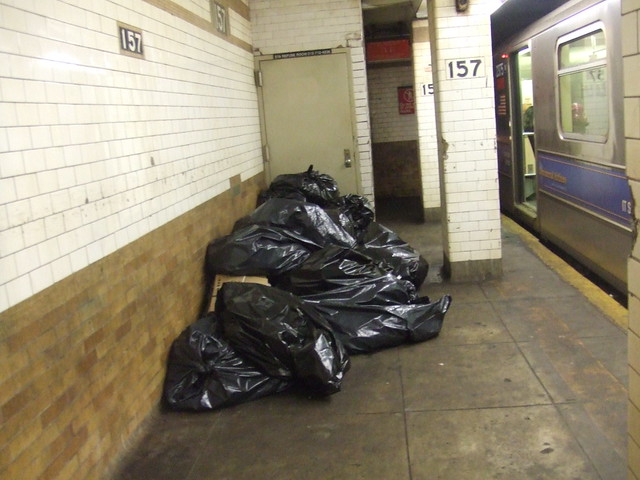
Earlier this year in February, Jeffrey Omura, SAS reader, sent me the above photo of the 157th St. platform with a note explaining how the trash would stick around for a few weeks. MTA workers would bag the garbage, but no one would ever come to collect it. Rats would move in and a stench would invade the rear of the platform.

Omura’s story isn’t an isolated one in the days of the MTA’s austerity budgets. A few years ago, then-Transit president Howard Roberts told me that cleaning budgets were going to be cut, and we’re still feeling — and smelling — the effects of those cuts. Today in his Daily News column, Pete Donohue explores the trash problem. No one is picking up the garbage, he writes:

Subway riders are being forced to wait on platforms that have plastic bags stuffed with foul-smelling dreck because the MTA regularly fails to meet its own garbage collection schedule, the Daily News has learned. On an average night, MTA trash trains and garbage trucks don’t make it to more than 100 stations that are scheduled for a pickup, Metropolitan Transportation Authority data show.

When the temporary storage space in a station fills up, the trash is left on a platform. It remains there – sometimes for days – before being carted away. It could be a bag tucked in the corner or more than a dozen bags near an entrance…The News found between one and 10 bags at a string of other nearby G train stations such as Bedford-Nostrand – and 30 piled on a platform at the elevated Astoria-Ditmars Blvd. station in Queens.

The MTA has eight garbage-hauling trains with flatbed cars. From Tuesday, June 14, through Tuesday, June 21, those trains missed 962 of their scheduled stops, NYC Transit division records show. (They made about 200 unscheduled stops.) The authority has nine garbage trucks assigned to the subways. They missed 260 scheduled stops over the same eight days, the records show, even as they made about 60 unscheduled stops. Some stations are supposed to get garbage collection once a day. At the other end of the spectrum, the least-busy stations are supposed to get it twice a week. The pickup rate is about 60% or 70%, depending on how you crunch the numbers.

According to Donohue, the MTA has put forward a handful of reasons why garbage collection suffers. He says that crews have to work around passenger train schedules as well as capital repair-related shut downs. He also notes that the nine garbage trucks are old and are out of service for around 118 days per year.

While he doesn’t mention previous years’ budget cuts, I have been told in the past that those cuts have also led to more trash on the platforms, but now the MTA plans to add more garbage collectors. “We’re certainly conceding trash in all instances is not being picked up in a timely fashion,” MTA spokesman Charles Seaton said to The News. “We have taken steps to improve the situation, and we will take further steps.”

Comments (3)
  • Extended Stay

    Featuring a wide range of sophisticated furnished apartments throughout the city and surrounding areas, ExecuStay can help you enjoy a New York extended stay that's both productive and relaxing.

  • Corporate Apartments

    As a resident of ExecuStay New York corporate apartments, you'll find that getting around is a snap, thanks to the many MTA subway lines, buses and yellow cabs.