Archive for July, 2011
Looking at private partners for capital funds
Posted by: | CommentsThe MTA’s $10 billion gap in its current five-year capital plan has been much publicized of late. With only five months and change remaining in 2011, the time for action is dwindling, and Albany is going to have to confront this 800 pound gorilla when the state legislature returns in the fall. With rumors of a renewed effort to initiate a congestion pricing plan and fears of a capital works shutdown that could impact the MTA and construction industry percolate, authority officials are trying to be as flexible as possible while seeking out new ways to fund construction initiatives.
Yesterday, at Crain’s Future of New York City event, MTA CEO and Chairman Jay Walder spoke on a panel about the future of infrastructure investments. While I could not attend the session this year, Crain’s own reporters were on hand to hear the talk. Shane Dixon Kavanaugh has the skinny as various government officials spoke of the need to explore public-private partnerships:
Mr. Walder of the MTA also conceded that private funds may be necessary to help close the yawning budget gap on the authority’s five-year capital plan, which remains unfunded by about $10 billion. “Private capital may play a part [in the plan],” he said.
But Mr. Walder maintained the MTA’s primary focus would be to continue to lower costs through innovation and efficiency measures, which he hopes will increase public support for large infrastructure projects in the future. However, Mr. Walder noted the authority needed more. “By themselves, efficiency and innovation won’t be enough,” he said, after the panel discussion concluded.
Which is where infrastructure funds, like the one Felicity Gates runs, could step in and fill the void. Ms. Gates said the average return on such funds in Europe and Australia, where they are most prevalent, can run as high as 12%. These long-term investments, however, can take up to 20 years to see a return. Historically, U.S. pension funds have not included infrastructure, according to Ms. Gates, because the municipal bond market has made it easy for governments to finance these projects. While that’s beginning to change—Ms. Gates predicted infrastructure investments could eventually equal the level of real estate investment in a pension fund—it will be a slow evolution. “Everyone expects it to happen overnight,” Ms. Gates said. “But it will not.”
By and large, I’m hesitant to embrace these public-private partnerships. Internationally, they haven’t been very successful, and oftentimes, the government granting the partnership in the first place has had to step in to resume control. That is, at least, what happened when London tried to institute a PPP for parts of the Underground. Some in Australia, India and Canada have been successful though.
In New York, if the MTA has to resort to a PPP, we can only speculate at the form, but it would likely involve ceding some amount of fare revenue to the private entity in exchange for money to float bonds for construction. As far as I’ve heard, the MTA cannot issue more bonds without additional financial support. Whether this model would represent a sound investment for a private entity or a safe financial move for the MTA remains to be seen. After construction, too, the MTA’s operating costs will increase as the authority will have to provide additional service to the new stations.
Right now, these are all just ideas, but they’re ideas coming to a head. The MTA needs action on its capital plan, and it needs money. Walder knows that state representatives are listening, and he knows that some legislators won’t be too keen on public-private partnerships. The onus then is on Albany to keep the transit system afloat and expanding to meet demand without sacrificing its autonomy.
Subway panhandling arrests up 76 percent in 2011
Posted by: | CommentsWhile Mayor Michael Bloomberg may think that there aren’t very many panhandlers left in the subway, the MTA and NYPD are seemingly intent on cracking down on those who are still begging underground. According to Pete Donohue’s latest, panhandling arrests are up by 76 percent this year over last. So far, 930 beggars and peddlers have been arrested in the subways as part of the NYPD’s Manhattan-based Operation Moving Target, an undercover initiative designed to stop subway solicitation.
The program seems based upon the Broken Windows theory of law enforcement, and the NYPD admitted as much in a statement to the Daily News. “The reason the arrests are up is because there has been a concerted effort on behalf of the Transit Bureau to address quality-of-life issues due to a clear correlation between quality-of-life offenses and major crime,” the NYPD said. “The Transit Bureau focus has been on law breakers, criminal recidivists and individuals possessing warrants.” In addition to netting repeat offenders who simply re-enter the system once released from jail, the sweep has caught some Norteno bands and run-of-the-mill homeless folks. Make of it what you will.
Bus partition pilot finally moving forward
Posted by: | CommentsThere’s nothing quite like a headline to get the ball rolling on a stalled pilot program. Nearly three years ago, a bus driver was murdered on the job, the MTA vowed to pilot a bus partition program to improve driver safety. It took almost a year to install the first partitions, and Transit has been testing them since Jan. 2010. Now, a month after another driver assault and weeks after the MTA announced plans to install security cameras in buses, the partitions are back in a big way.
According to a New York 1 report, 464 buses will receive the plexiglass partitions by year’s end. The program is still somewhat in the pilot phase, and Transit says they will install different partitions based on the type of bus. According to the NY1 story, the MTA will assess the two safety measures and “decide next year — with the union’s input — how to move forward.”
Bus drivers meanwhile seem mostly on board as safety has become a concern in the wake of some high-profile incidents. “A lot of operators don’t like them because they feel boxed in,” bus driver Lloyd Archer said. “I like them. They’ll protect me. I’d rather for someone to spit on that than spit on me, or punch that instead of punching me.”
Subway Security: The ‘new normal’ or just theater?
Posted by: | CommentsTen years ago this month, I set out with a friend of mine on a trip to baseball stadiums around the eastern half of the United States. We spent three weeks seeing the country and enjoyed games at 12 stadiums in 10 cities. We took backpacks into the games, and it was, despite the clichéd nature of the phrase, a carefree time.
And then in September of that year, things changed. Backpacks were viewed suspiciously and banned at sporting events. Passenger screening at airports grew tougher, and armed guards starting popping up everywhere: Penn Station, Grand Central, even sometimes in subway stations. After the 9/11 attacks, the mood changed as security of our nation’s transportation network became a paramount concern.
Over the next few months, we’re going to hear a lot about 9/11 and its implications. With the ten-year anniversary of the attacks looming, retrospects on past decade will emerge to the forefront, and already, we see this trend happening. Yesterday, the AP, in a long-form piece, explored how security underground in the New York City subways has changed since 2001. With armed NYPD officials leading police dogs and carrying radiation detectors fronting the story, the piece is heavy on the surveillance.
For police officers and city officials, armed cops in Penn Station and Grand Central are the way of things now, and we are constantly told to say something if we see something. “This is the new normal,” Inspector Scott Shanley of the NYPD’s Counterterrorism Division said to the AP. “The only people who sometimes get raised up are tourists.”
The piece highlights what we know: Madrid, London, Moscow and Minsk are among the cities whose subways suffered terrorist attacks. The cops are diligent in New York, but the system is very porous. “It’s really a potentially very vulnerable environment — one that you can’t totally protect,” William Bratton from Kroll Security said. “That’s the reality of it. … It’s a unique challenge.”
As the article talks tangentially about civil liberties concerns that were quashed by the courts — random bag checks still aren’t very popular — it glosses over the bigger issues: Is all of the outward display of security for good or for theater? “I look at people and who’s to judge?” Robin Gant, a commuter heading to Grand Central said. “You just never know who might be the one. No matter how safe you feel, you’re always on yellow alert.”
There’s a line between a cultivating a culture of fear and working behind the scenes to ensure security. Just how well is it working? Yesterday, a reader sent me the following description of incident that happened to this weekend. I’ll share it in the original:
“I was just on a subway train and there was a brand new backpack, all alone in the car I entered into at 14th St. By the next stop I got off and told the conductor. She listened but didn’t seem to care. That 1 train traveled for OVER 20 MINUTES uptown til the MTA actually did something about it. Finally at 103rd Street, an MTA official came on to the car and just casually took the bag off.
“I imagine the MTA must have some sort of protocol to deal with this type of situation. When they constantly ask us to “say something” if we “see something,” what good is it if a train makes 13 stops before someone inspects a potential bomb? Do you think the train conductor followed protocol? And if so, is that protocol at all effective?”
Over the next few months, I’m going to spend some time exploring those questions. What is the proper protocol? Is it effective? Those are questions that need answering. We see television commercials and a print advertising campaign from the MTA based around exactly the scenario described above, and a backpack sitting alone in a subway car is a red flag. Those are the types of incidents that should be taken more seriously than police officers with guns at Penn Station. Are they or is the security theater just for show?
The tribulations of bringing AC to the subways
Posted by: | CommentsWith the bar exam a week away, I’m going to be running a few pieces from the Second Ave. Sagas archives over the next few days. With summer fully upon us and temperatures expected to reach the triple digits on Friday, now is as good a time as any to appreciate air conditioned subway cars. So allow me to present this piece from May of 2010.

The R-17, shown here in operation as the Shuttle in 1982, was the first subway car outfitted with air condition. (Photo via Steve Zabel/NYCSubway.org)
With the warm weather upon us, New York City has been growing increasingly hotter and more humid over the last few weeks. Thunderstorms are in store for us tonight, and temperatures are going up, up, up all week with the threat of a 100-degree day on Friday. Summer in New York — with free concerts, long days and, of course, baseball games — is my favorite season but for one thing: The subways are utterly unbearable.
The worst part of riding around New York City in the summer are the underground waits. With train cars spewing heat from industrial-strength air conditioners, the stations themselves see temperatures soar beyond tolerable levels. The stagnant air induces sweat at hours of the morning far too early for that kind of heat, and only the blessed air conditioning of the train cars makes a commute tolerable.
These days, we take our air conditioned subway cars for granted, but it wasn’t always like that. The MTA undertook its current air conditioning efforts in 1967, and the thought of a summer ride without AC lives on only in the memories of long-time New Yorkers. So as we sit on the cusp of summer and Transit turns on the AC, let’s hop in the Wayback Machine to a time when the New York City Transit Authority just couldn’t quite get air conditioning right.
Our journey begins in September of 1955, an odd time to test air conditioning as the heat is already dissipating by then. On a day that saw the outside temperature hit just 62 degrees, NYCTA ran a successful test of its first air conditioned subway car, an retrofitted R-15 car. As station temperatures hit 81 degrees and the mercury outside climbed to 87.5 in un-air conditioned cars, the test car saw temperatures fluctuate between 68 and 73 degrees. The authority proclaimed this one-day test a success, and plans to outfit the entire subway fleet at a cost of $700 per car were drawn up.
This optimism was short-lived. A year later, the NYCTA unveiled another test run of the air conditioned cars. Six R-17 cars equipped with loud speakers, air conditioned and in-route music provided, of course, by Muzak, made headlines as Transit officials again extolled the virtues of air conditioning. At the time, Transit planned to test these cars along various IRT routes but ran into early troubles.
The authority tried to test it on the Shuttle route, but the short trip did not provide for ample testing time. “The run between Times Square and Grand Central takes one minute,” wrote The Times, “apparently too brief a time to cool the hot subway air taken in during the stops of one and one-half to two minutes at the shuttle terminals.” Passengers complained as well of stale air and high humidity.
By 1962, the promise of air conditioning had failed to materialize, and the NYCTA declared the $300,000 experiment a failure. Even after the successful test runs, Transit found humidity levels well beyond acceptable. “As humidity built up and breathing became difficult,” The Times said in 1962, “passengers fled to the fan-ventilated cars…To add to passenger discomfort the cool air was dissipated when doors opened at stations, while the humidity remained unchanged.” While PATH announced air conditioning, NYCTA was left searching for solutions.
Five years later, the city struck air conditioning gold. After tinkering with the technology, Transit found a costly solution, and early test runs were again successful. This time, the humidity levels were kept in check, and railfans began to stalk the air conditioned cars, riding them along the F line from terminal to terminal to bask in the cool air. With a grant from the government and $15 million from the city, Transit finally promised to outfit its rolling stock with AC.
Even still, the going went slowly. By August of 1970, finding an air conditioned car was likened to finding a needle in a hay stack, and a 1973 proposal called for full air condition only by 1980. Throughout the 1980s, those struggles continued. At various points in the decade, air conditioning either didn’t work or was on the verge of breaking down. In 1983, while Transit officials alleged that 50 percent of cars were air conditioned, one rider found himself with AC during only 20 percent of his trips.
Today, with new rolling stock and a better maintenance program in place, the subways are blissfully air conditioned, a haven from the heat outside and in the station. I’m too young to remember those days of un-air conditioned trains, but I have vague recollections from the mid-to-late 1980s of stiflingly hot rides in graffiti-covered cars. Even if the new rolling stock can seem somewhat sterile at times, I’ll take that air conditioned as the mercury rises and summer descends upon us.
‘Would you like a side of fried rat with that?’
Posted by: | Comments
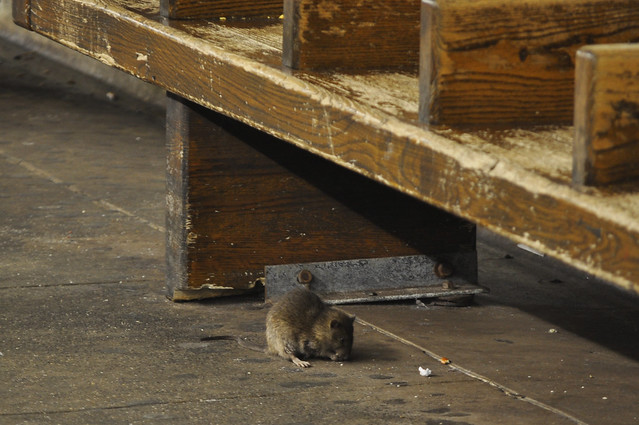
This little fella isn't getting electrocuted anytime soon. (Photo by flickr user Ludovic Burtron)
In my idle moments while waiting for a subway, I’ll often scan the tracks looking for some four-legged friends. I’ll watch as rats, ubiquitous everywhere underground in New York, scurry along the subway tracks looking for food. They dart over tracks and duck under the third rail, sometimes hopping atop it, sometimes scampering beneath. Even as the vibrations from approaching trains cause them to dart away, they avoid electrocution. It is a marvel of the subway ecosystem, but how do they do it?
Well, in this week’s FYI column in The Times, Michael Pollak has your answer:
They don’t form a grounding connection between the third rail and the track bed, transit officials said. “In order to be electrocuted you need to complete a circuit, which means you need to touch the third rail and the ground,” said John Campbell Jr., assistant chief electrical officer for New York City Transit. “It’s the same reason birds can sit on live uninsulated electric lines and not get electrocuted: there is no path for the current to flow.”
If a rat, bored with jumping, were unwise enough to reach up and touch the live part of the 600-volt third rail while keeping its other paws on the ground, it would be toast. But rats don’t do that. In most cases, either their bodies are not long enough to form a grounding connection, or their travels do not give them any reason to climb that way.
Pollak also spoke with a mammalogy expert at the American Museum of Natural History who doubts rodents’ needs to jump up on the third rail in the first place. After all, they are nimble enough to just go under. So while electrocution won’t solve the subway rat problem, perhaps, then, the MTA should just pick up the trash instead.
Taxi bill on his desk, Cuomo hesitates
Posted by: | Comments
A hybrid taxi roams the streets of New York City in 2007. (Photo by Benjamin Kabak)
As the flurry of legislative activity wrapped up in Albany last month, the Assembly and Senate took taxicab matters into their own hands. With some urging from Mayor Bloomberg, state representatives chose to act with the knowledge that the City Council would kowtow to the demands of the medallion owners and stymy the bill. Now, nearly a month later, we wait to see if Gov. Andrew Cuomo will sign the bill or veto it. Whose interests is he protecting?
The plan, as I’ve outlined in the past, is geared toward ensuring that underserved areas of the city can legally hail taxis. The plan will put up for sale 30,000 medallions for $1500 with conditions. These medallions can only be used for street hails north of 96th St. in Manhattan and anywhere in the Bronx, Brooklyn, Queens and Staten Island. They are designed to improve access to taxis while ensuring that areas where current taxi drivers say they pick up just three percent of passengers have legitimate street service.
In The Times today, Christine Haughney goes behind the scenes at the intense lobbying taking place in Albany. Cuomo has allowed the bill to sit on his desk for the better part of a month as he mulls over the fate of surface transportation for millions of New Yorkers who live in areas underserved by yellow cabs. He has been silent. She reports:
The fleet owners have stepped up efforts to persuade the governor to veto the legislation, arguing that the measure could jeopardize one of the city’s most vital industries. David Pollack, executive director of the Committee for Taxi Safety, a group that handles leasing operations for yellow medallions, said taxi drivers continue to send letters and call the governor’s office to oppose a plan that “would devastate 50,000 hard-working taxi drivers by flooding the market with new taxis.”
Michael Woloz, a spokesman for the Metropolitan Taxicab Board of Trade, echoed Mr. Pollack’s fears, adding that these cars would limit yellow taxi service. “We are currently educating the governor’s office on the many policy, economic, procedural, legal, operational and logistical problems with this bill,” Mr. Woloz said…
Micah C. Lasher, Mr. Bloomberg’s chief lobbyist in Albany, said the mayor would continue to talk with the governor about how “this represents important and very positive public policy for the residents of New York City.” At the same time, Mr. Lasher said, “we plan to be responsive to the concerns of medallion owners in implementing the plan.”
While medallion owners are lobbying against the bill, the city’s Taxi & Limousine Commissioner David Yassky says residents are eager for the changes. “We’ve gotten tremendous reaction from people in Brooklyn and Queens and the Bronx,” he said to The Times. “Not a day goes by when I don’t hear people say, ‘That’s such a great idea.’”
The economics of the opposition doesn’t make much sense, and Cap’n Transit has written an extensive takedown of the system and new plan. (Start poke around his site.) If taxi drivers aren’t keen on going to these underserved areas and don’t cruise around for fares, they won’t lose business, and the yellow medallions, which still provide exclusive street service in Manhattan and pickups at the airport, won’t really be devalued that much. It’s certainly not going to devastate the 50,000 cab drivers as, if anything, it will impact the rich medallion owners instead.
So we wait on Cuomo, and we wait for a key piece of transportation legislation. Taxis are an integral part of a public transit network. Sometimes, the subway or a bus can’t take us where we need to go. Sometimes, we need the trunk space, the speed or the convenience of a car service. Comprehensive taxi service allows for less car dependence in an urban area. Cuomo should sign the bill.
Weekend work affecting service on 16 lines
Posted by: | CommentsFriday night. You know what to do.

From 11:30 p.m. Friday, July 15 to 5 a.m. Monday, July 18, there is no 1 train service between 14th Street and South Ferry due to Port Authority work south of Chambers Street. 1 trains run express between 34th Street and 14th Street. 2 and 3 trains run local in both directions between Chambers Street and 96th Street. Free shuttle buses replace 1 train service between Chambers Street and South Ferry.

From 3:30 a.m. Saturday, July 16 to 10 p.m. Sunday, July 17, free shuttle buses replace 2 train service between East 180th Street and 149th Street-Grand Concourse due to track panel installation at Jackson Avenue, Freeman Street and 174th Street.

From 12:01 a.m. Saturday, July 16 to 5 a.m. Monday, July 18, Manhattan-bound 2 trains run express from Franklin Avenue to Atlantic Avenue due to platform edge repair at Bergen Street and Franklin Avenue and tunnel structural repair south of Atlantic Avenue.

From 6:30 a.m. to midnight, Saturday, July 16 and Sunday, July 17, Manhattan-bound 3 trains run express from Franklin Avenue to Atlantic Avenue due to platform edge repair at Bergen Street and Franklin Avenue and tunnel structural repair south of Atlantic Avenue.

From 12:01 a.m. to 5 a.m., Saturday, July 16, Sunday, July 17 and Monday, July 18, 3 service is extended to 34th Street-Penn Station due to Port Authority work at Chambers Street.

From 12:01 a.m. to 6:30 a.m. Saturday, July 16 and Sunday, July 17 and from 12:01 a.m. to 5 a.m. Monday, July 18, Manhattan-bound 4 trains run express from Franklin Avenue to Atlantic Avenue due to platform edge repair at Bergen Street and Franklin Avenue and tunnel structural repair south of Atlantic Avenue.

From 11 p.m. Friday, July 15 to 5 a.m. Monday, July 18, downtown 4 trains run local from 125th Street to 14th Street and uptown 4 trains run local from Grand Central-42nd Street to 125th Street due to track work south of 77th Street.

From 12:01 a.m. to 6:30 a.m. Saturday, July 16 and Sunday, July 17 and from 12:01 a.m. to 5 a.m. Monday, July 18, downtown 4 trains run express from 14th Street-Union Square to Brooklyn Bridge due to work on the Broadway/Lafayette-to-Bleecker Street transfer connection.

From 3:30 a.m. Saturday, July 16 to 10 p.m. Sunday, July 17, there is no 5 train service between East 180th Street and Bowling Green due to track panel installation at Jackson Avenue, Freeman Street and 174th Street. A free shuttle bus is available between East 180th Street and 149th Street-Grand Concourse. Customers between 149th Street-Grand Concourse and Bowling Green may take the 4 instead. Note: Shuttle trains operate all weekend between East 180th Street and Dyre Avenue.

From 12:01 a.m. Saturday, July 16 to 5 a.m. Monday, July 18, downtown 6 trains run express from 14th Street-Union Square to Brooklyn Bridge due to work on the Broadway/Lafayette-to-Bleecker Street transfer connection.

From 12:01 a.m. Saturday, July 16 to 5 a.m. Monday, July 18, uptown A trains run on the F line from Jay Street-MetroTech to West 4th Street, then local to 59th Street-Columbus Circle due to work on the Fulton Street Transit Center.

From 6:30 a.m. to midnight, Saturday, July 16 and Sunday, July 17, uptown C trains run on the F line from Jay Street-MetroTech to West 4th Street due to work on the Fulton Street Transit Center.

From 12:01 a.m. Saturday, July 16 to 5 a.m. Monday, July 18, there is no D train service between Pacific Street and 34th Street-Herald Square due to work on the Broadway/Lafayette-to-Bleecker Street transfer connection. The N and free shuttle buses provide alternate service.

From 12:01 a.m. Saturday, July 16 to 5 a.m. Monday, July 18, the 5th Avenue exit of the 5th Avenue station will be closed. E trains will stop at the station; customers must enter/exit on the Madison Avenue side.

From 12:01 a.m. Saturday, July 16 to 5 a.m. Monday, July 18, Coney Island-bound F trains run on the M line from Roosevelt Avenue to 47th-50th Streets due to station component work at Lexington Avenue-63rd Street.

From 11 p.m. Friday, July 15 to 5 a.m. Monday, July 18, there are no G trains between Hoyt-Schermerhorn Sts. and Church Avenue due to track work north of Hoyt-Schermerhorn Sts. G trains operate in two sections:
- Between Court Square and Bedford-Nostrand Avs and
- Between Bedford-Nostrand Avs and Hoyt-Schermerhorn Sts. (every 20 minutes)
Note: The A provides connecting service between Hoyt-Schermerhorn Sts. and Jay Street-MetroTech.

From 11:30 p.m. Friday, July 15 to 5 a.m. Monday, July 18, there is no L train service between Lorimer Street and Broadway Junction due to rail work at Myrtle Avenue and Halsey Street. Free shuttle buses provide alternate service.

From 4 a.m. Saturday, July 16 to 10 p.m., Sunday, July 17, Brooklyn-bound N trains skip 30th Avenue, Broadway, 36th Avenue and 39th Avenue due to structural overcoat painting along the Astoria Line.

From 12:01 a.m. to 6:30 a.m., Saturday, July 16 and Sunday, July 17 and from 12:01 a.m. to 5 a.m., Monday, July 18, Coney Island-bound N trains operate over the Manhattan Bridge from Canal Street do DeKalb Avenue due to installation of tactile and platform tiles at Cortlandt Street.

From 12:01 a.m. Saturday, July 16 to 5 a.m. Monday, July 18, N trains run local in both directions between DeKalb Avenue and 59th Street in Brooklyn due to work on the Broadway/Lafayette-to-Bleecker Street transfer connection.

From 6 a.m. Saturday, July 16 to 6 p.m. Sunday, July 17, Manhattan-bound Q trains skip Neck Road and Avenue U due to overcoat painting of the Brighton Line Bridges.

From 6:30 a.m. to midnight, Saturday, July 16 and Sunday, July 17, Brooklyn-bound R trains operate over the Manhattan Bridge from Canal Street to DeKalb Avenue due to the installation of tactile and platform tiles at the Cortlandt Street station.

From 12:01 a.m. to 6:30 a.m., Saturday, July 16 and Sunday, July 17, Sunday, July 17 and from 12:01 a.m. to 5 a.m., Monday, July 18, there are no R trains between 59th Street and 36th Street in Brooklyn due to line structure overcoat painting.
Photo of the Day: The ‘art’ of the 80s
Posted by: | CommentsWhile researching yesterday’s piece on weekend ridership on the L train, I came across the above photo in the archives of NYCSubway.org, and it’s a great glimpse into the past. The train is clearly being held at a red signal as riders are peering into the tunnel to see why they’re not going anywhere, and the outside is absolutely covered in graffiti. The photo is only 24 years old, but a lot of has changed underground since then. We have a long way to go yet.
A wait made longer by 30 seconds
Posted by: | CommentsTo better align service along the 1 and 6 with load guidelines during the summer, the MTA has reduced service along those two lines, and boy, oh boy, is The Daily News unhappy about it. In a rather lengthy article, Pete Donohue reports that the authority has reduced peak service on the 6 from 23 trains per hour to 21 and off peak service from 15 to 13. Along the 1, Transit running 16 peak-hour trains, down from 18, and between nine and 11 off-peak hours down from 10-12. In other words, expect to wait 30 seconds more for the train.
The MTA says that these adjustments are merely season as ridership slumps in the summer with school out and families head on vacation. “These are seasonal adjustments we’ve made based on declining ridership resulting from summer vacations and are similar to the seasonal adjustments we have been making along certain bus routes,” Transit said. “In most cases, customers would have to wait an extra 30 seconds for a train.” Still, that didn’t stop the News from finding irate customers along the IRT. “Whoever created the schedule should be forced to ride the 6 train all day,” rider Mary Dohnalek said in a letter, seemingly penned before service was scaled back, to Transit.
I always find it tough to stomach any service scalebacks because it always seems to take longer to restore service, but a Transit spokesman assured me that full service would be restored when school starts again. “Both of these routes have very frequent service, so the customer impact is small and there are multiple benefits, including operating more cost-effectively, reducing our energy use, which has an added environmental benefit,” a Transit spokesperson said to The News.