Archive for Abandoned Stations

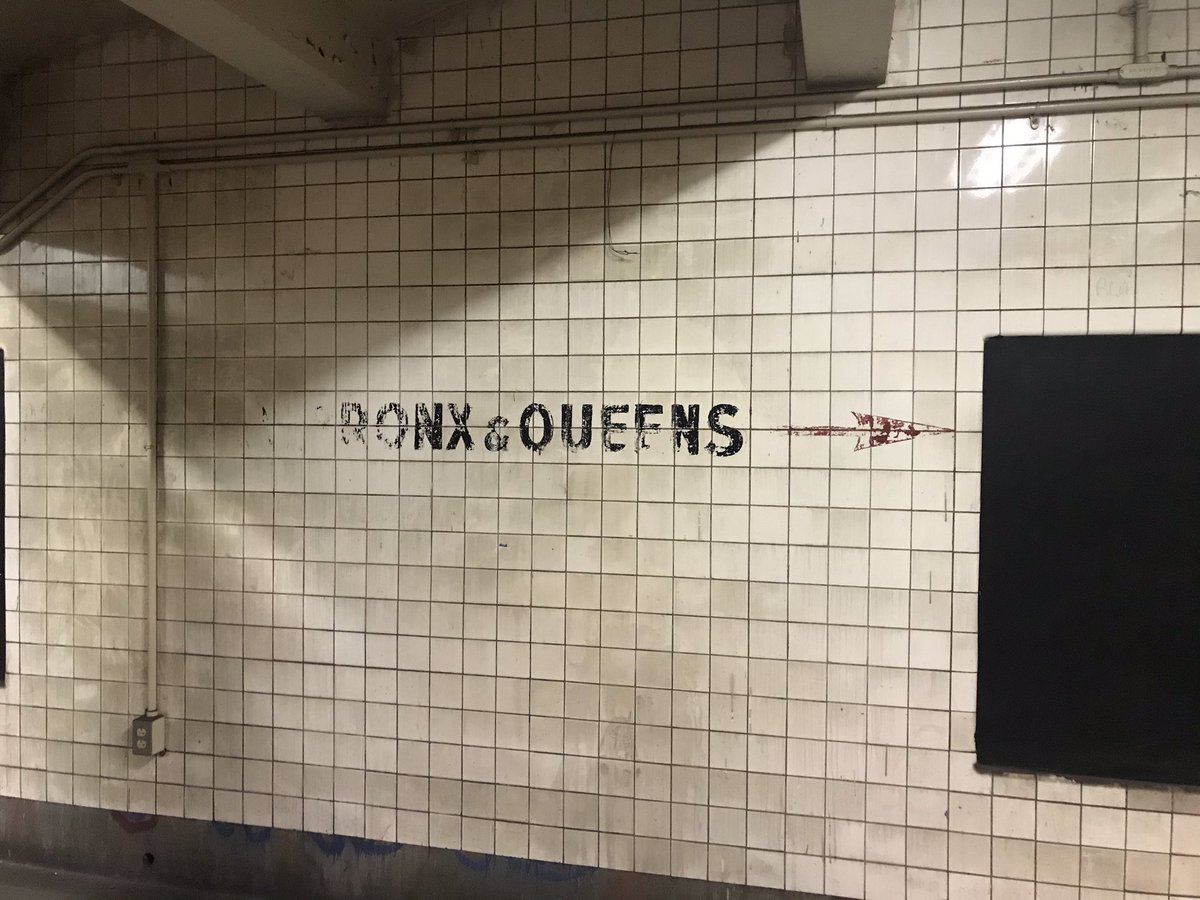
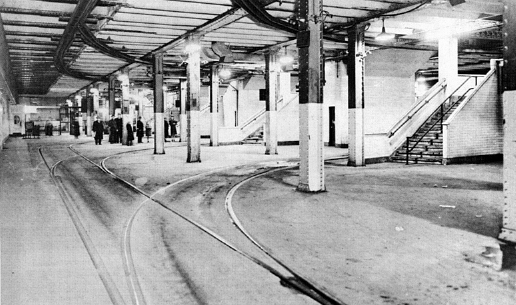
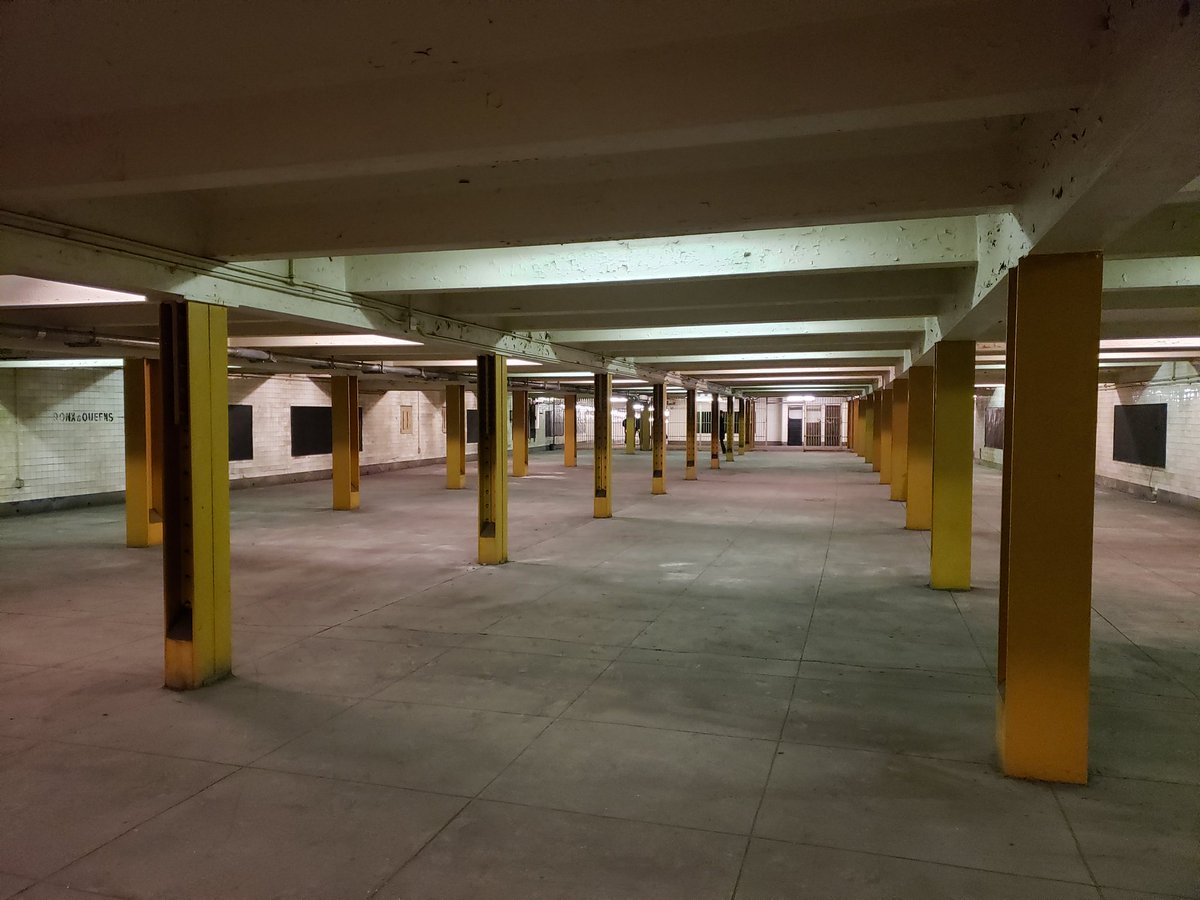
A glimpse at the lower level at Nevins St. This 1905 original has never seen train service. (Photo courtesy of NYCSubway.org/David Justiniano)

When the MTA recommissioned the old South Ferry loop last week, New York saw a subway station once closed for good returned to service. In the history of the city’s subways, this is a rare occurrence with only a few stations once lost to time returned to service. Throughout the city, the abandoned or half-built and never-completed stations flash by like ghosts from another era. Stare hard enough into the dark and stations at 91st St. and Broadway or 18th St. and Park Ave. South materialize out of the tunnels.

Elsewhere, parts of a system never realized remain hidden from view, poking their heads out now and then before receding into the shadows of history. The South 4th Street station shell above the northern end of Broadway on the G’s IND Crosstown line had its moment in the sun two and a half years ago when street artists turned it into their Underbelly canvas. That shell is part of a series of provisions for IND Second System lines at various stations throughout the city, and while the hints exist for those who know where to look, they’re largely out of sight and out of mind.

At another station in Brooklyn, an intriguing abandoned/never-used platform exists underneath Nevins St. and runs for some distance nearly to the Pacific St. platform along 4th Ave. at the current Atlantic Ave./Barclays Center station. Unlike the South 4th St. shell, this one has wall tiling and completed tunnels, and various nearby stations — DeKalb Ave., in particular — were constructed with its usage in mind. Today, it exists off of the Nevins St. underpass and remains forever unused, a remnant of a time when the city planned ahead even it wasn’t quite sure of where those plans might lead.

Various explorers, sanctioned and not, have ventured into the Nevins St. area. Before a rehab of the upper levels, the lower level was visible from the cross-under, but the existing platform areas have since been sealed off. Still, the photos available show finished tile and mosaic work and track beds. LTV Squad has a series of photos showing the extended tunneling and water damage to the current area.

The history of the station, as Joseph Brennan has explored, hints at the politics behind early subway construction. The lower level at Nevins St. was not, in fact, part of the original plans, and the Board of Rapid Transit Railroad Commissioners ordered a redesign amidst ongoing construction in April of 1905. Six months later, work started on the lower level, and it never came to use. Brennan explains:

The purpose of Nevins St lower was to allow two connections on the Brooklyn-bound local track that crossed under the other tracks. North of Nevins St, there could be a track coming from the Manhattan Bridge line (De Kalb Ave station) joining the Brooklyn-bound track. South of Nevins St, there could be a track diverging off the Brooklyn-bound track into a subway in Lafayette Ave. Running the other way, provisions were made for both the same connections in the wall alongside the main level local track…

The subway was opened in May 1908 to Atlantic Ave. The extension beyond was added in the Dual System plan in 1913, and was opened in April 1919. The provisions of 1905 for future construction were…:

3 West of Nevins St: Lower level trackway under main tracks to north edge of construction, and upper level removable wall. For two tracks off a Manhattan Bridge route. The BMT De Kalb Ave station was built as if this had still not been ruled out: its main track level is at the level of the IRT lower level, for the outbound track connection, and its upper mezzanine level has no structure blocking the path of a track off the IRT main level.

4 East of Nevins St: Lower level trackway under main tracks to east edge of construction, and upper level trace of provision for an opening in the side wall. For a Lafayette Ave subway. Such a subway was actually built for the IND system later.

5 West end of Atlantic Ave station: Upper level outbound local curve south into 4 Ave, and lower level crossing under main tracks to a ramp up to main level inbound local. Both are now obscured. The upper level curve is still visible in the wall of the Atlantic Ave station side platform, as extended northward in 1964. The lower level is hidden, and the ramp up is covered by the present westbound local track (2 3 trains) built 1962-1963.

Today, history sits beneath our feet at Nevins St., invisible to nearly everyone as thousands of passengers pass through the station each day. I’m always struck by the planning — or the over-planning — of the original builders of the subway. These days, we pare back our subway expansion plans from two stations to one, from four tracks to two. But a hundred years ago, construction was halted for six months to build provisioning never actually put into place.

These days, the BMT uses the connection over the Manhattan Bridge via DeKalb, and of course, it extends to Atlantic Ave. and beyond via tunnels that mirror the Nevins St. plans. That routing though swings north of and around the Nevins St. station. The IND, via the G, utilizes the Lafayette Ave. route and cuts through part of the tunnels constructed around Nevins St. Subway planners built the lower level at Nevins St. for a purpose, and though that purpose came to pass, trains forever bypass the station. All that remains is an intriguing abandoned station out of sight and out of mind.

Categories : Abandoned Stations
Comments (24)

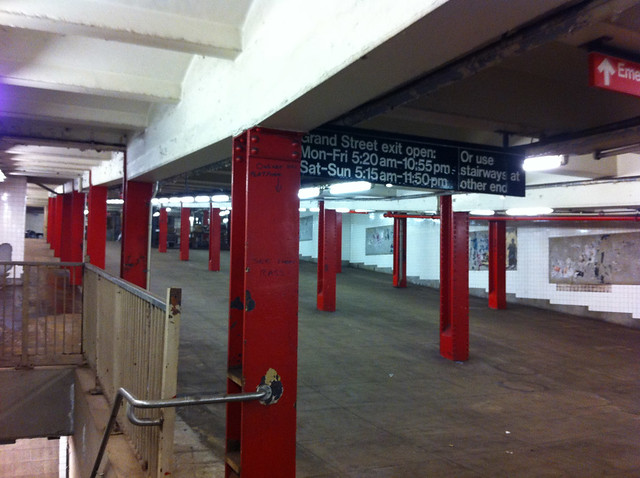
The Grand St. half of the G train’s Metropolitan Ave. stop is currently closed to passengers.

The G train as it winds its way through Williamsburg is chock full of urban underground surprises. The South 4th St. shell sits uncompleted, unacknowledged and adorned with graffiti above the northern end of the Broadway stop, and a few blocks up Union Ave., the Metropolitan Ave. – Lorimer St. stop contains its own little secret. Thanks to an anonymous Second Ave. Sagas tipster, we can take a close look inside an area long closed to the public.

The secret to this station lies in its name. Before the IND Crosstown line and BMT Canarsie line combined to create today’s Metropolitan Ave./Lorimer St. complex, the IND stop was called Metropolitan Ave./Grand St. with entrances along Union Ave. at both intersections. The station featured one of the overbuilt full-length mezzanines that is a hallmark of the IND stations throughout the city. Much of that mezzanine is now blocked off by the police station, some crew quarters and, well, an abandoned entrance.

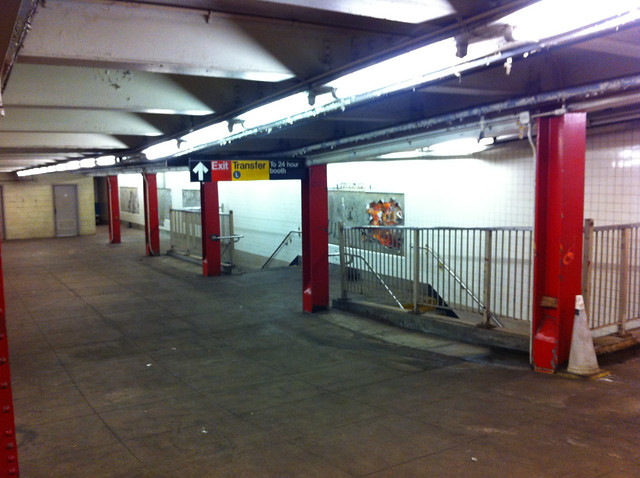
On the G train platform, evidence of the old name is visible in the tiling, and a shuttered staircase at the southern end of the platform leads upward to the now-closed Grand St. exit. My tipster, encountering an open grate a few months ago, did some exploring, and the photos show the station as it was before renovation in 2000-2001 changed the color scheme.

A transfer sign and staircases await passengers that will not be arriving any time soon.

We see a sloped ramp and station entrances in pretty good shape. Temporary walls mark the employees-only areas, and access to the platforms is gated off. All in all, there are publicly available and open parts of the system in much worse condition than this spot.

So what to do with it? Earlier today, I mused on the role passageways play in the subway system, and here is a functional one — albeit with some work to be done — sitting there without use. Considering the population growth in the area over the years since it was last in use, it’s a spot the MTA should consider reactivating.

The G train, meanwhile, is drawing some public support. The Riders Alliance — a group for which I sit on the board — along with local politicians is hosting a rally for the G this weekend. They’re not arguing for the reopening of this entrance, but they’re asking for increased G train frequency and out-of-system transfers between the G and J/Z in Williamsburg and the G and Atlantic Ave.-Barclays Center. “As the neighborhoods surrounding the G train continue to grow, it’s vital that their lifeline grow with them,” State Senator Daniel Squadron said.

For a few more shots of the abandoned mezzanine passageway, check out this set on Flickr.

Categories : Abandoned Stations
Comments (50)

WNYC's interactive map provides a glimpse into the lost ambitions of New York subway planners. (Click for the interactive version)

Long-time SAS readers know that I have a bit of a love affair with the New York City subway system’s abandoned nooks and crannies. I’m fascinated by the shuttered stations and the never-used shells. I’m impressed with the foresight of planners who built provisions for unfunded future expansion. I’m enthralled by the maps of the Second System, a dream unfulfilled that would have changed the city forever.

Every day, millions of New Yorkers commute through a subway system that has largely been static for decades. Although the Queens Boulevard connection opened a little over a decade ago and the Archer Ave. stations debuted back in 1988, the system has been largely as it is today since the mid-1930s. Yet, behind the facade of the subway map lies a handful of secrets. An abandoned station at 91st St. and Broadway flits past riders on the 1 train, and a redundant and closed platform at 18th St. and Park Ave. South can be seen from the downtown 6 train. Atop Broadway in South Williamsburg, a shell of a station never finished is host to both lost dreams and the Underbelly Art project. Near the Manhattan Bridge, a shuttered station plays host to the Masstransiscope.

We ride largely oblivious to these relics of another era and other plans. Maybe we know that the Second Ave. Subway has been a long time coming, but most don’t know that it was once designed to connect into the Bronx and Brooklyn. Yesterday, Jim O’Grady went inside the city’s lost subway stations and expansion plans. The team at WNYC produced an interactive map, and I’ve embedded the audio below. It’s a fascinating glimpse into the history of almosts under the streets of New York.

What strikes me most about O’Grady’s story are the way he and those he spoke with characterize the unrealized plans. “We built the subway into farmland on the assumption that people would live there and use them to get to work,” Moses Gates, an urban explorer who brought O’Grady into the tunnel underneath Nevins St., said. “We built a humongous shell station on the G line, or right off the G line, because there was going to be two other lines and two new tunnels under the East River that were going to converge there.”

Today, we can’t even gather the political will or money to build anything more than the barest of provisioning for a future station at 41st St. and 10th Ave. We can’t realize more than a few stations along Second Ave. We can’t envision a subway system stretching further out into or better connecting Queens and Brooklyn or one that better crosses the Bronx. Instead of living in the minds of planners, these dreams live only in fantasy maps found on various message boards throughout the Internet.

Costs, of course, are an issue. The increased construction costs coupled with the Great Depression and then later World War II and the rise of the automobile torpedoed the Second System plans before they could get off the ground. Today, we hear tell of inefficient capital building brought about by arduous work rules and NIMBY opposition. We are content with what we have when all around us are reminders of a past that could have been. Dream big, I say, because that’s how New York and its subway system became great in the first place. It’s fascinating to hear of South Fourth Street, but it would be even better to see a city with a line that passes through that station on its way east.

Categories : Abandoned Stations
Comments (31)

A schematic shows the Rockaway Beach Branch service from 1955 until it was shuttered in 1960. (Courtesy of Railfan.net)

As creative urban parks go, New York City’s High Line is a great success story. The city, with fiscal help from private donations, turned an abandoned and decrepit freight rail line that no longer went anywhere or connected to the rest of area’s transportation network into a popular park that weaves through a neighborhood teeming with residents, businesses and tourists. Now, everyone wants a piece of the action.

Across the country, urban activists are eying the nation’s dying rail infrastructure not for transit but for parks. In Chicago and Philadelphia and Detroit, community groups are searching for the “next” High Line — some infrastructure that can be turned into a park that will revitalize a neighborhood. It’s not quite that easy as New York’s High Line runs through a densely-populated neighborhood that already was a big tourist destination before the park opened, but that minor point isn’t stopping anyone.

Even within the city, New Yorkers are also looking for the next spot for the new High Line. Every few months, the Delancey Underground effort earns some press, and now an old initiative from Queens is gaining ink as well. On Friday, the Daily News explored how Queens residents are once again trying to turn the LIRR’s defunct Rockaway Beach Branch into a park. This isn’t a new plan; it last garnered coverage back in 2005. But with the High Line’s success, residents are emboldened to try again.

Lisa Colangelo has more:

Encouraged by the success of the High Line in Manhattan, a group of Queens park advocates are rebooting a proposal to rehabilitate an abandoned rail line into a greenway. The old Rockaway Beach Branch of the Long Island Rail Road, which went out of service almost 50 years ago, stretches from Rego Park to Ozone Park, cutting a swath through Forest Park.

“This is such an exciting idea,” said Andrea Crawford, the chairwoman of Community Board 9 who is helping organize supporters of the project. “It’s green, yet it has economic development opportunities. It would tie us in with other rail-to-trail projects happening all over the country.”

Crawford was part of a group of civic leaders who met with city agency representatives this week to discuss preliminary plans for a greenway along the route. Remnants of the line are visible throughout the area. The tracks ran along trestles above Metropolitan Ave. and Union Turnpike. The path is mostly clogged with trees and overgrown vegetation, but it still includes some train tracks and signal equipment and towers. The tracks, which lead into Forest Park just south of Union Turnpike and Woodhaven Blvd., are owned by the city.

As Colangelo explained, Community Board 9 supported the idea a few years ago, but Community Board 6 declined to authorize a feasibility study for a park. Residents in Forest Hills had raised concerns focused on “security and the impact on private property.” Today’s activists aren’t going to let obstacles from a few years ago hinder them.

Now, outside of the practicality of it — what money will turn this abandoned rail line into a park and is it in a part of the city to which people will travel to experience such a transformation? — there’s another issue: It’s part of a long-term effort that removes transit infrastructure from its intended use. By turning the West Side Line into the High Line, the city ensured that it would never be used for rail transportation again. If the Essex St. trolley terminal suffers the same fate, it too will never be a part of the city’s transit infrastructure.

The Rockaway Beach Branch has been fetishized by transit advocates for decades. The MTA once considered using the line as part of a one-seat ride to JFK or for Airtrain right-of-way before NIMBYs in Queens killed that idea, and an extensive thread on a popular transit message board traces the various ideas for reactivating the rail line. In his 40-year plan for the MTA, then-agency head Lee Sander mentioned restoring transit services to the line as well. Turning it into a park would immediately dash any of those hopes.

Therein lies the tension with old infrastructure: How long should a former train route lie fallow before we can accept other uses for it? Should the city be willing to discard half-formed plans to activate train lines that could provide useful service because someone else is louder or better connected? Turning the Rockaway Beach Branch into a rail trail will forever preclude using it for transit just as turning the Essex St. Terminal into a park or shopping area would do the same. That’s a decision that should not be made lightly.

Categories : Abandoned Stations
Comments (54)

A few months ago, as Jay Walder’s tenure at the MTA came to an end, word leaked out of an ambitious plan to turn some idle underground infrastructure owned by the MTA into a park. Called “Delancey Underground,” the plan involved bringing sunlight from above through fiber optic cables to create a park in the abandoned Essex St. Trolley Terminal. As New York City has seen the High Line take off on the West Side, the park proponents envision something similar for the Lower East Side.

As I understand it, the men behind this plan had a sympathetic ear in Jay Walder, and although press coverage of the Delancey Underground hasn’t died down, I’m not sure what their future holds. Even if the space isn’t turned into a park, the MTA, though, wants to see it redeveloped. Enter today’s video. In it, Peter Hine of the MTA takes us on a visual tour of the Essex St. Trolley Terminal, a mysterious space across from the J/M/Z platform that has been shuttered for decades. Sneak a peek:

I’m trying to arrange a tour of the space myself, but for now, Hine’s walk-through will have to do. While South 4th St., for example, remains sealed off seemingly forever, the Essex St. Trolley Terminal is firmly on the authority’s radar. As Hine says in the video, the MTA is looking for something to fill the space that “benefits both our transit system and its passengers.”

For Transit, converting these idle spaces into something useful is part of a new focus on “creative redevelopment and reuse.” If the authority can make money while turning parts of the system into spaces for urban creativity and exploration, even better. Still, the trolley terminal hasn’t been in use for sixty years. It could be a few more before anything lands there. For now, it’s still just a glimpse into the city’s transit past.

Categories : Abandoned Stations
Comments (30)

The IND Second System plans included a subway extension past 76th Street to Cambria Heights near the Nassau County border.

For students of the history of New York City and its subways, abandoned stations and half-built shells offer up an alluring reminder of what was and what could have been. Scattered throughout the city are various platforms now shuttered and lost to the era of longer trains, and of course, the provisions that remind us of the grand plans for the IND Second System capture the imagination. We know of the shell at South 4th Street and a similarly hidden one at Utica Ave. But what of the other subway mysteries?

One long-standing urban rumor has concerned a station along the IND Fulton line just east of Euclid Avenue and past the walls that mark the end of the C local train. This is the 76th Street station, an urban fable kept alive by an old April Fools joke, some mysterious construction barriers and track maps that hint of an unbuilt subway extension. The 76th Street station itself is a mystery. If it exists, it would be found at the area of 76th Street and Pitkin Ave. in Queens. Officially, it was never really built, and no one has photographic evidence of it. But there’s long been lingering doubts in the minds of even the most ardent subway historians.

The immediate tale of 76th Street begins where many subway legends start: on SubChat. A recently revived thread from February covered the discussion of a potential C extension down Pitkin Ave., and one person claimed to know someone who had the seen station. The topic comes up now and then, and in 2001, rumors of the station’s existence were prevalent.

What we know today are snippets of rumors and in complete images. The story is fueled by a cinderblock wall past Euclid Ave. and a signal that’s facing the wrong way. For some reason, subway construction crews at one point decided to brick up the area at the end of the local tunnel, and all that remains are stubs on track maps and signal schematics. A 2007 post by the LTV Squad simply fueled speculation, and like any good urban legend, the story doesn’t die.

An MTA board offers hope that the 76th Street station truly exists. (Photo via LTV Squad)

Early in the decade of the double aughts, two subway historians brought tales of the 76th Street station to light. In a comprehensive posting on April 1, 2002 that included some excellent Photoshops, Joe Brennan created a history of 76th St. He even claimed the station had been in revenue service but was shuttered as part of a city cover-up. That, of course, was an April Fools joke, but Randy Kennedy’s 2003 column on 76th Street was no laughing matter.

Kennedy spoke with one man who insisted the station exists, and his evidence was similar to that found by the LTV Squad. An electric board says 76th Street; the cinder block wall is an oddity; other transit workers and police officers claim the station exists on the other side of the wall. It’s a case based on circumstantial evidence, but until someone returns with photos, 76th Street will remain forever a debated part of subway lore.

And yet, we do know what was supposed to go past that cinderblock wall sixty-plus years ago. As part of the IND Second System, the Fulton Line was to split near Euclid with one section continuing along Liberty Ave. and the other heading east to 229th St. in Cambria Heights, right near the Nassau County line. Some plans called for the IND to use the LIRR right-of-ways, but the details are immaterial. Eventually, due to costs and some engineering concerns, the plans for such an ambitious extension were scrapped. It is true that a signal schematic references the “future 76th Street interlocking,” but that is ultimately a future that never came to pass.

Comments (38)

Renderings of the Delancey Underground pay homage to the Underbelly Project. Photo via Inhabitat.

Over the past year, since the Underbelly Project exposed New York City to the abandoned South 4th Street subway station, interest in the various unused parts of the subway infrastructure has been on the rise. It’s part of a cycle really. Over the years, various groups have called upon the MTA to reopen the City Hall stop, provide tours for shuttered stations and flat-out admit that some stations exist. After all, many at the MTA won’t admit that the South 4th Street shell exists, let alone that a street art project used it as a canvas.

Since Underbelly, though, the MTA’s relationship with its unused infrastructure has grown more strained. Transit sometime last fall sealed up one of the South 4th Street access points with a new false wall in an effort to keep vandals and urban explorers out. By doing so, though, they also allow a part of subway history when the city dared to dream big to fade away behind new walls. Not everything has been ignored though.

Across the tracks from the BMT’s Essex St. subway station rests the unused trolley terminal that, until 1948, brought riders across the Williamsburg Bridge. These days, the old station sits unused and in disarray, a visible relic of another error, but some architects and social innovators want to turn into an underground park. Eying the success of the High Line, they want to turn the trolley terminal into the Low Line. By channeling sunlight into the subterranean cavern via fiber optics network, they could print light and plant life to what is now a dank, dark space.

On Monday, James Ramsey, an architect and engineer from RAAD Studio, along with Dan Barasch of PopTech and R. Boykin Curry IV of a New York investment firm, unveiled the Delancey Underground website as part of a publicity push for their idea. They were featured in New York magazine and spoke at length with The Low Down NY about their idea.

Ramsey, who went on a tour with some MTA officials last year, talked about the concepts behind the Low Line. “We were thinking about this amazing space lurking underneath Delancey Street, totally in the darkness, dripping, just sitting there, not activated,” he said. “We started thinking, how can we activate this space, how can we make something appealing here? A very natural way to do that is to introduce natural sunlight. What happens if you (do that) is that you can actually grow some plants down there. It’s a totally bizarre fun idea but I think it makes a lot of natural sense.”

The trolley terminal at Delancey Street has sat unused since the late 1940s. Photo via Inhabitat.

A brief bit published by Inhabitat discusses some of the technology behind it as well:

Even though the park design will be set below the street, the goal is to create a space that is far from a dark, dank and depressing destination. The ground-breaking design team is banking on a high-tech fiber optic lighting system to enable a green space that is bright, sunny and welcoming. The park will be equipped with extensive lighting units utilizing fiber optics to channel natural daylight to the depths below. Dozens of lamppost-like solar collectors will be placed on the Delancey Street to complete this task. And as a bonus, the system the designers envision will also filter out harmful ultraviolet and infrared light, but keeping the wavelengths used in photosynthesis to foster and nourish plant growth.

The idea itself seems like a neat one on the surface. It rivals one out of Boston in terms of creativity and outside-the-box thinking, but the practical considerations make it a long shot. In conversations with transportation officials with knowledge of the situation, I understand that the team has a in with the current MTA leadership, but that leadership is on the way out in a few weeks. Hence, the recent effort to drum up public support. They’ve presented to city officials and will soon be meeting with Community Board 3 who would have to approve numerous aspects of this plan.

As far as the space is considered, the politics are a little more delicate. The MTA currently controls the unused trolley terminal, and they’re not going to simply hand it over to the Parks Department without adequate compensation or safety assurances. Furthermore, the authority rightly won’t contribute a dollar to this program, and anyone who replaces Jay Walder likely won’t view this project as a priority. Finally, it’s likely that the MTA or similarly situated government entity would have to open up this space to an RFP process and bidding before it could move ahead.

It took the High Line supporters ten years to realize their goals of a park atop that rail line. Patience, it seems, is a virtue for proponents of creative uses for public space. Maybe the Low Line — bad name and all — isn’t a perfect idea; maybe it won’t see the light of day. But it will make people think, and if the city can turn an abandoned trolley terminal into something useful, the early ideas will have been well worth it.

The Low Line park would bring light underground. Image via Inhabitat.

Categories : Abandoned Stations
Comments (26)

UNDERCITY from Andrew Wonder on Vimeo.

The last few months have been kind to underground explorers who poke around in areas off limits to the city’s law-abiding citizens. After the Underbelly Project drew headlines and arrests, urban exploration has become the next great Internet fetish.

This past week, The Times and NPR profiled Steve Duncan of Undercity who, along with Andrew Wonder and Erling Kagge, took some reporters to a few of the city’s more hard-to-reach spots. Among those were, of course, some areas of the subway. In the video above, the explorers go underground with a camera, and the 30-minute clip is stunning. The first part has them walking the tracks late at night to reach the old abandoned City Hall stop, and the video footage will leave your jaw on the floor.

Of course, what the three explorers and the reporters did is illegal. So do not try that on your end. Cops will be watching these tunnels. For more, check out the articles in The Times and on NPR.org.

Categories : Abandoned Stations
Comments (8)

The abandoned City Hall subway stop, with its Guastavino tile arches, is open for Transit Museum tours. (Photo by Benjamin Kabak)

Every few years, the existence of abandoned subway stations becomes front-page news that somehow sweeps the nation. With the onslaught of attention paid to the Underbelly Project in the South 4th Street shell, it was only a matter of time before reporters decided to revive their old stories on dead subway stations. Even though Transit has been allowing customers to ride the City Hall loop on the 6 train since early 2007, Huffington Post, Jalopnik, Fast Company and Yahoo! News decided to splash this story across their respective front pages last week. Their coverage echoes that found in an Associated Press story from 1984.

I can certainly appreciate the fascination with which those unfamiliar with the intimate details of the New York City subway system treat abandoned stations. The City Hall stop, in particular, has been exceptionally well-restored and maintained, and it’s timelessness and emptiness serve as a window into an era of city planning lost to today’s utilitarian approach. Still, it is a crown jewel with a very public history and one that shows how planning needs change as time wears on.

In the beginning, the City Hall stop was indeed the so-called crown jewel of the nascent subway system. Designed by Rafael Guastavino and Heins & LaFarge, the station served as the launching point for construction for subway construction in 1900 as then-Mayor Robert Van Wyck celebrated the groundbreaking. Four years later, Mayor George McClellan would usher in the age of public transportation as he helmed the first northbound IRT train to depart from the City Hall loop.

Early on, though, it became clear that the City Hall station was a showy redundancy. A few hundred feet from the Brooklyn Bridge station, the loop stop featured a wide gap in between the train car edge and the platform, and once the city extended the lengths of its train cars and subway stations, the City Hall stop became entirely unnecessary. By 1945, the station was closed at night and served just a few hundred paying customers a day. To conserve resources and make better use of the park above, the city closed the station at 9 p.m. on December 31, 1945. (Of historical note at the station today are the remains of the skylights that once let in natural light. While many of the windows of the arches have since blown out, some that remain have retained scraps of blackout paint used during World War II to hide the station from spying eyes.)

As early as 1965, the Transit Authority considered using the City Hall stop as a museum. “The station is unique, and to convert it into a museum is in the tradition of preserving the historic landmarks of our city,” TA Commissioner Joseph O’Grady said. Eventually, the TA chose the IND Court St. station instead. The authority did not want to construct a new loop for the Lexington Ave. local trains and could not store old BMT and IND train cars on the City Hall loop due to the varying car widths.

But the museum idea was one that would not die. In 1987, two letters to the editor published in The Times urged the city to reopen the station as a museum. The city’s “showcase station,” said one writer, “deserves a broader patronage.” Said another “The City Hall station was designed as the highlight of the IRT line. Its fine artwork can and should be preserved, and opened to public view. This would be a fitting commemoration of the men who built the subway, a reminder of how much New York history lies buried beneath the streets.”

In 1995, the idea finally seemed to gain fiscal traction and political support. Mayor Rudolph Guiliani gave the project his thumbs up as a tourist destination, and the MTA secured $750,000 in federal funds to make the museum a reality. At the time, the authority hoped to raise $2.4 million in private donations and kick in another $350,000 for the museum. The Transit Museum planned to restore the oak token booths and construct a glass partition to dull the screeching sound of the 6 as it looped through the curved station.

By 1997, the Transit Museum still hoped to open the station as a museum by the following, but the price tag had risen to $10 million. Museum officials were predicting upwards of 200,000 visitors annually, but while the tours were ongoing, no firm plans to start construction emerged.

As seen in this blue print, the eastern-most end of the City Hall subway loop is directly beneath the Mayor's office.

Two years later, Mayor Giuliani quashed the museum over alleged security concerns. Because federal terrorism suspects were being held in the nearby courthouse and because the front end of the station is directly under City Hall, the mayor believed a museum underneath his office presented a potential target. “There would be significant security concerns about creating public access to an area that is literally underneath City Hall,” Edward Skylar, a Giuliani spokesman, said.

Both the MTA and Public Advocate disagreed. “It’s ridiculous to think that if a terrorist had a bomb he couldn’t do just as much damage from another spot near City Hall,” one MTA official said, “It would be safer for people in City Hall if there were people coming and going from the old station because crowds tend to deter terrorists.”

“That station went through two world wars,” Joe Rappaport, then-Public Advocate Mark Green’s transportation adviser, said. “There is no reason now that it can’t be reopened to visitors.”

Giuliani won that battle, but the MTA spent $2 million to shore up the station anyway. The structure, not very deep underground, had to be shored up to ensure that trains could still pass through the arches, and in doing so, the MTA allowed the Transit Museum to lead tours for members interested in stepping foot in this abandoned station.

Today, we still debate the potential uses for abandoned stations. These former public spaces lie empty and neglected as various groups have proposed using them for restaurants, art galleries, shopping areas or even just officially-sanctioned memorials to another era. Sometimes a group of street artists come along to turn a forgotten station into a front-page art gallery, and other times, concerns about terrorism — overwrought or not — work to deprive a city of ready access to a beautiful abandoned subway stop.

Categories : Abandoned Stations
Comments (12)

Intrepid urban adventurers who set off in search of the South 4th Street subway station and the Underbelly Project art gallery are finding themselves greeted by a not-so-pleasant surprise. As Michael Grynbaum reports, around 20 people have been arrested for trespassing as they’ve set off in search of the hidden art project. The abandoned station sits directly underneath Brooklyn’s 90th Precinct station house, and as the MTA is trying to discourage illicit trespassing, a team of cops, including some of the plain-clothes variety, have been staking out the joint. So far, most of those caught have been charged with criminal trespassing while two received transit summonses. “This is not an art gallery; this is completely illegal,” one police officer said to The Times.

While the Underbelly Project curators claimed they destroyed the entrance point to the South 4th Street station, that claim is far from the truth. It is still physically possible to get up there, and those who have eluded the police found that the locals have tagged the art. For its part, the MTA reiterated its stance it will not be erasing anything on the walls, and the authority has already sealed off one of the site’s easier access points.

Amusingly enough, the authority also refused to confirm the location of the gallery to Grynbaum and The Times. “There are some bloggers who can pinpoint these places because they eat and sleep transit lore, but officially, no, we’re not confirming anything,” authority spokesperson Deirdre Parker said. It’s up there though behind chain-linked fences and well within the arm of the law.

Comments (2)