Archive for Bronx

4Bullets For three weeks in June, New York City Transit ran 4 express service in the Bronx as part of a pilot program. With a new signal system in place along the Jerome Ave. line, Transit ran express trains along the little-used middle track from June 8-June 26 in an effort to ease overcrowding on the popular 4 train and speed up the commutes of residents from the Bronx.

Today, Transit announced a new seven-week extension of this pilot program with an eye toward making it a permanent part of 4 train service in the Bronx. The new pilot will kick off on Monday, Oct. 26 and run through Friday, Dec. 11. As they did over the summer, Transit plans to run five Manhattan-bound express trains starting at 7 a.m. and continuing every 20 minutes until 8:20 a.m. The trains will skip eight stops along the way, one fewer than over the summer.

After receiving feedback from riders, Transit has decided to include Bedford Park Boulevard as an express stop. The trains, then, will start at Woodlawn and stop at Mosholu Parkway, Bedford Park Blvd.-Lehman College, Burnside Avenue and 149th Street-Grand Concourse. The route designation will indeed be a diamond 4.

For Transit, this pilot extension is a sign of the success of the line general manager program. David Knights, the IRT East general manager, has seen this project through from inception to its second pilot, and he would love to see it become a permanent part of Bronx 4 service. “Customers who use the Bronx Express 4 will skip eight stations, which should reduce their travel times by about four minutes from the 21-minute scheduled running time between Woodlawn and 149th Street-Grand Concourse during the height of the a.m. peak. This time savings is significant when heading to work in the morning,” Knights said.

Transit head Howard Roberts praised the time-saving nature of the program and the general manager’s initiative. “In New York City, every second counts and if we can give a few extra minutes to our customers, we will certainly strive to do so,” NYC Transit President Howard H. Roberts, Jr., said. “Thanks to the innovative thinking of David Knights, Group General Manager of IRT East and 4 Line General Manager Stepfone Montgomery, more service improvements like this should be expected by our customers.”

When all is said and done in December, Transit will evaluate the second of this program and determine its future. Hopefully, it will stick around, and hopefully, Transit will continue to explore how to utilize underserved express tracks — such as those along the F line — in order to ease congestion and reduce commute times while fully exploiting existing infrastructure.

Comments (18)

As a service to those SAS readers who ride the 5 in the Bronx, an announcement: Due to signal modernization efforts at E. 180th St., Transit will be suspending 5 express service in both directions along the White Plains Line in the Bronx from now until Nov. 11, 2009. All trains will run local between the 3rd Ave./E. 149th St. station and the E. 180th St. station. Furthermore, during the afternoon rush, four northbound 5 trains that usually run to Nereid Ave. will terminate at E. 180th St. Transit urges riders to switch to northbound 2 trains at E. 180th St. or other Nereid Ave.-bound 5 trains.

Per the agency press release, “The three month suspension of express service is necessary in order to accommodate the ongoing $280 million East 180th Street Signal Modernization Project. The scope of work includes the reconfiguration of track, installation of new signal equipment, the construction of a new relay room and additional Automatic Train Supervision (ATS) functionality for the Dyre/White Plains Road line.” It’s another part of the piecemeal system upgrade that should one day allow for CBTC and OPTO trains on the IRT lines.

Comments (5)
Jun
09

Praising the 4 express service

Posted by: Benjamin Kabak | Comments (5)

Yesterday morning marked the debut of NYC Transit’s 4 express service in the Bronx. The trial run, set to last until June 26th when it will be reevaluated, features four trains from 7-8 a.m. that skip most Bronx stops. The express trains shave approximately three minutes off of commuters’ travel times and, during day one at least, helped ease congestion on the perennially overcrowded IRT line.

During the inaugural day of this service, NY1 News spoke to those straphangers who took advantage of the new service, and it earned raves all around. With more room and a speedier ride, what’s not to like? “Express service is definitely much better. Get to work quicker and the local is always crowded. I’d prefer the express to stay,” one rider said.

I have to praise the MTA for this move. At little cost to the agency, Transit is taking existing unused tracks and adding service over them. This service alleviates overcrowding and provides for a faster ride, and it doesn’t require a significant capital outlay of new tracks, new tunnels or new stations. In fact, it sounds materially similar to the F Express plan for which I had lobbied in 2007.

Categories : Asides, Bronx
Comments (5)

Update (1:30 p.m.): In a move reminiscent of the diamond 6 service, NYC Transit is planning a pilot program that would see the 4 train run express in the Bronx. According to amNew York’s Heather Haddon, Transit hopes that by running some Manhattan-bound 4 trains as express from the 7-8 a.m. rush, the agency can reduce overcrowding along the popular line.

Per Haddon, some 4 trains will run express between Woodlawn and 149th St.-Grand Concourse. The trains would take advantage of the new signals on the line that would allow them run along the middle track and will stop at Mosholu Parkway and Burnside Ave. The pilot program is set to begin on June 8 and run through June 26. If it is succesful, the MTA will consider making it a permanent service.

The MTA offered up more more info in a press release, explaining the origins of the idea and the signal upgrades:

“The idea for this pilot is directly attributable to the Line General Managers program and it illustrates the types of innovations made possible when you have people running the railroad directly. David Knights, Group General Manager of IRT East and 4 Line General Manager Herb Lambert were looking to speed travel along a route that has been traditionally local in the Bronx,” said New York City Transit President Howard H. Roberts, Jr. “Signal improvements and the continued mechanical reliability of the car fleet have allowed them to try new ways of improving service.”

“By skipping nine stations, the Bronx Express 4 is expected to shave about 3.5 minutes off the 20 to 21 minutes scheduled running time between Woodlawn and 149th Street-Grand Concourse during the height of the a.m. peak. This is a significant time saving when you are headed out to work in the morning,” said IRT East Group General Manager Knights. “This pilot will determine the feasibility of bringing Jerome Avenue service in line with the Concourse, White Plains Road and Pelham Bay corridors by offering an express service to morning commuters.”

This pilot is possible because of the recent upgrades made to the center track signaling system within the 2005-2009 Capital Program. The signal job called for the installation of intermediate signals along the stretch of elevated track between Woodlawn and 161st Street. As a result of the project, we now have a greater flexibility of use with the middle track and can send trains in passenger service as well as work trains up or down the middle track. In the event of a disruption in service or track maintenance, we can also reroute trains onto the middle track. Similar signaling systems, allowing express service, are in place on the Flushing and White Plains Road Lines among others that have three tracks.

While the digital signs on the R142s render the 13 bullet rollsign moot, it’s worth noting that the MTA has four unused green bullets in its arsenal — 8, 10, 11 and 12. Maybe the express will earn a new numerical designation instead of the old diamond/express designation.

Comments (12)

An Unveiled Sign

A new Metro-North stop and the Bronx’s first transit addition in decades will open tomorrow morning. (Photo by Benjamin Kabak)

Tomorrow morning shortly before 6 a.m., a Grand Central-bound Metro-North train on the Hudson line will make a stop at Yankees-E. 153rd St. stop. It will be the first train with passenger to stop at this new station, and it will usher in an era of increased transit accessibility for Yankee fans from Westchester and Connecticut.

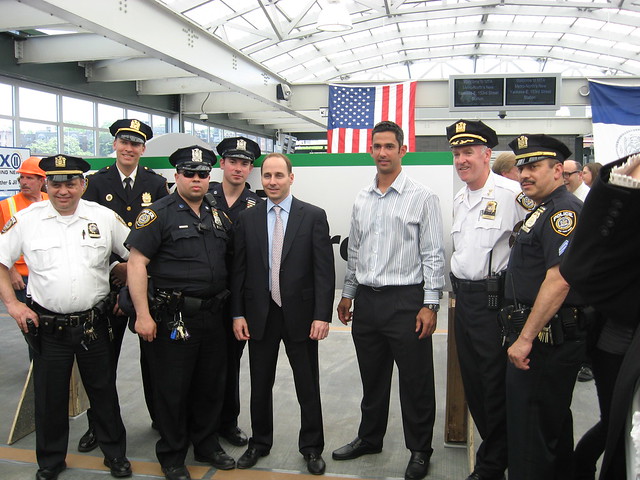
Yesterday, I went up to the new station for its official dedication. Joining me at Grand Central for the ride up north were Jorge Posada, David Cone and Brian Cashman as well as one Michael Bloomberg.

The day was a congratulatory one for the MTA. They opened up the new station at Yankee Stadium on time and on budget. The agency known for its massive delays and cost overruns held down an aggressive timetable and a $91-million budget for a project that had to be managed around active train lines.

It took just 24 months to build and should help reduce traffic volume in and around the South Bronx during Yankee games. “It’s another alternative to taking the subway here,” the Mayor said during the ceremony “And the more alternatives you give, the fewer people will drive.”

Jorgie, Coney and Cashmoney

The trip up north started at Grand Central Terminal with a deadhead ride — a free train — to the new station. The new schedules claim it is a 16-minute ride from Grand Central to the Yankee Stadium stop, and they’re not kidding. It’s a fast, smooth ride that will make just one stop — at 125th St. — when it debuts on Saturday morning.

When we arrived at the station, the Yankees just stood there as city and MTA officials took over. The Mayor started off with a joke. While chatting with Brian Cashman in the VIP train car on the way up — I, by the way, was with the press in a different car — he offered to pitch for the Yanks. “I throw righty and not lefty,” he said. “They just don’t need another right-handed pitcher. So I guess I’m out of that job and will keep my old one.”

Bloomberg

After that, though, it was all business. Bloomberg praised the MTA for realizing the three-decade-old dream of building a station at Yankee Stadium and in the South Bronx. He stressed how the station will improve the quality of life for not just Yankee fans but for residents of the polluted and congested neighborhood. “It’s not just for Yankee Stadium; it’s for the entire South Bronx,” he said while trumpeting his long-term goals of getting cars off the road in New York City.

After Bloomberg finished up, a spate of speakers followed him. Elliot Sander, the outgoing MTA CEO and Executive Director, MTA Chair Dale Hemmerdinger and Metro-North President Howard Permut gave the agency spiel. New Bronx Borough President Ruben Diaz, Jr., trumped the stadium’s impact on the Bronx.

Jorge, Cashman and the Cops

The technicalities of the station are advanced, and the structure itself is a sight to behold. It is a state-of-the-art 10,000-square-foot, fully ADA-accessible facility. Officials estimated up to 10,000 passengers per day for Yankee games, and if they reach that goal, vehicular traffic around the stadium should decrease significantly. It features four tracks all ten cars in length and real-time train arrival boards.

From an engineering perspective, the MTA had to spread out four tracks of the Hudson Line to construct the extra-wide platforms. The agency had to snake them between the columns supporting the Major Deegan Expressway and Exterior Street. Additionally, Metro-North has activated a section of track one mile east of the stadium stop to ensure that Harlem and New Haven Line trains can make the stop during gamedays and still hook back up with their proper routes.

In terms of service, the station will see regularly hourly service along the Hudson Line, but on gamedays, service will be increased significantly. Trains from Grand Central will leave every 15-20 minutes, and either three or four additional trains from points north along the Hudson, New Haven and Harlem lines will pass through the station prior to games. Anyone who lives near a Metro-North line east of the Hudson now has little reason to drive to a game.

The fare scheme is too complicated to explain in detail because it depends upon point of origination. In general, tickets to the station from points north will cost either 75 cents (off-peak) or $1 (peak) more than it does to get to Manhattan. From Grand Central to Yankee Stadium, peak tickets will be $6.50 and off-peak $5 until the fares go up next month. It’s certainly an expensive, if fast and comfortable, alternative to the subway.

Metro-North will also accept the $3.50 City Tickets good for weekend and holiday travel with the New York City limits, and all monthly passes will be honored as well. To beat fare-beaters, customers must have a valid ticket to exit the station before a game and to access the platforms afterward.

In the end, it’s hard not to be excited about this station. It’s a big, modern station just a five- to eight-minute walk away from the new Yankee Stadium. It should be popular for years to come, and it will open for business on Saturday. So if you’re off to see the Phillies play the Yanks on Saturday afternoon, take the train and take comfort in the fact that, when push comes to shove, the MTA can build a new facility on time and on budget. It may not be as sexy as the Second Ave. Subway, but as Hemmerdinger noted, these smaller expansion projects are just as important to the future of transit in New York City as the big-ticket items are.

Click through for a slideshow of the unveiling.

Categories : Bronx, Metro-North
Comments (11)

The fare hike countdown is reaching in end. In two weeks, subway fares will go up, and riders will begin to grumble: What do we get for shelling out more of our hard-earned bucks?

Well, in December, the MTA unveiled the plan service upgrades, but the agency couldn’t affix a time table to them. They had to make sure their finances were in order first. Last week, the MTA revealed that they do indeed have the funds, but they still have yet to announce dates for the service upgrades.

Today, the MTA unveiled a timetable of sorts for some of the service upgrades. Discussing the planned $13.7 million worth of service additions in the Bronx, the MTA said that they’ll be able to approve new services within the next two months. For Bronx residents who stand to benefit from new bus routes and enhanced interborough services, these changes can’t some soon enough.

Dorian Block has more on the upgrades:

The Metropolitan Transportation Authority has unveiled a $13.7 million set of enhancements to the Bronx’s subway and bus lines, increasing current service and creating new routes to transport the growing borough. Much of the money will be spent extending hours on several bus and subway lines, but the priciest single project is a $3.2 million new limited-stop bus — the Bx50 — that will run between Fordham Plaza and LaGuardia Airport…

Most of the improvements are scheduled to begin in June, with the LaGuardia bus and few others scheduled for September. “Right now we are waiting to see how the first-quarter revenues shape up, and if they come in as expected, we should be able to do the entire program,” said MTA spokesman Aaron Donovan…

Other big improvements in the program include 24-hour service on the Bx1, Bx3, Bx5 and the Bx13 routes, and an extension of the Bx36 route to Home Depot on Zerega Ave., a change that was requested by elected officials, community boards and Home Depot, on behalf of its employees. The extension will also serve the Castle Hill Houses and several other employers on Zerega.

For Bronx residents, these service upgrades represent real progress. For many LaGuardia workers, their commute has long involved a subway ride to Manhattan and a trip across 125th St. on the glacially slow M60 bus. The new Bx50 will make life easier for a lot of airport employees, and anytime a two-seat ride turns to a one-seat trip, transit passengers come out ahead.

Meanwhile, transit advocates are praising the MTA for delivering on their service upgrade promises. “The agency usually has to be dragged kicking and screaming, and I have to say this is a little more proactive,” Gene Russianoff, lawyer at the Straphangers Campaign said to the Daily News. “My instinct is that the enhancements are creative and would be popular, particularly the increases in service. They are thinking out of the box.”

Of course, this first round of service upgrades — the ones due in June — are just the tip of the iceberg. While the Bronx stands to benefit from these new bus routes, the real test will come in September when the MTA starts rolling out increased subway service. For now, we should applaud this advances and wait with bated breath for the city-wide changes to start rolling down the tracks.

The old Transit Authority logo courtesy of flickr user AllWaysNY.

Categories : Bronx, Fare Hikes
Comments (1)