Archive for Brooklyn

The Smith/9th Sts. station features new windscreens but no passengers quite yet. (Photo via the Second Ave. Sagas Instagram account)

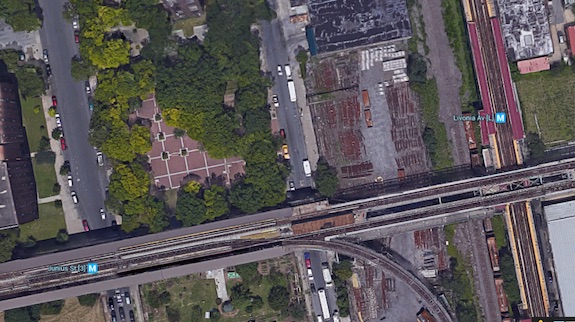
Soaring above the Gowanus Canal, nearly 90 feet above the ground, the Culver Viaduct offers sweeping views of the Manhattan skyline and, for years, a glimpse into the city’s crumbling transportation infrastructure. Sheathed in black wrapping to protect against failing waterproofing and crumbling concrete, the Viaduct is currently undergoing massive renovations that have left a significant portion of Red Hook without nearby subway service.

When the MTA first announced the Culver Viaduct rehab in 2007, plans called for a completion by the end of 2012. Well, here we are at the end of 2012, and the end is nowhere in sight. Over the course of the project, various pieces came and went. At one point, money for a full rehab for the 4th Ave. station disappeared, but local politicians were able to rescue most aspects of that plan. It was seemingly business as usual for an MTA capital project.

After various delays too tedious to chart here, the MTA shuttered Smith-9th Sts. in June of 2011 with a promise to reopen it in March of 2012. Nine months later, the MTA can say only that the station will open sometime during the first quarter of 2013, placing the station rehabilitation project one year overdue. Some reports in local Brooklyn media indicated that the station may not open until April. Those reports, however, have confused the project completion date with the station reopening. The two are not the same as the station can reopen before the entire project at Smith/9th is complete.

Meanwhile, the Culver Viaduct rehab witnessed another bump in cost by around $8 million. The MTA Board approved a retroactive modification to one of the project’s contracts for work on the 10th St. wall between 4th and 5th Avenues. The tale told in the modification plan is a warning for the rest of our infrastructure. It reads:

During a pre-award survey, some deterioration due to water leaks was observed, but the condition of the wall was determiend to be safe, and due to budget constraints, was not included in the contract scope. However, after contract award, during regular maintenance inspections, Subways observed further deterioration and by concrete core testing determined that the wall was in severely deteriorated condition and required extensive repair.

If that’s not a warning, I don’t know what is. A visual inspection can yield only so many details, and the MTA’s subsequent determination speak to the state of much of our outdoor subway system. We simply cannot afford to defer maintenance and repair stations, tunnels and supporting walls on the cheap.

Meanwhile, work will go on and on and on. Some of the delay at Smith/9th is attributable to the diversion of resources after Superstorm Sandy, but some of it isn’t. One day soon, Red Hook will have its subway stop back, and we’ll be left wondering what took so long. It’s the age-old MTA capital program question.

Categories : Brooklyn
Comments (54)

R trains have not run through the Montague St. Tunnel since the days before Sandy arrived.

After last week’s uproar over the G and L trains, the clamor from the crowd for more subway service has died down, but a few key missing links remain. The 1 train won’t be heading to South Ferry any time soon, and the J and Z trains haven’t yet reached Broad St. The Rockaways, as we know, will be cut off for a while as well. But the largest gap in service remains on the R line.

The Montague St. Tunnel, the R train’s link between Brooklyn and Manhattan, suffered severe flooding during the Sandy storm surge, and it hasn’t come back into service yet. According to a report in today’s Daily News, it’s going to be a while yet. MTA officials say it could be at least two or three more weeks, and Pete Donohue has some details:

Water from an unprecedented sea surge cascaded down a tunnel ventilation shaft at the southern tip of Manhattan, and it rushed down the stairs of the Whitehall St./South Ferry station, officials said. The volume of water in the tunnel was so great it extended up a steep incline into Brooklyn Heights – about four blocks from the riverbank. It stopped about 500 feet from Court St. station, MTA Chairman Joseph Lhota said. “That’s a long distance and the water was floor to ceiling,” Lhota said. “The tunnel and the equipment was severely damaged.”

New York 1 had the nitty-gritty on the damage:

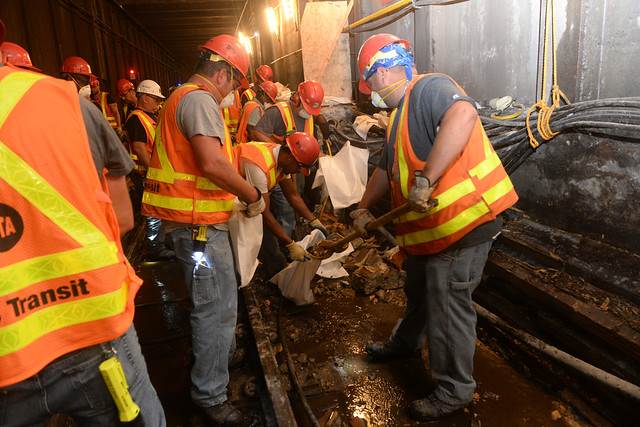
The R stations and tunnels are now pumped out and dry so crews can repair the saltwater damage. They components have to be replaced in each of the signals along that entire section of track. One example is the signal fuses. Crews say green mold has corroded the normally brown-colored components. Crews are also fixing light fixtures, telephone lines and fire alarms in the R tunnel.

It’s all well and good to repair these components and get the service back up and running but doing so without an eye toward immediate preventative measures is akin to closing the barn door after the horse escapes. Another storm will come; another flood will happen; and we’ll do this all over again.

Categories : Brooklyn, Manhattan
Comments (52)

As the Monday morning rush hour has come and gone, we’ve quickly learned that northern Brooklyn and parts of Queens are struggling under the demands of less than 100 percent transit service. With the L and G trains still shuttered due to flooding, residents of areas served by these trains were left with packed M and J trains, very long lines for buses and a growing sense that the MTA views them as second class subway citizens. When, they ask, will service be restored or alternate transportation options be available?

With a crowd swell of voices calling for the restoration of service, the MTA has stressed the attention it will pay to the L and G trains. In a statement this morning on Twitter, the MTA said that getting the G and L back up is “our highest priority.” They offered up more in a subsequent statement:

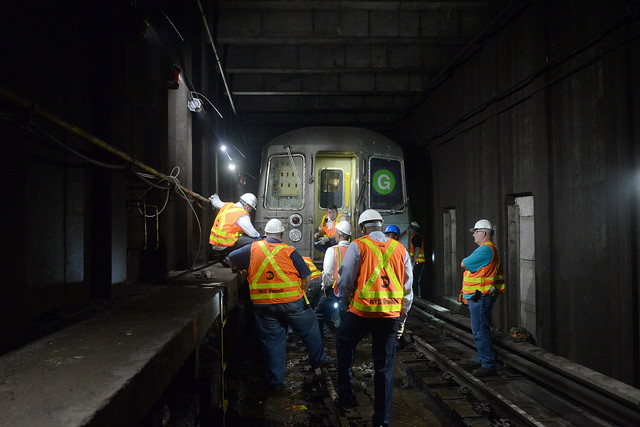
The MTA is very much aware of the difficult commute for our customers who usually take the G and L trains, as well as the crowding at the Marcy Avenue station. Getting the G and L running again is our highest priority, and crews are working around the clock on both. Pumping the water from those flooded tunnels is only the first step; signals must be fixed or replaced and then tested, among other restorations, before we can safely start service again. We know this is an inconvenience for our customers in the affected neighborhoods, and the entire agency is focused on getting those lines running again.

In other statements, though, MTA officials let slip their on takes on the G train. To The Observer, Adam Lisberg, the MTA’s head spokesperson, talked of ridership. “The answer on the L is that it’s impossible to turn trains around easily mid-route for a Brooklyn shuttle service,” he said. “[It's] very difficult to set up because of the track layout. They may try now that other lines are getting better service, but that’s just a discussion at this point. As for the G, enough of it is parallel to other lines—plus the naturally low ridership.”

(Later, Lisberg offered up some sympathy and an explanation for G train riders though. “Water that has sloshed in by way of Newtown Creek is obviously going to be more of concern,” he said to Capital New York. “The signal damage in the G tunnel, I’m told, is very severe.”)

Brooklyn politicians though have objected to the MTA’s approach. “The G train is not a second class line,” City Council Member Steve Levin said to The Observer. “It’s essential for the MTA to recognize that. For the last couple of years, ridership has been way up on the line, as many new businesses and residents have become reliant on the G train on a daily basis—not only to get into Manhattan but to travel within Brooklyn and to Queens.”

He continued: “I understand the constraints the MTA is working under, and it’s enormous constraints, what I expect them to do is provide the fullest service possible. I’m not an engineer, and I appreciate how complex the system is, but I expect that my constituents are treated the same as subway riders in every other neighborhood.”

Council Member Diana Reyna issued a similar call: “The task before the MTA is difficult but not impossible, and alternatives must be provided to those commuting to work.” Are the J and M trains — plus subsequent transfers — sufficient alternatives? Riders trying to get to work and school are saying no, and L and G train service may not return for a few days yet. It’s a bad situation made worse right now.

Comments (37)

The MTA will run extra subway and LIRR trains from the Barclays Center after events are over. (Photo by Benjamin Kabak)

My unintentional week of coverage concerning the new Barclays Center wraps up today with a look at an announcement from the LIRR. The MTA, as we know, will run extra service along the 2, 4 and Q lines after events at the Barclays Center in order to clear out the crowds, and this week, the agency announced plans to increase LIRR service out of the Atlantic Avenue Terminal as well. With extra train service and a dearth of easy parking in the area, everyone from the MTA to Brooklyn residents are hoping that relatively few people will drive to the Barclays Center.

“If you are planning on attending a Nets game or going to see JAY-Z, Barbra Streisand, Justin Bieber, The Who or any of the other top acts at Brooklyn’s hottest new venue, we will have plenty of trains to get you there and get you home at the end of your evening,” LIRR President Helena Williams said in a rather canned statement. “The LIRR’s new Atlantic Terminal is just across the street from the Barclays Center, so using the LIRR is definitely the most convenient way to go.”

The MTA has released a brocher detailing post-event service [pdf], and here’s a detailed breakdown of the plan:

The LIRR’s enhanced late-night service from Atlantic Terminal will feature eastbound trains departing approximately every 15-25 minutes after an event. Following Nets games, the last train from Atlantic Terminal will depart at 11:55 PM on both weeknights and weekends. Following evening concerts and other special events, the last train from Atlantic Terminal will depart at 12:41 AM weeknights and weekends. NYPD and MTA Police will be on hand to assist customers arriving at the Center.

There is, of course, a catch: These extra trains will essentially operate as shuttles, ferrying riders from Atlantic Avenue to Jamaica, where Long Island-bound travelers will have to catch the next scheduled train to their ultimate destinations. Still, as the MTA’s brochure illustrates, the increased service is designed to ensure that riders make it to their connecting trains in time. The shortest layovers in Jamaica will last all of two minutes, leaving very little margin for error. Island-bound riders who can’t get to Jamaica will have to resort to 2 or 3 train service back to Penn Station.

I was curious about the extra service. Who pays for it all, I wondered. The issue isn’t without controversy as the WMATA and Nationals have run into a dispute this season over service for games that run late. Metro has asked the Nats to pony up nearly $30,000 per hour when the team wants the D.C. subway to run later than normal. In New York, the system’s closing too early isn’t the issue but frequency is.

In New York, the MTA picks up the bill for extra service. The only exception concerns special service to Belmont for which the New York Racing Association pays. Officially, the MTA says it’s just part of the agency’s overall job. “Our subway, bus and commuter rail services remove cars from road, help improve the environment and support the economy. If thousands of people want to travel to a sporting event, a concert, a parade or just a nice day in the park, we are there to make their trips as safe and efficient as possible,” the MTA said to me in a statement. “Of course, the main reason we add extra trains and buses following sporting and other special events is to increase capacity in order to accommodate everyone, including regular customers who are not traveling to or from an event.”

I’ll leave you then with a question: Should the MTA pay for this service? It comes, after all, out of taxpayer and fare-payer pockets, but at the same time, the extra service goes a long way toward keeping cars off the road. One of the reasons why the Yankee Stadium parking lots, for instance, have been so empty is due to the increased Metro-North and subway service. It seems then that the few extra trains are beneficial to everyone. It’s a win-win a relatively marginal cost.

Categories : Brooklyn, LIRR
Comments (31)

A solitary straphanger ponders the new Atlantic Avenue-Barclays Center subway entrance on Monday afternoon. (Photo by Benjamin Kabak)

Amidst little fanfare on Monday afternoon, the MTA opened up a new subway entrance. This isn’t just any old subway entrance. Rather, it is the subway entrance that leads to the Barclays Center, an arena that sits atop rail yards handed over by the MTA Board to Bruce Ratner for a well-below market rate of $100 million.

Over the years, the Atlantic Yards debacle has garnered more than its fair share of debate (and a very thorough website devoted to tracking the project in all its glory), but one element that has seemingly flown under the radar until recently concerns traffic, transportation and pedestrian flow around the arena. Simply put, the arena is in a terrible spot for pedestrian safety.

On its north side is a six-lane road that features cars speeding by at all hours of the day, and on the other side is a six-lane road that features cars speeding by at all hours of the day. Meanwhile, parking in the area is nearly non-existent, and the city, Ratner and the MTA has spent a few months telling anyone who will listen to just take the train. The Barclays Center has begun an ad blitz showcasing how subway-accessible the arena is, and the Harlem Globetrotters plugged the LIRR last week. It may take a trip or two from intrepid drivers to discover the reality of the situation, but beyond some loading areas that are slightly recessed from the rest of either Atlantic or Flatbush Avenues, car access to the arena is nearly a non-starter.

An ad blitz to promote transit to the Barclays Center is currently underway. (Photo by Benjamin Kabak)

And so to accomodate the crowds, part of the arena work involved a new subway entrance that eliminated the need to cross these busy thoroughfares. Until Monday, passengers disembarking at the erstwhile Atlantic Ave.-Pacific St. stop had to cross either Atlantic or Flatbush to reach the location of the arena. A new subway entrance that leads directly from the IRT and BMT Brighton Line platforms and features wide concourses is ready, willing and able to accomodate the crowds that will fill the 18,000-seat arena.

With no public ribbon-cutting or any sort of press release, Transit had what could be called a soft opening of the subway entrance and the surrounding plaza on Monday. I took my camera to the area at around 5:30 p.m. and found it largely empty. The benches behind the eco-friendly entrance were in use, but only a few curious subway riders were making use of the new entrance. That will change as word gets around.

So besides some plant life growing on the entrance building, what did I find? The new entrance is, as the green globe attests, open 24/7 and provides easy access to 5th Ave. in Park Slope as well as the Best Buy building as part of the Atlantic Terminal Mall complex. The station entrance itself has clearly been built to handle a large influx of crowds. With two escalators, an elevator and five stair cases to go with an ample number of turnstiles, post-game subway riders will find it easy to get from the arena to their trains.

Once inside the station, a wide concourse with two ramps directs riders to the IRT trains. The ramp heading up leads to the Manhattan-bound local (2/3 trains) while an underpass ferries passengers to the express island platform for the 4 and 5 trains or the Brooklyn-bound local tracks. The staircase to the B and Q train platform is right around the corner. In fact, this station could improve the transfer between the IRT and BMT as the walk from the back of the local 2 or 3 platform to the lower level BMT Brighton platform is much shorter. I do worry that with only two small staircases leading down to the rear of the B/Q platform, crowds could build up after events.

A classic MTA sign fail at the rear of the Manhattan-bound IRT local platform obscures directions to the rest of the station complex. (Photo by Benjamin Kabak)

And so the station is ready for action, and it will be required to deliver. With busy roads and a relatively small sidewalk area surrounding the Barclays Center, getting subway-bound sports fans or concert-goers underground quickly and safely will be a paramount concern for event organizers. To the naked eye and with few riders around, the station looks ready to deliver. We’ll find out in ten days how it handles the crowd.

After the jump, a complete slideshow of photos from the new station entrance. Read More→

Categories : Brooklyn
Comments (41)

A common sentiment, express on a t-shirt.

When it comes to names, New Yorkers are very possessive and adverse to change. A few years ago, some subway conductors starting adding “Top of the Rock” to their announcement at Rockefeller Center, and the corporate addition drew more than a few eyebrows. New Yorkers object to the placement of NYU’s name at the Christopher St. and 8th St. subway stops, and the Mets still play at Shea Stadium.

Nothing though has generated more angst than the corporate naming rights deal at the former Atlantic Ave.-Pacific St. subway stop. For $200,000 a year for 20 years, Barclays has appended the name of its sponsored arena to the station, and Transit has dropped poor neglected Pacific St. Although the arena doesn’t open until month’s end, the station signage has been updated, and the IRT FIND displays are sporting some decidedly low tech decals. Even as protest t-shirts spring up, the station is now, for better or worse, Atlantic Ave.-Barclays Center.

But is Pacific St. supposed to have been left to the dustbins of history? Tough to say, says Norman Oder in a recent post at his Atlantic Yards Report. Noting that the signage wasn’t supposed to debut until the arena actually opened, Oder questions the MTA’s handling of the name change:

It turns out, when the $200,000-a-year deal was approved 6/24/09, the MTA board was told of a different plan. As the … meeting transcript shows, then-CFO Gary Dellaverson stated, “[E]ven though it appears to be a single station, of course it is in essence two different stations and there is two different names, and, it will be Atlantic/Barclays Arena and the Pacific Street Barclays Arena. So that is how it would be named.”

…Dellaverson has left the MTA, and agency spokesman Adam Lisberg says staff aren’t sure why he said it. “Folks here now believe that it was always intended to be Atlantic Avenue-Barclays Center,” he told me. The Pacific Street platform still has the name in a “beautiful mosaic [below], and we’re certainly not going to go in and chisel it out,” Lisberg said. Otherwise, the identifier is vanishing…

What’s the rationale? “If the sign on the map says Atlantic-Barclays,” said Lisberg, the sign at the station should match it. “Three names gets too long. Shorter is better.” “The decision to shorten it to ‘Atlantic-Barclays’ was made by the MTA purely for reasons of brevity and clarity, not as part of a conscious decision to commodify public space,” he added, in response to my suggestion that some people are concerned about such commodification. “For commuters, people reading the maps, for tourists… taking it to a concert, calling the station by two names instead of three is much simpler,” Lisberg added.

As Oder notes, the signs weren’t supposed to be revealed until the “Beneficial Use of the Subway Entrance is achieved.” In non-legalese, that essentially means that the date of the name change should have been the date the new subway entrance is available for public use. That clearly hasn’t happened yet. The signage, however, has changed, and the pre-recorded announcements trumpet “Atlantic Ave.-Barclays Center.” Consider it a few months of free advertising.

So the question I circle back around time and again concerns Pacific St. Should we mourn Pacific St.? While Lisberg noted to Oder that the Atlantic/Pacific complex is, technically, two different stations, that distinction has been lost to history since free transfers were instituted in 1967. Meanwhile, Pacific St. is a rather easy street to miss. Despite running parallel to Atlantic Ave., it’s not a destination; it’s quiet residential street. Anyone bound for Atlantic Ave. is far more likely to be looking for station’s namesake, the arena, 4th Ave. or Flatbush. It’s a name that could go without much fanfare, absent a naming rights controversy.

Yet, for the MTA to get it right with respect to naming rights, the authority can’t sacrifice the system’s identity. As I’ve said before, the new name can be appended to the old and should involve a reason — but not necessarily the reason — for traveling to such a station. It isn’t clear if the MTA gave away too much in renaming Atlantic Ave.-Pacific St., but dropping Pacific St. hasn’t gone over too well.

Categories : Brooklyn
Comments (50)

Even as we’re debating shuttering some subway stations, it’s easy to overlook how subway line routing can impact neighborhood development. A recent piece in The Wall Street Journal brings that point home though. On Friday, Melanie Lefkowitz profiled Kensington, Brooklyn. Surrounding the Church Ave. subway stop, the area is undergoing gentrification, and many in the neighborhood attribute new development to not only the F train but the G as well.

The B and Q aren’t too far away, but real estate watchers think the IND Crosstown extension is playing a key role. “Having the G train going over to Church has made a huge difference,” Kyle Talbott of Corcoran Group. “It’s cross-pollinated different neighborhoods that before were a little more separate; it has given people who work in different parts of the city access to Kensington, where before it was a little harder to get to.”

Anecdotally at least, this piece underscores the importance of diverse and divergent routing. Kensington, due to its proximity to Prospect Park, may have been alluring because of the F train alone, but by offering two service options that connect to geographically diverse regions of the city, the neighborhood is even more desirable. That’s how transit should work.

Categories : Brooklyn
Comments (33)

The bollards at Atlantic Ave. have finally been replaced by less intrusive security measures. (Photo by Benjamin Kabak)

When the Atlantic Ave. Long Island Rail Road terminal opened two and a half years ago, the security measures in front drew immediate criticism. Giant granite slabs — some shaped to serve as benches — blocked entrances and walkways. They formed a ring around the front as impenetrable to people as they were to potential terrorists, and over the past few years, the granite slabs were used more as garbage dumps than anything else. Memorably, No Land Grab called them tombs, and Streetsblog explored how they went above and beyond NYPD-endorsed security guidelines.

After facing constant criticism for 18 months, the MTA announced last August that the bollards would be replaced by more standard security measures. At the time, the authority had no renderings, but reports indicated that the new measures would be standard cylinders that, for better or worse, ring around buildings in Midtown and Lower Manhattan.

When I walked by the terminal a few weeks ago, work had finally begun on the bollard replacement project, and last week, Transportation Nation secured some definitive details. Per the MTA’s statement:

“The MTA and the Long Island Rail Road listened to concerns from local elected officials and community leaders who felt the stone bollards were intrusive and out-of-scale at their current size. As part of the original design, there were 15 granite bollards surrounding the new $108 million Atlantic Terminal Pavillion when it opened in January 2010. In consultation with the MTA Police and NYPD, we decided to replace the granite bollards with 60 smaller steel bollards that still meet the security requirements spelled out by the NYPD for public buildings of this kind. The new bollards will be 36 inches in height and approximately 12 inches wide. They will be placed around the perimeter of Atlantic Terminal approximately 4 feet apart.

The removal of the old bollards and the installation of the new bollards is part of [a] comprehensive perimeter security project being undertaken by MTA Capital Construction through a grant from the federal government. On April 12, a contract for the project was awarded to Adtec Enterprises of Mt. Vernon, N.Y., after the company submitted the winning low bid of $3.486 million. The overall project will take one year to complete, but most of the bollards have already been removed and installation of the steel replacements is expected to get underway soon.”

The granite blocks, which weighed around eight tons, have been removed. Yesterday, another reporter tried to venture over to the space to take some photos, and the workers objected. They refused to allow the reporter to take photos of the work in progress, and even after gaining authorization from the MTA press officer, Andrea Bernstein still had some troubles with workers. She snapped her photos, but the objections claiming a homeland security project rang a bit false. The bollards will be in view for all to see soon enough.

Ultimately, the bollards cost $1.2 million to build and another $150,000 to remove. The feds — and taxpayers — are footing the bill for another $3.5 million replacement project. So now a wrong has been righted, and the sidewalks at the intersection of Flatbush Ave. and Ashland and Hanson Places will now be pedestrian-friendly and safe. With a little foresight, this whole thing could have been avoided.

An unrelated reminder: I’m going to be on TV at 7:15 a.m. this morning. Check out Fox 5 for a segment on the Straphangers’ subway report cards.

Categories : Brooklyn
Comments (5)

While it is no substitute for more frequent service or the reopening of the F/G stop at Smith/9th Sts., Brooklyn-based riders of the B61 received a welcome addition to their route this week as Transit brought Bus Time to this beleaguered line. Beginning this past Monday, bus riders from Windsor Terrace to Downtown Brooklyn, by way of Red Hook, are now able to track the buses as they amble down the line. As the B61 is one of the borough’s least reliable routes, riders will now know just how late their buses will be.

In a sense, this type of technological upgrade is a cheap and ineffective substitute for better service. People don’t just want to know their bus is late; rather, they want buses to be on time and frequent. On the other hand though, numerous studies have shown mass transit riders are willing to weather longer waits if they know how far away the next bus is. The complaints shouldn’t cease, but wait times may be more tolerable if the element of surprise is removed.

The B61 joins the B63, the M34 and all of Staten Island as Bus Time-ready routes. The city-wide rollout will be completed by the end of 2013.

Categories : Asides, Brooklyn, Buses
Comments (14)

Miss Wit Tees is selling these for $14 a pop. That’s one way to fight a Bruce Ratner-inspired naming-rights deal. The protest language:

You can tear the buildings down, and run folks out of town, and spin your tales of heroism. Billionaires come, and billionaires go. Names change, streets are bulldozed, neighborhoods divided, but these coordinates remain the same. Change is great, destruction ain’t. When the name becomes Atlantic/Housing Way we might sing a sweeter tune. You can call it the Barclay’s whatever, but I’m Still Calling it Atlantic Avenue Pacific Street!

This ain’t the first time I’ve heard these sentiments. Based on the city’s collective experiences with the Triborough Bridge renaming, I have a feeling the discarded Pacific St. moniker will live on well beyond its elimination from the subway map.

Categories : Brooklyn
Comments (45)