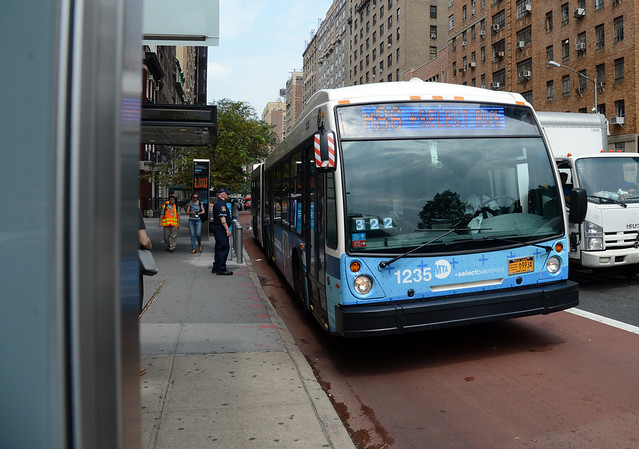
Archive for Buses
In Sandy’s aftermath, a thought on prioritizing road space
Posted by: | CommentsAs we await official word from the MTA on the state of the city’s subway system, it seems clear that service will not immediately return to normal. Although buses are set to hit the streets at 5 p.m., we won’t know much about subway service until later in the day. Early indications are, though, that the full system will be out for a few days at least.
So how do we move people throughout the city? I, for instance, live around seven miles from my office in Midtown and have to cross the East River to get there. We can’t all pile over the bridge at once, and the subway, which delivers millions of people each day to destinations throughout the city, isn’t going to be at full strength for days.
To that end, Transportation Alternatives has issued a call for street prioritization. Instead of a traffic free-for-all in which buses stuffed with people compete with private cars, bicyclists, taxis and emergency response vehicles, the city could rearrange traffic as such until the subways return:
- Emergency Bus Lanes to allow swift transit throughout the City until subway service is restored.
- Emergency Street Reservations exclusively for the safe use of walkers, bikers and emergency vehicles.
- Off-Peak Bridge Biking and Walking Lanes to ensure sufficient safe space for people on foot and bicycle and prevent overcrowding on the bridges.
- Emergency Biking Lanes on well-used routes to enable safe mobility, including coned-off Midtown bike lanes.
- Bike Parking Stations and Temporary Bike Storage in major employment centers in Lower Manhattan including Foley Square, Union Square, Herald Square, Times Square, Washington Square Park and Bryant Park.
- High Occupancy Vehicle Requirements on crossings into the most congested areas of the city.
- Carpool Staging Areas offering parking and passenger pick-up locations in support of drivers sharing rides to meet the HOV requirements.
As a few people noted last night, New Yorkers may be in for a shock when they discover just how slow, infrequent and, oftentimes, unreliable the bus system is, but for the next few days, we’re going to have to rely on it. The city should make sure buses get move quickly through neighborhoods, and these street-sharing suggestions deserve a consideration before the roads start to fill up after 5 p.m. today.
Transit Tech Update: BusTime set to hit the Bronx next week
Posted by: | CommentsOver the past few years, we’ve seen Transit begin the process of bringing real-time bus tracking to New York City. Eschewing an expensive, closed solution, the MTA instead went the open source route and has been developing BusTime, with its public API, in house for nearly two years. I explored the inner workings of the technology as it existed in February of 2011. Since then, a few routes in Brooklyn and Manhattan along with all of Staten Island have been added to BusTime, and the response has been overwhelmingly positive. Now, it’s nearing time for its Bronx debut.
Earlier this week, during testimony in front of the City Council, Craig Stewart, a Senior Corporate Management from Transit, said that the Bronx would, in fact, receive BusTime by the end of the month. “We are scheduled to fully deploy BusTime in the Bronx by the end of this month and to have it in all remaining boroughs by the end of 2013,” he said. “It is worth noting that customer feedback on the MTA Bus Time initiative has been overwhelmingly positive.” According to The Daily News, nearly 30 percent of Staten Island bus riders have used the service.
Available online via a mobile or full-featured browser and with the information accessible via text message as well, BusTime informs riders of how far away the next bus along the chosen route is. It’s a little less precise than a countdown clock with minutes, but bus travel time varies based on surface traffic. From my use of it in Brooklyn, it seems to take only a few refreshes to ascertain how long a wait will be and how distance translates into time. As the city-wide rollout continues, this technology should vastly improve the experience of traveling on — and waiting for — our buses. Now how about more dedicated lanes and a city-wide pre-board payment system?
Laguardia-focused SBS to improve airport travel times
Posted by: | Comments
Dedicated bus routes will drastically improve public transportation ride times to Laguardia Airport. [pdf]
Thanks to a bunch of NIMBYs in Astoria, we don’t have subway service to Laguardia Airport, and we’ve been waiting years for the city to wrap up endless studies concerning bus improvements. Today, though, marked a potential turning point in the much-maligned airport’s accessibility as the New York City Department of Transportation and MTA announced a sweeping series of bus improvements that will drastically reduce travel times to the airport.
Three new Select Bus Service routes will connect the airport to Manhattan, the Bronx and parts of Queens as well as nearby subway lines, the LIRR and Metro-North. With speedier buses running up and down 125th St., on Webster Ave. and through Jackson Heights, local bus service, as Streetsblog detailed earlier, should improve as well. According to the city and MTA, travel times could drop for some airport-bound commuters by as much as 40 minutes thanks to pre-board fare payment options, dedicated travel lines and signal prioritization efforts. The new routes should be rolled out over the course of 2013 and 2014.
“LaGuardia Airport is a transportation hub and a city unto itself that needs a better connection to the transit network and the region’s economy,” DOT Commissioner Janette Sadik-Khan said in a statement. “These routes will open the terminal doors to new neighborhoods and bring more reliable local service to people across three boroughs.”
As many New Yorkers know, Laguardia remains infuriatingly close but oh so far from the city’s public transit system. Even with service from five bus routes, service is painstakingly slow, and buses fill up very quickly with folks using local service, those who work at the airport and travelers with giant suitcases. Without a direct rail link or any bus improvements, the current situation is untenable.
So what are the details? Well, in Manhattan, new M60 SBS service would bring speedier connections to Metro-North and the subways at 125th St. while speeding up airport service by nearly 10 minutes. Harlem community leaders have long voiced the need for better bus service as well. In the Bronx, some Webster Ave. SBS rides would cross the Triboro Bridge and head to the airport, cutting travel times by nearly 50 percent. This extension is still under consideration. In Queens, new service to Woodside and Jackson Heights would utilize the BQE to clear up local streets and provide quicker and more direct service. (A PDF summary of these proposal is available here.)
Ultimately, these bus improvements are welcome, but they are no substitute for rail service. Improving access to Laguardia has long been a goal of Mayor Bloomberg and his PLANYC2020 vision, and it appears as though a part of his lasting transportation legacy will involve faster bus service to this airport. Still, we should not lose sight of the endgame: The subway — or at the least, an airtrain — should extend to Laguardia. Until then, incremental improvements, and not a game-changing scenario, are the best we can hope to achieve,
Liu: Cemusa bus shelters too dirty
Posted by: | Comments
A City Comptroller's report alleges that Cemusa has done a poor job cleaning its bus shelters. (Photo by flickr user animalvegetable)
When Cemusa entered into its 20-year contract with New York City to install and maintain bus shelters and newsstands across the city, critics lamented the death of New York’s individuality. Noted that the bus shelters were the same in the Big Apple as they were elsewhere, Brooks of Sheffield called unspecial and unoriginal. Others, meanwhile, had more legitimate complaints as Queens Crap complained of snow removal neglect and Sheepshead Bites accused of Cemusa’s bus stations of peddling in misinformation. Now, the city government is piling on too.
In an audit released earlier this week, New York City Comptroller set his sights on Cemusa’s failure to adhere to its bargain. Bus shelters aren’t as clean or well maintained as the company promised they would be, John Liu’s office said. The full report is available here as a PDF. The short of it from the Comptroller’s Office:
Under the franchise agreement, Cemusa is required, at its own expense, to clean, inspect, and maintain the structures in good repair. With DOT’s approval, Cemusa has outsourced its inspection, cleaning, and maintenance responsibilities to subcontractors. DynaServ Industries, Inc. (DynaServ) is responsible for cleaning, inspecting, and posting advertisements, and Pipeline Construction, LLC (Pipeline) was responsible for repairing and replacing damaged parts and performing electrical repairs and annual electrical inspections. This audit addressed Cemusa’s upkeep of the bus stop shelters, the most common type and widely used street furniture across the City.
The audit concluded that Cemusa needs to improve its oversight efforts to ensure that its subcontractors maintain bus stop shelters in compliance with its franchise agreement with DOT. Cemusa has certain mechanisms in place to assess its subcontractors’ performance regarding the upkeep of the bus stop shelters. However, these mechanisms do not provide sufficient assurance that the subcontractors’ performance ensures Cemusa’s compliance with the provisions of its franchise agreement regarding the upkeep of the bus stop shelters.
For the audit test period, Cemusa’s subcontractor, DynaServ, did not service (inspect and clean) the bus stop shelters at the level required. DynaServ’s productivity expectations (the number of shelters that can be cleaned by each crew in one shift) are overly optimistic and DynaServ has not allocated sufficient resources to ensure that each shelter will be cleaned twice each week on non-consecutive days as required. The audit also showed that Cemusa’s other subcontractor, Pipeline, needed to improve its performance in regard to responding promptly and repairing reported defective conditions. Further, there was insufficient evidence that all electrical inspections were carried out as reported. Based on these and additional factors discussed herein, we lack reasonable assurance that the bus stop shelters are serviced in accordance with Cemusa’s franchise agreement with DOT.
At a certain level, Cemusa disputed the Comptroller’s results. The company noted that Liu’s audit was based on one observable point in time and that the subcontractor routinely upheld its end of the deal. “No trend can be assessed and no conclusion can be drawn,” the company said. Despite protests from the Comptroller’s Office, Cemusa said cleaning efforts are generally sufficient and up to contractual standards.
Still, they agreed with five points from the report. It avowed the need for better subcontractor oversight, promised to clean roof panels more frequently and will establish proactive oversight and monitoring of contractors. After all, with 14 years left in the contract and more ad revenue rolling in, the company has a compelling reason to keep these shelters clean.
In response to the audit, Transportation Nation wondered if the criticism speaks to the problem of privatization. “When a private company manages public space,” Alex Goldmark wrote, “they too, leave it dirty sometimes, just like the DOT did when they managed bus shelters.”
That’s a bit of an oversimplification. The current bus stops, while perhaps not unique or to the liking of those who yearn for old New York, are cleaner, bigger and brighter than the old shelters. They’ve been modernized and are generally well maintained by Cemusa. I’ve watched those in my neighborhood cleaned regularly, and based on my lack of faith in John Liu, I am inclined to believe the City Comptroller’s Office relied upon a less than rigorous audit methodology here.
Still, privatization of public spaces isn’t a panacea. Cemusa may be paying $1.5 billion for the rights to the bus shelters and newsstands, but it still has to confront the same realities of maintenance and upkeep that the city did when it was in charge. From a use perspective, I’m far more concerned with the observations Al Rosen made in May: If the information concerning bus routes isn’t correct, who cares how often the glass gets cleaned anyway?
For the B61, a BusTime bonus for bad service
Posted by: | CommentsWhile it is no substitute for more frequent service or the reopening of the F/G stop at Smith/9th Sts., Brooklyn-based riders of the B61 received a welcome addition to their route this week as Transit brought Bus Time to this beleaguered line. Beginning this past Monday, bus riders from Windsor Terrace to Downtown Brooklyn, by way of Red Hook, are now able to track the buses as they amble down the line. As the B61 is one of the borough’s least reliable routes, riders will now know just how late their buses will be.
In a sense, this type of technological upgrade is a cheap and ineffective substitute for better service. People don’t just want to know their bus is late; rather, they want buses to be on time and frequent. On the other hand though, numerous studies have shown mass transit riders are willing to weather longer waits if they know how far away the next bus is. The complaints shouldn’t cease, but wait times may be more tolerable if the element of surprise is removed.
The B61 joins the B63, the M34 and all of Staten Island as Bus Time-ready routes. The city-wide rollout will be completed by the end of 2013.
Bus fare evasion now a $50 million problem
Posted by: | CommentsOne question I’ve struggled with over the past few months has concerned fare-jumping. Does the New York City media place too much of an emphasis on the revenue lost to fare-jumping? Should we care that a small percentage of transit riders try to duck their fares? At what point does the cost of increased enforcement outweigh the benefits?
When it comes to subway fare enforcement efforts, I’ve been firmly on the side of ignoring it. I think the media has spent all together too much time focusing on subway fare jumping as it is mostly just an inconvenience. Steeper fines are likely a sufficient deterrent by themselves. But what about buses?
For a while, the MTA had pegged bus fare evasion as a $14 million problem. Despite anecdotal reports of rampant fare jumping on certain bus lines, Transit had downplayed their bleed rate. Now, it seems, it may be worse than they thought. Pete Donohue had the report:
The MTA loses about $50 million in revenue each year to bus farebeaters — more than triple what it previously estimated, the Daily News has learned. The staggering figure is partly the result of a new way the authority calculates fare-dodging, but also indicates that the longstanding problem has worsened because of lax enforcement, sources said.
The authority previously had estimated that bus farebeaters were stealing $14 million worth of free rides annually. Gauging bus freeloading levels has been an inexact science. Drivers are supposed to keep tallies by pushing a button every time someone boards without paying. The authority also has used video to estimate the frequency of bus farebeating.
“This is situation we have to get under control,” MTA board member Allen Cappelli said. “Not only is it a significant amount of revenue, but you’re allowing people to behave in a lawless manner.”
At a certain point, some bleed is inevitable, but if the MTA’s $50 million estimate is accurate, the new bleed rate on the buses has jumped from around 1.5 percent of annual revenue to 5.5 percent of annual revenue. It’s probably time to address the problem.
As folks enter without paying their fares, it creates a disincentive for others to swipe their MetroCards, and enforcement has been lax. According to Donohue, the MTA is working to propose a citywide plan to “deter fare evasion,” and politicians are calling for more police activity aboard buses. It’s tough to say though what the golden ticket will be here. Until these figures decline though, bus fare evasion will garner headlines one way or another.
A better plan for Webster Ave. SBS lanes
Posted by: | Comments
One plan under consideration for Webster Avenue would bring an element of true bus rapid transit to the Bronx (Via NYC DOT and MTA)
The absurdly painfully slow process of bringing simple bus lane improvements to one street in one borough has claimed another victim as the city and MTA are examining ways to speed up transit along Webster Ave. in the Bronx. This time around, the various stakeholders are looking at the B44, a so-called Phase 2 route. After identifying the route in 2009 as SBS-ready, the city hopes to launch service in late 2013. What a ridiculous timeframe.
Anyway, as the project ambles along slower than a crosstown bus at rush hour, the MTA and DOT hosted an open house on the Webster Ave. line. This routing is a north-south one that parallels the 4 and the B/D subway lines and connects the 2 and 5 trains at one end with the, uh, 2 and 5 trains at the other end. It also intersects with the Bx12 SBS route, and of the 125000 residents who live within a quarter mile of the route, the vast majority of them do not own cars. Currently, an end-to-end run on the bus can take up to an hour.
Last night at the open house, potential plans were laid out for all to see, and they finally included median bus lanes. Noah Kazis from Streetsblog was on hand to file a report. While the MTA and NYC are also considering curbside and offset bus lanes, the center lanes stole the show. Kazis writes:
Since bus riders wouldn’t be able to wait on the sidewalk to board the bus, DOT would build new protected platforms in the street. If the platforms are built totally level with the bus floor, as on the subway, this would make boarding the bus much faster, especially for the elderly or disabled. As on all SBS routes, passengers would pay their fares before boarding, allowing buses to spend time moving rather than waiting for each passenger to dip their MetroCard in turn.
Median-running bus lanes and platform-level boarding are two of the most important features of world-class BRT identified in the Institute for Transportation and Development Policy’s BRT Standard scorecard. Existing Select Bus Service routes haven’t met the threshold for bus rapid transit according to ITDP’s system; the Webster Avenue route, it seems, could break the mold.
The Webster Avenue project is still in a very early stage and all three options are little more than concepts at this point. However, the potential for serious transit improvements is especially high here, because there’s already strong political support for Select Bus Service. Both State Senator Gustavo Rivera and Assembly Member Vanessa Gibson have endorsed Webster Avenue SBS, though they have not spoken about particular designs. More than 50 people participated in Wednesday’s open house, said a DOT spokesperson, and were broadly supportive of the transit improvements.
Of course, as the before-and-after diagrams from the SBS presentation [pdf] make perfectly clear, parking spots will be lost and traffic lanes as well. The regular slew of NIMBY business owners will raise a stink, and perhaps, the city will “settle” for something less groundbreaking in another 15 months.
To this, I say, “Prove me wrong.” It’s bad enough that these SBS routes don’t cross borough boundaries and deliver people from the Bronx to, say, a job hub or an airport in Queens. But let’s bring truly dedicated lanes to an area that needs traffic mitigation and transit improvements. The next step will be doing it in less than 48 months but perhaps I’m getting ahead of myself.
Some bus schedule adjustments; some weekend work
Posted by: | CommentsEarlier this week during the MTA Board members, Transit put forward a plan, as they often do, to adjust bus service schedules along a series of routes. In July, 17 bus routes will see altered plans with 12 lines suffering from reduced service and five lines seeing added buses. As is often the case when the MTA cuts service, people are none too thrilled.
This short bit from The Post pretty much sums up the public reaction to the move. With an intentionally inflammatory headline, the article focuses on the popular routes — the M23 and Flatbush Avenue’s B41 — that will see longer headways at various times of the day. The changes themselves are cost-neutral to the MTA but will have an impact on riders.
According to the Transit materials, these schedule changes are “a product of NYC Transit’s continuing effort to review and revise bus and subway schedules to ensure that they accurately meet customer demand and are in compliance with with MTA Board-adopted bus loading guidelines.” Some schedule changes are due to surface transit conditions as well. According to the staff summary, the changes will add somewhere from one to five minutes of wait time on some lines while reducing it on others. Most buses will end up with capacity at around 95 percent.
So it this a service cut? In the past, I’ve always been very hesitant to embrace these scheduling changes. While we don’t want empty buses running along our streets, we also don’t want to reduce service, and by first establishing load guidelines that make buses more crowded than we would prefer, the MTA Board can then cut service to meet those new load guidelines. In 2010, they did so extensively to meet budgets.
Furthermore, by cutting bus service even just a little, buses become less convenient. Their riders are more willing to pursue alternate routes than subway riders are, and a longer wait will inevitably lead fewer people to take the bus. For the bus to thrive, in other words, it has run frequently and reliably. So a few lines will suffer with fewer buses at various times during the day. These buses will be more crowded and less frequent. If we want to encourage transit use, that’s not a desirable outcome at all.
For more on the specifics of the service adjustments, check out the section that starts on page 110 of this pdf. In the meantime, the weekly service advisories follow after the jump. Read More→
Building a Better Bus: The three-door option
Posted by: | Comments
More buses with three doors will hit the streets of New York City soon.
As we well know, New York City buses, particularly along crowded routes, suffer from a boarding problem. With a MetroCard system that requires riders to dip their cards in one direction, boarding can seem interminable, especially at popular stations during rush hour. With a contactless fare payment system still a few years from seeing the light of day, the slow bus board process is one of the main reasons why it’s often faster to walk than it is ride the bus.
In addition to the slow boarding process, riders exiting through the front cause additional problems as those folks waiting to board must first have to wait for others to exit. Over the years, the MTA has tried — not very hard — to combat this problem. Low-floor vehicles make buses easier to enter and exit, and bus riders are reminded to exit in the rear. No one listens.
The best approach for combating this problem can be found along the Select Bus Service routes where pre-board fare payment options allow bus riders to skip the slow process of dipping a MetroCard. This isn’t coming to the local bus system any time soon, but the MTA is trying to import another SBS feature. The three-door bus is the latest in the MTA’s ongoing struggle to speed up travel.
The Times tackled the saga of the three-door bus yesterday. In what has become a hallmark of recent Times transpo coverage, the article treats these buses as a novelty. It’s a “Ha ha! This bus has three doors” type of article complete with a reference to the doors as a “complication” and a quotation from a psychologist trying to figure out why New Yorkers can’t exit buses like normal people elsewhere. “The back door has more real or imagined perils,” one Dr. Elyse Goldstein said.
Silly quotes aside, the piece sheds some light on the MTA’s bus plans:
Howard H. Roberts Jr., a former president of New York City Transit, said the agency had struggled with exiting problems on buses for years. He said it was especially hard because the fronts of buses are often filled with elderly passengers who want to minimize how much walking they do. “They prefer to get off at the front, the same door they got on,” Mr. Roberts said. “It’s a cultural thing, and it’s not particularly easy to solve that problem.”
..The authority recently ordered 328 buses equipped with three doors, supplementing its existing fleet of 90 three-door buses on its Select Bus Service routes. Henry Sullivan, chief maintenance officer for the authority’s Department of Buses, said that while it was too early to track what effects the extra door was having on passenger flow, he remained hopeful.
“Without having statistics, I know they’re using the middle door more,” he said about riders. “It’s easier for them to get out.”
It can’t hurt to try a third door, and the MTA had to order these buses for SBS routes. But it seems that people close to the front of the bus will just exit at the front while those near the rear and middle doors will opt for those points of egress. Buses will forever be inefficient and clunky for New Yorkers, and without pre-board fare payments, the boarding process will remain a painful one. Of course, if New York bus riders continue to head to the front door to exit, well, the drivers can always just tase them for it instead.
BusTime Notes: M34, B61, Transit Museum
Posted by: | CommentsA few quick notes on BusTime: The MTA’s in-house real-time bus tracking system is making its debut in bits and spurts. With Staten Island and the B63 on board and the Bronx on tap for later this year, Transit has unveiled the service on a few other routes. Manhattan’s M34 and M34SBS buses are now available on BusTime. This route had been the subject of an earlier, much more expensive tracking pilot, and the MTA switched over to the in-house solution earlier this week. On the downside, the bus countdown clocks along 34th St. are no longer in use.
Meanwhile, in Brooklyn, with word that the Smith-9th Sts. renovation will take nearly six months longer than anticipated, the MTA will introduce BusTime to the B61 in June. This bus — the only one serving Red Hook — helps alleviate the lack of nearby subway service, and Transit says they readied these buses ahead of schedule to help stranded straphangers adjust their travel schedules.
Finally, BusTime will take center stage at my next Transit Museum Problem Solvers event. Michael Frumin who has spearheaded the BusTime effort will be my guest. He’ll be on hand to discuss how BusTime can help with the problem of declining bus ridership throughout the city. It’s set for Wednesday, April 25 at 6:30 p.m. at the Transit Museum. Save the date.