Archive for Fulton Street
As a Transit Center grows at Fulton St., service changes abound
Posted by: | Comments
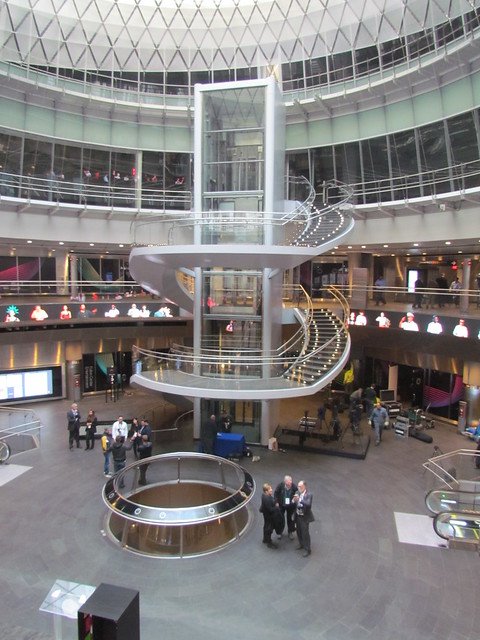
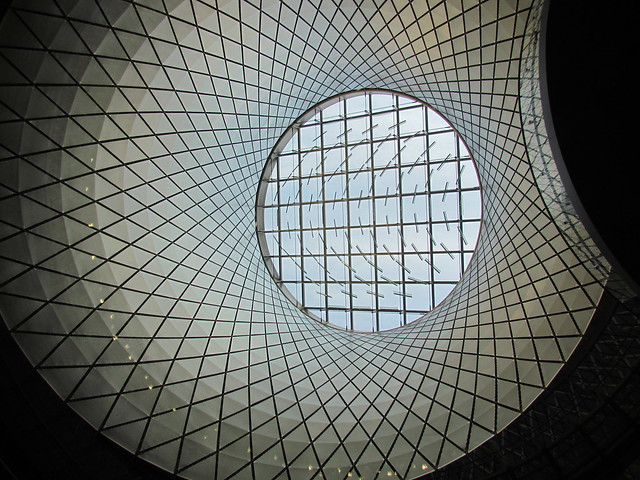
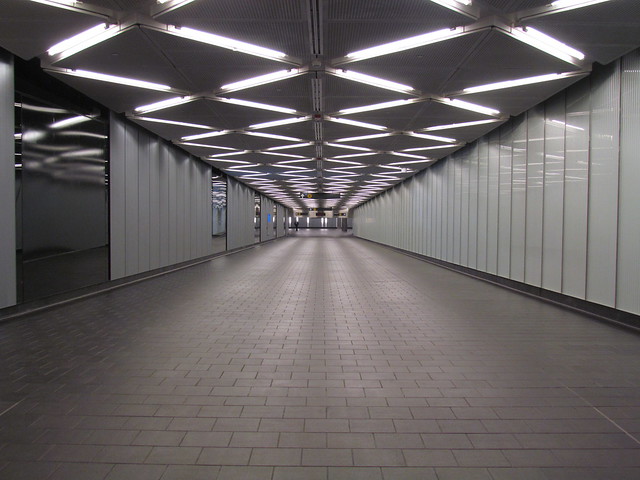
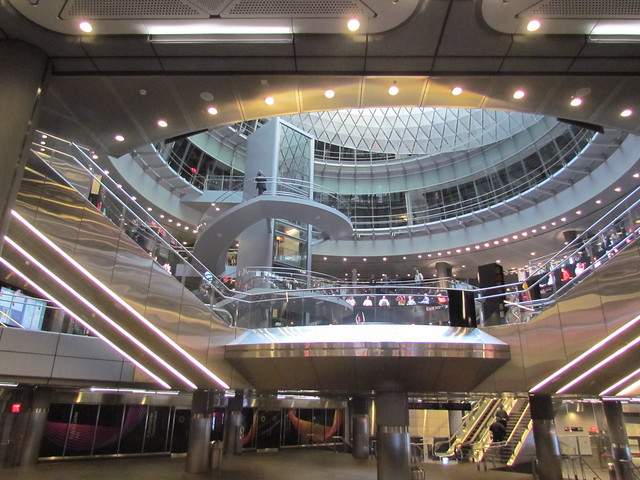
Scenes from above the construction at the Fulton St. Transit Center. (Photos by Peter Kaufman/Ink Lake Blog)
Charitably, the MTA is three years away from wrapping up construction at the Fulton St. Transit Center complex, and as the agency moves ahead with the work at a fairly brisk pace, weekend travel into and out of Brooklyn gets snarled at the new hub. This week, as a lead-in to our service advisories, we have some good stuff out of the construction site.
First, we have some pictures of the Hub. Peter Kaufman of the Ink Lake Blog works above the construction site and has been snapping some pictures as work crews raise a building there. The three thumbnails open larger versions in new windows, and the building is slowly coming together. I look forward to watching the progress via Peter’s camera, and I thank him for the photos.
Underground, things are about to get very, very messy. The MTA is on the verge of replacing a ramp and two staircases that connect the lower-level Broadway/Nassau St. stop with the rest of the complex. Per the press release:
In this current phase of construction, the AC mezzanine, a ramp and two staircases will be removed and replaced over the course of two weekends: January 9-11 and January 16-18. In addition, other subway work taking place on those weekends will affect travel in Lower Manhattan and Brooklyn. Effective Monday, January 18, a new temporary stair will replace the ramp that connects AC trains to the uptown 45 trains.
Also, the remaining platform stairs will each lead to a specific transfer or street exit. Riders are encouraged to consult way-finding signs and brochures that are available at station booths in midtown and lower Manhattan and downtown Brooklyn. Transit personnel will be on hand both weekends and on Monday, January 18 and Tuesday, January 19, to help direct customers.
One of the aforementioned brochures — detailing the various weekend work and its impact on those traveling through Fulton St. — is available here as a PDF.
To get users through the mess of service advisories, Transit has produced what they call a Life Sized Map of the change. These maps — three feet by four feet — are hanging up stations along the IRT lines that are affected by the Fulton St. work, and they help visualize the various reroutings plaguing popular subway lines. Riders, says Transit, are more apt to notice these maps than they are the oft-ignored service advisory signs that decorate subway stations every weekend. The LSM is embedded below, and you can click on it for a larger image. After the map — and the jump — this weekend’s service changes.
For the rest of this weekend’s service advisories, click here.
After four years, a northbound platform opens at Cortlandt St.
Posted by: | CommentsThe street-level entrance on the newly-reopened northbound platform at the BMT Broadway’s Cortlandt St. station. (Photo by Benjamin Kabak)
When the Twin Towers fell on Sept. 11, two subways around Lower Manhattan were badly damaged, but the MTA sprung into gear. Although both Cortlandt St. stops were destroyed, the station along the R/W and the 1 line south of Chambers St. — but not its Cortlandt St. station — reopened for service on Sept. 15, 2002. In 2005, though, the R/W station was again shuttered, this time to make way for various projects around Ground Zero.
On Wednesday, one platform at Cortlandt St. on the BMT Broadway line — the R/W station right near Century 21 — reopened. Although the southbound platform will remain closed until Sept. 11, 2011 to allow for Port Authority construction of their PATH train hub, the northbound platform — sans the Fulton St. Transit Center’s Dey St. connection — is in service for the first time in four years.
“Today we celebrate a significant step forward in the rebuilding of Lower Manhattan,” MTA CEO and Chairman Jay Walder said at Wednesday’s ribbon-cutting ceremony. “The MTA has played a key role in the revival of Downtown and we’re excited to provide customers with an improved station just in time for the holidays. The opening re-establishes a key travel link for Lower Manhattan residents, commuters, shoppers and tourists.”
The new station isn’t a radical departure from the past as the new South Ferry is. Rather, Cortlandt St. features some basic improvements. The station, which used to service approximately 15,000 passengers a day, has wider staircases and platforms. The walls have been retiled, and the station is sporting a fresh coat of paint.
“The opening of the northbound platform signifies an important milestone towards the completion of the Fulton Street Transit Center Project,” Michael Horodniceanu, president of MTA Capital Construction, said. “This is an important day for the community and we will continue this great momentum so that customers enjoy additional benefits as each element of the project is completed.”
As MTA officials and New York politicians gathered yesterday to celebrate the reopening, the station though remains dominated by blue construction walls. The southbound side is now fully encased behind blue construction walls, and what will eventually be the Dey St. Connector to the rest of the Fulton St. complex will not open until 2012. Still, politicians praised the gradual debut of pieces of the new Fulton St. Transit Center.
“Today’s reopening of the uptown platform of the Cortlandt Street subway station is another step toward repairing the damage inflicted by the September 11th terrorist attacks,” Manhattan Borough President Scott Stringer. “Projects like the Dey Street passageway, which the Cortlandt Street subway station was closed to make way for, are making Lower Manhattan an even more attractive place to live and work, and will draw families and businesses in the process.”
With renderings of the Dey St. passageway and eventual Fulton St. hub decorating the station, the Cortland St. platform is a welcome readdition to the Lower Manhattan transit picture. Slowly, slowly, progress builds apace.
Click through for a slideshow from the new station. Read More→
Northbound Cortlandt St. platform reopens today
Posted by: | CommentsAt 2 p.m. this afternoon, MTA officials and New York politicians were gather at Cortlandt St. for a ribbon-cutting ceremony to celebrate the reopening of the northbound Cortland St. platform. For the first time since August 2005, Queens-bound R/W trains on the BMT Broadway line will stop at the Cortlandt St. station. Unfortunately, due to prior plans, I won’t be able to make the ceremony at which MTA Chairman and CEO Jay H. Walder, Congressman Jerrold Nadler, Assembly Speaker Sheldon Silver, State Senator Dan Squadron, Manhattan Borough President Scott Stringer and Councilman Alan Gerson will appear. I do, however, hope to snap some pictures of the renovated station later today. The southbound platform will remain closed until at least early 2011.
Cortlandt St. nearly ready
Posted by: | Comments
Wet Paint signs portend an impending opening. (Photo by Matthew Denker)
Last night, on my way back to Brooklyn via an N local train, we slowly rolled past Cortlandt St., and I noted how the station no longer resembled a construction site. At least on the northbound platform, everything is nearly in place. The turnstiles and fences have been installed; the MetroCard Vending Machines are in place; the token booth is back.
According to MTA documents, the northbound platform itself will reopen in December, but the Dey St. connector won’t open until 2012. This morning, Matthew Denker sent me the above photo, and although wooden fencing still blocks the new staircase, the construction sheds no longer cover the station entrance. Transit is clearly gearing up for a reopening.
Shuttered since 2005 and a short walk from both the Rector St. and City Hall stops along the BMT Broadway line, the four-year absence of this station hasn’t been as bad for the area as it could have been. Lower Manhattan workers and residents and Century 21 shoppers, though, will be happy to see it reopen. I wonder, ifthe Dey St. passageway and the out-of-system connection to the Fulton St. subways will be featured on the sign in two or three years. Slowly, slowly, the pieces of the Fulton St. Hub are opening up.
With money in place, Fulton Hub progressing apace
Posted by: | Comments
Over the last three years, I’ve rarely had the opportunity to post good news about the Fulton St. Transit Center. Originally set to be completed two years ago but now planned for 2014, the massive Lower Manhattan project is now seven years and 100 percent over budget. Yet, earlier this year, when MTA Capital Construction President Michael Horodniceanu promised an on-time completion date, I believed him.
Those comments from Horodniceanu came four months ago. Although there is still plenty of time for the project to yet again fall behind schedule, the latest dispatches from the MTA present us with a glimmer of hope. The MTA earlier this week told Community Board 1 that the Transit Center is still on time, and with stimulus funds supporting the project, it is in fact humming along quite nicely.
“We’re doing very well in terms of progress on the construction,” Uday Durg, the MTA’s project manager, said this week. “We have the funding for those projects and we’d like to use the current market conditions to get them built as quick as we can.”
Matt Dunning from The Tribeca Trib had more:
Often touted as the “Grand Central Station of Lower Manhattan,” the new Fulton Street Station will be partially funded by $424 million in federal stimulus money, a little less than 40 percent of the $1.1 billion grant that the agency was first promised from the federal government. A year prior, it was revealed that the original price tag of $755 million had almost doubled. Without the federal money, the station’s unique oculus design would have been scrapped.
Since the money was delivered in August, Durg said the agency was able to finalize several contracts earlier than expected, including deals for construction of a new mezzanine and elevators for the A/C and J/M/Z platforms, as well as new entrances to the station on Williams and Dey Streets. Those projects are expected to be complete between May 2011 and March 2013.
Crews will finish later this year pouring the foundation for the new station’s vaunted main concourse, which will encompass a balcony of retail stores and restaurants and topped with an angled, cone-shaped dome to allow natural light to reach even the lowest levels of the complex. The next part of the station to be returned to everyday service, Durg said, would be the northbound platform of the Cortlandt Street R/W station, closed in 2005 due to work on the adjacent World Trade Center site.
While the cost of this project is questionable considering its final utility — after all, does Lower Manhattan really need Grand Central without an airport connection? — this development is definitely good news for a delay-plagued project. Barring any unforeseen troubles, the MTA should be able to wrap up the Fulton St. Transit Center by 2014.
At some point, Jay Walder should tell us what exactly went wrong here. This hub should have been finished two years ago, and now we’re celebrating the news that it’s still on pace to open in four years. For now, though, we’ll just recognize that Horodniceanu is sticking to his word. If he can keep this up for a few more years, perhaps the MTA really can turn over a new capital construction leaf.
A Transit Hub kinda, sorta grows at Fulton St.
Posted by: | CommentsWith the MTA still doesn’t know what the Fulton St. Transit Hub will look like or exactly when it will open, something is happening at the long-vacant lot at the corner of Fulton St. and Broadway. As a Curbed tipster reported today to the real estate blog, work crews are “beyond the digging and they are now laying beams to form the foundation.” Curbed has some pictures of the site. Meanwhile, we’ll just keep remembering how this project is now seven years late and 100 percent over budget. Ouch.
Fulton St. costs rising after legal ruling
Posted by: | Comments
The tortured history of the Fulton St. Hub is one we know quite well. Nearly seven years behind schedule and 100 percent over budget, this project aimed at revitalizing Lower Manhattan has become a symbol of the MTA’s construction problems. Recently, the MTA faced another economic setback as a New York State Supreme Court judge ruled that the agency owes displaced real estate owners another $40 million.
While I first saw this write-up in the Post, GlobeSt.com has a more thorough story. In a ruling issued late last month, State Justice Walter Tolub told the MTA that it will have to up its valuation of three Lower Manhattan parcels seized as part of the Fulton St. Transit Center project. The MTA had priced them as individual parcels, but the judge is considering them to be an assemblage with a higher price tag. Paul Bubny has more:
“The highest, best and most profitable use of the properties would have resulted in the construction of residential rental and condominium development, with ground and second floor retail development,” Tolub wrote in his August 28 ruling. Given that, “there is simply no question” that the three northernmost parcels along lower Broadway between Fulton and John streets “would have constituted an assemblage, and that the parties would have entered into a zoning lot merger, transferring the development rights. These lots were, for all intents and purposes, under common ownership and control.”
That common ownership of the four properties on these parcels came from the Reformed Protestant Church of the City of New York, the fee owners of 192, 198 and 204-210 Broadway; and from Brookfield Properties, which entered into a joint venture with the church on ownership of 200 Broadway. Brookfield and the church had discussed an assemblage of these parcels well before the MTA’s eminent domain seizure of the properties in March 2006, Tolub wrote. All have since been demolished.
According to Tolub’s ruling, the church had also been in active negotiations with the Riese Organization, which owned 194 Broadway, for developmental rights prior to the MTA’s taking the property. Based on comparable sales that took place in early 2006, Tolub ordered the MTA to pay the Rieses $35.2 million for 194 Broadway, and to pay the church and Brookfield a total of $106.5 million for the four other properties.
In a statement to me about the ruling, the MTA expressed its plans to file an appeal. “The MTA disagrees with the court’s valuation of property required by the MTA to complete the Fulton Street Transit Center and intends to appeal the decision,” the statement said.
Despite this legal setback and the potential for a higher price tag, the Fulton St. plans are not in fiscal jeopardy. “The project’s budget and the proposed 2010-2014 capital program include reserves for contingencies, which, if necessary, would cover these increased valuation costs,” the MTA said.
Attorneys for the victorious plaintiffs said they would seek fees and other expenses from the MTA as the case heads to an appeal. I certainly hope this transit center is worth it in the end.
Firming up the Fulton St. schedule
Posted by: | Comments
Last months, after the Doomsday winds died down the MTA could look toward a steadier short-term future, Capital Construction President Micheal Horodniceanu issued an aggressively bold schedule for the oft-delayed Fulton St. Hub. He guaranteed a 2014 completion date for the project now nearly 100 percent over budget. “What I present today, I stand by. I expect you to hold me accountable to it,” he said nearly three weeks ago.
Earlier this week, at the Community Board 1 meeting, Horodniceanu repeated his claims. While the project should have been wrapped up two years ago, it will open on schedule in 2014. “We’re back on track,” he said. “By the time we’re done, you’re going to have one of the most elegant stations in the system.”
Matt Dunning of The Tribeca Trib, a Lower Manhattan community paper, had more from the meeting:
Speaking before Community Board 1’s World Trade Center Redevelopment Committee on June 8, Horodniceanu said most of the planned improvements to the station would be finished by the end of 2012. “This is by no means one project,” he said. “What you’re going to see is a progressive roll-out of customer benefits as we go along. The important part is that we’ve reached a consensus on cost and schedule.”
Two pieces of the massive station reconstruction are already finished. The agency unveiled an improved 2/3 platform in 2006, and a new entrance to the 4/5 Train on the east side of Broadway at Maiden Lane in 2007. Horodniceanu said he expected the northbound platform of the Cortlandt Street R/W station—closed in 2005 due to construction on the World Trade Center site—to reopen in December 2009.
More improvements to the station, including a new William Street entrance and easier connection between the A/C and 4/5 Trains, would be complete in 2011, Horodniceanu said. The new Dey Street entrance and concourse that will eventually connect the station to the World Trade Center Transportation Hub, as well as a rehabilitated 4/5 platform would be done 2012…
The new transit center is designed to, piece by piece, replace the labyrinth of ramps and stairways that make up the current Fulton Street station. A balcony of retail stores will encircle the main concourse of the new station, one level below the street at Broadway and Fulton, with direct access to the 4/5 Train platforms. The A/C platforms and the Dey Street concourse will be on the level below. The main concourse will be housed in a four-story, glass-and-steel “head house” topped with an angled, cone-shaped dome to allow natural light to reach even the lowest levels of the complex.
For now, we are left with construction updates. MTA officials warn that the agency won’t begin award retail licenses for another three years despite interested tenants, and considering the pace of the project so far, this schedule remains ambitious.
With much of the money, however, coming from the federal government, I believe this project has reached a tipping point. The funds are there, and the political pressure will be on the MTA to get it built. For now, I have to remain cautiously optimistic, but when word of a delay or budget problems come down, I won’t be surprised.
For Fulton St., a deadline and budget but no dome
Posted by: | Comments
Will this be the final look for the Fulton St. Transit Center? Stay tuned.
The Fulton St. complex is a mess right now. The Cortlandt St. station on the BMT Broadway (N/R/W) line has been closed for nearly three years as work has progressed at a snail’s pace, and the Transit Center hub, originally scheduled for completion two years ago, has been delayed seemingly forever.
Yesterday, though, during the MTA Board’s Real Estate, Planning and Capital Construction Committee meeting, Capital Construction president Michael Horodniceanu proclaimed a firm deadline and a budget for Fulton St. According to Horodniceanu, construction on the complex will wrap up in 2014. The total cost will come in at $1.4 billion or twice its original projected cost. And the Transit Center’s dome — subject to much will it or won’t it debate — will be, well, something distinctive.
In a bold move, Horodniceanu guaranteed an on-time — at least for 2014 — delivery of the project. He first proclaimed the original 2007 deadline, set ten years ago when the MTA first broke ground at Fulton St., “totally unrealistic” and then said, “What I present today, I stand by. I expect you to hold me accountable to it.”
According to the plans presented yesterday, the Transit Center will still sit under a three-story building with 25,000-square feet for retail. The MTA has, however, scraped plans for a glass dome. For now, officials are simply promising something that will let in natural light to fill the glass-enclosed building. As expected, the dome was shelved because of costs.
Originally projected to run $750 million, the Hub will come in at $1.4 billion. The MTA has the money though for the project. Of the total, the original federal grant will cover $847 million, the MTA will kick in $129 million of its own money and stimulus dollars will cover the final $424 million.
Despite these above-ground concerns, though, work has continued underground, and the MTA set a series of deadlines for the complex. Looking ahead, riders on the A and C lines at Broadway/Nassau St. can expect 40 months of construction with service delays on nights and weekend.
Downtown Express, linked above, runs through a series of future deadlines: The Cortlandt St. station’s northbound platform will open in December with the southbound side closed until 2011. A new entrance on William St will open in 2011 as well. In 2012, the Dey St. entrance will open and the 4/5 station will get an overhaul. The work on the A/C mezzanine won’t wrap up until the spring of 2013.
I’m almost tempted to say, “So that’s that for the Fulton St. Hub,” but it’s not nearly that simple. The MTA has yet to choose a design for the top of its glass station house, and while that part of the project will be the proverbial icing on the cake in terms of projected completion dates, architectural decisions are never easy.
So the clock is ticking. Who knows how long Horodniceanu has as the head of Capital Construction? He’s been far more willing than prior heads to take public responsibility for missed deadlines and delayed projects and should, when the MTA rescue package dust settles, retain his position. He has five years to deliver a project that should be opening this year. He has $1.4 billion with which to work. The race is on.
To grasp the true scope of the bureaucratic mess surrounding the project, read back through the topic’s archives. For images of what the Hub and Transit Center will look like sans oculus, mosey on over to the Lee Harris Pomeroy page with some architectural renderings.
Fulton St. Hub rescued by stimulus billions
Posted by: | Comments
The dome has been saved! Long live the dome!
Rejoice, all ye Lower Manhattanites! The Dome of Fulton Street has been saved by stimulus cash heading the MTA’s way straight from Congress.
Finally, after an eternity of delays, hundreds of millions in cost overruns and 15 months of “we’ll decide next month,” the MTA can finally see a very faint glimmer of light at the end of the Fulton St. tunnel. To think, just three days ago, I was bemoaning the fact that this project will be well over half a decade late if it ever gets completed. It’s still going to wrap up late, but at least, there’s money for it again.
Anyway, joyous sarcasm aside, this is good news for the MTA. According to the agency’s CEO and Executive Director Elliot Sander, New York’s transit authority stands to gain between $1.5-$2 billion from the stimulus, and $500 million of that will head to Fulton St. Nearly William Neuman has the story:
The Metropolitan Transportation Authority expects to spend $497 million in federal economic stimulus money to complete the stalled and over-budget Fulton Street Transit Center in Lower Manhattan, the agency’s executive director said on Thursday. The money would bring the project’s cost to as much as $1.4 billion, nearly double what was estimated when it was conceived in the wake of the terror attack of Sept. 11, 2001.
The additional financing would allow the authority to move ahead with plans to erect an architecturally dramatic glass building atop the transit hub, said Elliot G. Sander, the authority’s executive director. However, it was not clear if the final design would include the project’s signature feature, a conelike skylight, known as an oculus, that would channel daylight into the lower areas of the station. Mr. Sander said the oculus could add about $40 million to the cost.
“The pavilion has to be many things to many people,” Mr. Sander said, referring to the glass structure. “It has to be a building of vibrant design with as much new retail activity as possible.” He called it “a highly visible portal to a modern transportation complex.”
Originally, this project was slated for a completion date around now and a budget of $750 million. It will far exceed those expectations and not in a good way.
Meanwhile, we have to consider a few things — political and planning — to this announcement. First, Sander issued it while testifying before Assembly Speaker Sheldon Silver. The Man who Killed Congestion Pricing again holds the keys to the MTA’s financial future. If he can shepherd a strong bailout plan through the Assembly, there’s hope yet. In return, Silver, long an ardent supporter of the Transit Hub at Fulton St., will finally get that hub. It’s a political tit for tat.
But on the other hand, I’m a little skeptical of this is a good use of stimulus money. While this money cannot go to operation budgets, couldn’t the MTA use $2 billion for the Second Ave. Subway? It is, after all, arguably a more important piece of the city’s future than a ritzy hub on Fulton St. Sure, they had to build something. Sure, they had to placate Silver. But that’s one expensive political bribe at the cost of better projects.
Either way, though, I can’t complain too much. This is an infusion of some much-needed cash to get a long-delayed project off the ground, and that’s good transit news.