Archive for Moynihan Station
City Planning calls for 15 more years for MSG
Posted by: | Comments
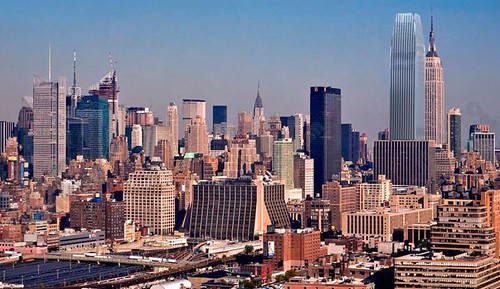
Moving MSG is a key to increasing Manhattan’s rail throughput. (Photo by flickr user [mementosis])
As the movement to reimagine and replan Midtown West takes shape and calls for some solutions to the Penn Station morass grow, the Department of City Planning is considering limiting the renewal term on Madison Square Garden’s occupancy permit to 15 years. The move — not without controversy — comes after a recommendation of 10 years from the Community Board and a request of an unlimited term from the Garden’s owners. A 15-year term would force the city to confront the problems of Penn Station before the end of the 2020s.
“While Madison Square Garden maintains that the arena special permit should continue in perpetuity, we believe the term is warranted due to the uniqueness of the site and the importance of Penn Station to the city,” Amanda Burden, director of City Planning Department and chair of the City Planning Commission, said.
Matt Chaban of Crain’s New York broke the story following the vote this morning, and his reporting provides some context on the next steps:
It’s been nearly a decade since efforts to move the Garden surfaced. Early talks involved city, state and federal governments, the three railroads that use the station, two developers and the Dolan family, which controls the Garden. Under that plan, the Garden would have moved across Eighth Avenue into the old Farley Post Office. It fell apart in 2008 under bureaucratic inertia and the wreckage of the real estate bubble. “We are recommending today that the commission call for a renewed, multiagency initiative to improve Penn Station,” Ms. Burden said.
Her notion of a 15-year permit drew vocal support from fellow commissioners, who will officially vote on the plan later in May. “I think 15 years, in my view, was a good decision and the minimum of what we could do because 10 years is too short and does not give the Garden enough to relocate,” said Commissioner Angela Battaglia, who had been skeptical of a limited term during past commission hearings…
Manhattan Commissioner Anna Levin reiterated the need to use the permit to jump-start the negotiations around the arena. “I’m fully in support of the general direction of the 15-year permit,” she said. “But we’ve got to rally the troops to get this to happen. It goes beyond these walls.”
Should a deal fall through, the special permit calls for a commission to reassess the area around the arena, perhaps creating more entrances on the plaza surrounding the Garden. The arena would not be responsible for such changes, but it would have to make way for them. “If such a plan does not come to fruition, making improvements to the station with Madison Square Garden at its current location will become critical to the future of Penn Station,” Ms. Burden said.
Various stakeholders expressed varying degrees of acceptance. The Municipal Art Society, which is seemingly more concerned with a great public space than a train station that can meet demand, still hopes for a 10-year permit while Madison Square Garden lashed out at the Commission’s decision. “Adding an arbitrary expiration for reasons unrelated to the special permit process or requirements would not only set a dangerous and questionable precedent, but would also hinder our ability to make MSG and New York City the long-term home of even more world-class events, and would harm a business that has served as a significant economic driver for the city for generations,” the arena’s owners said in a statement.
If the late-May vote upholds the 15-year permit and if the City Council does as well, the next decade and a half becomes a critical one for the region’s rail infrastructure. As I’ve mentioned a few times this year, the fight over MSG and, subsequently, Penn Station should not be about the above-ground elements. We can’t resurrect the old Penn Station, and we shouldn’t be sinking billions of dollars into a station house as we are with PATH at the World Trade Center site.
Rather, as Scott Stringer carefully elaborated, Madison Square Garden’s future must be tied to underground improvements. We need more track capacity, bigger platforms and a train station not interrupted by support columns that hinder passenger flow. MSG, already one of the country’s oldest arenas, has moved in the past, and it can move again if better transit connections warrant it.
Today’s announcement is the first real salvo in this fight, and the permit has clear a few hurdles before becoming law. Then, the battle of form vs. function over Penn Station will start to play out as well. For now, though, the move is a welcome one if we are to expand rail access into Manhattan, and the City Council should follow suit.
Stringer: Give MSG ten more years, but then …
Posted by: | Comments
The World’s Most Famous Obstacle to Penn Station Expansion, as seen from above. (Photo by flickr user [mementosis])
Madison Square Garden in its current form should be granted only a ten-year operating permit, and New York City must develop a comprehensive plan to redevelop Penn Station, Manhattan Borough President Scott Stringer said today. As the World’s Most Famous Arena’s ULURP application winds its way through the torturous seven-month review processed, Stringer’s office released a non-binding, 18-page report calling upon New York to get serious about improving Penn Station both at ground level and underground.
While I’ve been skeptical of the architectural arguments against MSG, Stringer’s report strikes the perfect middle ground between the aesthetics — or lack thereof — of Penn Station and the need to do a serious assessment of rail capacity and the region’s future transportation demands. “It is time to build a more spacious, attractive and efficient station that will further encourage transit use, reduce driving into the city and spur economic growth throughout our city and our region,” Stringer said. Borough President said. “While we need to ensure the Garden always has a vibrant and accessible home in Manhattan, moving the arena is an important first step to improving Penn Station.”
The Penn Station problem, as I’ve written lately, is often tough to discern in media coverage. Some prominent city historians and architectural critics have grown too obsessed with rectifying a 50-year wrong. They want to promote the Moynihan Station venture as penance for Penn Central’s decision to tear down the Beaux Arts Penn Station, and they want to move Madison Square Garden to build something that looks majestic. That solution doesn’t address the fundamental problem: Penn Station rail capacity is maxed out. The platforms are too narrow, and the trans-Hudson rail tubes are too few. How can a new MSG and a new Penn Station improve rail capacity into and through New York City?
To that end, Stringer has an answer, and he lays it out in the ULURP recommendation [pdf]. Noting that both Moynihan Station and the Penn Visioning plan do not “go[] far enough, nor address[] the physical constraint of the Garden on meaningful improvements to Penn Station,” Stringer first calls for improvements at the track level. Amtrak’s Gateway Tunnel will work, he says, only if platforms are wider, and to widen platforms, MSG and its support columns must go. “While moving Madison Square Garden,” he writes, “would potentially lead to a new, modern head house serving as a grand gateway into New York City, the true benefits in moving the arena would be increased below-grade flexibility that would allow for efficient track design.”
Thus, says Stringer, it’s time to develop a master plan for area. Involving all stakeholders — MSG, the city, the state, the feds, the MTA, New Jersey Transit, Amtrak, area business — will be a challenge, but the future economic development of the Midtown area and the city on the whole depend on it. “Master plans for regional and mass transit improvements can take years, sometimes decades, to implement,” Stringer says. “The city must begin to create a master plan now and not wait until the system is so congested as to be broken.”
Of course, we can embrace Stringer’s call for action readily, but what of the other stakeholders? Madison Square Garden has, at various points over the past decade, endorsed plans to move the arena, but recently, its owners spent around $1 billion in arena upgrades. A ten-year occupancy permit coming on the heels of a 50-year lease isn’t quite what they had in mind, and already we can see the signs of a brewing battle. Here’s their statement:
“Virtually all special permits are granted without artificial expirations. In addition to this, MSG meets all required findings for this permit and operates in a city where no sports arena or stadium has a time limit to its use. Given these circumstances, we have the reasonable expectation that we will be treated like every other applicant. Yet the Garden – a company that has recently invested nearly $1 billion in its Arena and helps drive the city’s economy by supporting thousands of jobs and attracting hundreds of annual events– is being unfairly singled out because of a decision that was made 50 years ago – to demolish the original Penn Station. Adding an arbitrary expiration for reasons unrelated to the special permit process or requirements would not only set a dangerous and questionable precedent, but would also hinder our ability to make MSG and New York City the long-term home of even more world-class events, and would harm a business that has served as a significant economic driver for the City for generations.”
There’s more than a kernel of truth in this statement especially surrounding the issues with the demolition of Penn Station. But while Madison Square Garden’s location makes it a very transit-friendly arena, there is no denying that it will inhibit rail infrastructure expansion and transit growth. Something may have to give, and Penn Station’s expansion is more important than the Garden’s maintaining its current spot.
So what’s next? Community Boards 4 and 5 have both endorsed a ten-year permit, and Stringer’s office has as well. None of these recommendations are binding, though, and the ULURP process next lands on the tables of the City Planning Commission before facing City Council. MSG will put on a full-court press before a ten-year permit becomes officials, but the end of MSG may be inevitable. Stringer’s recommendations provide a clear course forward, and they should be endorsed and adopted by the city while the team is right.
Once more unto the Penn Station breach
Posted by: | Comments
According to some critics, this is the ugliest rail station in history. Photo: Metropolitan Transportation Authority / Aaron Donovan
Earlier this week, I railed against the New York’s attempts at using the WTC PATH Hub as some great symbol of New York. It may one day be a distinctive building, but $4 billion can buy around half a new Hudson River train tunnel. As the pot for transit infrastructure is seemingly limited and dollars for buildings compete with dollars for actual rail expansion, we shouldn’t be spending money frivolously on fancy building when the area’s economy truly needs transit capacity improvements.
At this point, though, Calatrava’s hub is a foregone conclusion. Too much of it exists for the city to reallocate the money to somewhere more deserving, and it will open in a few years, replacing a temporary PATH terminal no one has ever called inadequate. A few miles uptown, though, a similar battle over Penn Station, Madison Square Garden and the future of West Side rail access is brewing.
I last tackled this topic not too long ago. In mid-February, the controversy over Madison Square Garden’s occupancy permit first reared its head, and I opined on the meaning of Penn Station. A subset of New York’s architectural community cannot seem to move beyond the reality that the current Penn Station is no great shakes. They bemoan decisions made 50 years ago and call upon leaders to reimagine a rail hub as a great public space worthy of the architectural musings of The Times.
Now, as then, Michael Kimmelman has taken charge, and from the headline on down, his latest piece prioritizes Penn Station’s future potential appearance over rail access and capacity. “Seizing a chance to right a wrong” is his angle, and from that alone, we see he’s talking not about improving transit but rather about improving the outward appearance of Penn Station.
“New York is at a crossroads,” he writes in the lede. “After half a century a fleeting opportunity has finally arrived to address the disaster of Penn Station, the nation’s busiest and most appalling transit hub, and to reimagine a new West Side for Midtown Manhattan that could be a center for development and innovation.”
Hello, hyperbole.
How goes the rest?
Because public officials haven’t wanted to derail Moynihan, they have soft-pedaled the figures, leaving many New Yorkers with the illusion that Moynihan will replace Penn Station and solve its problems. But just Amtrak will move there, not the Long Island Rail Road and New Jersey Transit. At the same time demands on Penn Station are about to explode, with the development of the Hudson Yards and the third phase of the High Line; the prospect of Metro North’s trains and its commuters coming into Penn Station after the completion of East Side Access; and Amtrak’s proposed Gateway Project, a first step toward high-speed rail, which could double the number of Amtrak and New Jersey Transit trains coming into Manhattan.
It’s not only that Penn Station, designed a half-century ago in a declining city for what seemed then an unlikely capacity of 200,000 passengers a day, is now handling more than twice that number. It is also a shabby, hopelessly confusing entry point to New York, a daily public shame on the city. The station fails to conform to certain fire codes and safety regulations, local officials concede. Possible fixes being explored by Amtrak, New Jersey Transit and the Long Island Rail Road, which have hired the consulting firm Aecom, don’t address the big, systemic problems, because they can’t. Not with the Garden there.
But here’s the bright side. Madison Square Garden has moved twice since its inception in 1879, and its present building is its fourth. Yes, the Dolans and their customers benefit from the perch above Penn Station. But there are options aside from the Morgan building to which the Garden might move again, options linked to mass transit, that should be attractive to its owners and fans.
At a certain point, I’ve almost begun to feel bad for Penn Station. It’s certainly not the most scenic of train stations, and as an entry point in the city, it sure pales in comparison with Grand Central. But the scorn heaped upon it stems more from the mistakes of city politicians who didn’t stop private railroad companies from bulldozing McKim, Mead & White’s original than from anything else. True concerns over capacity and cramped quarters could be addressed by removing Amtrak’s office space and opening up the corridors. Worries over crowd conditions and the ability of the hub to handle demand could be allayed with investment in a new trans-Hudson tunnel. A fancy building should always come last.
But here we are in 2013 and fancy buildings come first. We put the transit design cart before the capacity horse, and all we have to show for it is a $4 billion porcupine in Lower Manhattan and prominent voices agitating for a takeover of the Farley Post Office. Let’s take those billions of dollars we spend on architecture and invest in rail. Future generations of New Yorkers will be far more thankful for the added rail lines than for a nice building.
What we talk about when we talk about Penn Station
Posted by: | Comments
Even empty as it was before Sandy, Penn Station won’t win any beauty contests. Photo: Metropolitan Transportation Authority / Aaron Donovan
New York City and its residents have had a long and torturous relationship with Penn Station, both new and old. The destruction of the original McKim, Mead & White head house spurred the start of the preservation movement, and architectural critics and transit planners haven’t been too sure what to make of the current iteration. Today, as we face capacity concerns that would have bedeviled the original Penn Station decades ago, halting efforts to reconstruct and reconfigure the Amtrak, LIRR and NJ Transit hub have drawn no clear consensus.
The latest news concerning Penn Station is actually about its upstairs neighbor Madison Square Garden. The arena looms over Penn’s rail service both literally and figuratively, and right now, its short- and long-term future is up for debate. The arena’s special occupancy permit is up for renewal, and as the Dolan’s are asking for a perpetual permit, Community Board 5 members and some of the city’s urban planning critics are calling for a ten-year permit that would allow for Penn Station’s future and an arena relocation plan to work itself out.
“The 10-year renewal is an attempt to create a planning period to figure out another location for the Garden,” Raju Mann, head of CB5′s land use committee, said to DNA Info. “The reason we would like MSG to relocate is because the Garden sits atop Penn Station, which is North America’s most important train station, but is unfortunately woefully over capacity…The goal is to try to figure out how we can improve transportation and also build a great new arena.”
Now, it’s not an inherently bad thing that Madison Square Garden is atop Penn Station. It further incentivizes patrons to take transit instead of their cars and allows for easy access to and from events. Moving Penn Station west to the Hudson Yards area, as many have advocated, would inevitably lead to an uptick in automobile traffic along the West Side and a decrease in rail usage. (The 7 line extension, however, may mitigate some of the traffic concerns.)
In The Times today, Michael Kimmelman expands on this argument and comes out firmly against a perpetual permit. His defense is centered largely around the need for a larger and prettier Penn Station.
On their own New Jersey Transit, Long Island Rail Road and Amtrak have banded together to hire the design and engineering firm Aecom and James Carpenter Design Associates to devise ways to bring a little light and air down into the bowels of Penn Station. But so far the plans, hamstrung by the arena, seem only to recommend modest changes and perhaps the partial closing of 33rd Street at Seventh Avenue, to create a small pedestrian plaza. Serious change to the area, to heal one of most painful wounds the city has ever inflicted on itself, must involve the Garden.
Its owners, the Dolan family, have been pouring a billion dollars into upgrading the arena. New York taxpayers are effectively footing part of the bill. In 1982 the New York State Legislature, worried that the Knicks and Rangers might leave town, granted the Garden a tax abatement that last year alone saved the Dolans $16.5 million, according to the New York City Independent Budget Office. In 2008, by which time the abatement was estimated to have cost the city $300 million, the City Council recommended that it be ended, but the state legislature declined.
Penn Station was designed half a century ago when some 200,000 riders a day used it, but now 650,000 do, and that number is growing. With the Garden on top of it, relief is not likely. The City Planning Commission, which recommended the demolition in 1963 of the old Penn Station, now has, for the first time since then, a chance to atone by giving the permit a time limit. The permit that has just expired was for 50 years. Several years ago the Garden entertained a proposal by developers to vacate its site and move to the back of the post office. Having just spent a fortune on improvements, the Dolans probably have no desire to entertain a move now.
But a decade of wear and tear should help to amortize their investment and make the notion of a new home more palatable, especially compared with the endless prospect of sinking yet more millions into an already decrepit building. The Garden has already moved twice since its establishment, in 1879. Another move, one that sustains the arena’s mass-transit link, could provide an opportunity to build what the Garden should be, the newest and best sports and entertainment facility in the city: an architectural landmark as opposed to an eyesore, lately made to look even worse by the arrival of the spanking new and striking Barclays Center in Brooklyn.
The problem with any discussion around Penn Station is the way the dialogue is framed. Kimmelman’s line that any new Penn Station has to “heal one of most painful wounds the city has ever inflicted on itself” is tough to reconcile with transit planning. While Penn Station is ugly and dingy and, at best, utilitarian, the problem with the station isn’t necessarily the way it looks; the problems, rather, are the tunnel leading to it.
While Penn Station may require larger corridors and while we may want nicer views, some natural lighting and soaring ceilings, train capacity is far more important, and plans to move the Garden to the post office or to convert Penn Station into Moynihan Station across the street do little — if anything — to add train capacity. Instead, critics are arguing to spend billions on a new train station head house and more on a new arena because Penn Station is ugly.
To me, that’s not a solution to the real problem of transit capacity. Rather, it’s a solution to fixing something that went wrong fifty years ago. As a $4 billion train hub with no added capacity grows in Lower Manhattan, we should be more mindful of our approach to building transit-related structures. Let’s increase rail capacity before we drum up more plans to build something that looks nice at ground level.
Moynihan Phase 1 work to start later this year
Posted by: | Comments
New entrances into Penn Station will help alleviate dingy conditions at the rail hub.
When last we checked in on Moynihan Station, things were not looking good for the oft-delayed and rather expensive project. Phase 1 — essentially some wider concourses and more entrances — had to be scaled back amidst cost concerns when the bids on the project came in well above expectations. The Phase 2 work which includes the conversion of the post office building into the actual train station remains unfunded and a dream in the eyes of the project’s supporters.
Now, though, the Port Authority has some cause to celebrate. With a new price tag of $270 million, Phase 1 will kick off later this year, nearly two years after the ceremonial groundbreaking, Port Authority head Patrick Foye said yesterday. According to Reuters, Skanska’s $148 million bid to add street-level entrances at 31st and 33rd Sts. was the winning one. The different will go toward a new ventilation system and a mighty expensive underground walkway to Penn Station.
In comments yesterday, Foye spun this is a big step forward. Dana Rubinstein was on hand to report:
Foye, himself a Long Island Railroad commuter, said what has been a “fairly dingy” commuter experience would now “be fit for humans.”
…The project’s impact will be felt mainly by commuters. “It’s going to mean easier access to and from the tracks for Long Island Railroad commuters, New Jersey Transit and Amtrak,” said Foye. The authority was careful to present the project as Phase I of a two-part redevelopment that will culminate in the conversion of the Farley post office into an Amtrak terminal and retail center called Moynihan Station.
Though Related Companies and Vornado Realty Trust are still the designated developers for Phase II, the project is unfunded and generally considered, at the very least, dormant. Even so, Foye argued on Tuesday that the completion of this track work, which he called, “the concourse of the new railroad station, of the new Moynihan Station,” would help make the latter a reality.
“The way I’d say it would be that the commencement of construction here later this year is gonna send a message to the development community, to investors, to Related and to Vornado and frankly to the whole community that this project’s gonna happen,” said Foye, “And, we would expect that not only is it a precondition to Phase II and the redevelopment of this building, but that it’s commencement will accelerate those discussions and that investment.”
By itself, the Phase 1 project is a worthwhile one. Improving access into and out of Penn Station will go a long way toward easing the crush of commuters in this underground cavern. That the Port Authority worked to ensure bids came in at budget is a step in the right direction too.
As I’ve noted in the past though, the Moynihan Station plan — with a price tag ranging from $500 million to $1 billion — leaves much to be desired. It doesn’t increase track capacity through the city and represents a nice building for politicians and a lot of dollars spent on some cosmetic upgrades. If it’s a future key for high-speed rail, that’s an easier pill to swallow, but I still wonder about our infrastructure spending priorities at a time when funds are not freely flowing.
Moynihan Phase 1 scaled back amidst cost concerns
Posted by: | Comments
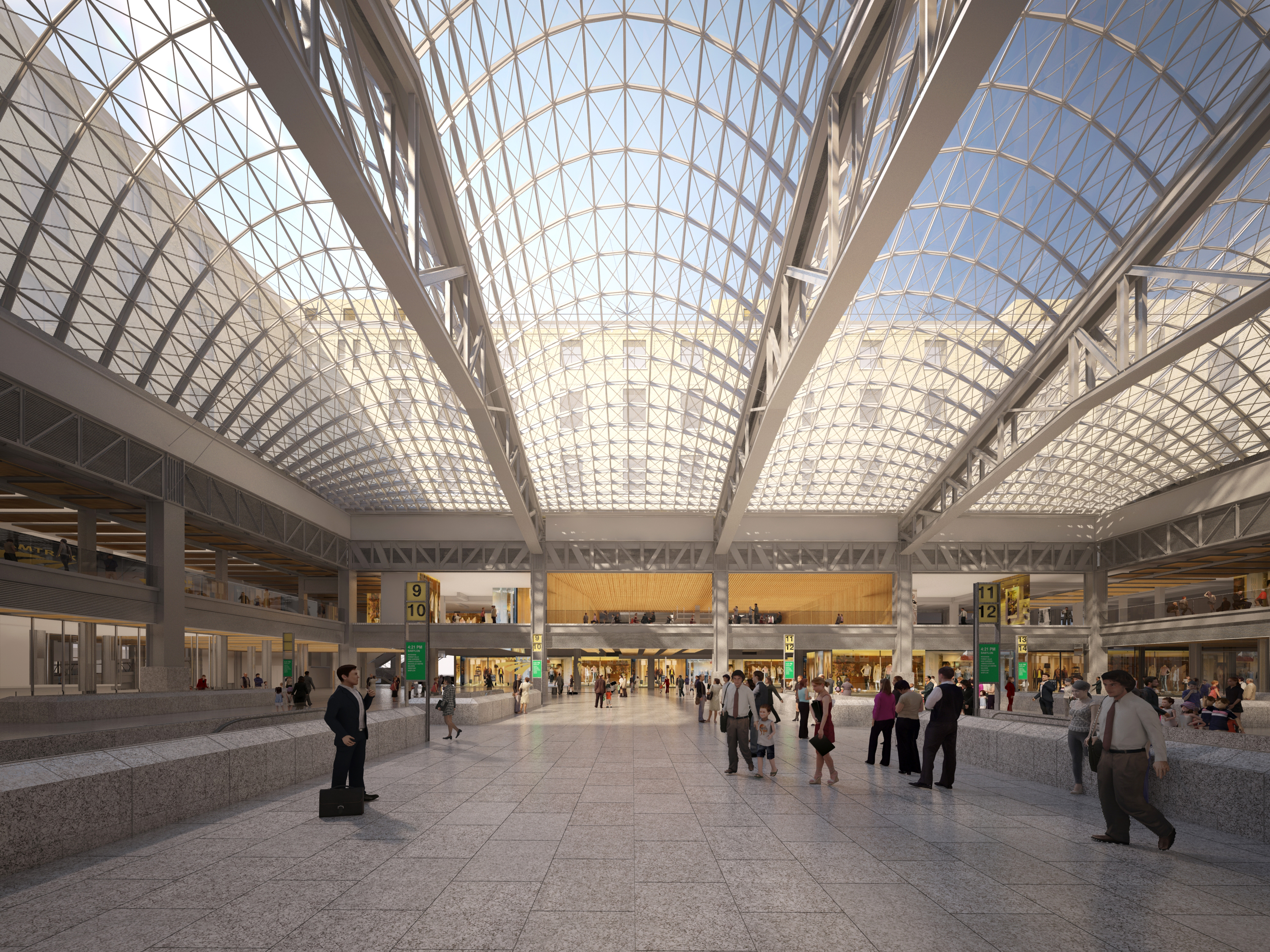
The chances of this Moynihan Station rendering becoming a reality are slim.
The Moynihan Station project won’t die and can’t really move forward either. Despite a TIGER grant and a groundbreaking in October 2010, the plan to spend more than a $1 billion without truly increasing cross-Hudson train capacity has hit a stumbling block. As The Wall Street Journal reports today, due to escalating costs, the already-modest Phase 1 is being further scaled back.
Phase 1 of the two-phase project was not a particularly ambitious set of improvements. For $267 million, the Port Authority, now the overseers of the site, had planned to build two new entrances to Penn Station from west of Eighth Ave.; double the length and width of the West End Concourse; drop 13 new access points to the platforms; double the width of the 33rd St. Connector between Penn Station and the West End Concourse; and make other critical infrastructure improvements. Now that bids are in on the work and every single one came in above budget, the PA is reducing the scope of Phase 1.
Ted Mann has the story:
State and federal officials wary about mounting costs plan to scale back the first segment of work for the future Moynihan Station, the latest setback for an ambitious project almost two decades in the making. Plans to revamp a concourse and upgrade passenger amenities in a portion of Penn Station were narrowed after officials determined that bids for the estimated $267 million project came in too high, said Patrick Foye, executive director of the Port Authority of New York and New Jersey, which is assuming control of the long-delayed venture…
“The response of the federal government, state government, MTA and Port Authority to the higher-than-expected bids is a unified approach to reduce the scope of phase one and thereby reduce the amount to be spent,” Mr. Foye said in an interview on Friday. “Phase one is funded and all government parties are working closely together to move phase one forward.”
…Mr. Foye said officials agreed to rebid the contract, focusing on the expansion of the existing West End Concourse, nestled beneath the main steps of the Farley building. Other elements of the first phase, including improvements to the 33rd Street corridor under Eighth Avenue, two new entrances to the station across Eighth Avenue and a new passenger waiting area, will follow once costs can be lowered, Mr. Foye said.
As I’ve long maintained, the Moynihan Station project borders on being a total waste. It’s a fancy way to fund some upgrades for the Amtrak platforms and ventilation infrastructure. It doesn’t offer up more track capacity into or out of the city, and it seems to represent spending on a structure that would allow politicians to point to something nice but not entirely functional. If these cost overruns and rejiggered project allow planners to take a second look at Moynihan Station, so much the better.
NY officials celebrate as Moynihan ‘Moves Forward’
Posted by: | Comments
A cutaway of Moynihan Station as seen from Penn Station.
The old Penn Station — that long-lost symbol of the city’s historic preservation movement — turns 100 this year. As City Room’s Michael Grynbaum meticulously detailed, the first passengers to ride the Pennsylvania Railroad passed through the doors of the famed building back in 1910, and while the city tore down the iconic building, today’s iteration is one of the busiest transit hubs in the nation. Yesterday, city and state officials used the Penn Station centennial to celebrate the groundbreaking for another project. Phase I of Moynihan Station, newly renamed Moynihan Moving Forward, is now, well, moving forward.
At 2 p.m. on Tuesday, Governor David A. Paterson, Senator Charles Schumer, Senator Kirsten Gillibrand, Congressman Jerrold Nadler, U.S. Transportation Secretary Ray LaHood, Mayor Michael R. Bloomberg — a veritable who’s who in New York politics — gathered to commemorate the start of the $267 million project. Just a few hours earlier, LaHood and Paterson had signed a grant agreement providing for $83 million in federal funding through the Department of Transportation’s TIGER program. Still, even as the back-patting spread in earnest, this project is far from complete and questions about both its usefulness and overall integration into the plans for the 34th St. area abound.
“This is an historic day for New York: not only the 100th Anniversary of Penn Station but also the birth of another,” Paterson said. “Today we break ground on one of New York’s most important transportation projects. While the size and scope of the project may have changed over the years, its goals have remained constant. This critical infrastructure project will create thousands of jobs for our construction workers and foster economic growth.”
While the state’s governor declined to mention the transportation benefits inherent in the project, Sen. Schumer, who led the effort to secure the TIGER grant, put them front and center during his remarks. “Moynihan Station is poised to be one of the greatest transportation and infrastructure legacies of our generation. Transportation infrastructure is the life-blood of New York and investing in it is a tried and true job creator,” he said. “The construction of Moynihan Station will create jobs, upgrade aging infrastructure, and leave behind an economic engine for the entire region. This project will bring together large numbers of people who can live and work in close proximity, which is New York’s secret formula for success. Our public transportation systems must continue to expand in sync with our population and job growth and confidence in the future.”

The fairy-tale version of the inside of Moynihan Station.
The Phase I construction — which I’ve covered in depth over the past few months — is modest in scope. While the entire project would realize a new train terminal inside the old Farley Post Office building, Phase I consists of better access points and cosmetic upgrades for the preexisting rathole that is Penn Station. As the press release lists, the first phase includes: “the expansion and enhancement of the 33rd Street Connector between Penn Station and the West End Concourse, which lies under the grand staircase of the Farley building” as well as “the extension and widening of the West End Concourse to serve nine of Pennsylvania Station’s 11 platforms, new vertical access points and passenger circulation space and entrances into the West End Concourse through the 31st and 33rd Street corners of the Farley building.” These most celebrated of all entrances will be opened by 2016.
Planning for the second phase, says the governor’s office, is “well under way.” In other words, don’t hold your breath. Still to prove that point, the Moynihan Station Development Corporation released the renderings with which I’ve decorated this post. If or when the $1.5-billion Phase II sees the light of day, it will at least look nice.
Yet, the project still suffers from a lack of planning. Basically, Moynihan Station is the very definition of putting lipstick on a pig. It takes a recognize urban problem — the ugliness of the current Penn Station — and spruces up the Amtrak depot. It doesn’t offer up more track capacity into or out of the city, and it doesn’t really integrate the New York City end of the ARC Tunnel. In fact, there’s no small irony to the fact that this groundbreaking came just a few days before the two-week ARC Tunnel review is up. At Penn Station, it’s almost as though the left hand doesn’t know what the right is doing, and one of those hands is planning to spend a significant amount just to make everything look nicer.

The Phase I upgrades will cost $267 million.
Transit-related developments irk the Empire State Building
Posted by: | Comments
With Penn West, not shown, and 15 Penn Plaza, center, the Empire State Building could be getting some unwanted skyline company soon.
Earlier this spring, as part of its plan for 15 Penn Plaza, Vornado Reality revealed plans to reopen the Gimbels Passageway between 6th and 7th Avenues underneath 33rd St. Although the company’s development proposal failed a Community Board vote and is still awaiting an anchor tenant, the City Planning Commission approved the building, and as Speaker Christine Quinn is a friend to developers, a City Council vote next week is all but assured. But if a group of people banding together to protect the Empire State Building’s place amidst the New York skyline has its way, 15 Penn Plaza may not get so high off the ground.
The problem is one of height and proximity. Vornado’s new high-rise, located just two blocks west of the iconic Empire State Building, would top off at 1216 feet. The art deco building at 350 Fifth Ave. rises to just 1250 feet before the radio spire and lightning rod reach to just over 1453 feet. The new building, fear landmark preservationists, will radically alter the way the Empire State Building is perceived.
“The Empire State Building is the internationally recognized icon on the skyline of New York City,” Anthony Malkin, one of the owners of the Empire State Building, said. “We are its custodians, and must protect its place. Would a tower be allowed next to the Eiffel Tower or Big Ben’s clock tower? Just as the world will never tolerate a drilling rig next to The Statue of Liberty, why should governmental bonuses and waivers be granted to allow a structure as tall and bulky at 15 Penn Plaza to be built 900 feet away from New York City’s iconic landmark and beacon?”
The various renderings — many of which are collected at The Architect’s Newspaper Blog — range from dire to reasonable. Take a look, for example, at the view from New Jersey or the way 15 Penn Plaza looms to the west of the Empire State Building if seen from the east:

The Observer’s Eliot Brown has more on Malkin’s crusade:
He first came to be involved with 15 Penn Plaza when Vornado began shepherding the plans for the tower through the city’s seven-month-long public-approval process, which concludes with the vote by the City Council this month. The size of the tower caught him off-guard, he said. He began to round up consultants and push for changes, including at the City Planning Commission, given that such a building so close by would significantly change the skyline. “We’re not talking about preventing tall buildings in New York,” Mr. Malkin said. “The question here is this tall building here in New York, being approximately 800, 900 feet away from the Empire State Building, crowding the distinctive skyline of the city.”
He is no fan of the design—he likened it to “an undersea ICBM”—and sees a decision on the tower as a historic one, saying it is “akin to the loss of Penn Station.”
As for what’s driving Mr. Malkin, it seems to be a transparent self-interest. He views himself as a guardian of his building’s place in the skyline, and, as such, he is protective of anything that might encroach on that. If there are financial motivations-and Mr. Malkin says there are not-they are not obvious (although he has raised concerns that the new skyscraper would interfere with his building’s radio tower). The Vornado tower and the Empire State Building would compete for two different types of tenants; namely, those willing to pay high rents for modern space at the Vornado tower (banks and the like), and those who can’t. Tenants at the Empire State Building include the FDIC and nonprofits like Human Rights Watch, for instance.
Malkin isn’t alone in his fight. Peg Breen of the New York Landmarks Conservancy expressed her surprise at the size of the proposed 15 Penn Plaza as well. “It’s hard to understand how City Planning could say that 15 Penn Plaza would have no impact on the Empire State Building when they already lowered a proposed 53rd Street building for that very reason,” she said. “We would urge the Council to look at the discretionary waivers and bonuses this proposal has received.”
As this battle brews, though, and the fate of the proposed development atop the Gimbels Passageway awaits City Council action (and the inevitable lawsuits), the altered skyline could come into play at 8th Ave. as well. As Jeremy Smerd from Crain’s New York York Business reported yesterday, the city, state and Vornado are haggling over the potential sale of 1 million square feet of air rights above the Moynihan Station. With the initial contracts for Moynihan’s Phase 1 approved on Monday, the air rights are the next big issue that must be sorted out.
Interestingly, an air rights deal could lead to a quick development at 33th St. and 8th Ave. If Vornado works out a deal, Penn West, a 67-story, 693-foot-tall tower above the new depot, could begin to rise soon. It’s going to get awfully crowded along the 33rd St. corridor soon, and the iconic Empire State Building may soon have some tall transit-related company indeed.
Moynihan construction start in October
Posted by: | CommentsAfter this week’s PACB approval, construction on Phase 1 of Moynihan Station will begin in October. With a tortured history that rivals many of New York City’s late-20th Century transit expansion plans, a firm start date for the project is good news indeed. Phase 1 is a $267-million expansion plan for Penn Station, and it is expected to be completed by 2016. When the $1.5-billion Phase 2 will get off the ground is anyone’s guess, but when the project is finally completed, New Yorkers will enjoy a much airier and roomier commuter rail hub, evocative of the old Penn Station. Issues concerning track capacity into and out of New York City will not be addressed.
Public Authorities Control Board OKs Moynihan Phase 1
Posted by: | CommentsThe New York State Public Authorities Control Board has approved Phase 1 of the Moynihan Station project. The vote today is a significant step forward as four years ago, the same board blocked then-Governor Pataki’s plan for the station. With a significant amount of federal funds in place and plans for the station complex broken up into the cheaper Phase 1 and the most costly Phase 2, the early work can go forward while the state scrounges up the dollars for the $1.5 billion Penn Station expansion.
Phase 1 of the Moynihan Station plan is a $267 million cosmetic and infrastructure project. It involves building two entrances to Penn Station, dropping 13 new “vertical access points” to the platforms, and widening some underground concourses. The Empire State Development Corporation had signed off on it in March.