Archive for MTA Absurdity
Liu: ‘I hold [Walder] responsible’ for MTA funding woes
Posted by: | CommentsOver the years, John Liu has become a prominent New York City politician who doesn’t have a clue about MTA finances. As early as 2007, I questioned his knowledge of transit funding, and he has over the years continued to espouse falsehoods and non-sequitors about the MTA. Now, with Jay Walder’s looming departure, he has somehow managed to raise his own bar yet again.
In a brief interview with a local Queens community paper, Liu slammed Walder for leaving the MTA, and while I don’t disagree with the overarching sentiment that Walder is leaving before he finishes the job, Liu’s statements are patently absurd. “I’m very disappointed that Walder’s leaving and I hold him responsible,” Liu said. “He basically just threw his hands up and waved the white flag. I think it was a cop-out.” Responsible for what, exactly? Considering the only recent MTA report to come out of Liu’s office was a petty one on service changes, I’m sure Walder isn’t going to take Liu’s accusations too seriously.
Meanwhile, Liu, who refuses to take the position that pension reform is needed because it would alienate his high-powered friends in labor, thinks the solution to the MTA’s woes can be found through the magically federal government fairy. The MTA, he says, will be fine if only the feds would give it more money. And this a politician many think will try to run for mayor in 2013?
A short rant on LaGuardia Airport
Posted by: | CommentsI arrived home from my trip to Minneapolis this afternoon and had the unfortunate occurrence of landing at LaGuardia. After spending a decent amount of money in the Twin Cities, I didn’t feel like forking over $40 for a cab ride back to Park Slope, and so I attempted to take the M60 and the subway. A whopping two hours after I collected my luggage, I walked through my front door. It would have taken only another hour and a half to walk.
The first part of my trip involved a lengthy wait. I missed an M60 while waiting for my luggage and had to wait another 15 minutes for the bus. So while the schedule says they run every 7-9 minutes, this one showed up 15 minutes later. The driver apologized after we left LaGuardia and claimed the bus that should have arrived in between had “broken down or something.”
Meanwhile, the bus was utterly packed, and it reeked of stale urine. The luggage rack filled up quickly after the Delta terminal, and as we slowly crawled through Astoria, I reflected on the absurdity of the situation. It took nearly 40 minutes for me to get from LaGuardia to 125th St. and Lexington via a bus, and I still had to take a lengthy subway ride. Somehow, LaGuardia, which sees nearly 24 million passengers a year, is barely transit accessible.
Now, flyers of course have their shortcuts. Many take cabs to the nearest subway stop and hop on there. Others simply book out of JFK. But with a highway right next to it, LaGuardia should be transit-accessible. Whether it’s a true bus rapid transit route to the airport, an extension of the AirTrain or the N or something as easy as pre-board fare payment, the city and the MTA should make an effort to make it easier to get there. Next time, I might just walk.
Inside the travails of fighting an MTA summons
Posted by: | CommentsRemember the tale from last week of Aaron Goldberg? He was the man ticketed on a Select Bus Service bus because he had no proof of payment due to the MTA’s faulty equipment. Today, NY1 has a follow up, and Goldberg’s tale, at the least, has a happy ending: His ticket was dismissed.
However, Goldberg is just one in a sea of people battling the Transit Adjudication Bureau, and as NY1 notes in its report, others were not so lucky. Goldberg had a TV news station on its side, but others went to their TAB hearings only to find out they had to produce even more evidence. To make matters worse, the evidence is usually available only from the MTA, the organization prosecuting these people in the first place. “I am going to have to wait for them to send another appointment in the mail. Then they’re going to give me the paperwork to send to transit, which is going to take me a month to get. It’s frustrating,” Sharone Lott, another summons victim, said.
NY1 also spoke with civil liberties attorneys who echoed what I’ve heard before: There are serious doubts about the legalities of the TAB. From evidentiary standards to open access to the timeliness of the procedure, lawyers are working to create a more balanced adjudication process that better fits the U.S. judicial system. “Don’t get a summons, because you don’t want to be going down to that place, because once you go down there, you’re probably not going to understand what’s going on,” Chris Dunn, associate legal director of the NYCLU, said. “The deck is going to be stacked against you, and it’s just a very dark and mysterious process.”
The signs of a customer-focused approach
Posted by: | Comments
The MTA's budget problems apparently rendered the rest of platform too expensive for this sign.
Throughout his abbreviated tenure as CEO and Chairman of the MTA, Jay Walder has tried to focus on customer service. Even as he was forced to preside over cuts in bus and subway service and numerous layoffs, Walder has ushered through some initiatives designed to improve the customer experience, and his successor should do even more. The system’s information presentation certainly could use the overhaul.
For Walder, three intertwined initiatives aimed at improving customer service are likely to be the high points of his two years at the MTA. The new PA/CIS system — colloquially known as countdown clocks — was in the planning stages long before Walder returned from London, but he pushed the project through. Now, riders along the IRT routes know when their trains are coming and how long they must wait. Similarly, a bus tracking system is in the works, and the authority’s overhauled website along with a new commitment to open data make it slowly easier for the public to find tools that make their commutes easier.
Yet, despite the increase in information, the subway system itself can be maddeningly obtuse to navigate. The signs — remnants of the Massimo Vignelli overhaul in the 1960s — haven’t been updated in decades, and teasing information out of them can be difficult. My personal favorite is the one at right above. For the sake of visual appeal, the MTA has shortened platform to “plat” on their “No Exit” signs. Someone unfamiliar with the system sure would be excused if they didn’t know what that meant.
Another personal favorite is this one from West 4th Street:
As a regular rider of the B and D, I know what this confusing array of words means. In an attempt to decipher the text in a missive on signs I published last March, I wrote: “The B train stops at W 4th St., except when it doesn’t, and then you can take the D and transfer to the Q at De Kalb Ave. Usually, the D train runs express and skips DeKalb, except during late nights when it runs local and stops at DeKalb. Good luck, too, determining when that “late night” period is or figuring out what to do for those 90 minutes after the B stops running and before the D makes its stop at De Kalb. Even the MTA’s website is helpless on that front.”
I am not, apparently, alone. In his column this week on Sheepshead Bites, Allan Rosen delves into the world of confusing MTA signage, and he urges the authority to pay attention to customer complaints. On the same confusion regarding the B train, he writes:
Regarding signage, the IND provided timetables accurate to the half-minute at major subway stations informing passengers when trains would arrive. The MTA doesn’t wish to burden us with such details and has instead taken the path of simplicity. For example, a typical sign now reads “No B (in an orange bullet of course) Nights and Weekends.” Although useful information, what does one do at 10 or 11 p.m.? How do you know if you missed the last B train or not? I am all for simplicity and clarity, but sometimes functionality should override. While I think the IND went overboard by using half minutes, and that timetables on the stations are not really necessary today, the MTA at least should inform passengers on their signage when the first and last trains are due. “No ‘B’ before 6:20 a.m. or after 10:18 p.m., Mondays through Fridays” is far more useful information than “No ‘B’ Nights and Weekends.”
I’ve played the B train guessing game at West 4th St. before, and Transit never announces if B trains stop running or which train is the last to pass through the station. I enjoy a good mystery as much as the next person, but that is one time when I’d rather have the answer handed to me on a silver platter.
One solution is as Rosen proposes: Ask the customer. Find out which signs work and which do not. Find out what information a typical subway rider needs at various times of the day, and figure out how to deliver that information to the subway system. At West 4th St., for instance, clocks that had the wrong time in 2007 still don’t keep an accurate hour. If those could be used to notify customers of the last B train, they would be far more useful than they are today, and that is a type of customer service improvement the next MTA head should look to bring to the system.
MTA ‘moving to fire’ bus driver after 15 suspensions
Posted by: | CommentsThere’s no job security quite like working for the MTA. Take, for instance, this tale from today’s Daily News. Edward Meehan, an express bus driver on Staten Island who lives in New Jersey, just earned himself his 15th suspension for violating MTA rules. This time, the authority placed on leave without pay when he used his express bus as, in the words of Pete Donohue and Kerry Wills, “as a private lounge to meet a lady friend while on duty.” His previous suspensions were for speeding, running red lights and various other traffic infractions.
Meehan claims nothing illicit happened in the bus. He says he’s happily married and was just meeting his friend to talk. But he isn’t denying that he said his X22 was delayed an hour because of traffic. He also filed for overtime pay for the time he spent sitting in his bus with his lady friend. “He claims they were just talking,” one source said. “He said he was going through a hard time and she’s a friend.” According to a report by Barry Kluger, the MTA Inspector General, Meehan met with this woman in his bus at least three times in April.
The MTA will now try to fire Meehan, but they have gone down this road before. In 2008, after the MTA moved to fire him for “gross negligence” following numerous speeding incidents, an arbitrator reduced the penalty to 25 days without pay. That’s a slap on the wrists, and it certainly makes me think that there’s no job security quite like having a gig with the authority.
Today in endless escalator outages: 181st St.
Posted by: | CommentsFor years, the MTA has struggled with its escalators. At stations that are deep underground, the moving staircases — which operate for 24 hours and take quite a beating — break regularly, and when they do, repairs are often slow to come. Today, we arrive at 181st St. where one of the the lengthy escalators has been broken since February. Then earlier this week, the second escalator broke, and suddenly straphangers had to hike up and down the staircases.
For residents of the area, broken escalators in Washington Heights are, in fact, the norm. NY1 reports that the MTA says these escalators work less than half of the time. “I moved to this neighborhood in 2006, and it’s been going on since,” one subway rider said. The first escalator was repaired fairly quickly, but the one out since February remains entombed in a wooden box.
The MTA offered up an array of excuses. As Tina Redwine reports, “MTA officials said the problem with the 181st Street escalator is that workers needed to disassemble heavy equipment, one piece weighing up to 2500 pounds, in order to send the escalator out for repair. Then it has to be reinstalled and tested.” It will be another 10 weeks at least, and the authority said that this timeline is “not good enough.” Still, as we’ve seen at Lexington at 53rd St. and countless stations around the system, broken escalators are the norm far more often than they should be.
MTA IG uncovers chain-link fence fraud
Posted by: | CommentsDid you hear the one about the chain-link fence company submitting bogus work claims? That’s the focus of Pete Donohue’s column today, and the story is an odd one. Apparently, the MTA contracted with Long Island-based the American Chain Link & Construction company in the “early 2000s” to provide fencing around various transit properties. The company submitted invoice “devoid of any backup documentation to explain what expenses the company had incurred for such things as materials, equipment rentals and labor, according to the inspector general’s office” and got paid anyway.
At some point, the MTA Inspector General got wind of the fraud and began investigating. Only 14 of 100 invoices had enough detail to allow the IG to examine the work, and all but one of those were deemed fraudulent. Suffolk County authorities claim the lack of documentation meant they could pinpoint only $31,000 in fraudulent charges while the case settled for a guilty plea and the forfeiture of $60,000 the MTA still owes American. Donohue even mentions that “bus managers in the same transit agency, meanwhile, routinely challenged American’s bills and paid less than what the company initially sought.” What a strange story.
MTA Bus manager faces disciplinary action for family contracts
Posted by: | CommentsAn MTA Bus manager is facing disciplinary charges for steering nearing $2 million worth of bus supplies contracts to businesses owned by his family, The New York Post reported this weekend. Dean Carbonaro, a bus manager who The Post says chews on cigars and watches “Jerry Springer” while at work at a Bronx bus depot, has approved parts contracts for well above market value so that his family could benefit, an investigation revealed. “Obviously, this kind of behavior cannot be tolerated. Employees can’t seek to benefit family or friends from any of their work activities,” Barry Kluger, inspector general, said.
According to those who work at Carbonaro’s Zarega Maintenance Facility, the boss would instruct his workers to replace bus panels even if the vehicles were in working order. “Shop foremen would say they didn’t need the panels, but Carbonaro told them to put them on. They couldn’t believe it,” one mechanic said to The Post. For its part, the MTA simply said Carbonaro has been “served with disciplinary charges.” I wonder what he would have to do to lose his job.
Lawsuit of the Day: On the G train…
Posted by: | CommentsToday’s injured passenger lawsuit is brought to you by the letter G. Meet Jonathan Lynn. Last August, he attempted to board a G train at Classon Ave. only to find that the doors were shutting. He made that mad dash down the platform, stuck his arm into an open door and found himself being dragged by the train. After suffering a series of horrific injuries, including multiple arm fractures, he is suing the MTA and the train’s operators.
In the Daily News article, Lynn at first claims the train’s operator waved him along, but he later seems to contradict that statement. “I didn’t think it was real. [I thought] the door’s going to open, he’s going to stop, he’s going to hear me,” Lynn said. “I bounced off one of the pillars, hit my head and that’s the extent of my memory.”
If it sounds fishy to you, it certainly does to me. I’m guessing Lynn tried to board a train right as it was closing, the conductor failed to see him in time and the driver started the train. As a poll attached to The Daily News article shows, already people are overreacting to an injury that is likely partially the fault of the victim as well. People will rabble for more safety precautions; politicians will wring their hands; and the case will settle. The lesson here: Just wait for the next train. It’s never that far away.
Walder: Panhandling numbers down, not eliminated
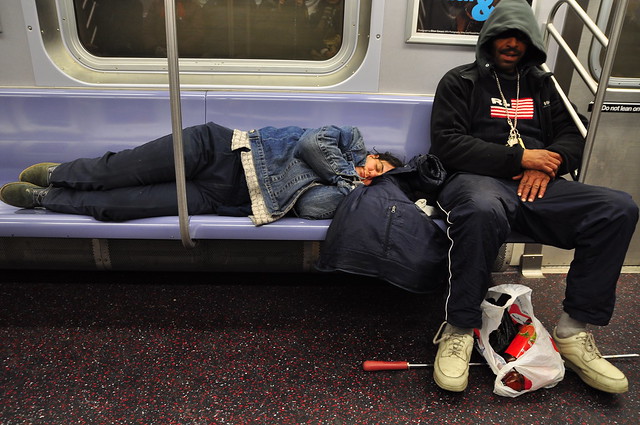
Posted by: | CommentsWhen Mayor Bloomberg two weeks ago announced that there aren’t very many panhandlers left in the subway, he drew the ire of, well, most straphangers and homeless advocates across New York. Panhandling, as anyone who rides the subway knows, is alive and well underground. Beggars, musicians, kids selling candy: you name it, and it’s there. Yesterday, though, MTA head Jay Walder tried to clarify Bloomberg’s comments, and his point is a valid one.
While speaking with reporters after yesterday’s MTA Board, Walder addressed panhandling. He noted that “panhandlers are certainly something that you do see in the system” but allowed for a decrease in numbers lately. “When you compare the situations that you see in the subway today with the situations that some of us will remember from a number of years ago, I think the conditions in the subway today are very, very different,” he said. “I think the N.Y.P.D. has done an excellent job at being able to control and try to deal with this. I would not say that it has been eliminated; I think that is certainly not the case. But I don’t think equally that you can compare what we see today to what you might have seen 30 years ago on the subway.”
It’s tough to deny that panhandling and the presence of homeless people in the subway is has decreased lately, but it’s certainly a problem. Homeless people living in stations create unsafe conditions, and panhandlers of varying degree are a near-daily sight in the subway. As the system is open, cheap and warm, those without reliable shelters will continue to seek safety and change underground. Until the city provides better options, panhandling will be a fact of life underground no matter what the mayor says.