Archive for MTA Bridges and Tunnels
For the 19th straight month, toll traffic declines
Posted by: | CommentsThe MTA released the May numbers for its bridges and tunnels division yesterday, and for the 19th straight month, toll volume has declined. According to the most recent numbers, May 2009 saw 799,890 tolled trips per day, down from a high of 837,537 per day in October 2007. Comparing years, May 2008 saw 200,000 more drivers than did May 2009, and overall toll traffic is down 3.1 percent from 2008 through the first five months of the year.
Bill Henderson, member of the Permanent Citizens Advisory Committee to the MTA, told The Post’s Tom Namako that the slumping economy and ongoing job losses are the culprits behind the declining toll traffic. I like to think commuters are being more economically and environmentally responsible by heading to the subways while eschewing driving. As the MTA raised the rolls on its bridges and tunnels just nine days ago, it will be interesting to see if those increases cause an even bigger slump in toll volume for July.
MTA Bridge & Tunnel toll revenues plummet
Posted by: | CommentsWhile subway ridership has reached 59-year highs, the poor economy is costing the MTA in toll revenue. According to the latest figures from MTA Bridges and Tunnels, toll revenue declined over $55 million in 2008 as compared to 2007. Average daily traffic at the tolled crossings declined 3.2 percent last year with decreases spiking as the economy worsened. So much for that safety net.
As Bridge and Tunnel tolls go, so goes the MTA
Posted by: | Comments
Lost in the discussion about East River tolls and congestion pricing is the great irony of the MTA. Since the tolled bridges into and out of Manhattan are such cash cows, New York City’s public transit network is kept afloat by the same forces many public transit advocates would like to limit.
The history of MTA Bridges and Tunnels is one of Robert Moses. He ushered through the construction of the Triborough Bridge in the 1933s, and over the years, Moses used his position as head of the Triborough Bridge Authority to consolidate toll revenues while increasing his reach.
By the 1960s, Moses was gone; the city’s bridges and tunnels continued to generate large amounts of surplus cash; and the city’s subways were teetering on the brink of collapse. Hence, the MTA was born, and now the city’s bridges and tunnels subsidize mass transit to the tune of $700-$900 million a year.
But what happens when New Yorkers stop driving? That is the question posed by Pete Donohue in a Daily News article today:
The number of drivers using MTA bridges and tunnels has fallen for 12 straight months, another troubling threat to the agency’s bottom line, officials said Wednesday. “I can’t say I remember anything like that,” MTA Bridges and Tunnels Acting President David Moretti said.
The latest statistics show drivers took 25 million trips over bridges and through tunnels last month, down 1.3 million – or 4.8% – from October 2007.
Much of the 12-month slide can be attributed to high gas prices. But last month’s downturn may be the result of commuters no longer having jobs to go to in Manhattan, officials said. Traffic at the MTA’s four Manhattan crossings was down on average about 7% from September to October, even though gas prices had fallen, Moretti said.
Right now, since the fares were raised in March, revenues aren’t down, but if these trends continue into next year and beyond, the MTA will need to raise even more cash. In that regard, I wonder how a congestion pricing plan would come into play. While a congestion fee with guaranteed revenue heading to the MTA could generate upwards of $400 million a year, would enough cars be discouraged from driving to impact the bottom line for the MTA Bridges and Tunnels division?
As congestion pricing plans would allow for tolls to be deducted from the charge to enter the Central Business District, I doubt the MTA would see a decrease in revenue from the bridges and tunnels. But as the economy walks a dangerous tightrope, it will be interesting to see how one of the authority’s biggest sources of revenue fares. Little do we realize that, as the Bridges and Tunnels go, so go the subways.
City to spend $4M to rename a bridge
Posted by: | CommentsThis morning, I spied a SubTalk poster urging me to “Celebrate the dedication of the Robert F. Kennedy Bridge.” It took me a good two minutes to figure out that the MTA was referring to the erstwhile Triborough Bridge. Now, according to CityRoom, the City of New York is set to spend $4 million over the next two years as they go about renaming the bridge after the former New York Senator and Massachusetts native. The funny thing about this expensive renaming outlay is that no one in New York is going to call this bridge by its proper name. It will always, to natives of this city, be the Triborough Bridge. (And anyway, it should have been named after Robert Moses. It was his bridge through and through.)
A bridge by any other name
Posted by: | CommentsIn January, before everything blew up, Eliot Spitzer started an effort to rename the Triborough Bridge for RFK. Yesterday, near the fortieth anniversary of the assassination of Kennedy, the New York State Assembly voted to pass the name change. Gov. Patterson says he’ll sign the bill, and the Triborough Bridge will soon have a new name.
MTA raises the tolls
Posted by: | CommentsThe final round of the 2008 fare hikes went into effect last approximately 36 hours ago. At 3 a.m. on Sunday morning, the tolls on the MTA-controlled bridges and tunnels around the city went up. NY1 has the details and the MTA has a handy chart detailing the new fares both with and without the E-ZPass discounts. And that’s all she wrote for the fare hikes.
Haberman: Name the bridge after someone more deserving
Posted by: | CommentsClyde Haberman, writing his NYC column in The Times, argues that the City shouldn’t rename the Triborough Bridge after Robert F. Kennedy. I agree. Interestingly, Haberman proposes naming the bridge after Andrew Haswell Green, a 19th-century urban planning who has been nearly completely overshadowed by Robert Moses. [The New York Times]
Spitzer wants to rename Triborough for RFK
Posted by: | Comments
When Robert F. Kennedy was assassinated in 1968, he was at the time a Senator from the great state of New York. Yet, since we associate the Kennedy’s with Washington, DC, and Massachusetts, no one really remembers RFK’s ties to New York. Now, Gov. Eliot Spitzer wants to correct that oversight.
In today’s State of the State address, Spitzer will announce his plans to rename New York City’s Triborough Bridge in honor Robert F. Kennedy. The new name for New York’s iconic bridge will the Robert F. Kennedy Memorial Bridge. That’s a mouthful.
The New York Times’ Sewell Chan has the response from the Kennedy family at Cityroom:
“I think we’re very excited about it, and very pleased,” Kathleen Kennedy Townsend, the former lieutenant governor of Maryland and the eldest of Senator Kennedy’s 11 children, said in a phone interview this morning. “I do know this has been a dream for quite awhile. We’re very, very happy that Governor Spitzer has decided to take it on.”
Mrs. Townsend, who was 17 when her father died, recalled traveling over the Triborough Bridge with him from La Guardia Airport as a child. “I remember going over it so many times with my father, when he was a senator, coming into Manhattan, going out,” she said. “It’s really touching. It would be really fabulous to recall that he was the senator from New York, if ever so briefly, and that there would be a way to remember him in that city. It would be wonderful tribute to all that my father did.”
Interestingly, this isn’t the first time that someone has tried to rename the bridge in honor of RFK. According to The Sun, in 1975, Gov. Hugh Carey wanted to name the bridge after RFK but was blocked by none other than bridge builder Robert Moses himself. Gov. George Pataki also thought about the idea.
In response to this announcement, well, I’ve never seen such vitriol from the Cityroom commenters. While a lot of people were critical of the idea, basically, it came down to two complaints: New York tradition and RFK’s tenuous relationship to the state. The Triborough, they argue, is a self-explanatory name and evokes images of New York’s spirit during the Depression. Plus, RFK ran for Senate in New York so he could better position himself to run for president. (Hmmm. Doesn’t that sound familiar?)
My initial thoughts here turned to Robert Moses. The Triborough Bridge is a symbol of Good Robert Moses. This was Moses when he got stuff done that people wanted him to get done. This was well before the seemingly racist Moses who had no regard for New York City neighborhoods or its people.
If anything, the bridge should be named for Robert Moses himself. Of course, we can’t name the bridge Good Robert Moses Memorial Bridge, and associating Moses’ name with anything in this city is still problematic even today, nearly 30 years after Moses’ death.
My next thought is to live the bridge as it is. The Triborough Bridge is a simple name for a rather majestic set of roadways and bridges that pass through and connect three boroughs and a few islands. But it’s a New York icon. If this name change goes through, in ten or twenty years, New Yorkers will still call it the Triborough Bridge. Don’t believe? Just ask someone to point out the Joe DiMaggio Highway, so named in 1999.
In the end, this name will serve as a fitting tribute for a man who was a real leader in civil rights in America and a man whose career and live were cut tragically short. But I do have to wonder if the bridge is the best of things to name after RFK. The Triborough already has a name, and New Yorkers are not quick to forget it.
MTA fare hike proposal hits subway riders harder than drivers
Posted by: | Comments
How did we miss this story for so many weeks? According to a report by Jeremy Olshan in The Post, the MTA’s fare hike leaves subway riders footing a higher percentage increase than drivers using the MTA Bridge and Tunnel tolls. In the era of the congestion fee and an increased call for traffic calming in New York, these findings are dismaying to say the least.
Furthermore, the MTA is partially reiterating its claim that Metrocard vending machines are to blame. Since these machines can support only fare increases in multiples of $0.25, the MTA is limited in its ability to raise the fares across the board. While the city eagerly awaits the outcome of the congestion fee battle, this transgression will not stand, man.
Olshan elaborates:
Despite all the talk about congestion pricing and discouraging driving in favor of mass transit, motorists get off equally – and in many cases easier – under the MTA’s proposed fare hikes. The cash toll for bridges and tunnels would rise 11.1 percent, from $4.50 to $5, under the proposal, compared to the 12.5 percent subway hike from $2 to $2.25.
Of course, only 25 percent of drivers and 15 percent of bus and subway riders pay the base fare. Using EZ-Pass, toll payers would shell out 6.25 percent more as the rate rises from $4 to $4.25, and a five-ride MetroCard would increase the price per ride by 13 to 20 percent.
In addition to breaking what could become an important subplot in the fare hike debate — especially once those public hearings begins — Olshan tracked down some choice quotes for his piece as well.
Paul Steely White, head of Transportation Alternatives: “We should be doing more to encourage people to take mass transit instead of driving. They need to not be ashamed to raise those tolls. They should sock it to motorists and give transit riders a break, because it’s the drivers who are contributing to pollution and global warming.”
Andrew Albert, MTA board member: “There’s no question we should be encouraging transit usage first. I don’t know why you would favor motorists. If anything, they should be hit harder.”
Jeremy Soffin, MTA spokesman: “The goal is to treat everyone equally and have the increase be as close as possible to 6.5 percent. It’s easier to accomplish that with tolls and EZ-Pass and on the commuter rails. The subway fare is more complicated.”
Yikes. This is not a good situation for anyone. The MTA comes out looking bad, and subway riders are getting screwed while drivers, the scourge of many New Yorkers, are getting off easy.
Right now, the easy solution should be the one the MTA is looking into: Raise the tolls on the roads the extent such that they don’t need to shaft subway riders. Drivers should be the ones footing the bill for public transportation considering that many people drive in this city when they don’t have to. A fare hike like that one would be a preemptive congestion fee.
So how can we get this message to the MTA? Go to the public hearings and demand accountability. Find out why drivers are getting off with a lower percentage increase while subway riders are getting stuck with a higher bill. Nothing about this fare hike is set in stone, and if enough people band together, the proposals can change. It worked with the F express; maybe it can work with the fare hike too.
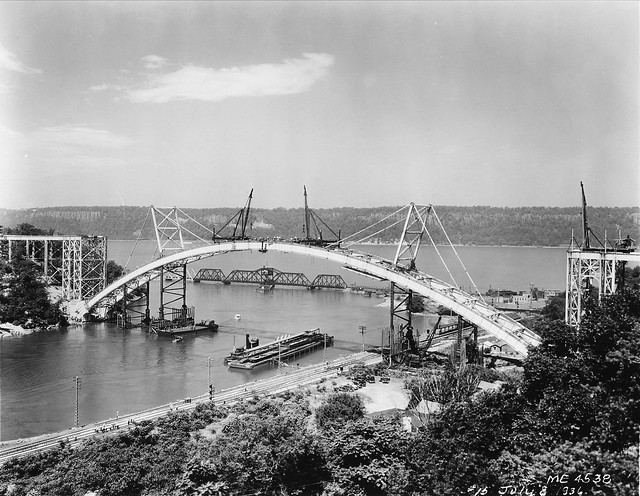
MTA begins much-needed reconstruction of Henry Hudson Bridge
Posted by: | Comments
The Henry Hudson Bridge, a Robert Moses project, provides the northern-most escape off the island of Manhattan. (Courtesy of flickr user King Coyote)
Let me leave the subways behind for a minute and talk instead about a lesser-known branch of the MTA: MTA Bridges and Tunnels. Once the various authorities headed by Robert Moses, the MTABT came about under the consolidation of those authorities when the MTA came into existence in the 1960s. MTA Bridges and Tunnels is the largest such public authority in the nation.
While not nearly as interesting or as environmentally friendly as the subways, every now and then something Bridge and Tunnel-y comes along that strikes my fancy. The recent news about the road work on the Henry Hudson Bridge is such a story.
The bridge at the north end of Manhattan spanning the waters known as the Spuyten Duyvil Creek and I go way back. Heading to high school, I would cross that bridge every day. Leaving the city from my home on the Upper West Side, I would cross that bridge. And of course, heading back into Manhattan, I would cross the lower level of that bridge, and it would feel like riding over some rugged, back-country dirt road.
Well, no longer will that road test your car’s shocks because the MTA is going to start a three-year construction project on the original roadbed of the 70-year-old bridge. The Associated Press has more:
Crews have begun preliminary work to replace the original Depression-era lower-level deck of the Henry Hudson Bridge as part of an $84 million rehabilitation project, transit officials said Thursday.
The project will replace the four-lane lower deck of the bridge and rehabilitate the approach…The work is expected to be finished in the spring of 2010, said the Metropolitan Transportation Authority’s Bridges and Tunnels division, which operates the city’s major bridges and tunnels. It will be done in four stages as each lane is replaced, the agency said.
As anyone who has recently driven across that lower level knows, this is a project years overdue. But interestingly enough, this is the first such deck replacement since the bridge opened on Dec. 12, 1936. The upper level, as I think back to the traffic jams, had its deck replaced in 1998.
Traffic will be bad crossing this span as they tackle a lane at a time, but in the end, it will be well worth it. After 70 years of service, this bridge needs a new lower level.