Contractors have filed suit over the MTA’s debarment regulation as transit advocates worry about the short-sightedness of the new rule.
During last month’s MTA Board Meetings, a routine discussion on a procurement contract took an interesting turn. The agency is currently in the process of awarding a two-year, $38.8 million contract for elevator installation and other accessibility upgrades at the 4 train’s 170th Street station and had initially identified six potential qualified bidders for the project. In the end, only two companies opted to bid on the work while three of the others declined to propose offers, citing, as the MTA put it in Board materials, “excessive risk associated with terms and conditions contained in the contract.”
On its surface, a few companies dropping out due to “excessive risk” hardly seems newsworthy, but underlying that excessive risk was the MTA’s new debarment policy. At the direction of Gov. Andrew Cuomo, the New York State legislature earlier this year passed a law mandating that the MTA institute a debarment (or disqualification) policy, ostensibly to maintain better oversight over project budgets and timelines. The MTA’s current emergency policy, designed to comply with law, mandates a five-year debarment for any contractor that delivers a project at least 10 percent late or at least 10 percent over budget.
Watching contractors drop out of the bidding process like flies following the implementation of the debarment rule was anticipated and feared by MTA executives and external watchdog organizations alike, and many have accused Gov. Cuomo of once again taking a wrecking ball to a problem that required a more delicate solution. Now, a group of contractors is fighting back, as they have filed a lawsuit in federal court alleging that the MTA’s debarment rule, as enacted, is unconstitutional. Neither the state nor MTA will comment on pending litigation, but so far, debarment has been a predictable mess for the MTA.
A Recent History of Debarment: an Executive Order, a hastily-enacted law, and emergency rule-making
The recent history of debarment in New York State starts with an executive order issued by Gov. Cuomo in late January. EO 192 established a requirement that all state agencies “rely on the determination made by other state entities” regarding debarment of a contractor. Thus, if any state agencies or any public authority for which Cuomo appoints the chair or CEO, as he does with the MTA, determines a contractor must be debarred, every other state entity must adhere to that decision.
With this EO, the risk to contractors doing business with any New York state entity increased exponentially, and for months, the contractor industry has been buzzing with concern over this requirement. It’s compounded by the reality that debarment in one state often leads other states to disqualify contractors, and suddenly, a contractor can find itself out of government work entirely.
Then, in April, as part of the budget negotiations, the state legislature approved a debarment requirement applicable specifically to the MTA. The new requirement, Section 1279-h of the Public Authorities Law, became law with no public hearing or comment period and obligated the MTA to create a “debarment process for contractors of the authority that prohibits such contractors from bidding on future contracts, after a debarment determination” by the MTA. The state directed the MTA to create a debarment regulation applicable “in situations involving a contractor’s failure to substantially complete the work within the time frame set forth in the contract, or in any subsequent change order, by more than ten percent of the contract term; or where a contractor’s disputed work exceeds ten percent or more of the total contract cost where claimed costs are deemed to be invalid pursuant by the contractual dispute resolution process.”
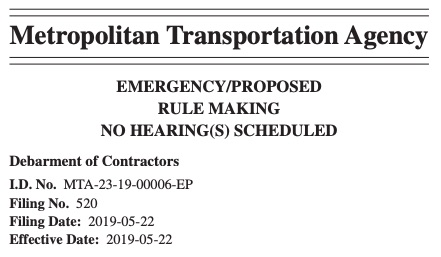
And that’s just what the MTA did. In May, the MTA issued an emergency regulation, since twice extended, that did exactly what the state legislature and governor mandated, each time without any public hearing or comment period. If any contractor faces debarment, three MTA employees will hear the complaint, and while the contractor will be able to present defenses, the debarment panel is not permitted to employ discretion in determining whether to proceed with debarment. If the grounds for debarment are met — if the contractor misses the target completion date by 10 percent or if the project is over budget by 10 percent — the MTA must debar, and the MTA can also opt to disbar the contractor’s corporate parents, affiliates and subsidiaries. It is, to put it mildly, draconian.
Concern over debarment from within and outside the MTA
Even before the contractors filed suit a few weeks ago, debarment has faced criticism from agency insiders and watchdogs who have frosty relationships with Gov. Cuomo. The Permanent Citizens Advisory Committee to the MTA raised concerns about the process that lead to the debarment regulation in a letter to MTA Chair Pat Foye earlier this year. Lisa Daglian wrote:
We are particularly troubled that this emergency action was taken during the Executive Session…Contractors must be held accountable, but so too must the MTA for the decisions it makes: undertaking such a sea change in secret sends a message that the authority is in a constant state of emergency, is above the law, and can make or bend the rules as it sees fit. The public has a right to know what the MTA’s Board members are voting on, and how. They have a right to review documents in advance of public meetings, and comment on proposed rule changes. They should not have to read about votes taken in secret for “emergency orders” that will ultimately affect them for many years to come.
Since debarment was approved, I’ve spoken with senior officials within the MTA who are extremely concerned with the chilling effects of debarment. Based on the challenges of working with the MTA, an organization known for being unable to manage project scope and budget, and the now-steep penalties, these MTA officials have routinely expressed their beliefs that debarment will lead to a decrease in the number of companies willing to work with the agency and a corresponding increase in project budgets. To combat the potential risk of debarment, those contractors willing to take on the risk will now be incentivized to submit bids with significantly inflated price tags and long construction timelines, thus further exacerbating the MTA’s cost crisis.
Good governance groups have picked up on this potential effect as well. “On debarment — which we strongly oppose — at Monday’s Transit Committee meeting, it was revealed that three vendors didn’t submit proposals on a design-build contract because of risks from debarment,” Reinvent Albany’s Rachael Fauss said to the MTA Board last month. “This risks includes factors beyond their control. Debarment is bad policy and a big mistake because it reduces competition. This means higher prices and a smaller pool of expertise to draw from.”
At a time when the MTA wants to increase the scope of its work and is on the verge of moving forward with a plan that calls for over $10 billion of construction spending every year for five years, imposing a five-year debarment penalty could whittle down the field of contractors to too few to complete the work. If only two out of six would bid on ADA work now, how can the MTA hope to fulfill its promises to deliver 70 fully accessible stations within five years?
And within the environment of the MTA, ADA work is considered relatively easy. I’ve spoken with MTA officials who are concerned that debarment could put Siemens and Bombardier at risk of losing their abilities to bid on MTA projects. If that were to happen, it would be functionally impossible for the MTA to complete most of the five-year capital plan at all. There simply aren’t enough companies able to do work within New York to ensure competitive bids and enough bodies to perform all of the work in the face of a debarment threat.
Contractors file suit to stop debarment regulations
In an effort to stop the MTA from enforcing its debarment rules, a group called the Alliance For Fair and Equitable Contracting Today, or AFFECT, filed suit shortly before Thanksgiving. The Alliance, represented by one-time Acting U.S. Solicitor General Neal Katyal, consists of the General Contractors Association of New York, the New York Building Congress, the Associated General Contractors of New York State LLC, the Building Trades Employers Association, and the American Council of Engineering Companies of New York. It is the über-lobbying group for the contracting industry, and in their lawsuit, they say, “Debarment is a death penalty for a public works contractor.”
In short, the suit alleges a variety of constitutional violations, including the Contract Clause, the Supremacy Clause, the Dormant Commerce Clause, procedural and substantive due process, and the First Amendment. The MTA’s debarment regulation applies retroactively and thus rewrites pre-existing contracts. It also affords the MTA with no leeway in determining fault. A few sections of AFFECT’s complaint struck me as particularly noteworthy. Calling New York’s approach to debarment “wildly out of step” with other debarment regimes around the country, AFFECT states:
The Debarment Statute and MTA Regulations do not require any wrongful conduct by the contractor or permit consideration of mitigating factors or allow inquiry into whether the contractor, engineer, or other vendor acted in good faith. MTA authorities must debar a contractor, consultant or supplier once a determination is made that the contractor exceeded the statute or regulation’s schedule or claim thresholds. No consideration is given to why a project went longer or whether a claim for a cost overrun was put forth in good faith. Nor is any consideration given to whether the contractor has taken steps to prevent schedule and cost overruns in the future.
As a result, the Debarment Statute and MTA Regulations create a draconian regime where a contractor operating in good faith may be debarred for merely exercising its express contractual rights to request additional time or costs due to changes necessitated by the MTA or a third party.
Whether this is a winning legal argument is, of course, another question and one premature to answer. The MTA has around two weeks to file a response to the lawsuit, and state and agency representatives have defended debarment all year. “The MTA is changing the way we do business to deliver for our customers and that means ensuring the historic $51 billion capital plan will be delivered on-time and on-budget,” Abbey Collins, an MTA spokesperson, said in a statement last week. “Beyond that, we don’t comment on pending litigation.”
I find the state’s approach to debarment far too limiting and am sympathetic to the arguments I’ve heard from MTA insiders and advocates that debarment will be harmful in the short-term to an agency looking to build fast. It’s not a solution to the MTA’s cost crisis and actually exacerbate it in the long run. Whether a court decides to invalidate the debarment regulations or not, New York state (and by extension the MTA) and its contractors should work out a better solution to the problem of cost overruns and missed deadlines. The debarment sledgehammer isn’t the answer.