Archive for MTA Economics

Debt payments are making up an ever-increasing amount of the MTA's annual budget. Image via RPA/ESTA.

A few weeks ago, the Regional Plan Association and the Empire State Transportation Alliance dug deep into the MTA’s budget projections and voiced their concerns over the MTA’s ballooning debt balloons. For long-time transit watchers, the agency’s debt isn’t a new storyline, but the numbers are increasingly heading upwards. The system is saddled with more debt than every before, and there’s no sign of relief on the horizon.

Yesterday, Streetsblog excerpted parts of the presentation which I’ve seen as well, and the picture isn’t a pretty one. According to the MTA’s own metrics, debt payments will account for over 17.5 percent of its operating budget by 2014, and according to the RPA and ESTA, the real total based upon the MTA’s sleight-of-hand accounting may be closer to 23 percent. Labor costs will fall to around 53 percent of expenditures.

“Every year,” Noah Kazis wrote, “more and more money that might go toward paying bus drivers, buying fuel, cleaning stations or keeping fares affordable is instead spent on debt service. Even over a period when pension costs will have risen by a billion dollars per year, it’s debt that is chewing up the MTA’s budget.”

Besides the debt, though, the other area of growth concerns pensions. In 2003, pension spending accounting for under five percent of the MTA’s operating budget, but by 2014, that number will rise to around 9.36 percent. That type of growth is unsustainable and worrisome. The MTA cannot become a pension and debt organization while running a subway system, but by 2014, over 30 percent of its operating budget will be tied up in those two areas.

So why so much debt? Kazis explains:

That debt is the outcome of decades of diminishing state support for public transit. After a major infusion of capital under the Hugh Carey administration, Governor Mario Cuomo cut all direct support for the MTA capital program. Though Cuomo found other revenues for the capital plan, notably by repurposing Westway dollars for transit, George Pataki just let those zeroes stand and put the cost of the capital plan on the MTA’s credit card, starting the debt build-up in earnest. Pataki also started using dedicated transit funds to pay the state’s commitments to the MTA, essentially double-dipping on those funds and costing transit almost $200 million a year.

The 2009 passage of the payroll tax helped the MTA’s budgets significantly — it is now the agency’s largest dedicated revenue source – but Albany’s decisions to kill congestion pricing and bridge tolls meant that the MTA still had to borrow heavily to pay for repairs and mega-projects like the Second Avenue Subway.

The result is a massive run-up in debt. Though the MTA spent only $848 million on debt service in 2004, according to RPA, it is projected to spend more than three times as much, $2.67 billion, in 2014. Debt alone will eat up 17.6 percent of the MTA’s operating budget by 2014; worse, RPA says that an alternative calculation shows the 2014 debt load at 23.1 percent of the operating budget.

Talk about debt often causes other people’s eyes to glaze over. They just want to know that trains will run frequently and on time, that the fare won’t go up and that there will be a seat for them on the next train. But these debt payments will impact the MTA’s ability to provide service. The authority can cut employees; they can cut trains and buses; they can raise; but they cannot cut debt. Without better and more concrete investment in the system, debt will balloon, and the rest of us — the riders and commuters who depend upon the subways — will lose out.

Categories : MTA Economics
Comments (9)

As inveterate transit watchers know, the MTA’s current financial crisis is years in the making. The perfect storm of decreasing state and city subsidies combined with ever-increasing labor costs and spiking debt payments has led us to today’s tenuous position. That said, a few key politicians have been instrumental in overseeing the decline and fall of state support for New York City’s transit system, and they deserve special recognition of their own.

Over at WNYC’s Empire blog, friend-of-SAS Colby Hamilton published an insightful and thorough post on the origins of the MTA’s fiscal crisis. Hamilton highlights an oft-ignored part of the MTA’s history. As he writes, “Out of this pool of transit tragedy one person bears a disproportionate responsibility for the current mess the nation’s largest public transit system is in. That person is former Governor George Pataki.”

Now, Pataki wasn’t the first person to remove MTA subsidies. In fact, under the first Cuomo Administration, the MTA lost nearly $1 billion in annual state subsidies, but those were replaced with money from the failed Westway project as well as revenue-backed bonds. The funding remained the same while the sources diversified. Under Pataki, it all fell apart. “Cuomo understood the importance of the MTA and the transportation system,” Peter Derrick, a former MTA official who accused Pataki of politicizing the agency, said. “The MTA basically set the transit budget and the governor didn’t stick his finger in the pot. Pataki came in and totally brought his own people in who were not transit people.”

With the Peter Kalikow’s of the world running the show, the MTA slipped precipitously into an embrace of debt. Hamilton explains:

The crux of Pataki’s culpability was the desire to float large capital programs without finding new streams of revenue. “Pataki said, ‘Oh no, I don’t have to do that. I’m going to be the governor that doesn’t have to raise taxes or raise fares,” said Derrick.

“It’s very tempting to put stuff on the credit card,” said William Henderson, executive director of the Permanent Citizen’s Advisory Committee to the MTA. “That’s essentially what we did. The result is the kind of debt and debt service we have now.”

Peter Kalikow was Governor Pataki’s MTA chief for most of his administration. He says that, in fact, Pataki was willing to allow fare increases, but the reality is that paying for capital needs through debt is actually a good thing. “A lot of guys yell that there’s so much debt. That’s nonsense. What you have to do is keep the fares at the level that you can pay the debt service,” Kalikow said. “If the state doesn’t give you the money, you’re going to have to do bonds. I don’t think that’s a terrible thing to do.”

Debt, as Kalikow says, isn’t always a bad thing. In fact, certain projects such as the Second Ave. Subway should be funded through debt because those projects will generate enough revenue to cover bond payments. But many other projects, including system modernization, will not expand the revenue base enough to generate money for the debt payments. Today, we’re stuck with debt for everything whether appropriate or not.

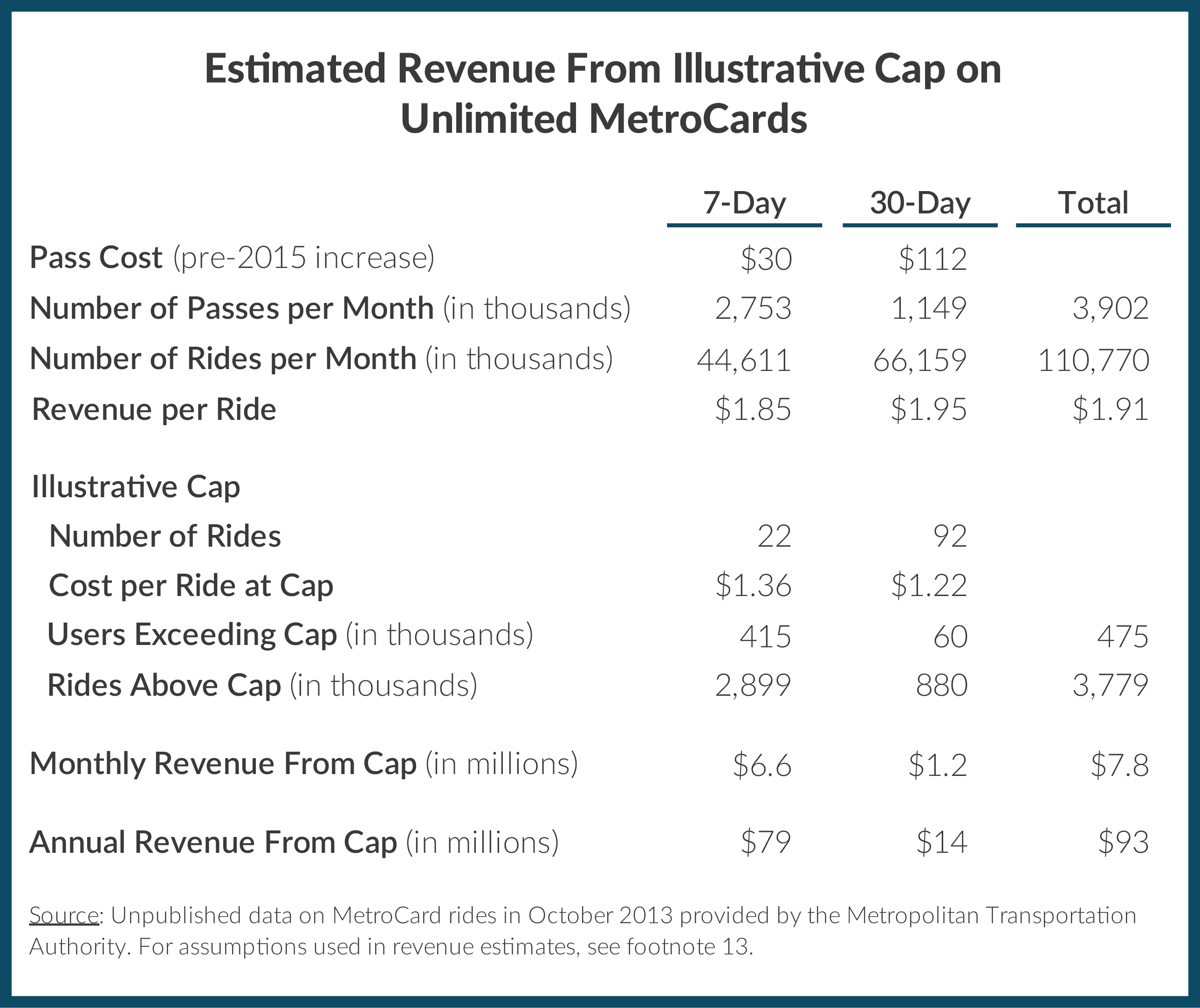
Now Hamilton’s piece contains most of the story, but as a few commenters pointed out, it’s not everything. Labor costs have risen have more than labor productivity has, and the artificial depression of the fare in nominal dollars since the advent of the unlimited ride MetroCard in 1996 has hurt the MTA’s bottom line as well.

Of course, the ultimate question concerns the future: Where do we go from here? As Hamilton notes, the next MTA head will have to take a long, hard look at the way the MTA is funded, and Albany must be willing to do so as well. I’m not too optimistic.

Comments (11)

Since the Port Authority announced its new budget on Friday, the New York City transportation scene has been a-flutter with interesting takes on the situation. Yesterday, we discussed how the new toll and fare structure could usher in a congestion pricing scheme that would generate more revenue for transportation and transit while reducing the traffic that currently chokes Manhattan. Today, I want to pick up a different thread involving the lessons New Yorkers should take from the Port Authority’s situation.

While the MTA and the Port Authority are intertwined, the two agencies operate off of a set of very different assumptions. The Port Authority is entirely self-sustaining. It relies on the revenue from PATH fares and bridge and tunnel tolls — mostly those bridge and tunnel tolls — to fund its capital and operating budget. The MTA, on the other hand, does not. While MTA Bridge and Tunnel revenues have long been used to subsidize bus and subway operations, they don’t come close to covering the operating and capital costs associated with running the MTA.

At Transportation Nation last night, Andrea Bernstein wrote an encompassing look at the fare proposal, and she discussed the differences between the PA and the MTA and how they impact each other. She writes:

Unlike, say the NY MTA, which gets (dwindling) subsidies from the government and from taxes, the Port Authority raises all its own revenue from tolls and fees. The bi-state authority is controlled by two governors, in this case, NJ Governor Chris Christie and NY Governor Andrew Cuomo. Both men have cut taxes, and have made it clear they don’t intend to raise any more. Which means the Port Authority revenues look increasingly attractive to both men — who, after all, do have to pay for infrastructure one way or another.

Governor Christie has asked the Port Authority to use the $1.8 billion it would have contributed to the ARC tunnel to improve roads, which solves part of the budget hole created by Christie’s decision not to raise the gas tax to fund the state highway trust fund, which is broke. And the NY MTA — controlled by Cuomo – has asked for $380 million from the Port Authority for the NY MTA’s capital plan. “These raids are pressuring the fares,” says Kate Slevin, executive director of the Tri-State Transportation Campaign. “Christie is using the $1.8 billion to plug holes in the state’s transportation program.”

But Tom Wright, executive director of the Regional Plan Association, backs the plan to raise tolls. “Tolls should not be off-limits. There has to be some way to pay for surface transportation.”

This difference inevitably leads to another question: Should the MTA be self-sustaining? Should New York’s authority pull a PA and raise tolls and fares to the point where everything can pay for itself? The answer to that question gets to the heart of the meaning of public transportation, and rational minds can certainly disagree.

The general nationwide perception about mass transit is that it’s a way to improve mobility for poor people. In the City Hall News article about congestion pricing, one source even says as much: “How does transportation affect the ability of the region to grow in a sustainable way? It’s a way to invigorate a center city and bolster mass transit, which is what poor people use.”

But in New York, that perception does not align with reality. Because jobs are concentrated on the isle of Manhattan and parking space is necessarily at a premium, people from all classes need public transit, and our city’s economy depends on it. The cost of use then must be low enough for the stereotypical poor people, but it also must be low enough to disuade people who might consider driving from doing so. (Similarly, the costs of driving must be high enough to do the same.)

That argument is a roundabout way, then, of making the case for subsidies. Earlier this week, I discussed the IBO report on the MTA’s uncertain revenue streams. By relying on a volatile mix of taxes and fees, the MTA is risking financial instability. Fares and tolls provide a far more constant source of revenue, but higher fares risk pricing out people who most need transit.

The MTA then is at the fulcrum of a political fight. Some in the state want to further reduce subsidies raised by taxes and fees. Others understand the need to fund transit but only to a certain extent. Eventually, the MTA will have to rely more and more on higher fares and toll hikes to pay the proverbial bills. Without subsidies, that swipe will only get higher. Just ask PATH train riders how they feel about that.

Comments (44)

With the MTA’s release of its 2012-2015 budget, the analysts came out in full force. While most were skeptical of the various assumptions tenuously supporting the authority’s plans, the city’s Independent Budget Office takes a different approach. The MTA revenues, they say in a report released on Friday, are resting on some highly volatile taxes and fees, and small shifts in the economy and political winds could leave the authority flailing for dollars.

For many transit policy wonks, the IBO report simply reinforces what we already know. By relying so heavily on real estate transfer taxes, an unpopular payroll tax and various other subsidies instead of a relatively steady stream of revenue generated by fares and tolls, the MTA risks financial instability tied to the economy. When, for instance, the real estate market collapses as it did in 2008, the MTA’s own financial outlook plunges.

Take a look at the following chart from the IBO report:

It ostensibly showcases the volatility of fees and taxes as compared with fares and tolls, but it tells another story as well. That story focuses on addition. By adding the payroll tax the previous mix of various fees and taxes that support the MTA, the state was able to push its contributions in line with the 2005-2007 trend line after three years of collecting amounts below normal. As the MTA depends upon these revenue streams to stay afloat, how often can they expect Albany to add more? Based on recent responses, the answer is “not very.”

The IBO’s report is short, but it sheds some light on the appropriations process. It walks through the convoluted ways in which various taxes and fees are collected by the start, siphoned into general funds or specific appropriations buckets and then redistributed to the MTA. Along the way, the state often reappropriates funds for other uses, and that’s how the MTA has seen $260 million in supposedly dedicated revenue vanish at the click of a button.

For a sense of the process, take a look at this table. Click to enlarge.

From the IBO’s perspective, the problems involve volatility. The MTA expects to draw in nearly as much in dedicated taxes and fees as it does from fare revenue. Adding the dollars collected from its tolls alters the balance to an extent, but the agency is still depending upon fees and taxes for over 40 percent of its annual budget. The IBO sees these revenue streams as too volatile and would prefer the MTA rely on fares and tolls — which have a tendency to remain constant over the years.

“While dedicated taxes and fees can hold down upward pressure on fares and tolls, the transportation authority’s growing reliance on these revenue sources does not assure fiscal stability. Some of the authority’s largest dedicated revenue sources are among the most sensitive to the ups and downs of the business cycle and the even more pronounced swings in the market for real estate,” the report says.

So what can the MTA do? The IBO clearly wants to see the authority rely more on fares. “Dedicated revenues do not assure stable funding,” they say over and over again. But the MTA’s current fare policies are the result of legislative bargaining. By agreeing to avoid fare hikes more frequently than every other year, the MTA earned the $1.5 billion in payroll tax revenue. If the payroll tax were to disappear, the MTA would have to institute a steep fare hike, and if they institute a steep fare hike off schedule, they risk incurring the wrath of Albany.

Finally, the 800-pound gorilla in the room concerns spending. The IBO report doesn’t delve into the MTA’s expenses, but they do highlight how in 2003, the authority’s overall revenue hit $6.4 billion while in 2010 it was over $10 billion. Even accounting for inflation, a jump in revenue — and concurrent spending — by nearly 50 percent is alarming. A good chunk of that money is going toward debt service on the never-ending capital plans while others are going toward increased labor expenses. Either way, spending has to be curtailed as well. Just as the MTA’s revenue streams cannot keep increasing ever upwards, neither can its expenses.

Ultimately, the issue circles back to the purposes behind mass transit. If the subways and buses are a public good for everyone, fares cannot be too high, and the MTA must depend upon a steady stream of taxes and fees for support. If, however, Albany is reticent about balancing the taxes and fees, the fares must go up, and public transit starts to become to expensive. The MTA has managed to walk that tight rope without falling, but the latest from the IBO seems to pull the safety net out from underneath the precariously balanced authority.

Categories : MTA Economics
Comments (5)

I found myself glancing over a map of the New York City subway and in a sense, marveling over the expansiveness of the subways. The current system may fall short of the dreams from the 1920s and 1930s; after all, where are those grand Second System routes or the Utica and Nostrand subway extensions? But we live in an age in which it takes a decade to build a two-mile, three-stop subway, and the system as it exists represents a fortuitous alignment of political will and corruption, reckless spending and a disregard for the lives of construction workers.

Today, subway expansion moves at a far more leisurely pace. A one-stop extension of the 7 line to 11th Ave. and 34th St. won’t be ready until late 2013, and Phase 1 of the Second Ave. subway is still at least five years away. After that, the MTA’s capital plans slow to a halt. With no long-term environmental studies under way, the best hopes for subway expansion rests on the shoulders of Phases 2-4 of the Second Ave. Subway. We’ll probably find a pot of gold at the end of the rainbow before that comes to pass.

Right now, the MTA is working to find a way to continue even its current meager slate of very expensive construction projects. The authority has put forward a budget for the next three years that rests on assumptions. It assumes that the city will fork over some dollars. It assumes that the federal government will sign a check. It assumes that Albany will do something, anything, to help continue infrastructure construction projects in New York City. Few people are comfortable with those assumptions.

The voices speaking out the loudest have come, of course, from the advocacy arena. The politicians have been deadly quiet. Kate Slevin of the Tri-State Transportation Campaign expressed her concerns that the MTA’s proposed spending plan relies on too many assumptions, and already those assumptions are breaking down. “If any of them,” she writes, referring to and listing the various assumptions, “don’t play out as the agency hopes, the whole plan could fall apart.”

The first to go, as TSTC itself noted, is federal funding. In the latest infrastructure bills making the rounds in the House, the MTA comes out behind. TSTC provided this dire summary: “In particular, House Transportation & Infrastructure Chairman John Mica’s proposal for the next federal transportation bill would cut federal funding to the state by $7.2 billion over the next 6 years and would cost the state almost 45,000 jobs in the first year alone. If the House bill is enacted, federal transportation aid to the state would be cut by about a third, which would decimate both the MTA and the New York State Department of Transportation’s unfunded capital construction plans.”

The MTA’s current funding plan assumes over $4 billion in federal grants. If even $1.2 billion of that is stripped away, as TSTC notes, the impact could be devastating. That cut would be the equivalent of canceling all Metro-North maintenance and improvement work for the next three years; or canceling all subway station renewal, rehab and accessibility work for the next three years; or delaying much of the East Side Access project indefinitely. That is a future no one wishes to contemplate.

Streetsblog sees these assumptions and fears that the MTA will take on more debt to fund projects whose revenues cannot truly support bonded debt. A financial crisis then is ticking ever nearer for the MTA. Forget, then, about dreaming big; forget even about dreaming small. We likely won’t see any semblance of a fantasy map pass for reality any time soon, and the system we have soon — along with the few additions currently under construction — are all that we’re going to get for some time. That’s a shame.

Categories : MTA Economics
Comments (27)

On the heels of a report that the MTA is losing $31 million to fare-jumpers, one State Senator wants to jack up the penalty. Charles Fuschillo, a Nassau County Republican, has proposed to raise the fine for fare-jumpers from $100 to $500, and he wants scofflaws who fail to pay the fine in a timely fashion to be penalized an additional $100.

Fuschillo, who has submitted a bill with these proposed changes, says he has the MTA’s bottom line in mind. “Fare-paying riders are being forced to pay the multi-million tab for those who are trying to beat the system. At a time when every dollar counts, the MTA and its riders can’t afford to pay for freeloading fare-beaters. Raising the fines for fare evasion will create a stronger deterrent by making the cost of an illegal free ride far more expensive,” he said.

The bill, which has been referred to the Senate Rules Committee, is numbered S05870 and is available here. The $500 fine would likely to be high enough to serve as a serious deterrent.

Categories : Asides, MTA Economics
Comments (27)

One way or another, the MTA's turnstiles will earn some revenue. (Photo by flickr user Karen Foto)

Every few months, the MTA rolls out another report on the revenue lost to fare-jumping, and every few months, the same report leads to a bunch of outrage. How could the MTA give up so much fare revenue? Why aren’t more cops patrolling the stations? This is why we can’t trust the authority do anything properly. And over and over and over again.

This year’s story rings true to form. After finding that the MTA lost approximately $27 million to fare-jumpers in 2009, a report covering 2010 found $31 million in lost revenue due to fare-beaters in 2010. According to coverage of the report, fare-jumpers entered the system in 2009 18.5 million times without paying. That’s 50,684 per day, and cops handed out 120,000 summonses all year.

Per The Daily News, turnstile-hopping seems to be the rare case where crime does pay. As The Daily News notes, a fare-jumper who gets caught just once every six weeks would gain money. Six 7-day MetroCards cost $174 while the summons sets them back $100. This year, with the economy stagnant and the fares up over early 2010, the MTA estimates that’s 1.5 percent of riders jumped the fare as compared with 0.9 percent last year.

Pete Donohue had more on the MTA’s response:

The MTA said the report – presented at a transportation think tank’s conference this year – was not an official document. Average weekday ridership is about 5.4 million.

“New York City Transit takes fare evasion very seriously and is continually working with the NYPD on cost-effective strategies to combat it, such as targeting high-incidence locations and placing cameras in key areas,” MTA spokeswoman Deirdre Parker said.

She said transit cops have made 12,468 arrests for fare evasion this year, up 5.5% from the same time last year. Officers have issued 37,825 summonses to evaders this year, a 1.7% increase from the same period in 2010.

Whether or not there is an actual problem, police officers have called upon politicians to raise the fine. A 2009 effort to jack up fare-jumping penalties to $250 went nowhere in Albany, but NYPD officials want a renewed effort. “I think the state legislature should consider raising the fine,” Police Commissioner Ray Kelly said. “It would probably be a good idea.”

What would be a good idea though? Perhaps raising the fine makes sense. If the price is high enough to deter fare-jumping, then the penalty would be ideal. If, as the News says, jumpers get caught on average of once every 6-13 week, it would have to be a substantial fine.

Beyond that though, the MTA and the NYPD probably shouldn’t do much. While the pure numbers sound high — 18.5 million! — in percentage terms, they’re not. As even the News noted, only 1.5 percent of riders are jumping this year. For any business that’s more than an acceptable bleed rate, and it’s tough to tell how much extra revenue one police office at nearly $80,000 a year would net. Perhaps it would make sense, but perhaps it wouldn’t be the best use of police resources.

Basically, fare-jumping is a sunk cost for the MTA. It is the price of doing business in a system that can’t station a cop in 468 stations 24 hours a day, 7 days a week. A higher fine should temper the problem, but anything else is simply overkill.

Categories : MTA Economics
Comments (31)

As the MTA looks to shore up both its operating budget and five-year capital plan, the agency is prepared to turn toward a set of familiar funding sources to stay afloat. In a sweeping budget released yesterday at its Board meeting, the authority reiterated that its operating budget will require fare hikes as planned in both 2013 and 2015 as well as the current mix of dedicated taxes if the agency is to maintain a balanced budget. Meanwhile, the capital plan will rely on even more debt as the authority plans to borrow nearly $7 billion to close its funding gap.

“By keeping our focus on making every dollar count, this financial plan brings stability back to the MTA’s finances,” outgoing MTA Chairman and CEO Jay Walder said. “As a result, we’re able to meet our commitments to avoid service cuts and fare increases next year. The savings also pave the way for a new funding strategy that will advance vital capital investments that protect the safety and reliability of our transportation network.”

In its budget documents, the MTA made clear that its basic assumptions rely on continued support from Albany and continued inaction from those interested in repealing the payroll tax. In its release, the Authority noted that the budget was prepared based on four basic assumptions: a three-year zero wage increase initiative that “reflects new fiscal realities”; two fare hikes in 2013 and 2015 as planned; more cost-cutting measures; and “continued receipt of dedicated taxes and subsidies.”

Both union leaders and Albany representatives are likely nervous about these assumptions. With the TWU negotiations looming, a net-zero wage increase would either leave their members with stagnant salaries for three years or with their ranks reduced as the MTA can keep labor spending steady by simply cutting positions. In Albany, as Lee Zeldin and his ilk attempt to overturn the payroll tax, the MTA has made it clear that it needs the $1.5 billion in subsidies. If they want to reduce the tax burden in suburban counties that already enjoy mass transit benefits, they’re going to have find a way to replace those revenue streams.

Meanwhile, the MTA said it will turn toward debt financing and more state and city contributions to find its capital plan. With a $10 billion gap and $4 billion already cut from what was once a five-year, $28 billion plan, the MTA has applied for a $2.2 billion low-rate federal loan and will issue $4.7 billion in MTA revenue bonds, bringing the total debt to $6.9 billion. It anticipates drawing in around $890 million from the sale of 347 Madison and other underutilized properties and has asked the city, state and Port Authority for a combined $1.7 billion as well.

Transit advocates did not rush to embrace this plan. The Tri-State Transportation Campaign sent out a lengthy statement yesterday:

The financing plan announced today would all but guarantee that tomorrow’s New Yorkers would face much higher fares and future service cuts. It centers around borrowing an additional $6.9 billion to fund the transit system’s capital needs, saddling future generations with yet more debt. Seventeen cents of every fare dollar already goes to pay off old debt, and this plan would significantly increase that amount.

Furthermore, this plan is balanced only with the help of assumption after assumption. It relies on new revenue from the Port Authority and a loan from the federal government. It assumes changes in labor agreements. It relies on an increase in support from New York City. It relies on an increase in the agency’s debt cap by the State, and approval by the State Legislature of new bonds. It assumes that federal transportation funding will remain at existing levels, when many in Congress are calling for drastic cuts.

Much of our region’s economic dynamism can be traced back to the investments made since the MTA’s first multi-year rebuilding program was created in 1982. The capital program generates tens of thousands of new jobs and tens of billions of dollars in economic activity. The projects that the capital plan supports — such as station rehabs, signal modernization, track work, lighting, and customer assistance — are essential to the region’s prosperity. But this plan amounts to a ticking time-bomb.

The city and Mayor Bloomberg declined to comment, but the Citizens Budget Commission issued a call to action:

The new proposal is better than doing nothing to meet the essential infrastructure needs of mass transit. But it has a critical flaw – it proposes to borrow billions without presenting a corresponding plan for new revenues to match the increased long-run debt service burden. In the coming months, as the proposal is debated, this gap should be meaningfully addressed by our elected representatives…

The MTA Board, in consultation with the Governor and legislative leaders, should develop a revised financing plan. It should rely on prudent forms of borrowing and identify adequate revenues to cover future debt service. The best medicine for the MTA’s fiscal woes is new revenue from sources such as accelerated and larger fare and toll increases, increases in auto user fees such as vehicle registration and drivers’ license fees, and a better version of the much maligned efforts to charge for auto access to central Manhattan. Of course existing sources must be retained and optimized. A viable strategy for maintaining and enhancing mass transit inevitably requires that New Yorkers pay more in some way. Our political leaders should be honest about that fact and address the problem rather than temporarily dodging it.

It’s tough to feel too good about this plan. It would indeed help the MTA to finish its big-ticket items, and they must have this money. But saddling the authority with more debt will just lead to future cuts and fare hikes. Already, the MTA is carrying too much debt, and as it looks toward the next ten or fifteen years, debt will begin to hinder its actions.

For now, though, the lines have been drawn and assumptions have been aired. It’s a first step in what will be a long process, and how it ends will impact the long- and short-term futures of New York City’s aging subway system.

For more on the budget, read through the MTA’s plans right here.

The MTA engaged in a very public and heated battle to slash staffing numbers last year in an effort to keep payroll expenses level, and it almost worked. According to a new report from the Empire Center, the MTA’s payroll increased by only $71 million — or 1.4 percent — last year as its headcount declined by 852 employees. The average MTA salary comes in at $71,237.

The report, a project of the conservative-leaning Manhanttan Institute, can be interpreted in numerous ways, and it again highlighted the MTA’s overtime expenses as labor costs will move to the forefront this fall. The topline findings are as they always are: More than 10 percent of the MTA’s workforce — administrative or otherwise — earned over $100,000 last year while 268 employees doubled their base pay through overtime and three tripled theirs. Jay Walder led the pack with his $350,000 salary while seven other executives earned more than $241,000. One Long Island Rail Road conductor earned $240,489, three times his base pay, through overtime while another took home $230,069. As the Center’s list of 100 highest paid employees shows, the top earners are split amongst administrative personnel and unionized workers.

The center, meanwhile, highlighted the engineers and conductors making bank via overtime. They found the following in the $150,000 club:

  • 53 Metro-North conductors who averaged $90,367 over their base salaries of $76,127;
  • 19 Long Island Railroad foremen who averaged $82,111 over their base salaries of $81,946; and
  • 15 Metro-North engineers who averaged $75,929 over their base salaries of $80,521.

The MTA laid the blame for the payroll increase on the shoulders of its unionized workers. “In 2010, the MTA eliminated 3,500 positions, froze managerial salaries for the third straight year and cut 15% of administrative payroll, en route to an annual budget savings of more than $500 million,” the authority said in a statement. “Nonetheless, payroll did increase from 2009 to 2010 due to the 4% wage increase awarded by an arbitrator to the members of TWU Local 100.”

Nicole Gelinas analyzed the numbers and found that with fewer workers, those remaining are earning more due either to the TWU raises or overtime. She again noted how benefits have backed the MTA into a corner. “Without a doubt, these jobs are tough; it’s easier to write newspaper columns than to walk hot tracks or sit in a booth all night. But these jobs are not poorly paid,” she wrote. “The average New Yorker in the private sector earns about $55,120. The MTA worker earns 31 percent more — and has retirement security, while people in the private sector worry about whether they’ll be able to retire at all.”

Lee Zelding, the payroll tax employees who seemingly fails to understand how MTA payroll expenses and overtime allocation work, also issued a pointed statement: “Once again, a new report has been released highlighting the MTA’s continued fiscal mismanagement. This time the issue is with the MTA’s payroll. Whether it’s increasing payroll expenses, excessive salaries for administration, or abusive overpayments to employees, the MTA continues to come up short in bringing the expense side of the ledger in line with the revenue side of the ledger,” he said without making much sense.

Ultimately, it’s going to cost money for the MTA to stay afloat. New York straphangers want clean subways, and they want on-time performance. They want better facilities and more reliable rush hour trips. They want things that cost money — from track worker salaries to management. The MTA is going to try to freeze wages. Yet, at a certain point, overtime expenses are cheaper than hiring more workers, and labor costs are relatively fixed. That payroll went up only by 1.7 percent seems like a step in the right direction even if the path to fiscal responsibility has a long way to go.

Categories : MTA Economics
Comments (36)

The legislation designed to protect dedicated transit funding from executive branch raids has cleared the State Assembly after gaining Senate approval earlier this week, Streetsblog reported a few minutes ago. The Transit Lockbox, as it is being called, institutes stringing reporting requirements and legislative approval for any attempt by the Governor to reappropriate transit funds into the state general fund. The text of the bill is available here, and I’ve offered up my support and analysis of the measure right here.

The bill now moves onto Gov. Andrew Cuomo’s desk for his approval, but that signature is no sure thing. As Jim O’Grady at Transportation Nation reported earlier in the week, Cuomo had not thrown his weight behind the measure. One source said to O’Grady via email, “We’re hearing that Cuomo is blocking the lockbox bill so that he can retain the ability to steal transit funds. (This is the same Cuomo who ran for governor last year on restoring honesty and ethics to government.)” The Governor has yet to comment.

Comments (4)
  • Extended Stay

    Featuring a wide range of sophisticated furnished apartments throughout the city and surrounding areas, ExecuStay can help you enjoy a New York extended stay that's both productive and relaxing.

  • Corporate Apartments

    As a resident of ExecuStay New York corporate apartments, you'll find that getting around is a snap, thanks to the many MTA subway lines, buses and yellow cabs.