Archive for New York City Transit

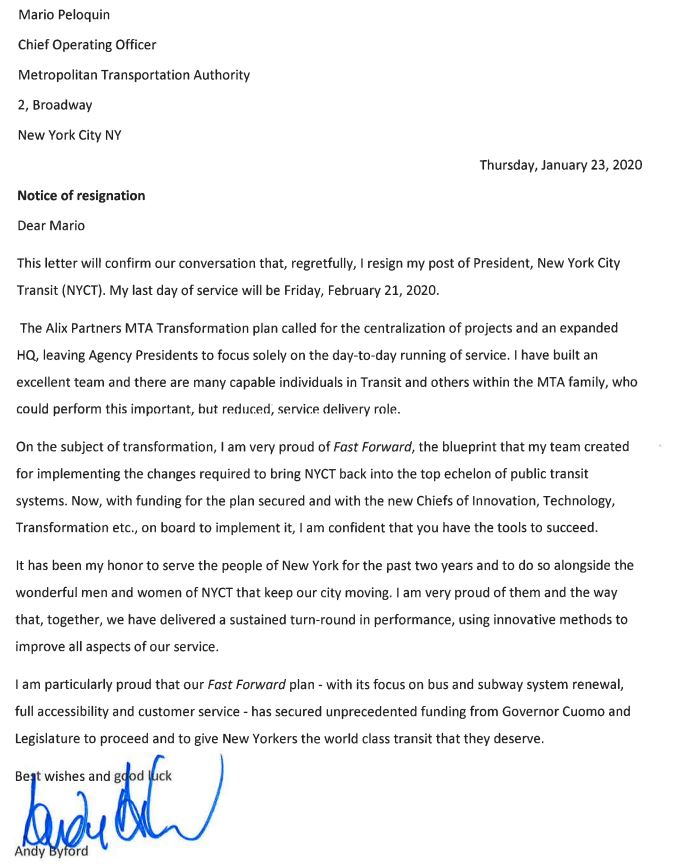
The executive shuffle at New York City Transit continues in the wake of Tom Prendergast inheriting the MTA’s top job. Joseph Leader, a 27-year Transit vet, will assume the role of head of Department of Subways, taking over for Carmen Bianco who was recently named Acting President of Transit, the MTA announced yesterday. Leader will report to Bianco as Transit officials remain focused on repairing the damage Sandy inflicted on the subway system.

“The subway system faces enormous challenges in order to continue to meet the primary objective of providing safe and reliable service to 5.4 million customers each day,” Leader said in a statement. “This must be done even while we continue to invest in critical system maintenance and conduct a massive rebuilding effort in the wake of Superstorm Sandy…Having witnessed up close, the damage caused by Sandy, I am well aware of the work that remains.”

Leader comes to the Senior Vice President spot after serving as the Chief Maintenance Officer for Transit with oversight of track, infrastructure, elevators & escalators, electrical systems, and engineering and electronics maintenance. Now, with Maintenance of Way under his purview, he should make sure those deficient structural inspections are improved.

Comments (0)

As Tom Prendergast transitions from his role atop New York City Transit to his new job as MTA CEO/Chairman, he has named Carmen Bianco as the Acting President of the nation’s largest mass transit system. Bianco, the current Senior Vice President of Subways at Transit, has 30 years of transit experience under his belt and will lead the agency as Prendergast engages in a nationwide hunt for a permanent president.

“I have tapped Carmen for this assignment in recognition of his leadership skills, his knowledge of our system and his proven ability to take the lead during an extremely challenging period,” Prendergast said in a statement. “Aside from NYC Transit’s regular operations, Carmen will also be guiding us through a major rebuilding period to bring the system back from Sandy’s damage.”

Bianco will continue to usher the subway system through its post-Sandy recovery efforts. Even as service to the Rockaways is set to resume early this summer, the system faces challenging maintenance problems as saltwater erosion takes over. “We have a lot of work to do, but we will not lose sight of our primary goal: maintaining and operating a system that provides safe and reliable service to those who depend on NYC Transit’s buses and subways,” Bianco said in a statement. “I have the greatest team in the world supporting me, and their contributions will be critical to achieving that goal every day.”

Comments (0)

For fans of subway ridership data, this time of year is always a joy for it is when New York City Transit unleashes the 2012 station-by-station ridership figures. We can see which stations are the most crowded and which have enjoyed big bumps in riders. We can drill down on Sandy’s impact on subway ridership — Queens, for instance, saw a bump of only 379 total riders over 2011 — and we can see which subway stations are losing riders. The data, in other words, is tremendous so let’s dive in.

First up, we get the usual suspects. In the MTA’s glance at the top overall stations, only one station from the 2011 top ten fell out of the list. Times Square, with over 62 million riders, and Grand Central with just under 43 million, occupied the top two spots with Herald Square, Union Square, the two Penn Station stops, Columbus Circle, Lexington at 59th St., Lexington at 86th St., and the 53rd St. station filling in the rest. The 53rd St. station, in fact, hopped over Flushing-Main St. to claim the tenth spot, and for the first time since 2009, the top ten most popular subway stations are all in Manhattan.

Now, that’s the boring stuff. I certainly know how crowded Times Square is; I see it every day on my way too and from work. The real story here though is that ridership at Times Square jumped by 2.4 percent and has increased by 3.5 million since 2007. The sheer number of people entering the system that is practically off the charts.

While 2.4 percent increase in riders is impressive — it’s well above the systemwide average of 0.9 percent over 2011 — it pales in comparison with some stations seeing massive growth. I always find more interesting to list these stations instead. Maybe we can see partners relating to New York City development or transit usage in certain areas; maybe we can see the impact of a nearby station closure forcing straphangers to hoof it a few more blocks.

To start, I usually weed out stations that were closed the year before. Elder Ave., for instance, saw growth of 168 percent in 2012 over 2011, but that’s because it was partially closed the year before. So which station took home the crown? That would be one whose need I’ve questioned before: 21st St. on the G train. Ridership at that station jumped by 28.7 percent last year, but it’s still just the 405th most popular station. In other words, only 13 stations have lower ridership, and most of those are on the Rockaways. In fact, many stations along the G train witnessed high growth, including Beford/Nostrand and Flushing Ave. with increases over 6 percent and Fulton St. with a jump of over 8 percent.

Another station showing intriguing and obvious growth was Rector St. In the weeks after Sandy, as straphangers streamed from the ferry terminal to the nearest 1 train station, overall ridership eventually jumped by 15 percent at Rector. Howard Beach, the A train’s terminal since the storm, also saw entrances jump by 15.7 percent as well. Other notables included Carroll St. (due to the nearby Smith/9th Sts. closure), Queensboro Plaza and New Utrecht Avenue.

Finally, the last bit of interesting information concerned the Atlantic Ave./Barclays Center station. The arena opened during the last weekend in September, but its first three months were enough to help push ridership up that station by nearly 800,000 riders or 7.5 percent. I’d imagine we’ll see even more of an increase after a full year of arena customers.

I’ll probably be breaking down some additional numbers over the next few days. The weekend ridership figures in comparison with weekday totals help highlight popular nightspots and the biggest 9-to-5 job centers. For now, feel free to peruse the raw data for annual riders right here. See anything particularly interesting?

Comments (15)

With the arrival of FASTRACK on the J line this evening, every Manhattan trunk line has gotten to enjoy the pain and benefits of the MTA’s new maintenance program, but media coverage has been nearly non-existent. Since an initial burst of concern over longer rides for those using the subway between 10 p.m. and 5 a.m., the media has largely reported the outages with none of those “straphanger-on-the-street” quotes. Although I’m usually skeptical of such coverage, maybe it has a point.

As the MTA has trumpeted FASTRACK, we’ve gotten a laundry list of accomplishments. We’ve heard about bags of debris, pounds of scrap, ties replaced, drains cleared, third rail cleaned, pumped rooms treated. We’ve also heard bits and pieces about station environments. Last week, for instance, at the Lexington Ave. local stations, crews replaced 36 signs, over 1400 station light bults and 57 square feet of floor tile. Considering the state of the MTA’s stations, though, that’s not a considerable amount of work, and riders are starting to notice.

One reader sent me the following about Queens Boulevard a few days ago, and it’s not the first time I’ve heard such sentiments:

I live along the Queens Boulevard line and I happened to get off at Queens Plaza last night. Except for the condition of the rails and trackbed, which looked nice, the station didn’t look at all rehabbed. There were still leaks coming from the walls, and that one area of the station (back of the Manhattan bound local track) where it looks as if the pipe has been leaking forever and the wall is damaged. I am not to sure what the main goals of FasTrack seem to be as far as infrastructure that doesn’t have a short term effect on service but the station was rehabbed in the last few years and I’m wondering why these weren’t fixed.

Now, the purpose of FASTRACK isn’t to fancy up stations. It takes a concerted, long-term effort to do that, and FASTRACK’s raison d’etre involves the hidden infrastructure that runs the system. Yet, it’s always felt like an incomplete program to me because that forward-facing element is missing.

When the MTA takes something away from us, it’s easier to swallow if they give us something in return. For instance, a fare hike that’s accompanied by a service increase is far more acceptable than a fare hike accompanied by either nothing or service cuts. Likewise, if riders are suffering through longer rides, closed stations and inconvenient commutes especially during the already-unreliable overnight, they expect something in return. They want those dingy stations cleaned up and repaired. They want those leaky pipes sealed. They want something more pleasant than what they have now.

For the MTA to realize this desire, FASTRACK would have to be reconceptualized. It has to become something with a notable forward-facing component. It has to offer up tangible improvements and not just online laundry lists of accomplishments. When the next MTA capital campaign features spending on the signal system, the MTA should be able to deliver countdown clocks on the B Division in return. That’s the kind of trade-off that would make FASTRACK more acceptable in the eyes of the public even if we know and recognize that may not have been the agency’s original intentions.

Comments (52)

One solution for New York City’s diverse rolling stock could involve movable platform edge doors.

I’ve haven’t spent much time lately talking about subway collisions and deaths. After an early-2013 spate of hand-wringing over press attention to these incidents, what some were calling an epidemic has largely died down, and the TWU’s terrible plan to slow down trains hasn’t gone far. Furthermore, I don’t believe it’s a coincidence that as press coverage has diminished, so too have copy-cat jumpers and train/passenger collisions. Now, we’re just bombarded with endless announcements over the PA system concerning the safety of the platform edge.

Earlier on Tuesday night, though, a collision happened that drives home the idea that there is but one real solution to the problem. It’s an expensive solution that may not be practical but would have many added benefits, and it’s a solution that requires engineering creativity and an extensive capital outlay. That solution is one I haven’t been quick to endorse over cost concerns, and it is platform edge doors.

Last night, as I left my office and entered the subway at Times Square, the PA system spoke of a problem impacting the West Side IRT. There were no 1, 2 or 3 trains running uptown between 72nd and 96th St. due to a police investigation. I figured the news would not be good, and I was right. CBS New York has the gruesome details:

A 18-year-old male was struck and killed Tuesday evening by a northbound 2 train as he reportedly tried to cross the train tracks at the 79th Street station on the Upper West Side. The accident happened at around 6:30 p.m. on the express tracks. Service was disrupted on the Nos. 1, 2 and 3 subway lines in Manhattan due to the police investigation.

Law enforcement sources told 1010 WINS’ Sonia Rincon that the victim, who turned 18 on Tuesday, was with a group of friends. At least two jumped down and tried to cross — one made it, WCBS 880?s Alex Silverman reported. A witness said he begged the teens not to run across the tracks, but he could not stop them. “They crossed the tracks the hard way, as opposed to coming upstairs and going around,” the witness told CBS 2’s Derricke Dennis. “They just ran across the tracks and got hit by the 2 train in the express tunnel.”

Police said the emergency brake on the Bronx-bound train was pulled after the operator saw one teen make it across the tracks from the uptown to the downtown side, then tried to stop the train for the second boy. But the operator could not stop in time.

All around, that’s about as bad as it gets. Two 18-year-olds — who were found to have a bottle of rum with them — entered on the wrong side and decided to rectify the situation by cross four tracks at rush hour. The 2 train, accelerating through a 24-block express straightway out of 72nd St., couldn’t stop in time, and plenty of people were in the station to witness the collision. It’s tragic; it’s horrific; and it’s worthy of a Darwin Award.

This tragedy illustrates the only way to protect people is by physically barring their entry onto the tracks. We’re not going to slow express trains down as they bypass local stations, and while a motion sensor may have served as a warning, it sounds as though the 2 train was moving too fast to stop in time. So we’re left with expensive platform edge doors. They can save energy, keep tracks clean and save lives. Without an obvious big-ticket item on the MTA’s next capital plan, maybe it’s time to give them a whirl.

Comments (68)

It is fitting that, after I wrote about subway delays this morning, the news of the afternoon concerns, well, even more subway delays. Despite the subway system’s quick rebound after Superstorm Sandy, all is not well underground. As we know, once saltwater gets inside of any piece of electronics, there’s no going back. No amount of cleaning will stop the erosion, and that’s what happening to Transit’s infrastructure.

As Jim O’Grady reports today at Transportation Nation, service disruptions will become the norm as the MTA races to spend the billions of dollars in storm aid it will soon have at its disposal. Over the next few years, the MTA will receive nearly $9 billion for both repairs and system hardening, and it must spend the money quickly or forfeit it. To that end, warned Transit President Thomas Prendergast expect delays, especially along those lines most hit by the storm surge.

As the MTA noted, a pair of recent signal problems in the Montague St. Tunnel could be blamed on salt water damage caused by Sandy’s flooding, and that’s just the tip of the proverbial iceberg. “The subways have recorded more than 100 signal failures related to Sandy since service was restored after the storm, plus problems with switches, power cables and other infrastructure,” spokesperson Adam Lisberg said to WNYC. “Most of those failures happened in yards, but some were on mainline tracks and led to at least short service disruptions.” The disruptions will likely be concentrated in Lower Manhattan, the East River Tubes and parts of Williamsburg, but as with the storm itself, the ripple effects will be felt all over the city.

Comments (22)

As a brief follow-up to my early post on 2012 ridership figures, the MTA announced the final tally for subway usage, and it’s a doozy. Total subway ridership hit 1.654 billion last year, the highest it’s been in 62 years, and the average weekend ridership matched the all-time historic high, set back in 1946. Furthermore, these records come amidst an estimated 43.8 million rides lost to Superstorm Sandy.

“Our ridership growth has been strongest among discretionary riders and during off-peak times,” Thomas F. Prendergast, MTA Interim Executive Director, said in a statement. “Recent trends, like the younger ‘millennial’ generation increasingly gravitating toward transit around the country, are building on older trends, like the introduction of unlimited cards and free transfers between subways and buses, to continue the long-term ridership growth over 20 years.”

It’s unclear how weekday ridership compares to historical averages, but it’s at or near record highs as well. Considering how pervasive automobile usage has become in society today, it speaks volumes of transit’s place in New York’s economy and daily life that ridership has continued to climb over the past twenty years. It’s also something to ponder how the system seemed in the late 1970s and early 1980s. Moving forward requires a strong capital commitment, but it must happen.

Comments (32)

Once upon a time, the G train wasn’t a particularly popular train. The remnants of this era are still evident in the state of the line. Desolate, half-abandoned platforms that aren’t close to a state of good repair mark the line, and the way it shuffles back and forth between Queens and Brooklyn with nary a stop or even a tunnel in Manhattan lends it the air of being part of The Other.

Yet, despite the mysterious sense of foreboding allure that surrounds the G train, it is both popular and reliable. It touches some of the more rapidly growing areas of Brooklyn and connects job centers in Long Island City and Downtown Brooklyn while skirting through residential neighborhoods. It comes reliably, if not often enough, and can be rather crowded during rush hour and, when running normally, on weekends.

Passing through or around various other subway lines, the G is also ripe for better connections to the rest of the city, and to that end, the Riders Alliance — an organization for which I sit on its board — has targeted the G for its first campaign. Its goals are rather simple: The Alliance is building grassroots support to pressure politicians and the MTA into adopting a few easy improvements for the G, including a free out-of-system transfer between the G and the J/M/Z and the G and the Atlantic Ave./Barclays Center station, increased train frequency at rush hour, improving communications with riders and reopening closed entrances.

At a rally on Sunday with approximately 75 riders, the Alliance and a few local politicians presented the requests and a letter to the MTA for a full line review similar to that conducted on the L and F lines over the past few years. The letter came from State Senators Daniel Squadron and Martin Malavé Dilan. “After calls to expand weekend L services to Williamsburg were made in 2011, the MTA discovered that transit riders are a reliable resource and know a thing or two about what improvements can be made, and where,” Dilan said in a statement. “These suggestions are worth looking into. And I hope the G Line can share the same success that came of the working relationship between the MTA and L riders last year.”

The letter expressed similar sentiments. “We ask,” it read, the MTA to “review schedules and ridership on weekdays and weekends, with the goal of creating a schedule that is more reflective of ridership patterns.” It is a modest request and one tough to turn down.

While the MTA hasn’t yet issued a full response to the letter, in a statement to The Wall Street Journal, Adam Lisberg offered a glimpse into the MTA’s thinking. “Our decisions to add service reflect on what we go out and measure,” he said. “What they’re calling for is not borne out by our numbers.”

And therein lies the MTA’s chicken-and-egg problem. First, the MTA sets its own load guidelines. If it doesn’t find the train crowded, that’s because its definition of crowded may not line up with yours or mine. (For what it’s worth, a train is full when every seat is taken and a quarter of the car is standing.) Second, the MTA has often said that demand doesn’t warrant more service, but it’s very possible that more frequent service will lead to greater demand. New Yorkers avoid the G train because they think it doesn’t run very often, they think waits are too long and they think trains are too crowded for the service. By changing perceptions and encouraging ridership, ridership will go up.

The G train has gotten better over the years but it could be more valuable. It could help feed riders off the L and to the M. It could serve as a true lifeline through growing neighborhoods. It could be a great way to travel in between Queens and Brooklyn without that annoying loop through crowded Manhattan stations. The MTA should give a nod to these possibilities and explore ways to make the G better.

Comments (56)

The subway accident rate has remained low as ridership has increased over the past ten years. (Source: New York City Transit)

I am growing weary of discussing platform edge doors. As I mentioned on Twitter yesterday, I believe the increased public concern over subway platform safety is a ruse to deflect attention away from the real issues facing our transit system. Politicians can use subway platform system to claim they care about transit issues and are looking out for riders when, in reality, the incident rate was one per 11.3 million subway riders and nearly a quarter of those were suicide attempts. But here we are. Again.

Because of two high-profile homicides that were both a far cry from normal, New York City Transit has been forced to respond to increased calls for, well, anything on subway platform safety, and during yesterday’s MTA Board Committee hearings, officials unveiled a 46-page presentation awkwardly entitled “Customer Contact With Train Incident Report.” In it, the MTA lays bear just how little of a problem this is and presents a few solutions. From public awareness campaigns to the challenges facing any sort of platform edge doors to hope for a next-generation track intrusion detection system, the MTA is clearly paying lip service to all solutions, but its options going forward are limited.

So first things first: How do people get hit by trains? According to Transit, in 2012, 54 customers were struck while in the tracks and another 51 were hit by a train while in the station. The agency says that 33 were suicides or attempted suicides while three customers fell in between cars. Short of locking car doors, the MTA can’t do much more stop people from moving in between cars, and the only solution that will put an end to subway suicides are platform edge doors. The remaining 105 collisions last year fall in that space between avoidable and unavoidable based on the circumstances.

The first step in the MTA’s campaign against collisions involves the public awareness effort. Already, the PA/CIS systems are broadcasting safety messages, and those will soon spread to the backs of MetroCards, the MetroCard Vending Machine screens, the digital ads aboveground at certain train stations and every social media outlet imaginable. At this least, this effort could scare passengers away from standing too close to the platform, but as New York is New York, straphangers won’t budge all that much.

In the realm of technology, the MTA can look to limit access to the tracks, develop a warning system or both. The first part is tricky. Even as some cities retrofit their transit system with platform edge doors, circumstances underground are working against the MTA. First, it’s costly, and the MTA has no money. Second, the rolling stock isn’t standardized and won’t be for at least another decade. Third, station infrastructure — curved, narrow platforms with both little room for required electrical systems and weak platform edges — is lacking for such an effort. Fourth, operations could suffer from extended dwell time and flagging requirements. Even though the MTA received 12 responses to its request for information, yesterday’s presentation contains the seeds of the agency’s argument that platform edge doors are basically a non-starter.

So what can happen? First, the MTA says it will expand its Help Point system which would allow customers to warn train dispatchers of a person in the tracks. This is useful as long as the train isn’t barreling down on a station or potential victim. Help Point, which I’ve mentioned obtusely as a waste of money, could be at 100 stations by the end of next year and system-wide by the end of the decade.

Second, the MTA could look at intrusion detection. Here, the idea is that an advanced imaging system can tell when a human-sized something is in the tracks and sound an alarm that essentially shuts down the system. In theory, it sounds promising, but it’s an early-stage idea. The MTA is going to initiate a Concept of Operations, but it could be years before a solution is ready for any sort of practical pilot testing or implementation.

That leaves the MTA and its customers then with few solutions to something that isn’t a major problem. The agency is going to move forward with some sort of safety pilot program, but doing so is as much about placating the rabbling masses than it is about finding a long-term solution. And while I don’t mean to minimize tragic deaths caused by train collisions, at a certain point, the cost and time spent on the non-problem will detract from Transit’s real issues that impact us all.

Comments (88)

In an ideal world — one where money doesn’t matter and planners could reconstruct the New York City subway from scratch — platform edge doors would be the standard. They protect tracks from debris and people from the tracks and allow for climate controlled stations, among other benefits, but they are also costly and technologically challenging to install in a system short on cash and with non-standardized rolling stock and curved platforms.

With an increased media focus on a few tragic accidents involving trains crushing people to death, politicians have renewed calls for platform edge doors. I’ve long maintained that this is a solution in search of a problem. Accident rates are around 1.5 per 50 million riders, and fatalities are even lower than that. Still, the MTA has had no choice but to listen.

As The Post reports today, the MTA is considering a pilot program for the L train. Platform edge doors would work on this ATO-equipped line with standardized rolling stock, but the MTA warns that a full system roll-out would cost over $1 billion. The agency is also planning on increasing the frequency of PA announcements concerning the dangers of standing too close to the platform edge. More concerning to every day subway operations is a rumor of a TWU missive concerning train speeds upon entering a station. (Train operators suffer tremendous psychological side effects long after these collisions.)

So what should we expect? The MTA will probably explore the idea of an ad-support pilot for some L train stations, but system-wide adoption remains a hazy long-term goal. A true TWU slowdown seems unlikely, but without public action from the MTA on some of the issues surrounding train fatalities, subway speeds could suffer. All of this goes to show how sensational news events don’t always lead to sound policies or public investments.

Comments (46)