Archive for PANYNJ

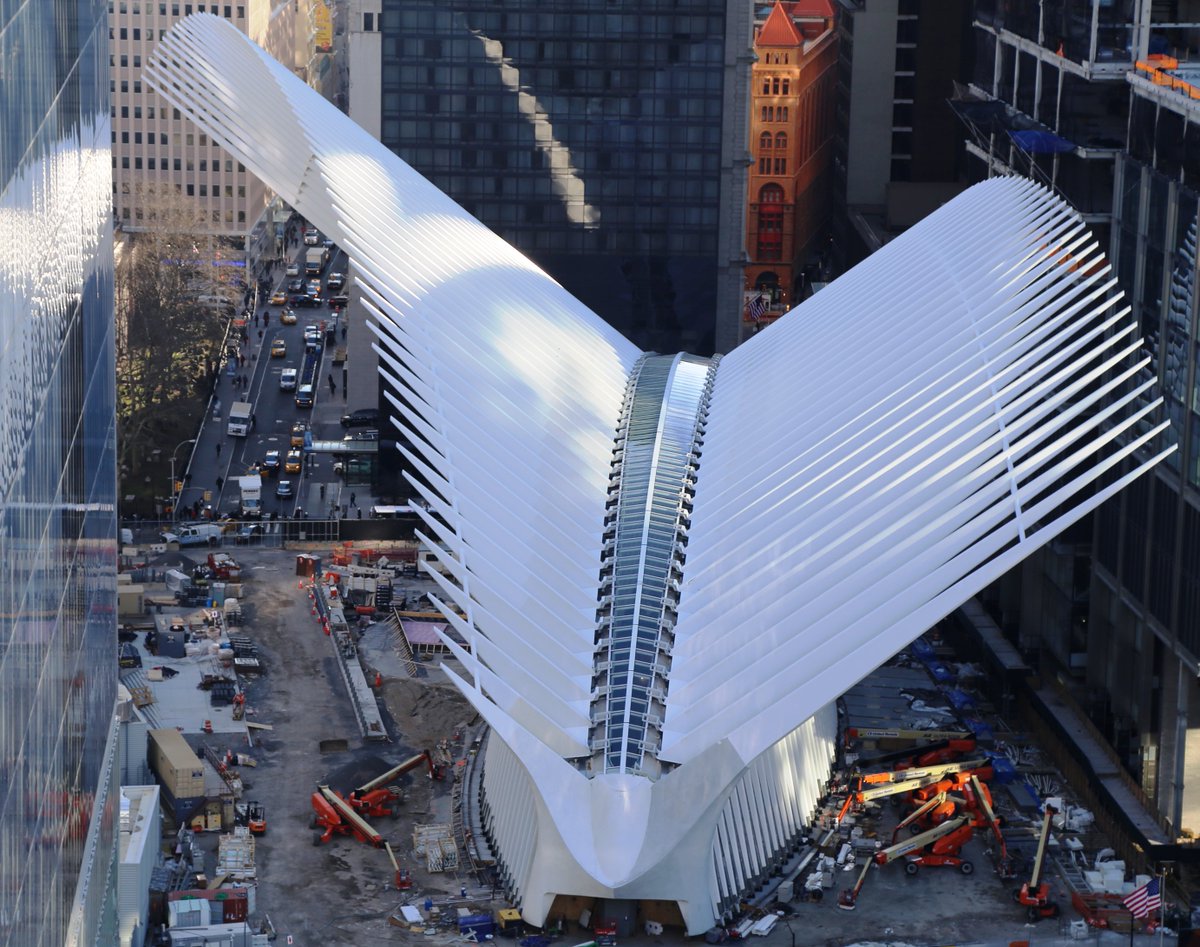
A rendering of the world’s most expensive subway station.

Early last week, a Port Authority twitter accounted trumped the installation of the first above-grade part of the Calatrava PATH Hub. For the Port Authority and Lower Manhattan, it was a big moment. In fits and starts, the Hub has taken shape, and even though it won’t open for a few years, it’s finally getting somewhere. It’s an occasion worth celebrating, but perhaps a tepid celebration is in order.

Over the years, I’ve written skeptically about PATH’s new World Trade Center hub. It is a $3.7 billion monument to Santiago Calatrava that does little to advance transit access to Lower Manhattan. It doesn’t offer added capacity; it doesn’t expand PATH’s reach. It is, in essence, the world’s most expensive subway stop.

It’s almost flippant to refer to the PATH hub as an overpriced subway terminal even if that’s what it is because the expense and construction time have had a very negative impact on Port Authority’s other transit-related projects. With so much money sunk into the PATH station, other efforts have taken second stage, but until recently, we haven’t had a good grasp on the extent of the situation. That changed this week when Stephen J. Smith published an in-depth look at the PATH hub. He is, as expected, very critical of the entire project, and I will excerpt liberally.

We start with its cost and origins:

When the grandiose ambitions and the emotions of 9/11 met with the famously flush Port Authority, disaster struck. Mission creep, an inattentive governor and extreme politicization sent costs skyward, eventually outstripping even the record-setting resources devoted to it. Its wings had to be stilled and its supports thickened, the bird in flight devolving into an immobilized stegosaurus. The world’s most expensive train station, it seems, was not expensive enough to contain all of New York’s dreams.

For nearly $4 billion, most cities could build entire subway lines. Even the MTA, which frequently breaks cost records of its own, managed to build its Fulton Center hub, a renovation of five densely tangled lines, for $1.4 billion. Nobody’s subway tunnels cost more than the MTA’s, but even they could fund most of the second phase of the Second Avenue subway, from 96th Street to 125th, with that kind of cash.

The World Trade Center PATH station is actually not a particularly busy one. “No one intelligently could say that the level of design and architecture associated with it was commensurate with the level of usage,” said one former commissioner. (Like nearly everyone we interviewed for this story, he would only speak on the condition of anonymity.)

To make matters worse, the World Trade Center station doesn’t draw the traffic to warrant the expense. It is the city’s tenth busiest subway stop when stacked against the MTA’s own ridership, and no one is advocating for a $3 billion station at Lexington Ave. and 53rd St.

Beyond that, Smith tells the story of its funding: When originally proposed by Calatrava, the $1.9 billion price tag was a red herring. Port Authority and the feds came to terms on the grant before anyone knew how much the full project would cost, and the various stakeholders took advantage of the uncertainty. Site foundation costs are baked into the PATH Hub costs, and a lot of common infrastructure costs eventually foisted onto Port Authority “might not have passed the FTA’s muster,” Smith explains.

Port Authority had a chance to reign in costs. One of its heads, appointed by Eliot Spitzer, vowed to cap spending at $2.5 billion and had a plan that eliminated many superfluous elements to keep costs down. But, as with many transit expansion efforts in New York, this one too fell by the wayside when Spitzer resigned in the wake of his sex scandal. Chris Ward, Gov. David Paterson’s replacement, wanted to see accomplishments, never mind the costs. So Calatrava’s passageways and wings were retained, and the project marches ever onward as it becomes the world’s most expensive subway stop.

Are there lessons we can take from this? Of course, there are, but it’s not really about Albany oversight or better control over Port Authority’s purse strings. Rather, it’s a lesson that should unfold a few miles north at the site of what is currently Madison Square Garden. Pending a City Council vote, various city stakeholders seem serious about the opportunity to do something about Penn Station and MSG, and, for better or worse, that something will involve a new station house.

The mistakes of the World Trade Center Hub should not be repeated at Penn Station. If the city overhauls Penn Station, transit expansion should trump a fancy building designed by a big-name architect who wants to leave his mark on New York. We’ve spent far too much on buildings that do far too little to improve the region’s mobility problems, and that time should end. If we learn one thing from the PATH debacle, it should be that.

Categories : PANYNJ
Comments (81)

Over the weekend, seemingly in only an article in The New York Times and not anywhere else on the Internet, the New York State Department of Motor Vehicles announced a new look for the state’s driver licenses. Beginning in July, New Yorkers renewing their licenses or getting new ones will receive hard polycarbonate cards with two black-and-white photos. Ostensibly this is a move to combat counterfeiters and purveyors of fake IDs.

The details surrounding the new licenses — including word of a lawsuit over the contract reward and bidding process — are laid out in Jesse McKinley’s article. For now, this move will have little impact on anyone’s life as we’re not being asked to fork over the dough to receive new licenses yet. I wanted to take a look at the sample though because something familiar grows in the background.

license-articleLarge

If you look closely you will see that the background is not a usual symbol of New York State. The seal of New York, the city skyline and Niagara Falls have all been banished from the license, and in their places are the Statue of Liberty and….Santiago Calatrava’s half-built World Trade Center PATH train transportation hub? Pardon my incredulity but since when do semi-realized architectural renderings for a project not due for completion until maybe 2015 or maybe 2016 qualify as a Great Symbol of New York State?

To me, this reeks of an ex ante justification for the transportation hub — or perhaps even an ex post attempt at excusing the project. As of now, the hub is set to cost nearly $4 billion and won’t do a lick to increase rail capacity. It’s supposed to be an anchor in Lower Manhattan and a symbol of the area’s rebirth 15 years after the September 11th attacks, but it’s become a sign of New York’s inability to invest sensibly in infrastructure while keeping costs under control. We should have great public spaces, but we shouldn’t be bilked out of money by an architect more concerned with his vision than New York City’s needs.

And so, we’ll be forever reminded of this multi-billion-dollar porcupine in Lower Manhattan that really serves as a gateway to and from New Jersey because it will be featured ever so prominently on state-issued ID cards. Today, it’s not a symbol of anything really because it doesn’t exist, and when it does exist, it shouldn’t be a symbol New York should embrace so readily.

Comments (53)

Without much fanfare, the Port Authority has restored PATH train service to its pre-Sandy levels. Via a Tweet early Wednesday evening, the agency announced that weekend service to and from the World Trade Center and Exchange Place will commence this Friday. For Jersey City-bound travelers coming from points south in New York City, this announcement — unaccompanied by a press release — is a welcome one.

PATH’s service restoration comes nearly four months to do the day after we witnessed stunning video footage of water flooding through PATH’s system. Although the PA wasn’t nearly as transparent with its post-Sandy images or plans, we heard that water completely flooded the tunnel between Lower Manhattan and Exchange Place, and a subsequent escalator malfunction at Exchange Place was seemingly the result of such flooding. Four months and countless dollars later, PATH service — an oft-underlooked but key element of the region’s transit system — has been restored.

Yet, even with the good news, I am left wondering what now? The Port Authority hasn’t been too forthcoming with its plans, but now that service levels have been restored to pre-Sandy levels, the PA must placate concerns over future storms and future flooding. Will the agency invest in storm and flood mitigation efforts? Will the new $4 billion PATH hub in Lower Manhattan be protected from future storm surges? According to one report, Sandy cost PATH 18 months on that project, but subsequent denials cast doubt on that story. If those delays were due to hardening efforts, it would probably be a worthwhile one.

We cannot as a region afford to look this gift horse in the mouth. Outside of the Rockaways, South Ferry and New Jersey Transit’s inane treatment of its rolling stock, transit services were restored to pre-Sandy levels very quickly. But that doesn’t mean doing nothing is an adequate response today or for the future. Be it PATH, New Jersey Transit or the MTA, our transit agencies should be preparing for the next storm now and not three days before it’s due to hit.

Categories : Asides, PANYNJ
Comments (8)

Santiago Calatrava’s monstrous testament to the power of no public oversight.

The saga of Santiago Calatrava’s World Trade Center PATH hub is a familiar one to long-time readers. What once started out as a $2 billion project expected to take four years to build has stretched every onward and upward to become a $3.8 billion, six-year undertaking. It’s long been unclear exactly what is driving the costs and the timeline issues, but Hurricane Sandy, ostensibly, did not help.

In an interview in The Times today, Cheryl McKissack Daniel, president of McKissack & McKissack, spoke about the PATH hub. Her words were not optimistic:

Q. You’re also working on the World Trade Center transportation hub.

A. There’s another long one!

The World Trade Center started out being about 48 months and quickly grew to about six years. And now, after Sandy, that added another year and a half to the whole project. Everything was flooded — everything was new and flooded. And all of that had to be replaced because it’s all electrical work.

We are part of a large team with Turner and Tishman to provide construction management services and it’s really more on the consulting side for the Port Authority.

Vivian Marino, the Times interviewer here, was handed a gift horse and decided to turn it down. It’s a Very Big Deal that Sandy and the subsequent damage added another 18 months to this project, and logical follow-up concerns costs. The Port Authority has, so far, been mum on anything relating to this project and its projected spend.

Meanwhile, I’ve heard from a few sources that Sandy isn’t the only factor behind this delay. These sources claim that Santiago Calatrava’s influence (and meddling) have led to some redesigns and cost increases. Additionally, others have questioned Downtown Design Partnership’s ability to manage public perception and the behind-the-scenes timeline.

So what we’re left with here are more questions and concerns. It’s likely that this PATH terminal won’t wrap until after work on 1 World Trade Center is finished, and it’s guaranteed to cost $4 billion. To make matters worse, that $4 billion isn’t going toward any sort of increase in capacity or service levels. What a mess.

* * *

Update (4:00 p.m.): Via Twitter, the Port Authority issued a statement disputing Daniel’s statement: “Info provided by Ms. Daniel is wrong. The anticipated completion date of the WTC Transportation Hub remains 2015.” The fact, remains, however, that the project is set to open after 1 World Trade Center, cost nearly $4 billion and take eight years to construct. Is it worth it?

Categories : PANYNJ
Comments (85)

PATH will run a full weekday schedule tomorrow for the first time since Hurricane Sandy, Governors Chris Christie and Andrew Cuomo announced today. Beginning at 6 a.m. Wednesday morning, trains will once again run from Hoboken to the World Trade Center, offering up that elusive one-seat ride that had been knocked out due to sever damage from flooding.

“Restoring full PATH service to the region is possible because of the hard work of the men and women at PATH who labored 24/7 to bring this critical transit link back to life after the most devastating storm our region has ever suffered,” Gov. Christie said in a statement. “PATH riders’ patience, understanding and flexibility under such difficult circumstances are great examples of how the people of this region respond in the face of tragedy, and today is another major step toward returning our daily lives and routines to normal.”

With this announcement, PATH’s weekday service is fully restored with trains running from Newark and Hoboken to the World Trade Center and from Journal Square and Hoboken to 33rd St. on pre-Sandy timetables. Overnight weekday service will run from Newark to 33rd St. via Hoboken and from Newark to the WTC station. For now, though, and throughout February, Exchange Place and World Trade Center will be closed during the weekend as crews continue to make necessary repairs. The Port Authority expects to restore all PATH service to pre-Sandy levels sometime in March.

Categories : Asides, PANYNJ
Comments (4)

Weekday overnight PATH service between Newark and the World Trade Center stop will resume operations this evening, Port Authority announced today. With this resumption of overnight service, PATH’s weekday overnight service offerings have returned to pre-Sandy levels, three months after the storm swept through the region. Exchange Place and the WTC station will be closed throughout February from 10 p.m. Fridays through 5 a.m. Mondays as crews work to restore weekday service between Hoboken and the WTC and full weekend service.

Meanwhile, last week, Ted Mann profiled the challenges facing PATH in an excellent article in The World Street Journal. PATH has leaned heavily on manual operations and jury-rigged signal systems as well as assistance from New Jersey Transit and the MTA to restore its infrastructure. As Mann notes, a large portion of the PATH system was within the Sandy flood zone. “If I had parts of system that were not affected, yeah, it’d be easier to bring those back, but virtually all of my system was damaged,” Acting PATH Director Stephen Kingsberry said.

While reading Mann’s article and watching PATH and the MTA approach their respective rebuilding efforts, I’ve often wondered if it makes sense to have two distinct agencies responsible to entirely different oversight bodies. While PATH spans two states, it is an integral part of the New York Metropolitan area, and hundreds of thousands of New Jerseyians and New Yorkers rely on PATH to travel across the Hudson. As the region recovers from the storm, perhaps a second look at how PATH operates in relation to the rest of the region’s transit network should become a louder part of the discussion.

Categories : Asides, PANYNJ
Comments (47)

Nearly two and a half months after Superstorm Sandy swamped the PATH system, the Port Authority will be restoring some 24-hour service to its beleaguered interstate subway system, Governors Chris Christie and Andrew Cuomo announced today. Starting tonight, PATH service between the hours of 10 p.m. and 5 a.m., seven days a week, will commence between Newark and 33rd St. via Hoboken with stops including Harrison, Journal Square, Grove Street, and Newport in New Jersey and Christopher Street, 9th Street, 14th Street, and 23rd Street in Manhattan. This route will also run non-stop over the weekends starting at 10 p.m. on Friday and running through 5 a.m. on Monday.

According to the press release, restoring PATH service “has been a top priority for the Port Authority.” Wise minds could debate what exactly that means for the same amount of time it took the PA to restore service. Still, I won’t look a gift horse in the mouth that closely. For lots of commuters and New Jersey residents, even this limited 24-hour service is a welcome relief to the transit desert that had enveloped the area.

Meanwhile, the World Trade Center stop will not be a part of this service restoration. The infrastructure between the WTC and Exchange Place was seriously damaged during the flooding, and as this week’s escalator malfunction showed, there’s still a long way to go before everything is normal again. Still, this is a big step. Now who wants to go to Barcade in Jersey City?

Categories : Asides, PANYNJ
Comments (10)

If the G train, is New York City’s forgotten stepchild of a subway, what does that make the PATH trains? Serving as a vital link between rapidly-growing waterfront communities in New Jersey and both Lower Manhattan and Midtown, PATH saw a record 76.6 million riders in 2011. But since Superstorm Sandy swamped the system, PATH riders have been left in the dark by a two-state agency seemingly responsible to no one.

Earlier this week, the Port Authority finally restored a vital PATH link between Hoboken and Manhattan, at least partially. With service out to the flooded terminal, the city had been suffering tremendously with some residents even contemplating moving. The situation is still not ideal as service is operating only between 33rd St. and Hoboken and only between 5 a.m. and 10 p.m. The missing late-night and overnight service is a major concern.

In announcing the restoration of service, Gov. Cuomo and Gov. Christie issued a joint press released that included no statement from either Governor. Even their press secretaries couldn’t be bothered to put words into their mouths for the occasion — which tells you how little they seem to understand the value PATH has to the city. The press release trumped the return of train service for “more than 29,000 commuters” but neglected to mention when 24-hour service would return. The release also noted that direct service from Hoboken to the World Trade Center terminal “remains several weeks.”

Meanwhile, PATH’s reluctance to provide any further information has annoyed customers for nearly two months. Yes, Sandy created dire circumstances, but as the MTA’s willingness to share information has shown, customers appreciate updates. Furthermore, PATH’s own insularity can lead to absurd situations as well.

Take, for instance, a message on Twitter issued by @PATHTweets yesterday. In an effort to assist customers navigate the system, PATH issued this statement on traveling from Hoboken to the World Trade Center:

Yes, you’re reading that correctly. This is the official PATH account telling its followers to go into Manhattan to Christopher St., 1.5 miles away from the World Trade Center, travel back to New Jersey and then go back into Manhattan for this trip. Later, PATH clarified that the Hudson-Bergen Light Rail was still cross-honoring fares, but what of the subway? Why not take PATH to 9th St. and switch to a downtown A, C or E train?

The problem of course is one of artificial agency turf wars. PATH later defended their instructions on the grounds of providing single-fare information, and therein lies the problem. Even though riders can use pay-per-ride MetroCards to swipe into the PATH system, there are no free transfers between the systems, and planners and politicians often act as though the two agencies are utterly foreign.

In an ideal world, the PATH system would be integrated into the New York City subway with easier transfers and fare payment technologies. Other than state boundaries and controlling agencies, there’s no real reason, from a regional transportation perspective, to separate the various entities and their rail systems. But politicians are stubborn, and change is slow-moving. We’re left instead with a PATH system lacking in common sense and transparency when it could be so much more.

Categories : PANYNJ
Comments (123)

The video atop this post is a 35-second glimpse at the power of floodwaters. During Hurricane Sandy, the storm surge, as we know, knocked out many of the MTA’s services, but New York City’s Transit Authority got most of the subway up and running within a week. In New Jersey, PATH suffered more severe damage and has been slower to come back, but starting Monday morning, the World Trade Center link will reopen.

Over the weekend, Governors Andrew Cuomo and Chris Christie announced the resumption of limited service between the World Trade Center stop, Exchange Place in Jersey City and points west. The WTC PATH line will run from Monday through Friday from 5 a.m. to 10 p.m. with stops at Newark, Harrison, Journal Square, Grove Street and Exchange Place and in New York at the World Trade Center. Hoboken, though, remains shuttered due to extensive damage.

The Port Authority, a two-state entity, has not been nearly as forthcoming with information about the damage its PATH system sustained or its efforts at repair as the MTA has been. We’ve seen limited images of the tunnels and little word of ongoing work. For thousands of riders who rely on the connection between Exchange Place and the World Trade Center, the restoration of even limited service is welcome news, and that workers put in the hours non-stop over the Thanksgiving weekend should not be overlooked.

The release from the two governors’ offices contained more information on the efforts to restore service. Right now, there is no weekend service so workers can continue to make “the remaining necessary repair work.” Additionally, when the WTC line reenters service on Monday morning, the 33rd St. line will resume trips between Journal Square and 33rd St. with all station stops in Manhattan. On weekends, the 33rd St. line will stop at Harrison and Newark as well.

As to Hoboken, the release sums it up: “Service at the Hoboken station, which saw unprecedented and widespread flooding remains suspended due to the fact vital switching equipment was destroyed and cannot be salvaged. Crews are working 24/7 to replace the signal equipment and restore communications in the tunnels, a process that is expected to take several weeks.”

For now, ferry service and shuttle buses will continue to offer additional transit options for riders from Hoboken who are left without their PATH service, and as repairs continue, it’s imperative to begin discussing ways to avoid these problems in the future. Whether the answer lies in tunnel plugs, flood doors or an as-yet-undiscussed solution, the region needs to begin planning for the next storm now. It’s only a matter of time before we get another.

Meanwhile, we should also remember not to take transit and its workers for granted. The storm hit four weeks ago, and only a few isolated trouble spots remain. Overall, the MTA and, to a similar extent, Port Authority have put in some diligent work restoring the system. We now know what these agencies can accomplish when faced with a crisis. Can they transport those experiences to day-to-day operations and long-term capital construction projects?

Categories : PANYNJ
Comments (21)

Lost amidst the clean-up efforts after Sandy was a bit of good news for Upper Manhattan. As The Daily News reported last week, the planned $180 million revamp of the Port Authority’s bus terminal at the George Washington Bridge is set to start this month. The renovation is set to overhaul the building’s ugly facade and bring approximately 100,000 square feet of retail space to the underused terminal.

The former tenants of the space moved out over a year ago, and work on this project was set to launch last January. It was, however, delayed due to issues with funding and the various developers chosen for the project. Now, with a start date nearing, community leaders are pleased the project is moving forward. “We don’t see this just as getting the eyesore out of the community,” Maria Lizardo, an official with the Northern Manhattan Development Corp., said to The News. “We must make sure that it’s a hub for local employment.”

Categories : Asides, PANYNJ
Comments (28)