Archive for PANYNJ
NY, NJ spar over Tappan Zee funding plan
Posted by: | Comments
The two final proposed replacements for the Tappan Zee Bridge.
New York State has put forward an ambitious $16-billion plan to replace the Tappan Zee with a multi-modal bridge. The new structure will feature rail and bus lanes and will improve transportation in between northern New Jersey, upstate New York and the metropolitan region. The state, however, has not allocated funding for the project in its next five-year capital plan, and Gov. David Paterson, in the waning days of his time in Albany, is searching for a funding solution.
To that end, Paterson floated the idea of folding the Tappan Zee into the Port Authority. The newly-rich PA could spend some of its ARC allocation on the bridge replacement, and New York and New Jersey would split the toll proceeds. Even though the bridge does not go into New Jersey and advocates feared it would be, in the words of the RPA’s Neysa Pranger, “a tough sell,” Paterson’s people believed that the bridge’s importance to the region would be a compelling enough reason to move forward.
“The ball’s in their court right now. But if they’re ready, I’m ready,” Paterson said of New Jersey. “And if they’d like to do it with the next governor, that’s fine, too.”
And guess what Gov. Chris Christie said? Well, he said no no no. “I can’t make this any clearer to New York than this: Stop screwing with us, OK?” he said. “You’re not going to come and pick our pockets. New Jersey’s not going to permit it anymore.”
He went on: “Gov. Rockefeller, may he rest in peace, decided that he wanted to keep all that money to himself. Well you want to keep all the money to yourself? Then you pay for the repairs by yourself. Unlike the George Washington Bridge, unlike the Holland and Lincoln tunnels, where we share the toll revenue and we share the cost of maintenance — like the airports.”
Christie appears to be ignoring the part of Paterson’s proposal where New Jersey gets to keep the toll money, but it’s not a surprise that he shot this idea down. What is surprising is his reaction. It’s tough to find anyone who thinks New York is “screwing” with New Jersey or picking the state’s pockets. New York provides jobs for workers in the region who take home their earnings to spend in New Jersey. We don’t capture revenue through a commuter tax any longer, and we’ve put up with increased congestion due to the influx of cars from across the Hudson River.
At some point, New Jersey and New York are going to have to work together to solve the transportation problem. If Christie and Paterson can’t, maybe Christie and Cuomo can. If not, we’ll just have to wait out these obstinate politicians. The traffic and transportation problems will remain long after Christie out of office.
An alternate subway but only for a mile and a half
Posted by: | Comments
PATH's limited service in Manhattan doesn't make it a viable subway competitor.
Had the tunnel construction held up in the late 1870s, today’s PATH system would be the region’s oldest subway. But a series of construction mishaps, including a few fatal tunnel blowouts in 1880, shelved the plans for a New Jersey/New York underground train until work resumed in 1902. By 1911, the system as we know it today was in place, and for all intents and purposes, the New York City end of the PATH system has remained unchanged for 99 years.
Today, PATH is a small but vital part of the region’s transportation network. Its popularity seemingly peaked in the years before the Holland Tunnel opened as a transportation competitor, but the little railroad still carries over 250,000 passengers a day, most of whom are bound for the World Trade Center stop or one of the stations underneath 6th Ave.
The stations themselves resemble an alternative subway in New York City, and the vast majority of the city’s straphangers rarely have the need or opportunity to ride PATH. The routing in Manhattan after all covers just 1.4 miles and already runs where the subways go. (As a historical side note, the PATH tracks along 6th Ave. are in between the IND local tracks and above the express tracks. New York City had to build the independent 6th Ave. line around the preexisting PATH infrastructure.)
Yet, in today’s Times, Michael Grynbaum wonders if more commuters would be willing to turn to the PATH system come 2011. Why? Because of the fares. As Grynbaum relates, one trip on the PATH train costs just $1.75 while a pay-per-ride swipe of the MetroCard will cost over $2 even with the bulk discount next year. Those few folks riding from the village to Chelsea should imply take the PATH, he writes.
To the uninitiated, a ride on the PATH train might seem like stumbling into a Bizarro World subway. The familiar wooden benches of the subway station are replaced by curvy seats made from silver plastic. The ubiquitous security warning — “If You See Something, Say Something” — is rendered in PATHese: “You Call It In, We Check It Out.” The signage has a less graceful version of the subway’s Helvetica, and the Corinthian columns are painted an oddly vivid blue.
But regular riders say that PATH trains are more frequent, cleaner and quieter than subway trains. “Significantly less screeching,” said [Greenwich Village resident Casey] Smith, who, like many converts to PATH, stumbled upon the railroad months after moving into his neighborhood. In two years of daily rides on PATH, he said he had never waited longer than five minutes for a train.
It is difficult to measure how many PATH passengers ride the train solely within Manhattan, and officials at the Port Authority of New York and New Jersey, which operates the railroad, say that those customers have traditionally made up a small percentage of the railroad’s New Jersey-centric ridership. Dozens of riders can be spotted boarding Midtown-bound trains on weekday mornings at the PATH stations in Manhattan. With the price of a monthly MetroCard going up to $104 next year, longtime PATH riders say they expect to see more riders coming through the turnstiles of that railroad, where a 30-day pass costs $54.
New York City Transit officials were rightly dismissive of PATH’s potential competitiveness. “I don’t believe it’s ever been a concern,” MTA spokesperson Charles Seaton said to The Times.
It is romantic to think of a better-funded and somewhat more monder competitor to the MTA’s subway service, but the real problem is that the trains simply don’t go anywhere. “Dozens of riders” at one station represent just a fraction of the people who rely on the more extensive subway system, and by and large, people commuting from the village to West 33rd St. simply walk anyway. This isn’t a high-demand route. Now, if we want to talk about better integration between PATH and NYC Transit, that’s a different story altogether.
Inside the WTC Calatrava transit hub
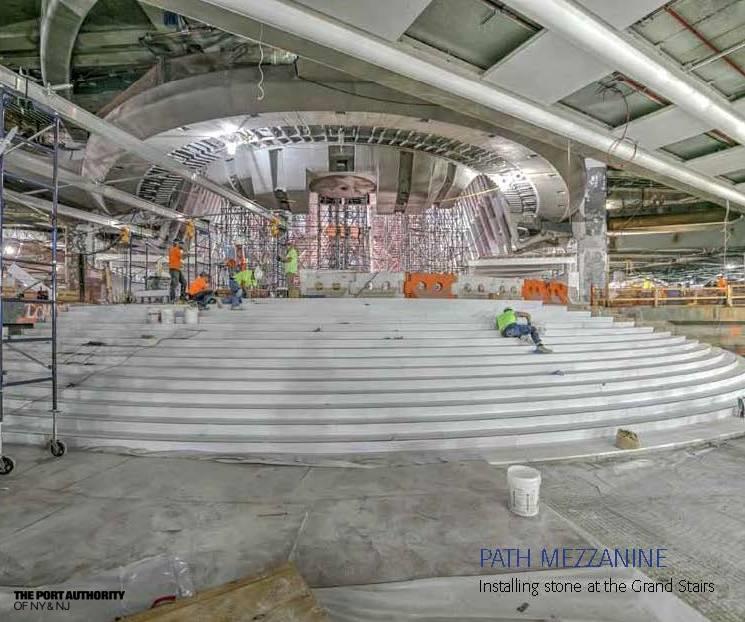
Posted by: | CommentsWhen all is said and done, the Santiago Calatrava-designed transit hub at the World Trade Center site will carry with it a $3.2 billion price tag, some garish architecture and a vast underground complex that connects the PATH stop with the 12 subway lines at Fulton St. The project should be completed by 2014, and yesterday, The Wall Street Journal’s Metropolis blog scored a short animated video of the future hub from Brookfield Properties, a development partner at the WTC site. I’ll let the picture speak for itself.
For PATH stations, a $200 million overhaul
Posted by: | CommentsThe Port Authority’s PATH system has a reputation for being, in the words of one author, “drab, dirty and uncomfortable.” Some trains aren’t adequately air conditioned, and the system’s stations haven’t been upgraded in years. That should begin to change, however, as PATH will invest $200 millionin its stations as part of a $1 billion upgrade plan.
The changes are extensive. As The Record’s Tom Davis reported earlier this week, the money will go toward expanding platforms along the World Trade Center line to “accommodate 10-car trains, which will allow an additional 400 passengers per trip”; a new public address system; better signage and maps; new station benches, lighting and flooring that “will make the wait in stations safer, more comfortable and visually appealing”; and a public arts program that will beautify the drab stations. “Mass transit over 40 years or so has continued to evolve, and you see train stations across the country are continuing to evolve,” Bill Baroni, deputy executive director of Port Authority, said. “We’re doing the same with the PATH stations.”
The crown jewel of this renovation will be the Harrison Station that currently serves the Red Bulls’ new arena. A $100-million investment will see a new pavilion arise that can better accommodate the larger crowds, and PATH officials believe the upgrades will help attract more people to the cross-Hudson subway and take a few folks out of their cars. “We’re trying to make it more commuter friendly,” Baroni said. “Like all good transit systems, we’re evolving constantly.”
Senate declines to approve Hemmerdinger for PANYNJ post
Posted by: | CommentsAfter Dale Hemmerdinger was ousted from his role as the MTA Chair as part of last summer’s funding package, he resurfaced in November when, in a fit of cronyism, Gov. David Paterson nominated him to join the Port Authority board. Well, apparently, that nomination isn’t going too smoothly. As Eliot Brown of The Observer reported earlier this week, the State Senate has so far passed on the Hemmerdinger nod because the transportation committee hasn’t given its approval yet. And why the hold-up? State legislatures still believe that Hemmerdinger, despite meeting with anyone who asked, was not, in the words of Andrew Lanza (Rep. – S.I.) “forthcoming with information about the policies of the MTA or responding to the riders or elected officials.” What a bunch of buffoons.
In New York, ARC tunnel could face eminent domain delay
Posted by: | CommentsAs the Port Authority has begun its preparations for construction of an $8.7 billion commuter rail tunnel under the Hudson, its need for property has arisen to the forefront. In a report prepared for New Jersey Gov. Christopher Christie, an advising committee has warned that the start of construction on the New York side could be delayed by up to six months if issues relating to eminent domain takings are not resolved. Patrick McGeehan goes in depth into the issue today in The Times, but in a nutshell, some local business owners are questioning the need for a second train terminal so close to Penn Station. Still, the Port Authority says it is following proper procedure, and with the recent eminent domain holding concerning the Atlantic Yards plans, a legal challenge here would be highly unlikely to survive. [The New York Times]
Where have you gone, Dale Hemmerdinger?
Posted by: | CommentsOn Oct. 5, Jay Walder assumed his role as the current CEO and Chairman of the MTA, and upon his arrival, outgoing chair Dale Hemmerdinger returned to his real estate roots. Hemmerdinger, a major player in New York State’s Democratic party, was not out of a public role for long though. As The Observer reported a few weeks ago, Hemmerdinger was nominated to the Port Authority board in mid-October by Gov. David Paterson. Even more so than the MTA Board, the Port Authority’s board has become a dumping ground for what reporter Eliot Brown termed “many a campaign donor, budding politicians in search of a placeholder, and onetime political heavyweights who have passed their peaks.” Political patronage lives on in New York.
NJ Transit, PANYNJ unveil new websites
Posted by: | CommentsA screenshot from New Jersey Transit’s new website. Click to enlarge.
With the MTA’s website stuck in neutral, looking as though it belongs in the 1990s and featuring a lot of information and no easy way to find any of it, two of its regional competitors have unveiled redesigned sites over the last two weeks. New Jersey Transit has streamlined its site and now presents up-to-the-minute line status, and the Port Authority unveiled its first site overhaul in 13 years last week.
We start with the new New Jersey Transit site. Shown above in the screenshot, this new site is a pared-down and streamlined version of their old one. The home page is modular with easiy-to-find information. It features the at-a-glance service updates and urges customers to sign up for e-mail and text message transit alerts. While New York City Transit’s TripPlanner is nowhere to be found on the MTA’s homepage, NJ Transit’s is front and center on the redesigned site.
In terms of information integration, NJ Transit’s new site represents a real step forward for the commuter rail. One of its main new feature is a system-wide rollout of DepartureVision. This monitoring system “displays train departure boards on your computer or mobile device” and is now available online by navigating to most of the stations on the new website. Imagine a similar feature for our subways.
On the page discussing the redesign, NJ Transit explores the theory behind their new website. It is all about reducing the number of clicks a user must make to find anything.
Throughout the site, information is better organized to give you what you need with as few clicks as possible. Need to find parking? Traveling to Newark Airport? Planning a trip to Prudential Center? You can access all of this information and more right from the homepage. We’ve also improved our presentation of service advisory information, by conveniently organizing it by rail line or bus route.
That is, in a nutshell, one of the MTA’s biggest problems. The information is there, but it is not presented in any logical way. Navigating through the various sub-agencies’ pages takes far more time than it should, and the home page has no structure to it. As more and more transit agencies overhaul their websites, the MTA just gets left further behind in the technological dust.
New Jersey Transit isn’t the only local agency unveiling a new site. Late last week, Port Authority did just that. Take a look and click to enlarge:
“In recent years we’ve worked on multiple fronts to make the Port Authority more accessible and transparent to the public we serve. Our new web site is a major advance on these efforts, by providing more information about our various businesses and making that information available in a user-friendly way,” Port Authority Chairman Anthony R. Coscia said.
This new site features a minimalistic home page with numerous features behind it. Customers can access real-time alerts, an improved trip finder and more thorough explanations of ongoing PA initiatives and projects. Good luck getting real status updates on the MTA’s capital programs.
In the end, New Yorkers benefit from these redesigned websites. It’s easier to find information that helps us commute around our area. But at the same time, the MTA’s old site just looks worse and worse. I don’t know of any agency plans to overhaul the site, but for the MTA to improve its customer relations and its transparency, a new website is a necessity.
On the need for a new Penn Station
Posted by: | CommentsWhile my daily focus here encompasses New York City Transit and MTA projects, to the west of Manhattan, a new rail tunnel is under construction. The Port Authority’s ARC Tunnel, spurred on by a significant stimulus investment, is slowing making its way toward Midtown Manhattan. The current plans are to build a significant extension to Penn Station, but the reality is that New York City needs Moynihan Station with its increased capacity and better pedestrian flow. To that end, Bloomberg Media’s architecture critic James S. Russell explored the shortcomings of Penn Station and the need for a better solution to the city’s rail access problem. Check it out. It’s well worth the read.
Inside Calatrava’s tunnel
Posted by: | CommentsNearly seven and a half years later, the various Ground Zero projects are starting to come together. This weekend, the Daily News explored a transit-related aspect of the massive redevelopment program: the East-West Connector that will run from Fulton St. and the new Port Authority PATH terminal to the Winter Garden and Battery Park City. Douglas Feiden captured some film, above, of the project and reports that it is due to open in 2013 or 2014.