Archive for Queens
From Queens, ideas for an expanded subway system
Posted by: | Comments
The 1939 plans for the IND Second System would have expanded the subways to the far reaches of Queens.
New York City’s local races — of which there are plenty this year — tend to bring out the crazier transportation ideas. Over at Streetsblog, local candidates have offered up their views on the MTA ranging from the incomprehensible to the sensible while Sal Albanese has focused his mayoral campaign around a congestion traffic plan that would boost mass transit. My favorite though comes to us from Queens.
Leroy Comrie, a current City Council member, is running for Queens Borough President. He isn’t likely to top Melinda Katz who has the backing of the county leaders, but that shouldn’t stop him from trying. In announcing his candidacy, Comrie unveiled his desire to see new subways for Queens. The plans aren’t exactly well formulated or even on the table, but the idea is an intriguing and fanciful one.
The Daily News had more about the ideas put forth by the chair of the Council’s Land Use Committee:
Councilman Leroy Comrie re-launched his bid for borough president this week by dropping a stunning bombshell: he wants a new subway line in Queens. “The E and the F lines are more congested — we could build another line in that tunnel,” said Comrie (D-St. Albans). “Those are the most congested lines in the city.”
The J and Z lines that connect Brooklyn to Queens also could use an overhaul, he said.
The cost of additional service makes Comrie’s proposal as likely as a Mets World Series victory this year. After all, the long delayed Second Avenue subway, which will run from 63rd to 96th Sts. in Manhattan, will cost $4.5 billion by the time it is finished in 2016.
I’m not quite sure what Comrie intends to do with the Queens Boulevard line. There’s no room to “build another line” in the same tunnel, and any new subway in Queens should enhance service, not duplicate preexisting routes. Still, there are significant parts of Queens that are sorely lacking subway service.
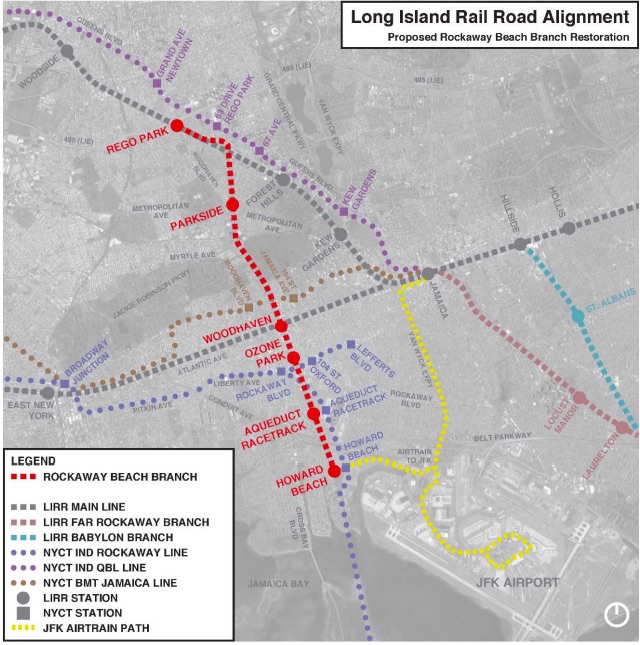
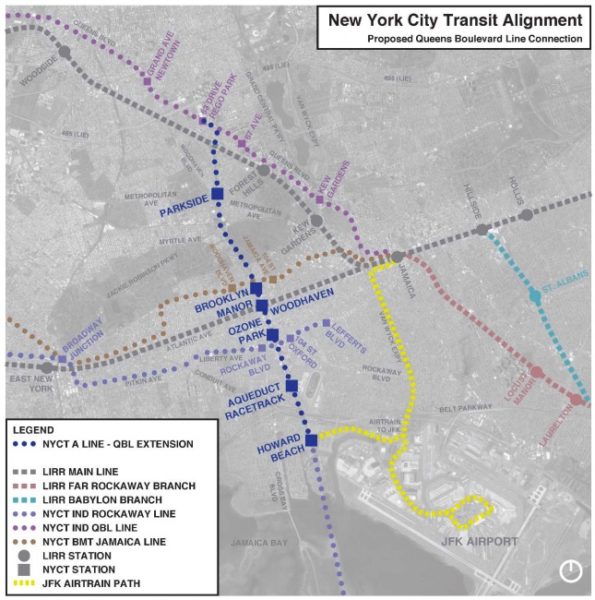
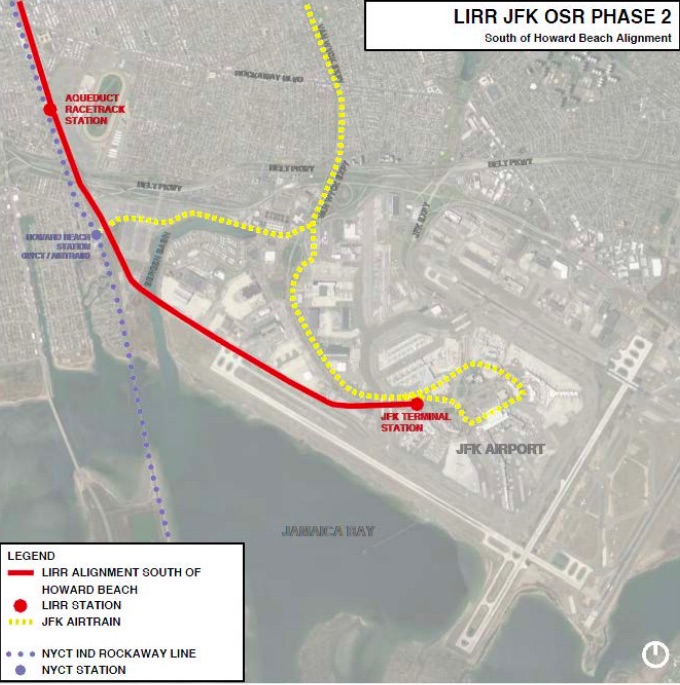
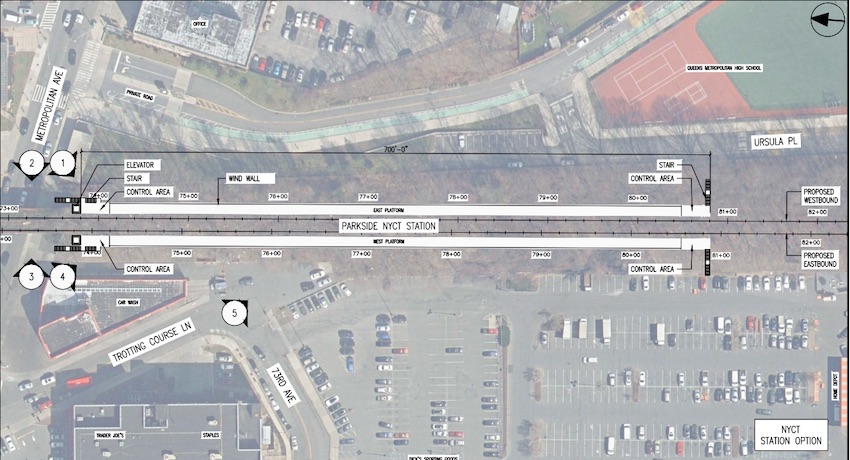
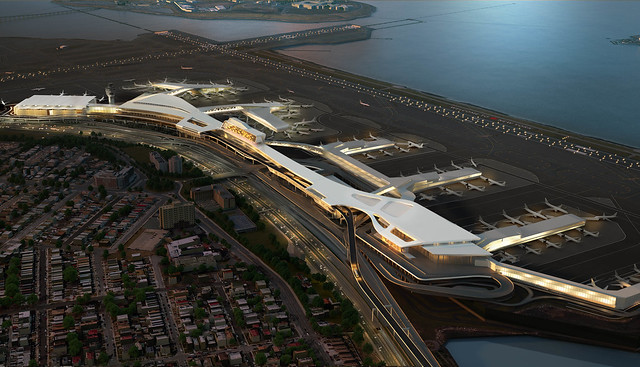
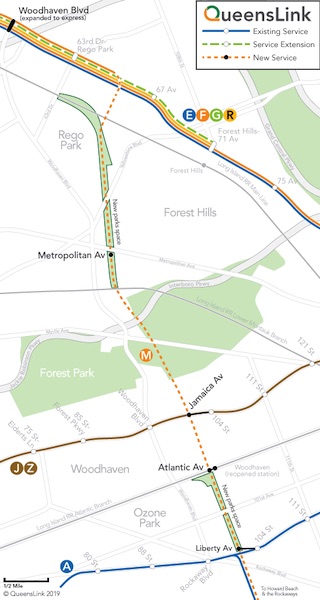
For starters, a rail connection to Laguardia would improve mobility to the airport. In terms of access to and through residential neighborhoods, Middle Village could use better subway service, the areas east of Flushing are cut off from the system, and, of course, the Rockaway Beach Branch line could be reactivated. That last proposal has been in the news of late.
With around 2.25 million people, Queens is the second most populous borough, but its subway routes are limited. The western parts of Queens are well served, but the eastern parts are not. Additionally intra-borough, north-south travel is nigh but impossible. Had either version of the Second System plans (1929 or 1939) seen the light of day, Queens would have a more extensive subway network, but only bits and pieces have come online over the decade. None of the transformational lines have seen the light of day.
Ultimately, Comrie’s ideas won’t go anywhere. His candidacy is barely hanging on by a thread, and he’ll likely drop out well before September’s primary. Plus, the Borough President has very little pull in matters of state or even city politics. Still, I like seeing bold ideas presented to the public. Subway expansion plans happen only when leaders are willing to champion them, and if anyone in Queens truly wants better subway service, the calls for it must start somewhere.
FASTRACK returns to the Queens Boulevard line tonight
Posted by: | Comments
Shuttle buses and 7 trains will pick up the slack during Fastrack this week. Click the map to enlarge.
In a repeat of the mid-March FASTRACK treatment, the MTA’s not-so-new overnight construction program returns to the Queens Boulevard line this evening. From 10 p.m. to 5 a.m. each night this week, there will be no subway service between Jackson Heights and 21st-Queensbridge on the F or the World Trade Center on the E. Shuttle buses and the 7 train will provide alternate service.
Here’s how this goes:
- E in Queens only between Jamaica Center and 74th Street/Roosevelt Avenue
- F in two sections:
- Between 179th Street and Roosevelt Avenue and
- Between Coney Island-Stillwell Avenue and 21st Street-Queensbridge.
- M service ends early each night and the M shuttle operates between Metropolitan and Myrtle Avenues all night.
- R service ends early each night and the R shuttle operates in Brooklyn between 95th Street and 36th Street all night.
So how does one get around? Well, the MTA offers up these lovely suggestions:
- Take the 7 between Manhattan and 74th Street-Roosevelt Avenue or Queensboro Plaza
- Take the N between Manhattan and Queensboro Plaza
- In Manhattan, transfer at 5th Avenue/42nd Street-Bryant Park for the 7 or F, Times Square-42nd Street/42nd Street-Port Authority for the 7 or A, and 34th Street-Herald Square for the F or N
- In Manhattan along 8th Avenue, take the A local instead of the E
- Take free shuttle buses running LOCAL between Queensboro Plaza and 74th Street-Roosevelt Avenue making station stops at Queens Plaza, 36th Street, Steinway Street, 46th Street, Northern Blvd and 65th Street
- In Queens, transfer between shuttle buses and trains at 74th Street-Roosevelt Avenue for the 7, E and F or Queensboro Plaza for the 7 and N
While looking at the map and the shuttle bus route, I realized it’s an odd service pattern. It connects a 7 train stop with another 7 train stop while running above the route of the Queens Boulevard local trains, but it doesn’t contain to the F at Queensbridge. Thus there is a bit of a gap in service. It’s useful for people who need the Queens Boulevard local stops, but it’s not useful for anyone continuing to travel on the F.
And as with last time, not much in the way of media coverage here. FASTRACK is here to stay, and it’s causing nary a stir any longer.
Can you tell me how to get, how to get from Brooklyn to Queens?
Posted by: | Comments
A sighting of the rare G train. (Photo via flickr user Bitch Cakes)
The geography of New York City makes for some strange transportation bedfellows. Manhattan — a long, narrow island — contains a lot of key job centers and is the house of city government while Brooklyn and Queens, as close neighbors, are home to a combined 4.7 million people. Yet, it’s relatively easy to take a train into Manhattan and relatively painful to travel between the counties of Kings and Queens. That’s a problem.
Every now and then, this transit imbalance takes center stage for a few days. On and off for the past few years, the Pratt Center has tried to fight for better interborough travel options, and the G train remains an object of scorn and derision. Yet, true Select Bus Routes between Queens and Brooklyn remain elusive, and plans to build subway connections died along with the rest of the Second System in the 1930s.
For many New Yorkers, they why of it all is elusive. In 2013, it’s viewed as a great failing that there is no quick way to get from Forest Hills or Astoria to Downtown Brooklyn or Park Slope, that the best transit route from Coney Island to Flushing involves hours of travel through three boroughs. Yet, these patterns have their roots in the history of the city’s economic development and transit policy, and yesterday, at The Atlantic Cities, Richard Greenwald, a history professor at St. Joseph’s College, offered up a brief history of the tortured connections. Here’s his take:
In the beginning, the New York City subway system, as historian Clifton Hood details in his masterful book, 722 Miles, was a commuter line. As such, it was designed to bring people to where the jobs were, and that meant Manhattan. So all subway routes lead there…While the subway got people from the outer boroughs into Manhattan, the once-vast trolley system of New York connected the residents of Queens to Brooklyn…
The demise of the trolleys in the late 1930s and ’40s seems to be largely responsible for disconnecting the two sister boroughs. Yes, they were replaced by buses, but buses have never — for a number of reasons — been able to cement the connection the way trolleys seemed to.
Starting in the 1920s, a company called National City Lines started buying up street car lines, then mostly privately owned. In 1936, the company became a holding company owned equally by General Motors, Firestone Tire, Standard Oil of California, and Phillips Petroleum. Perhaps you can guess where this is going. NCL bought up trolley systems in over 40 cities and 15 states, converting them almost overnight into bus lines. In 1947, they were indicted in federal court, in what became known as the “Great American Streetcar Scandal.” Two years later, the four original companies who owned NCL, along with MAC Truck, were found guilty of conspiracy to monopolize mass transit. But by then the damage was done. Most of the nation’s streetcar system was in junkyards, replaced by buses.
Outside of the streetcar conspiracies, Greenwald points his fingers at the social stigma attached to buses as a reason why the trolley connections were cut. “In the outer boroughs of New York, trolleys had acted as a primary mode of transportation,” he said. “Buses, on the other-hand, were tertiary, connecting commuters first-and-foremost to subway lines.” That’s not quite accurate though as the current Brooklyn bus map and the old trolley map look awfully similar. At ground level, at least, it’s no harder or easier to travel between Brooklyn and Queens than it was 80 years ago.
What happened were social shifts. Up until the last decade or so, few people noticed the poor quality of transit connections between Brooklyn and Queens because no one wanted to travel between these two boroughs. As gentrification took hold though, suddenly, middle/upper class neighborhoods were disconnected. It’s easy to travel from East New York to Jamaica or the Rockaways via the IND Fulton Line. It’s not easy to get from South Slope to Forest Hills without a arduous slow ride through Manhattan on the F train. Neighborhoods eight miles apart may as well be in different cities.
Fixes for this problem are not easy to identify. Even the long lost Second System wouldn’t have materially improved connections between Brooklyn and Queens. We instead need something as creative and fanciful as Vanshookenraggen’s Franklin Ave. Shuttle extension (or the entirety of his Second System plans). Such plans, though, require money to be no obstacle, and for the foreseeable future, money is an obstacle.
In the meantime, a better Select Bus Service would do the trick with a focus on interborough connections between neighborhoods that are current disconnected. Of course, SBS takes literally years of planning and is fraught with its own problems. Meanwhile, as jobs migrate from Manhattan to centers in Brooklyn and Queens, the Outer Boroughs remain frustratingly disconnected, a victim of the history of the economic growth and centralization of Manhattan and a lack of foresight by politicians over the past 100 years. It’s a rather familiar story after all.
Photo: Rockaway A train service resumes tomorrow
Posted by: | Comments
A test train arrives at Broad Channel. (Photo via MTA New York City Transit)
Seven months after Sandy swept through, the A train returns. Beginning tomorrow at noon, the A will again run from Howard Beach to the Rockaways. First announced two weeks ago, this service restoration is approximately a month ahead of schedule, but despite the good news, lots of Sandy-related work looms large in the future.
As part of the relaunch of the A train tomorrow, the MTA will run a Nostalgia Train from Howard Beach to the peninsula. The R1s and R9s will depart at 10:30 a.m. with various agency officials and local dignitaries on board. There will be speeches at Rockaway Park-Beach 116th Street Station, and then regular A/S service begins anew. If you want to ride the H train, get thee to the Rockaways as tonight and tomorrow morning are your last chances.
Rockaways A train service to return May 30
Posted by: | Comments
The MTA will restore service over these tracks, washed out during Sandy, on May 30.
The MTA twitter account broke the news first, but Gov. Andrew Cuomo’s office put out the press release trumpeting the return of full A train service to the Rockaways a full month early. A train service across Broad Channel and into the Rockaways will begin again on Thursday, May 30, seven months since Sandy swept away the subway tracks and just in time for the summer beach season.
As part of the restoration efforts, the MTA had to rebuild 1500 feet of washed-out tracks, replace miles of signal, power and communications wires, and rehab two stations that were completely flooded by the storm surge. Additionally, crews buried a two-mile-long corrugated marine steel sheet wall 30 feet into the soil along Jamaica Bay to “to protect the track against future washouts and ensure the line is ready to handle future coastal storms.” (For more on what the MTA had to do to repair the damage, check out this laundry list of projects complete with photos.)
“Superstorm Sandy devastated the entire MTA network like no other storm, but the MTA did a remarkable job of restoring service following the storm and at the end of this month, the A line in the Rockaways will be up and running,” Governor Cuomo said. “The last six months have meant substantial cleanup and repair, leading to the rapid restoration of full service in all but the hardest-hit facilities. Now we must focus on the priority and challenge of making permanent repairs to keep the subways safe and reliable for years to come because the people and businesses of New York depend on a strong and robust mass transit system. The difficult work of rebuilding the system to be stronger and more resilient has just begun, but we will build back better and smarter than before.”
The surprise announcement, nearly a month early, came as the MTA unveiled a series of flood-mitigation measures. The agency demonstrated an inflatable tunnel plug near South Ferry and plans to implement these plugs at vulnerable spots throughout the system. Additionally, Cuomo and the MTA announced a Sandy Recovery and Resiliency Division which will manage the years-long, billion-dollar recovery effort. This new division will oversee efforts to protect stations, fan plants, under-river tubes, tunnels, ground-level tracks, signals, train shops and yards, traction power substations, circuit breaker houses, bus depots, train towers and public areas vulnerable to flooding. The first assessments are due in July.
For the MTA and, more importantly, the Rockaways, this announcement is a major milestone in the Sandy recovery efforts. One of the hardest hit areas is going to see its subway line reconnected to the rest of the system, and the only remaining outage is centered around the new South Ferry station. Still, from what I’ve heard, repair efforts will be extensive and may include some long-term service outages in some of the more badly damaged tunnels. The MTA has not yet commented (or firmly established) these plans.
Rockaways subway service inching closer
Posted by: | CommentsAs the MTA tries to fulfill its promise of restoring A train service over Broad Channel and to the Rockaways by the end of June, a few bits of news have trickled out regarding the status of these efforts. First, the MTA announced late last week that indicator board in the signal tower at Rockaway Park – Beach 116th St. is up and running once again. In other words, the signal system — which had been utterly destroyed by Sandy — is up and running again.
According to the MTA, this is no small feat. The signal system in place in the Rockaways is decades old, and the MTA burned through its supply of spare parts. Crews had to refurbish old parts that were inundated with salt water or find replacements. These efforts will be magnified as other signals knocked out by Sandy and its floodwaters continue to degrade. Still, work remains, as Joe LaPorta, a signal engineer said. “The TA signal shop rebuilds these. They can’t even get them from a manufacturer anymore,” he explained. “By the end of the day, we might have all this cleared up here. But the yard part we can’t clear up, because we’re still waiting for parts.”
With the signal system on the mend, Transit will soon begin testing trains, The Wave, Rockaway’s local paper, reported on Friday. According to Transit officials, test trains will likely run across Broad Channel during the week of May 17th, and if all goes well, service will resume in June. As of yet, there is no set June date for restoration of the A train, but for Rockaway residents who have faced more than six months without a subway connection, it cannot come soon enough.
For LaGuardia, a new limited bus service looms
Posted by: | Comments
The MTA has proposed a new bus service for LaGuardia that will use the BQE and Grand Central Parkway to provide a speedier ride.
Absent extending the N train through Astoria — a dream that died at the hands of NIMBYs over a decade ago — the best way to improve transit to LaGuardia Airport involves buses. As buses have limited capacity especially for suitcase-laden travelers and with surface traffic heavy and variable on the roads approaching the airport, it’s not an ideal solution. Still, as the city examines various Select Bus Service routes to the airport, the MTA is working to boost existing service for a hub that’s near and yet so far.
This evening in East Elmhurst, the agency is hosting a public comment session on a proposed expansion of LaGuardia bus service. As you can see from the map above, the new route provides a connection from Jackson Heights to the airport via the BQE and Grand Central Parkway. If all goes according to plan, the new service would debut in the fall, and here’s how the MTA describes it:
The Metropolitan Transportation Authority (MTA) proposes revisions to MTA Bus Company operated bus service to LaGuardia Airport. A new limited-stop bus service is proposed connecting LaGuardia Airport with regional transit hubs in Jackson Heights and Woodside, traveling non-stop via the limited-access Brooklyn-Queens Expressway and Grand Central Parkway. The service would be named Q70 Limited. The Q70 Limited would operate 24 hours a day, seven days a week.
Coincident with the implementation of the Q70, it is proposed that the current Q33 local bus route between Jackson Heights and LaGuardia Airport be shortened to no longer enter LaGuardia Airport. The northern terminus would be relocated to 95th Street and Ditmars Boulevard in East Elmhurst, and the southern terminus would remain in Jackson Heights at the E/F/M/R/7 subway station. The Q33 would retain its current hours of service, operating 24 hours a day, seven days a week.
There’s good and there’s bad here. The good is obviously the speedier connection via limited access roads from the subway in Queens to the airport. This 24-hour service could dramatically improve transit connections for travelers trying to reach LaGuardia, and eliminating local stops in Queens means that all riders of this bus will be trying to reach the airport as quickly as possible.
The bad aspects of this plan though are problematic. First, the BQE and Grand Central do not have dedicated bus lanes and feature soul-crushing rush hour traffic jams. The buses, as with most in the city, will be subject to the whims of the road conditions. Additionally, by cutting off the Q33 before the airport, many local riders who live in the area and work at the airport will find their transit route eliminated. Doubling back to pick up the new Q70 Limited will add time to these trips. Finally, these buses will face capacity problems as they fill up with luggage and passengers. It’s a problem on the M60 and on the Q33 that this plan doesn’t solve.
Ultimately, this is a band-aid for a larger access problem. It takes existing resources and reshuffles them around to provide a better transit experience, and that’s fine if we’re thinking bigger. But LaGuardia access proposals haven’t moved beyond buses since the failed attempt at proposing a subway extension in the late 1990s. It’s time to revisit that effort whether the alignment runs through Astoria or above the Grand Central Parkway. In 2013, one of the city’s major airports shouldn’t exist in a transit desert.
Broad Channel service still on track for late June restoration
Posted by: | CommentsAs we mark the six-month anniversary of the day Superstorm Sandy swept through the region, South Ferry garners the bulk of the media attention for a variety of reasons. It was the MTA’s newest station, and it suffered dramatic damage, all of which occurred underground and in Lower Manhattan. But it wasn’t the only part of the subway system that suffered.
In Queens, all those miles and neighborhoods away from South Ferry, the subway system that connects the Rockaways to the rest of the city suffered as well. The Broad Channel crossing was wiped out completely, and the infrastructure on the peninsula was heavily damaged. In late March, the MTA said it was targeting a June date for A train service to be restored, and that date holds true today.
I checked in with MTA spokesman Kevin Ortiz this morning, and he tells me that the agency is still on track to restore Broad Channel service by the end of June. Simply running trains over the channel doesn’t mean work will stop, and crews will contain to combat the corrosive effect of saltwater for the foreseeable future. Yet, restoring subway service will be a big lift for this storm-ravaged area struggling to stay afloat after Sandy.
NYC reps call for federal funding for Rockaway rail study
Posted by: | CommentsThree New York politicians have called upon the federal government to deliver funding for a study on reactivating the city’s long-dormant Rockaway Beach Branch. Tying such an effort into both Sandy-related infrastructure investment and improved mobility for Queens and Brooklyn residents who currently face very long rides into Manhattan, Congressmen Hakeem Jeffries and Greg Meeks joined New York State Assembly Representateive Phil Goldfeder this weekend in requesting that some federal Sandy relief aid be earmarked for the project.
“Although Superstorm Sandy destroyed our coastlines and paralyzed our communities, we have an opportunity to rebuild the City in a smart and sustainable way that proactively addresses our future needs,” Rep. Jeffries said during a Sunday press conference. “Residents of Southern Brooklyn and Queens currently face the longest commute averages in the City because of the lack of reliable transportation. Restoring the Rockaway Beach Rail Line would not only ease the commute for hundreds of thousands New York City residents, it would also spur job growth and revive local businesses that have been struggling since the Great Recession hit in 2008.”
Goldfeder has been a leading political voice expressing support for the rail line, and enlisting Meeks and Jeffries should bring some further attention to the idea. It may not be as au currant or sexy as a High Line-style park, but expecting a High Line-style park to pop up in central Queens is foolish at best. Rail’s impact, as these politicians pointed out, would be far more beneficial for everyone.
“Immediate investment in this project would offer a permanent and viable transit solution for the millions of hard-working families all across Queens,” Goldfeder said. “It became evident after Sandy that we need to increase public transit options and improve our infrastructure for our neighborhoods in Southern Queens and Rockaway. Restoring the rail line will help prepare our communities to become more resilient for our future and allow our local economy to thrive for many years to come.”
Now, as park activists push forward with an RFP, we just have to wait for Washington to respond.
Previously: Rockaway Beach Branch coverage, QueensWay coverage
Photo: MTA targeting June for Rockaway subway service
Posted by: | Comments
A sheet wall will help protect vulnerable subway tracks from future storm surges. (Photo via Kevin Ortiz on Twitter)
If all goes according to plan, A train service to the Rockaways could resume in June, Transit spokesperson Kevin Ortiz tweeted today. Ortiz posted a series of photos of ongoing work on Broad Channel as crews are busy repairing and hardening the system. Including in the work is a 40-foot sheet wall across Broad Channel that will provide a seven-foot-tall wall against future storm surges.
The wall will diminish the once-grand views as the A train crosses the channel, but it’s a small sacrifice if it can better protect these vulnerable tracks from future wash-outs. Of course, the storm surge from Sandy topped seven feet in many areas. Hopefully, this wall will be tall enough to adequately protect key infrastructure.