Archive for Service Cuts

On December 17, 2001, the V train made its first controversial run from Queens to Manhattan. Nearly five months earlier, on July 23, 2001, the W had made its first run from Brooklyn to Astoria via the Manhattan Bridge and the BMT Broadway line. Today marks a sad day in the history of those two trains as later this evening they will each run their last route before suffering at the hands of the MTA’s planned service cuts.

On Monday morning, the rush hour will be chaotic. Subway riders in Astoria will see the Q arrive instead of the W, and while the N will make local stops in Manhattan, the Q as the W’s replacement will still run express along Broadway. Meanwhile, those in Middle Village will be even more confused when their M trains go from Essex St. to Broadway/Lafayette via the Chrystie St. Cut. Along Queens Boulevard, the V train will be a part of New York subway history, lost to a budget crisis and a lack of funding from Albany.

For many New Yorkers, the deaths of these train lines will be unnoticed. V riders will hop the M without a second thought, and while some Brooklyn riders from Bay Parkway will miss the M, most people will go about their subway-riding lives with nary a thought to it. But for others, the deaths of these subway lines means funeral.

One Astoria resident is hosting a remembrance of the W train tonight. Bill Reese is celebrating the “short, complicated and often pathetic life of our beloved W.” At 10 p.m., he and other W train riders will gather at Ditmars Boulevard to ride the last W train to Union Square. They’ll hop the return train — the ultimate W to head to Astoria — before celebrating at the beer garden. It is a wake fit for a train, and rumor has it that the organizer will be decked out in W train paraphernalia.

Reese isn’t the only one mourning the death of subway lines. In fact, some politicians are exploiting the moment to gain the spotlight as well. Peter Vallone will join Transportation Alternatives at 8:30 this morning to ostensibly call for more transit funding. I’m surprised to see Vallone lend his name and face to this campaign as he hasn’t been very transit-friendly. Later in the day at 8:15 p.m., Transportation Alternatives will rally in Astoria for better transit before also heading to the beer garden. Service cuts make for strange bedfellows.

The V train too will be feted as NYCentric and Newmindspace, the creators of the hipster-haven that is the New York City pillow fight, have organized a final V train ride. Revelers will gather at Second Ave. before 11 to ride the last V train, set to arrive in Forest Hills at 12:11 a.m. Those who join are encouraged to wear orange.

As New Yorkers celebrate these trains, though, it’s important to remember that these service cuts are going to impact everyone. Some Bronx residents can’t get to the nearest pool. Others will find their neighborhood buses unceremoniously eliminated. Others will find longer waits and crowded trains during off-peak hours. Service cuts are unpleasant business.

One day, the MTA may restore service when its finances improve. Today, though, is a sad day for the millions of New Yorkers who depend upon the subways and buses to take them to work, school and fun. In a city so dependent upon transit, these cuts show just how ineffective our state government is. Will anyone be held accountable?

After the jump, some info about the final rides of the M, V and W trains in their current configurations.
Read More→

Categories : Service Cuts
Comments (16)

Updated (11:45 a.m.): Nearly six years ago, the MTA changed its service patterns and didn’t tell anyone. In 2004, when the Manhattan Bridge reopened, service patterns along the B, D, Q and N trains changed in parts of three boroughs, and riders ignored the warnings.
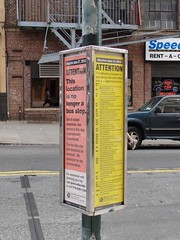
In the build-up to the services changes, the MTA tried to draw out as many people as they could. Mayor Bloomberg and the city’s politicos took a heavily-publicized ride across the Manhattan Bridge. The TA printed new maps that celebrated the system’s centennial anniversary while drawing attention to the new service patterns across the Manhattan Bridge. After two decades of construction, the publicity campaigns were tremendous.

Still, many riders were left confused. Tourists bound for one part of the city found themselves a river away from their destination, and people trying to get home ended up bound for the 4th Ave. stations instead of the Brighton Line. Despite numerous employees with new maps, a signage blitz that alerted riders to the new patterns and a lot of media attention, a good number of New Yorkers ignored the warnings.

Enter 2010. This weekend, the MTA will cut two train lines and re-route a third. These are the most significant service changes since the Manhattan Bridge reopened in 2004, and for the last month, the MTA has gone on the offensive. Posters, such as the one at right, have appeared in stations throughout the system instructing straphangers of the changes. New maps have been available since early June. The bullet decals throughout the system have been changed. It’s impossible to miss the fact that the service is going to change.

Yet, in a brief article in Metro, Carly Baldwin found people who have no idea service cuts are coming. Two-thirds of passengers polled on a rush-hour M train had no idea, says Baldwin, that the train would soon be destined for Forest Hills by way of 6th Ave. “What? Are you serious?” Jose Gonzalez said of the service change. “This sucks. The M train is right by my house. Now I’ll have to change trains.”

I couldn’t believe that people could be this ignorant of the subway service changes. Although the bus cuts have been less transparent, signs are up at every bus stop in the system where the service will change, and the subways are plastered with signs. As my girlfriend said tonight when I told her of the widespread ignorance, “What do you mean? It’s been everywhere. The signs are everywhere. The brochures are everywhere. The new maps are up.”

Beyond the MTA’s own efforts at alerting people, the service cuts have been in the news since January. It’s true that the Student MetroCards may have dominating the coverage, but the subway cuts have not gone unreported in the papers and on TV and the radio. Anyone who doesn’t know service is going to change this weekend simply hasn’t been paying attention.

And therein lies the rub. People don’t pay much attention to the MTA. They don’t read weekend service signs; they don’t listen to on-board announcements; they don’t educate themselves about transit issues. They simply ride the trains and complain. Maybe the misleading politicians drown out the MTA’s own press efforts; maybe people just don’t want to know. Whatever the reason, New Yorkers are generally woefully under-educated about transit happenings.

So on Monday, confusion will rein supreme. Wall Street-bound M riders will be surprised to find their train at Broadway and Lafayette. Those waiting for the W will be in a for a long wait. The riders will blame the MTA; the MTA will have to herd the crowds. It will be business as usual in the subways.

Categories : Service Cuts
Comments (26)

A bus stop no longer With the MTA’s service cuts to subway and bus service now just a handful of days away from becoming a reality, neighborhood associations are finally waking up to the reality of the situation. Although the cuts were first announced in January and the MTA hosted hearings on their plans over the winter, many have either ignored the news or been in denial. No longer, though, will a group of Brooklynites remain silent.

A group of protesters will gather this afternoon at 5 p.m. at Union St. and Smith St. in Carroll Gardens to protest the impending end of the B71. While the group’s press release claims the bus runs to Red Hook, the route in reality goes from Crown Heights to Van Brunt and Sackeet Sts. in Cobble Hill. This bus is near and dear to me because it stops around the corner from where I live, and the neighborhood association is now asking Assembly-woman Joan Millman, State Senator Daniel Squadron and City Councilman Brad Lander to do something.

“If this bus disappears, our developing neighborhood will be left completely in the lurch,” Brad Kerr of the Columbia Street Waterfront Association said. “We have no other public transportation, no subway, and the MTA is not offering any alternative. This move will hurt everyone who’ve struggled for years to rebuild this area.”

When I first received word of this rally, I raised a skeptical eyebrow. The B71 runs twice an hour, often not on time and with few people on board. Buses that run down Bergen and 9th Sts., while not as convenient, will pick up some of the slack, and the protest just seemed ill-timed to me. Why were these associations waiting until four days before the cuts are put into place to raise their voices?

I posed some of these questions to Marta Heilborn, a B71 rider who is part-organizer of these protests. She told me that she didn’t know about the MTA’s hearings or cuts sooner. Else, she would have started protesting then. She also informed me that she supported a congestion pricing plan that would have funded the MTA.

At the same time, the organization’s press release questions why the MTA has not used stimulus funds to help cover a gap. But, as I’ve said, even with stimulus funds, the MTA would still be staring down a $300 million. The cuts would go on anyway.

In 90 minutes, when residents gather, it will be too late. There is, of course, an online petition, but who will listen? The MTA doesn’t have the money to restore service, and the politicians seem content to put in perfunctory appearances at community protests without offering any legislative or economic solutions.

So protest away, I say. Get that outrage on the record. Make sure the politicians are listening, though, because this situation is just as much their faults as it is the MTA. Just don’t expect that bus line to be miraculously saved tomorrow. The cuts are coming.

Categories : Service Cuts
Comments (34)
Jun
21

SAS on WCBS TV

Posted by: | Comments (2)

Early this morning, WCBS TV reporter Magee Hickey put together a piece on the upcoming service cuts and the revelation that more cuts are coming this winter. She got some footage of a crowded 7 train, spoke with a few commuters not too keen on the cuts, and interviewed me. For those interested, the video is available here and the web story is available here. Unfortunately, I can’t embed the clip, but check it out nonetheless.

Comments (2)

Rush hour on the L train. Crowding on some lines could get worse in the winter. (Photo via flickr user Tasayu Tasnaphun)

When the MTA announced what I termed its efficient slate of service cuts in January, the train line eliminations and bus route restructurings earned headlines while a technical provision about load guidelines went largely ignored. Everyone wanted to hear about the end of the V train, the death of the W and the official move to cut G service to Forest Hills. No one cared if a car would now be considered full when every seat is taken and 10-18 straphangers are standing.

Today, we care for the MTA has unveiled a small slate of service cuts that will take advantage of these new load guidelines and go into effect in December. The cuts will largely target some underutilized bus routes but will also involve the restructuring of rush hour service along the 7 line. When new train schedules are implemented in December, a handful of lines will see headways increased from one to 2.5 minutes. According to The Times, transit officials say these changes are “routine adjustments to account for trends in ridership, which has sagged in the weak economy.”

The MTA’s own internal documents tell a similar story. The MTA Board’s Transit Committee books — available here as a PDF — say that these service adjustments will save the MTA $4.1 million annually and will “more closely align subway service with customer demand and established guidelines for subway operations.” Conveniently, those established guidelines are the new load guidelines that go into effect next week and allow the MTA to cut train frequency while still operating trains within its own acceptable parameters.

As for the details, the cuts are sparse but have the potential to impact many early rush-hour commuters and off-peak riders. Transit will be scaling back service on 31 bus routes while increasing it on 14, but the biggest cuts are along the IRT Flushing Line. Express service will now begin at 6:20 a.m. instead of 5:30 a.m., and riders along the 7 will lose four early-morning express trains. To meet demand, Transit will add one local trip between 5:20 and 6:10 and two local trains between 9 and 10 a.m. These cuts will be into effect in December, and other lines affected include the 1, A, F, J, L and M trains. A chart showing the new train frequencies is below.

The MTA's revised load guidelines show less frequent off-peak service. Click the image for a chart easier to read.

These new service cuts raise a few questions. First, why is the MTA continuing to cut service? The answer to his one is simple: The authority remains a few hundred million dollars in debt, and Friday’s decision to save the Student MetroCard program does little to alleviate the financial pressure. As The Times reports, the authority’s tax revenue is falling below projection, and the agency still hasn’t figured out how to close its $400 million budget gap. Thus, more service cuts.

The second question is one few people want to ask: So what happens next? At this point, the MTA has revised its load guidelines, has cut off-peak service and is starting to whittle away at the fringes of rush hour traffic. Will the agency begin to pare down its peak-hour offerings? Are we in line for a fare hike? Even the carrot of $90 million in stimulus funds wouldn’t be enough to close the gap, and the Senate has yet to move on a potential transit operating aid package.

The MTA’s first proposed budget is due at the end of July, and it must contain a net-zero on the balance sheet. The service cuts or the fare hikes could be extreme, and John H. Banks, a six-year veteran of the MTA Board, put it best. “This is just the beginning,” he said to The Times. “Unless there is a dramatic change in what is anticipated from Albany and the city — which I don’t expect — we’re in for a bumpy ride, no pun intended.”

Categories : Service Cuts
Comments (32)

Public Advocate Bill de Blasio calls upon the MTA to rehire its station agents during a rally last week. As a City Councilman, de Blasio did not support revenue-generating plans such as congestion pricing. (Photo via flickr user Public Advocate Bill de Blasio)

Not a day went by at the end of last week when the MTA did not find itself subjected to some sort of protest. First, the TWU and Public Advocate Bill de Blasio spoke out against station agent cuts. Then, Senator Chuck Schumer and labor leaders urged Congress to pass a $2 billion emergency transit operating aid relief bill. Finally, students at public schools throughout the city walked out on classes Friday to call upon city leaders to fund Student MetroCards. As the week ended, it became instantly clear who understand what was happening and who did not. The outcome is perhaps a bit surprising.

On the surface, the de Blasio-lead protest, pictured above, seemed genuine, but I believe his was the least effective and most indicative of political grandstanding. While ignoring the seeming reality of the MTA’s precarious fiscal position, de Blasio twisted the MTA’s economic reports to meet his political ends and issued statements that seemed to have little basis in fact.

“We cannot cut corners when it comes to straphangers’ safety,” de Blasio said. “New Yorkers who depend on station agents for security and essential services deserve a chance to have their voices heard. The MTA’s new public hearings will only work if they listen to New Yorkers and commit to incorporating their feedback before final decisions get made.”

His office’s press release touting the rally made sure to note that the MTA claims lost revenue due to fare-beating grew from $7 million to $20 million last year. Why? Because the MTA, he says, eliminated over 200 station agents. The Public Advocate fails to note that the MTA’s accounting methods changed as well. Perhaps the increase in fare-jumping — still a de minimis loss — was related to the axing of the agents, and perhaps, it was not. To draw that conclusion is unwarranted.

What de Blasio did not mention at his rally last week was his record on measures that would have provided the MTA with enough money to halt potential service cuts. As a City Council representative, de Blasio voted against congestion pricing because he feared it did not allow for enough additional transit options for his Brooklyn-based constituents. Now, we get service cuts and fewer station agents. Seems like a terrible trade-off to me.

Luckily, though, de Blasio wasn’t the only one raising a stink last week. A group of teenagers called upon the city to fund the Student MetroCard program. The kids left school, hopped on the subway and marched from City Hall to the MTA’s 370 Jay St. building to protest cuts to the free travel program, and as they did so, they targeted the politicians and not the MTA.

The politicians responded with words of support, but as City Council members and even Pedro Espada professed their desires to see student travel remain free, little progress has been made to shore up the program’s finances. Students, though, recognize that talking to politicians and not the MTA is the proper route. After all, the politicians are the ones who have stopped paying for this program, and the MTA isn’t a school bus operator. New York State and its municipalities foot the bill for student travel elsewhere; they should be doing the same in the city.

Finally, Senator Schumer and a group of transit labor leaders rallied in support of a federal measure that would deliver $2 billion nationwide to troubled transit agencies. The money probably won’t come from Washington until well after the MTA implements its service cuts, but as states dither on implementing tough funding schemes for their urban areas’ economic drivers, Washington may have to pick up the slack, albeit temporarily. As with the students, Schumer understands what needs to be done. He isn’t always the most vocal leader on transit matters, but if the money needs to come — if the pork has to flow — the state’s senior Senator has a way of delivering.

Yet, we shouldn’t have to rely on Schumer’s logrolling measures. We shouldn’t have to sit through Bill de Blasio’s public hypocrisy. We shouldn’t see this city’s students speaking out as lone voices of reason lost amidst bitter political debates. In two weeks, subway service will slow down. In two months, student rides may not be free. Neither of these outcomes are predestined, but as long as the city and state politicians we entrust to govern fail to do so, the millions of us who rely on transit will have to pay.

Categories : Service Cuts
Comments (13)

I have such mixed thoughts about the future of the Student MetroCard program. On the one hand, students in New York City should enjoy free rides to and from their public schools as every other public school student in the country does. On the other hand, the city and state — and decidedly not the MTA — should be picking up the tab for this benefit. On other other, other hand, I have to wonder why Albany can get so up in arms when Student MetroCards are threatened but can’t be bothered to lift a finger when buses and subway routes are eliminated.

Today, the news is guardedly optimistic for the future of the Student MetroCards as politicians and MTA officials believe something will happen to save the free rides for students. Even as New York State prepares to shut down its services because warring factions in Albany can’t come to a budget agreement, legislatures will step in to save student fares. Time, though, is of the essence as the MTA Board plans to vote in less than two weeks on its proposal to eliminate the free rides.

“The sentiment of almost everybody in our conference is that the money has to be put in there,” Dov Hikind, a Brooklyn assembly rep, said to The Wall Street Journal. While other state officials echoed Hikind’s line of thought, no one could say from where the money will flow. In March, Pedro Espada proposed bridge tolls to fund student rides, but that plan hasn’t garnered much attention since then.

Meanwhile, a quote from Richard Brodsky in The Journal struck me as appropriate too. “When the MTA said that the number was $210 million,” he said, “that was clearly not the case. When I announced that they could do this for nothing, that was clearly not the case.” I’m glad to see Brodsky’s admitting that student travel comes at a cost to the MTA, and I’m relieved to see Brodsky’s recognizing that the MTA’s $214 million figure appears to rely on what they would draw in as revenue if they charged students full fare. The actual cost of administering the student travel program and allowing students to ride for free remains to be seen.

At 347 Madison, the MTA, in the words of spokesman Jeremy Soffin, remains “optimistic” that Albany will come through. Yet, I embrace this rescue plan with some hesitation. What about we the fare-paying public? Don’t we deserve a proper funding package as well?

When the MTA implements its service cuts on June 28, over 2 million straphangers and countless more bus riders will find their commutes and travel around the city drastically altered. Trains will be slower in arriving and more crowded. Some trains won’t run at all; others will see new service patterns; and everyone will pay the price. The people suffering are the workers in New York who drive the city’s economy. Just as the city’s students deserve their free rides, so too do the rest of us warrant subway service that meets demands regardless of the price tag.

If Albany is willing to sacrifice something for students — bridge tolls, congestion fees, whatever it might be — it should be willing to up the ante for the rest of us who need the subways to lead productive lives. Our collective trips to work and to play are just as important as a high schooler’s trip to school, if not more so. Where’s our funding package?

Categories : Service Cuts
Comments (34)

This station kiosk at the local BMT stop at Prince St. closed on May 13. (Photo via flickr user Tim Faracy of Bklyn)

Taxpayers have to shell out $40,000 per day as long as the MTA is not allowed to dismiss its station agents. At least, that’s what Jay Walder, MTA CEO and Chairman, estimated the costs were yesterday morning at an emergency meeting of the MTA Board held to address recent legal setbacks as the MTA looks to dismiss station agents and shutter kiosks throughout the system.

The saga of the station agents is one oft examined here at Second Ave. Sagas. Recently, the news has been coming fast and furious. On Friday afternoon, after issuing a temporary injunction against the station agent dismissals last month, a Manhattan Supreme Court judge ruled that the MTA could not shutter station kiosks without holding public hearings. Even though the authority had held these hearings a little more than a year ago on the same closure plans, because Albany averted the layoffs through a funding package and because the MTA had rescinded the cuts last year, the MTA had to host new hearings because “concerns of the citizenry” could have shifted in time.

On Tuesday afternoon, the same judge amended her order to require the MTA to reopen booths it had closed earlier this year. This order has been stayed pending an appeal. Meanwhile, the MTA Board voted unanimously to host four hearings — one per borough impacted by the booth closures — in mid-July before voting to cut station agents and close kiosks after that. It is, as Walder said today, a foregone conclusion, and the MTA is holding these hearings simply to comply with the court’s order.

“I wish I could tell you that that situation changed,” Walder said. “There’s no indication today, as we stand here or sit here today that the situation, the financial situation is any better than it was when we took this action months ago.”

As expected, the response from the TWU was one of protest. Union officials and Public Advocate Bill DeBlasio are going to host a press conference urging the MTA to hire back, albeit temporarily, the laid-off station agents (at a cost to the taxpayers), and the union continues to push its safety-first platform. “Digital signage and cameras can’t come to the aid of passengers, and can’t offer that immediate link to police and fire that our station agents provide,” TWU Local 100 president John Samuelsen said.

And that’s where we come in. For years, I’ve doubted the efficacy of the station agents. While they may act as a psychological security blanket for straphangers and a limited deterrent for some criminals, they’re not allowed to assist a victim in the midst of a crime and have little effect on those determined to do something bad. Maybe the solution lies in fixing the agents’ roles.

Let’s take a look at a station diagram. Below is a map of the 28th St. stop at on the 7th Ave. IRT.

This station today features just one agent and remaining station booth on the uptown platform in between the two staircases at 28th St. The booth and agent are in the fare-control area and thus have a limited view of the platform. Those people waiting on the platform between 28th and 27th Sts. aren’t visible to the station agent, and those waiting at the southern end of the station are a block and a half away. By sitting behind the turnstiles inside a booth, the agent is useless for anyone under duress at the far reaches of the platform, and this reality is acted out at stations around the system.

To solve this problem while actually increasing safety, the MTA and TWU should work together to change the job. Station agents should be positioned anywhere throughout the station. They should be available to help those at the fare-control area, but they should also patrol the platforms as a set of eyes. They aren’t police officers and don’t have law enforcement powers, but the agents could be used as a community watch for the subways. That has to be a stronger deterrent than the mostly useless agents out in force today.

The MTA, though, can’t enact this plan without more money, and the TWU has spent its efforts defending jobs instead of offering up better suggestions. We the taxpaying and subway-riding public instead will get a labor fight, more layoffs and the bill for what amounts to a legal technicality under the station agents can be eliminated through the proper procedures in six-to-eight weeks. It hardly seems worth it.

Comments (7)

When residents who live along the M line from Bushwick to Middle Village wake up on June 27, they will find their commutes drastically altered. The M will no longer travel down Nassau St. and into Southern Brooklyn. Instead, with a new orange bullet denoting a Sixth Ave. trunk route, the M will take the Chrystie St. Cut to Broadway/Lafayette and make local stops up Sixth Ave. to Forest Hills. It is a service cut with a purpose.

For thousands of commuters, this new service pattern will be a step up. Having a one-seat ride from Bushwick to Midtown while bypassing the need to switch to the crowded F train is a service improvement the MTA should have implemented years ago, and today, Metro explores how residents in the norther parts of Brooklyn are looking forward to the new service patterns.

“My roommate and I were thrilled when we found out,” Adam Thompson, whose nearest stop is at Central Ave. on the M, said to Carly Baldwin. “I hang out in the West Village a lot and this will be the first time I don’t need to take two trains to get there. I really think we’re the only community not getting screwed by the service changes.”

If only life in the post-service cuts era were as rosy as Thompson makes it out to be. It’s certainly true that Thompson’s weekday rides to the West Village will be vastly improved, but that’s about it. After 11 p.m. on weeknights and at all times during the weekend, Thompson will still be stuck with a three-train ride to the West Village. Futhermore, as the MTA explains, weekend headway increases and load guideline revisions means that trains will arrive less frequently and will be more crowded. A service cut is a service cut is a service cut.

At some point in the future, when the real estate tax revenues rebound, the MTA’s fiscal outlook will turn from red to black, and the agency may begin to explore restoring lost service. When it does, the M should still service Midtown via the Chrystie St. Cut, but until then, we can’t gloss over the reality that, on June 27, subway service will be worse for everyone in New York City. The new service patterns may sound alluring, but I’d prefer service to meet demand and not these cuts.

Categories : Service Cuts
Comments (68)

MTA Board to meet to address station booth closure plans

Updated (5:50 p.m.): Four days after ruling that the MTA couldnot shutter station booths because the authority did not follow proper procedure, the same Manhattan judge has ordered the MTA to reopen token booths and station kiosks that were closed last month as part of the MTA’s budget crisis. Despite holding mandated hearings in early 2009 on the same closure plans, Judge Saliann Scarpulla has ordered the MTA to hold hearings this year because concerns over the closures may have changed. The new ruling is a blow to the MTA, and the authority says it will appeal the order tomorrow morning.

The agency released a statement this afternoon:

The MTA continues to disagree with the court’s ruling that additional public hearings are required before the station booths and kiosks can be closed, and that the kiosks closed in May need to be re-opened. These closures were necessitated by the MTA’s dire financial situation, and the need for the savings they generate remains.

We believe the prior public hearings fully conformed with the legal requirements and will be appealing the judge’s order as soon as it is entered. The appeal triggers an automatic stay of the lower court’s order, and the MTA therefore should not be required to re-open the recently-closed kiosks at this time.

At the same time as the MTA pursues the appeal, we will be proceeding on a parallel track with the public hearing process. With that in mind, an MTA Board meeting is scheduled for tomorrow at which the Board will be asked to authorize the public hearing process to move this vital cost-saving initiative forward.

Concurrent with this appeal, the MTA Board in a special session at 9:30 a.m. tomorrowwill meet to discuss the future of the station agents under fire. Per a note from MTA CEO and Chair Jay Walder, the board will “address the litigation strategy” and will vote to start the public hearing process on the booth/kiosk reduction plans.

Friday’s ruling and today’s order both hinge on technical procedural issues, and the MTA can overcome the findings simply by holding another round of costly and time-consuming hearings. In the meantime, the agency will pay out at least $100,000 per day in taxpayer money until the station booths are closed for good in a few months. The TWU may have won this round of lawsuits, but I have to wonder who comes out ahead.

Categories : Service Cuts
Comments (5)
  • Extended Stay

    Featuring a wide range of sophisticated furnished apartments throughout the city and surrounding areas, ExecuStay can help you enjoy a New York extended stay that's both productive and relaxing.

  • Corporate Apartments

    As a resident of ExecuStay New York corporate apartments, you'll find that getting around is a snap, thanks to the many MTA subway lines, buses and yellow cabs.