Archive for Subway Cell Service
Subway cell service no sure thing without carriers
Posted by: | Comments
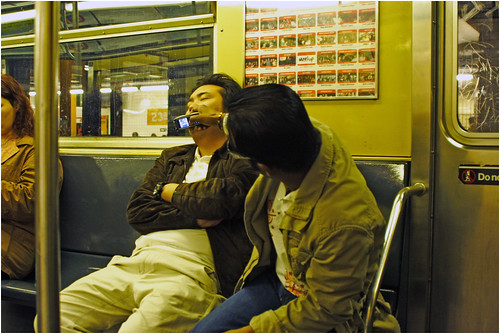
Abusing sleeping people is just one of the many things you can already do with your cell phones in the subway. (Photo by flickr user Dr Joolz)
When last we saw the underground cell phone service plan, the MTA had just announced a $46.8-million deal with Transit Wireless to equip the subway stations with cell service. But what if you install a cell service system and no carriers come?
That’s the question Scott posted in his comment, and that’s the question Crain’s New York Business pondered as well. The business journal noted that “it remains to be seen” if cell service providers are going to pony up the dough to provide customers will snippets of cell service in areas where customers spend a relatively minimal amount of time.
Amanda Fung reports:
Some question how Transit Wireless will recoup all the money it has to spend on building the network. While it will be technically challenging to wire the stations, once a network is set up and operational, the success of it is riding on the wireless carriers’ participation. Carriers will have to determine if offering cell phone service on the subway platforms and stairwells will generate more revenue per user or reduce churn rate, analysts said…
A spokesman for Sprint Nextel said the company will review the fees and determine if it makes sense for the company to participate.
Verizon Wireless and T-Mobile would not comment on their plans. AT&T Wireless, which led a competing consortium made up of the other major carriers, declined to comment because it said the MTA had not informed the company of its decision.
Supposedly, Transit Wireless has already fielded inquiries from at least one wireless provider, but without AT&T on board, the MTA’s and Transit Wireless’ plan will lose much of it luster. Right now, AT&T, Verizon and T-Mobile duke it for the top spots. If AT&T users — including those using the iPhone — can’t take advantage of the system, you’ll end up with a poor excuse for a cellular system.
For a comparison there, look no further than Washington, D.C. When I lived in D.C. from August 2005 until June 2006, I could never use my then-Cingular/now-AT&T cell phone in the Metro because AT&T hadn’t opted to sign on to the service terms for underground signal retransmission. To tell you the truth, I wasn’t missing much.
This Holy Grail of subway cell service may just end up as another idea that sounded good on paper but didn’t work out economically. If the carriers don’t sign on, kiss that late-night underground phone call good bye.
Annoying cell phone conversations coming soon to a platform near you
Posted by: | Comments
Fade in on a nearly-empty subway station. It’s 2:30 a.m., and you’re stuck at the 2nd Ave. subway stop waiting for an F train that never shows up. Mostly drunk and dead tired, you just want to sit there quietly until the train rolls up to shuttle you back to Brooklyn.
But the air is pierced by an all-too-familiar sound. It’s that blasted Nokia ringtone you’ve come to know and despise. As the loud, obnoxious cell phone user proceeds to shout the amazing details of how a friend just puked all over the bathroom at d.b.a, you can’t help but think about how you wish the MTA had simply kept the subways cell-phone free.
Now, I know what you, reading this on Sept. 20, 2007, are thinking: What a far-fetched scene. The MTA hasn’t been able to get its act together in well over two years of talking about subway cell service. What makes me think they can do it now?
‘It just ain’t that big…’
Posted by: | CommentsThat Guy, right, just doesn’t need that much space to air out his crotch. (Photo by flickr user strohchop)
Everyone can tell a story about the time that guy on the subway had his legs spread. You know that guy. He’s the one taking up space for three people because he either can’t close his legs or feels a special compulsion to share his crotch with a trainload of commuters.
No one elicits more groans than that guy. Boarding a train during rush hour in search of a seat, you run into that guy, and your commute home is ruined. You glare at him without making eye contract. You try to nudge your way into a seat with no success. It’s happened to us all.
Well, one more in Melbourne, Australia, is sick of this rude behavior and won’t stand for it anymore. Martin Merton, an American expert on subway etiquette, will soon be publishing a book in Australia called There’s No I in Carriage. The book, according to Dr. Merton’s Website, covers topics ranging from the obnoxiously loud cell phone user or iPod-headphones wearer, the rider unable to hold in a fart for the duration of the trip and of course the perennial favorite, the seat hog.
Now, I know what you must be thinking: Who in their right mind would write a book about subway etiquette? This can’t be real, right? O ye of little faith. Of course it’s real. Or at least that’s what Connex Melbourne, the company in charge of Melbourne’s subways, wants you to believe.
Connex is relying on viral videos produced with maximum kitsch featuring a fake psychology to drive home points relating to real-life subway etiquette. And they’re pretty funny. In the video relating to leg spreaders, embedded below, Dr. Murtin recommends releasing live chickens to attack the offending crotch.
I have to wonder if this could work in New York too. The subways could use a little more humility and etiquette and a little less pushiness. But considering that only 5.3 people a day see and say something, this viral campaign would probably just fall flat in New York. But the next time you see a crotch where three people should be sitting, just think chicken.
For more of Dr. Merton’s videos, check out the good doctor’s YouTube page.
‘Can you hear me now?’ Straphangers wonder about MTA pay phones
Posted by: | Comments
The odds are pretty good this phone doesn’t work. (Courtesy of Flickr user Paololluch)
MTA pay phones are often a last-ditch solution for stranded Straphangers needing to make an underground call.
Just this Monday, in fact, I saw one subway rider walk approach the pay phone with exceptional caution. This woman in her mid-twenties looked to be running late. She peered into the tunnel at W. 4th St., hoping to spot a glimmer of an approaching F train. With no train nearing the station, she cautiously approached the payphone.
The payphone was your typical subway pay phone. It looked like a few drunk NYU students had probably smacked the receiver around a little. There was nothing growing off of it. But this woman didn’t trust the phone. She pulled a wool glove out of her pocket and then lifted the receiver, holding it an inch or so away from her ear. This woman would have no part of this phone touching her.
Into the slot at the top went the quarter…and into the change return slot fell that very same quarter. Surprising no one on the platform, the pay phone did not work. In fact, according to a newly-released poll by the Straphangers Campaign, nearly a quarter of the NYC subway pay phones are inoperable.
Here’s what the public interest group found:
In one survey of 886 telephones at 100 randomly selected subway stations, 29% were found to be “non-functioning,” with problems ranging from no dial tone to coin slot blocked (survey margin of error is +/- 4%). This finding is consistent with 2006 findings when an identical campaign survey also rated 29% of phones non-functioning.
In a second survey, the campaign tested 537 pay telephones in the 25 most-used New York City Transit subway stations and found 22% to be non-functioning.
Noting that the current contract between Verizon and the MTA does not guarantee any minimum number of working pay phones, members of the Straphangers were a bit dismayed. “Given the importance of being able to communicate with the outside world, especially during times of delay and emergency, we’re disappointed the MTA and Verizon removed the guarantee for a minimum level of service operability,” Neysa Pranger, one of the group’s coordinators, said in a press release.
Two of the Straphangers’ findings, in my mind, raise some interesting questions. The group found that all of the pay phones in the stop on East 86th St. were functioning as were all of the phones at the stop on the West Side IRT at 72nd St. But only 29 percent of the phones at the Jamaica Center stop on the E, J and Z lines were working. Do the socioeconomic conditions of the neighborhoods in which these stops are located have anything to do with the pay phones’ operability?
Meanwhile, as plans to wire the subways for cell service have seemingly faded away, it would probably be useful to have working pay phones in the tunnels. You never know when your train line might break down.
No cell signal is good news
Posted by: | CommentsIs there anything more annoying than that person on the Q train during rush hour who whips out a cell phone as the train spends three minutes crossing the Manhattan Bridge? You know who I’m talking about; it’s the person shouting seemingly to themselves as they rush to make a call that could wait until they get off 8 minutes later at Atlantic Ave.
Just think if that person could spend their entire subway commute yapping into their phone. That at least was the plan in 2005. But since then, little to no progress has been made, and The New York Sun reports today that the plan may be dead in its tracks. Here’s what outgoing MTA chair Peter Kalikow had to say:
The chairman of the Metropolitan Transit Authority, Peter Kalikow, said yesterday that he was “not sure” if the agency would complete a deal with one of the four service providers who have submitted bids for the project. “I would hope they’ll come back to use with a revised bid doing it the way we like,” Mr. Kalikow said following an Assembly oversight hearing on the MTA yesterday.
So, Mr. Kalikow, what way might be the way you like? Well, that’s to limit cell phone conversations to the stations only. And why don’t cell companies like that? Money, of course.
Cell phone service providers bidding on the project say wiring stations and not tunnels is cost-ineffective. Phone conversations on subway platforms are too short to bring in any real money.The cash cow would be the long subway ride that allows for a more substantial use of cell phone minutes.
It would cost millions of dollars to wire the subway stations, and the average conversation would probably last all of two minutes. Luckily, in this case, the economics don’t work, and those riders who just want to find some last solace from the neverending cell phone din can still take refuge in the subways.