Archive for Subway History

Jan
10

Photo: Enrico Natali’s Subway

Posted by: | Comments (1)

When the Nostalgia Train ran last month, straphangers itching to experience or relive riding on trains from another era had the chance to do so. It wasn’t quite the same as being there though as the cars, as they’re usually kept on display, have a decidedly museum-y feel to them. Yet, the novelty never wears off.

For a different kind of glimpse back into the city’s history, we have Enrico Natali. In 1960, the photographer would surreptitiously capture scenes from the New York City subway. Today, we do the same with cell phone cameras and digital devices, but Natali used a Yashica. Starting this weekend, his photos will be on display in California, a far ride from New York, but luckily for the Internet, we can view them from the comfort of our own computers.

The Daily Mail has a bunch of shots and a small article about Natali, and the Museum of Contemporary Photography has a page of 28 Natali photos. My favorite is this capture of 51st Street. The missing tiles on the wall are evocative of stations that today are in need of repair. After 52 years, some things never change.

Categories : Subway History
Comments (1)

Bruce Davidson’s photographs of the subway from the early 1980s remain some of the more iconic images from the time period. His stark photos show the system at its nadir. Graffiti-covered trains and dark stations belie the dangers that were inherent in the subways at the time. We’ve come a long way from those days, and now Davidson’s images evoke a bygone era that we’d rather not revisit.

Earlier this year, Davidson’s book was reissued, and a few weeks ago, he penned an essay on his experiences for The New York Review of Books. In it, he talks about overcoming his fear of the subway as he rode into parts of town that a guy with a fancy camera would otherwise never visit. He speaks of approaching subjects to get their permissions for photos, and he relates a tale of getting mugged near Chauncey Street in Brooklyn.

Today, with subway crime far below record highs, we often take safety for granted, and the new rolling stock lends an air of sterility and security to our rides. But Davidson’s essay reminds us that we’re not far from those bad old days. Give it a read; it’s well worth it. (NYRB via Kottke)

Categories : Asides, Subway History
Comments (2)

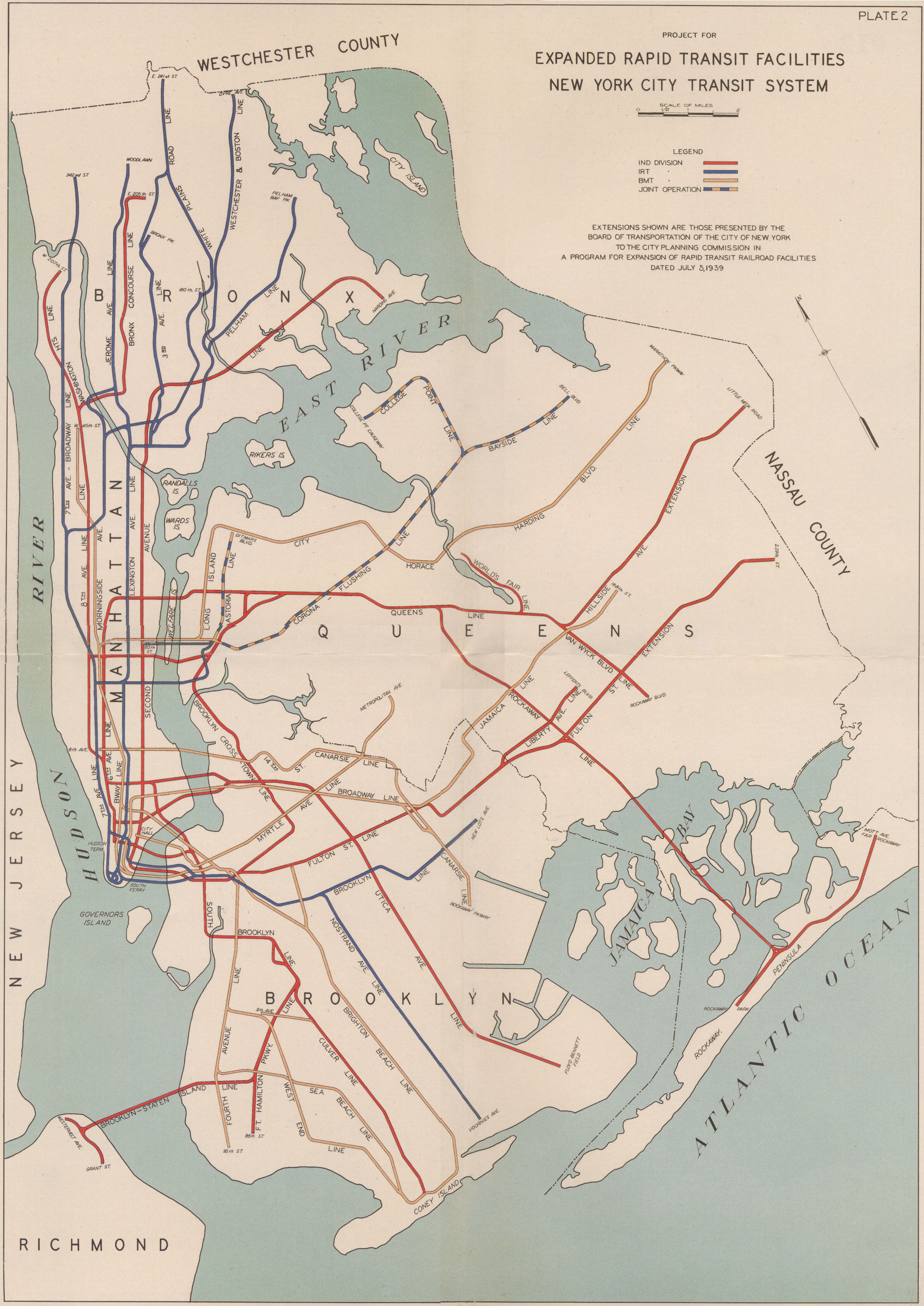
The IND Second System plans included a subway extension past 76th Street to Cambria Heights near the Nassau County border.

For students of the history of New York City and its subways, abandoned stations and half-built shells offer up an alluring reminder of what was and what could have been. Scattered throughout the city are various platforms now shuttered and lost to the era of longer trains, and of course, the provisions that remind us of the grand plans for the IND Second System capture the imagination. We know of the shell at South 4th Street and a similarly hidden one at Utica Ave. But what of the other subway mysteries?

One long-standing urban rumor has concerned a station along the IND Fulton line just east of Euclid Avenue and past the walls that mark the end of the C local train. This is the 76th Street station, an urban fable kept alive by an old April Fools joke, some mysterious construction barriers and track maps that hint of an unbuilt subway extension. The 76th Street station itself is a mystery. If it exists, it would be found at the area of 76th Street and Pitkin Ave. in Queens. Officially, it was never really built, and no one has photographic evidence of it. But there’s long been lingering doubts in the minds of even the most ardent subway historians.

The immediate tale of 76th Street begins where many subway legends start: on SubChat. A recently revived thread from February covered the discussion of a potential C extension down Pitkin Ave., and one person claimed to know someone who had the seen station. The topic comes up now and then, and in 2001, rumors of the station’s existence were prevalent.

What we know today are snippets of rumors and in complete images. The story is fueled by a cinderblock wall past Euclid Ave. and a signal that’s facing the wrong way. For some reason, subway construction crews at one point decided to brick up the area at the end of the local tunnel, and all that remains are stubs on track maps and signal schematics. A 2007 post by the LTV Squad simply fueled speculation, and like any good urban legend, the story doesn’t die.

An MTA board offers hope that the 76th Street station truly exists. (Photo via LTV Squad)

Early in the decade of the double aughts, two subway historians brought tales of the 76th Street station to light. In a comprehensive posting on April 1, 2002 that included some excellent Photoshops, Joe Brennan created a history of 76th St. He even claimed the station had been in revenue service but was shuttered as part of a city cover-up. That, of course, was an April Fools joke, but Randy Kennedy’s 2003 column on 76th Street was no laughing matter.

Kennedy spoke with one man who insisted the station exists, and his evidence was similar to that found by the LTV Squad. An electric board says 76th Street; the cinder block wall is an oddity; other transit workers and police officers claim the station exists on the other side of the wall. It’s a case based on circumstantial evidence, but until someone returns with photos, 76th Street will remain forever a debated part of subway lore.

And yet, we do know what was supposed to go past that cinderblock wall sixty-plus years ago. As part of the IND Second System, the Fulton Line was to split near Euclid with one section continuing along Liberty Ave. and the other heading east to 229th St. in Cambria Heights, right near the Nassau County line. Some plans called for the IND to use the LIRR right-of-ways, but the details are immaterial. Eventually, due to costs and some engineering concerns, the plans for such an ambitious extension were scrapped. It is true that a signal schematic references the “future 76th Street interlocking,” but that is ultimately a future that never came to pass.

Comments (35)

The Nostalgia Train will ferry straphangers from Grand Central to Yankee Stadium tonight. (Photo via MTA)

Another baseball post-season, another playoff appearance for our own New York Yankees. With the club’s 16th playoff berth over the past 17 seasons, the MTA is once again rolling out the Nostalgia Train for a timeless jaunt up to the Bronx. It’s become an annual tradition and one that attracts Yankee fanatics and railfans alike.

Tonght’s Nostalgia Train will be departing from the uptown express tracks at Grand Central at 7:15 sharp. It will stop at 59th, 86th, 125th, 138th and 149th Streets before arriving at Yankee Stadium. Transit will do it again tomorrow before Game 2 and ahead of Game 5 on Wednesday if the Yankees’ series with the Detroit Tigers makes it that far. This year’s Nostalgia Train consists of cars originally operated by the old Interborough Rapid Transit company from 1917 into the early 1960s. Be forewarned though: These vintage cars aren’t air conditioned.

Categories : Subway History
Comments (10)

I got back to New York City pretty late tonight after my flight north from Florida was left circling above Wednesday’s thunderstorms. Instead of a new piece, I’ve decided to run something from the archives so I can get to sleep. I’ll have more later this morning. In the meantime, enjoy this look back at some recent subway history that I wrote originally back in August of 2009.

75px-NYCS-bull-trans-9.svg I grew up three blocks away from the West Side IRT station at 96th and Broadway. For the first six years of my life, I learned the subway from the front windows of the 1, 2 or 3 trains. The 2 — the old red birds — were my favorite until one day in 1989 when the MTA introduced the 9 train.

Six-year-old Benjamin was smitten. It was a brand new subway train that would stop at his home station and skip some far-away stations in Upper Manhattan and the Bronx in which I as a child never set foot. I was disappointed when I realized that the 9 trains were just 1 trains with a different bullet, but to me, that 9 always looked like a big grin. It was a welcoming child of the subway system.

In high school, I came to enjoy the 9 train. During my junior and senior years, I would take the subway from 96th St. north up Broadway to 242nd St. before walking up Post Road to my school on 246th St. Each day, I would hope for a 9 train because, in my mind, it was faster. The 9 train skipped four stops north of 125th St. while the 1 skipped only three. It was simple subway math.

After high school, the 9 train faded from my subway conscious. I didn’t have to use it any longer, and on Sept. 11, 2001, the MTA suspended 9 train service as they had to change a slew of routes to accommodate for the damage to the subway system in and around Ground Zero. While the 9 returned a few days after the one-year anniversary of those terrorist attacks, it was but an afterthought. Less than three years later, it would be wiped from the map, a victim of the northern Manhattan population boom that continues to this day.

Soon, we’ll celebrate the 22nd anniversary of the good old 9 train. The first 9 — in reality, a rebranded 1 — rolled off the line Monday, August 21, 1989, twenty years and six days ago. Donatella Lorch reported on this service addition for The Times:

The new service provides ”skip-stop” service between 6:30 A.M and 7 P.M. on weekdays, freeing the old No. 1 local to skip four stops between 137th and 242d Street. The purpose, says the Transit Authority, is to provide a faster and less crowded ride for people in the Bronx and Upper Manhattan. Not everyone believes this will happen. Some passengers say they will spend more time on platforms, transferring or waiting for the right train to come along…

“It slows me down because I have to change trains for no good reason,” complained Frank Gary as he waited yesterday evening at 137th Street for an uptown train to 157th Street. “I knew about it this morning so I did not get confused.”

Jared Lebow, a Transit Authority spokesman, said the new line would save up to three minutes on a ride from South Ferry to 242d Street. That’s not much, he said, but cumulatively, over the course of a day, enough time is saved to get more use out of the trains. He also said that a total of 28 No. 1 and 9 trains would now run during each rush hour, instead of the 25 that used to run on the No. 1 line.

For 16 years, residents of northern Manhattan complained about the 9 service. While those of us passing through enjoyed the luxury and perceived speed of the seat-saving skip-stop service, people in Marble Hill, Inwood, Washington Heights and Harlem felt slighted by the MTA.

By 2005, the need for this service had greatly diminished. In fact, as the skipped stations had grown in ridership, Transit had to restore full-line service to Upper Manhattan and the Bronx, and 12,000 per day experienced more frequent service when the 9 was axed. “Skip-stop service on the 1 line is an idea which today doesn’t make sense for our operations or our customers,” Lawrence G. Reuter, the president of New York City Transit at the time, said to Sewell Chan in 2005. “By eliminating skip-stop service, the majority of riders along the 1 line will benefit from shorter travel times and will no longer have to stand on platforms as trains pass them by during rush hour.”

The last 9 train rode up and down the West Side IRT local tracks on May 31, 2005, and it passed quietly into subway lore. Nearly 22 years ago, it debuted, and now it is but a memory in the minds of New Yorkers, a fleeting part of straphanger past. Sometimes, I believe the MTA should revisit skip-stop service to better apportion crowds on locals, but for now, the 9 simply rests in peace.

Categories : Subway History
Comments (17)

With the bar exam a week away, I’m going to be running a few pieces from the Second Ave. Sagas archives over the next few days. With summer fully upon us and temperatures expected to reach the triple digits on Friday, now is as good a time as any to appreciate air conditioned subway cars. So allow me to present this piece from May of 2010.

The R-17, shown here in operation as the Shuttle in 1982, was the first subway car outfitted with air condition. (Photo via Steve Zabel/NYCSubway.org)

With the warm weather upon us, New York City has been growing increasingly hotter and more humid over the last few weeks. Thunderstorms are in store for us tonight, and temperatures are going up, up, up all week with the threat of a 100-degree day on Friday. Summer in New York — with free concerts, long days and, of course, baseball games — is my favorite season but for one thing: The subways are utterly unbearable.

The worst part of riding around New York City in the summer are the underground waits. With train cars spewing heat from industrial-strength air conditioners, the stations themselves see temperatures soar beyond tolerable levels. The stagnant air induces sweat at hours of the morning far too early for that kind of heat, and only the blessed air conditioning of the train cars makes a commute tolerable.

These days, we take our air conditioned subway cars for granted, but it wasn’t always like that. The MTA undertook its current air conditioning efforts in 1967, and the thought of a summer ride without AC lives on only in the memories of long-time New Yorkers. So as we sit on the cusp of summer and Transit turns on the AC, let’s hop in the Wayback Machine to a time when the New York City Transit Authority just couldn’t quite get air conditioning right.

Our journey begins in September of 1955, an odd time to test air conditioning as the heat is already dissipating by then. On a day that saw the outside temperature hit just 62 degrees, NYCTA ran a successful test of its first air conditioned subway car, an retrofitted R-15 car. As station temperatures hit 81 degrees and the mercury outside climbed to 87.5 in un-air conditioned cars, the test car saw temperatures fluctuate between 68 and 73 degrees. The authority proclaimed this one-day test a success, and plans to outfit the entire subway fleet at a cost of $700 per car were drawn up.

This optimism was short-lived. A year later, the NYCTA unveiled another test run of the air conditioned cars. Six R-17 cars equipped with loud speakers, air conditioned and in-route music provided, of course, by Muzak, made headlines as Transit officials again extolled the virtues of air conditioning. At the time, Transit planned to test these cars along various IRT routes but ran into early troubles.

The authority tried to test it on the Shuttle route, but the short trip did not provide for ample testing time. “The run between Times Square and Grand Central takes one minute,” wrote The Times, “apparently too brief a time to cool the hot subway air taken in during the stops of one and one-half to two minutes at the shuttle terminals.” Passengers complained as well of stale air and high humidity.

By 1962, the promise of air conditioning had failed to materialize, and the NYCTA declared the $300,000 experiment a failure. Even after the successful test runs, Transit found humidity levels well beyond acceptable. “As humidity built up and breathing became difficult,” The Times said in 1962, “passengers fled to the fan-ventilated cars…To add to passenger discomfort the cool air was dissipated when doors opened at stations, while the humidity remained unchanged.” While PATH announced air conditioning, NYCTA was left searching for solutions.

Five years later, the city struck air conditioning gold. After tinkering with the technology, Transit found a costly solution, and early test runs were again successful. This time, the humidity levels were kept in check, and railfans began to stalk the air conditioned cars, riding them along the F line from terminal to terminal to bask in the cool air. With a grant from the government and $15 million from the city, Transit finally promised to outfit its rolling stock with AC.

Even still, the going went slowly. By August of 1970, finding an air conditioned car was likened to finding a needle in a hay stack, and a 1973 proposal called for full air condition only by 1980. Throughout the 1980s, those struggles continued. At various points in the decade, air conditioning either didn’t work or was on the verge of breaking down. In 1983, while Transit officials alleged that 50 percent of cars were air conditioned, one rider found himself with AC during only 20 percent of his trips.

Today, with new rolling stock and a better maintenance program in place, the subways are blissfully air conditioned, a haven from the heat outside and in the station. I’m too young to remember those days of un-air conditioned trains, but I have vague recollections from the mid-to-late 1980s of stiflingly hot rides in graffiti-covered cars. Even if the new rolling stock can seem somewhat sterile at times, I’ll take that air conditioned as the mercury rises and summer descends upon us.

Categories : Subway History
Comments (22)

An L train sits at Myrtle Ave. in 1987 (Photo courtesy of NYC Subway)

While researching yesterday’s piece on weekend ridership on the L train, I came across the above photo in the archives of NYCSubway.org, and it’s a great glimpse into the past. The train is clearly being held at a red signal as riders are peering into the tunnel to see why they’re not going anywhere, and the outside is absolutely covered in graffiti. The photo is only 24 years old, but a lot of has changed underground since then. We have a long way to go yet.

Categories : Subway History
Comments (14)

The subway system is replete with shuttered passageways whose existences are known only to those who remember the old days. The most extensive of those walkways lies abandoned under 6th Ave., and it connects the Herald Square IND station to the southern end 42nd St./Bryant Park stop. Opened in the early 1940s with the idea of, according to a 1940 New Yorker article, “reliev[ing] congestion at these points by distributing passengers over a greater area,” the passageway closed in 1991 after a horrific sexual assault in what was then a largely abandoned section of subway history.

The video above, shot in 1991 shortly before the MTA shuttered the tunnel, takes us back in time. It offers a glimpse inside the passageway before it was shuttered. The signs are vintage IND, and the ads are vintage early 1990s. From the video, it’s clear to see how foreboding and empty the walkway appeared at a time when crime in the subways was still relatively high. Today, few signs of the walkway exist, but it still lies there abandoned and unused underneath Sixth Ave.

For more on this tunnel and others lost to time, budget cuts and safety concerns, check out my post on the shuttered passageways from April 2010.

Categories : Subway History
Comments (9)

Once upon a time, before the subways took us underground and cars took over aboveground, New York City’s travel landscaped was marked by railroad trains. These trains snaked through Outer Boroughs and carried well-to-do city denizens to their beachfront country homes, miles away from the hustle and bustle of busy Manhattan. These days, those railroads are lost to time as rampant urban expansion, but their rights of ways live on in quirky fashion.

Over the weekend, The Times unearthed a block-long right of way from the dearly departed Manhattan Beach Branch of the New York and Manhattan Beach Railway, a predecessor to the Long Island Rail Road. A bunch of homeowners along E. 18th St. between Avenues U and V enjoy backyards that are actually a part of the railroad’s right of way. The homeowners are filing suit to claim title to the now-defunct railroad lane via adverse possession, and it doesn’t sound as though the MTA, the railway’s predecessor in interest, plans to spend too much time contesting the suit.

The Manhattan Beach Railway, as this old map shows, once delivered residents from the Greenpoint ferry terminal to Manhattan Beach. The railway ceased carrying passengers in 1924, and today, the Brighton Line runs just a few blocks west. Before the suit was filed, few of the residents even knew a railroad once past behind their houses, and I wonder how many other rights of ways for city railways exist in backyards around Manhattan and Queens.

Categories : Asides, Subway History
Comments (10)

On the same day I discussed intrusive MTA announcements, allow me to present Harry Nugent, one-time conductor on the 1 train.

Gothamist dug up this video over the weekend, and it provides an interesting counterpoint to the MTA’s automated announcements. They may be easier to hear, but there’s a certain charm to a conductor who’s willing to inject personality and information into the PA calls. It’s funny too how these complaints come full circle. We have automated announcements because the PA systems weren’t up to par, but now the PA systems with their pre-recorded messages are grating as well. You can’t win ‘em all.

For more on Nugent, check out this 1993 article The Times ran to commemorate his retirement.

Categories : Subway History
Comments (10)
  • Extended Stay

    Featuring a wide range of sophisticated furnished apartments throughout the city and surrounding areas, ExecuStay can help you enjoy a New York extended stay that's both productive and relaxing.

  • Corporate Apartments

    As a resident of ExecuStay New York corporate apartments, you'll find that getting around is a snap, thanks to the many MTA subway lines, buses and yellow cabs.