Archive for Subway Maps

A distorted sense of geography is a hallmark of the London Tube map.

New York City has, for obvious reasons, a close tie with the now-completed 2012 Olympics. Our Mayor wanted it for the city while many New Yorkers fought against it, worrying about costs, security and added mayhem that hosting the global competition for two weeks would bring to the city. Ultimately, the Mayor still managed to secure his 7 line extension, and the city received two new baseball stadiums, a basketball arena and potentially a new soccer stadium as well. What we missed besides the Games themselves is hard to see.

Meanwhile, London just wrapped up a compelling spectacle of competition but managed to scare away many residents and tourists. The economic bump expected from the Summer Games may not materialize, but the presence of tens of thousands of foreigners making use of London’s transportation infrastructure may help Transport for London readjust the way it presents itself.

As we know, London has entirely eschewed a subway map that nods to geography. The famous Harry Beck map presents a schematic of the system with notoriously famous results. Riders unfamiliar with the complex geography of London streets often find themselves wasting time on the Tubes when walking a few blocks would be more efficient. The Olympics apparently laid this to bare, and Joe Peach at This Big City penned an amusing and insightful column on it:

With millions of visitors in London for the 2012 Summer Olympics, the city’s transport network is under more pressure than ever before. If you want to head to the Olympics, chances are you’ll get the next tube to Stratford, even though there are countless other stations that link to Olympic sites. Aware of the challenges of dealing with millions of extra riders, most of whom won’t be local and will be relying on geographically flawed signage for directions, TfL have made some temporary updates…

Route maps on underground carriages are now littered with pink boxes pointing out which stations can be used to access Olympic events. This photo shows what you’ll find if you take the Jubilee Line, and London’s 12 other lines are all looking pretty similar. Though relatively minor additions, they represent a pretty radical development for a map that has barely changed its visual approach in eight decades…

London’s underground network is the oldest in the world, and as a result many stations are named after once-significant local features (in fact, much of London is named after once-significant local features). The effect of this is the present-day destinations they largely exist to serve rarely get prominent placement on signage, with obvious potential for confusion among travellers. Though investment in technology and improved infrastructure is critical for the London Underground to remain efficient (and TfL is doing both of these things), improving the design of the network’s wayfinding tools also plays a key role. A functional city needs citizens and visitors that are well-informed, and with TfL rethinking its underground map and signage, London has become that little bit easier to get around, for locals and visitors alike.

Peach’s last paragraph above is key, and it’s something map designers often lose sight of. As I discussed last week, Massimo Vignelli’s controversial New York City subway map was to be used in conjunction with two other maps, but the MTA never embraced the Verbal Map. Thus, Vignelli’s diagrammatic map never caught on and annoyed many who tried to use it. In London, Beck’s diagram has ruled for decades, but the city seems willing to embrace some added information.

I’ve written a lot over the years about the search for the right map, but it seems more and more likely that the one right map doesn’t exist. The proper approach to directional wayfinding involves making sure riders have the right information in the right format at the right point. London is working its way toward a better solution. I wonder if New York needs to do the same.

Categories : Subway Maps
Comments (14)

Forty years later, Vignelli's map remains a hot topic in New York City.

There’s something about Massimo Vignelli’s infamous subway map that lends itself to a constant reassessment. It comes up inevitably in any discussion about global subway map design, and the torturous chapter in New York City subway map design in the 1970s isn’t complete without a full rehashing of the Vignelli controversy. This year marks the map’s 40th anniversary, and it still manages to inspire and infuriate all at once.

Today’s missive on the Vignelli map comes to us from Alice Rawsthorn writing in The International Herald Tribune. Under the headline “The Subway Map That Rattled New Yorkers,” Rawsthorn speaks to Vignelli on the 40th birthday of his map and reviews its problems. “The map,” she writes, “was, indeed, riddled with anomalies, but that was the point.”

Design buffs have always loved his map for its rigor and ingenuity. When the future graphic designer Michael Bierut made his first trip to New York in 1976, he took one home to Ohio as a souvenir. But many New Yorkers were outraged by what they saw as the misrepresentation of their city, while tourists struggled to relate Mr. Vignelli’s design to what they found above ground. In 1979, the M.T.A. bowed to public pressure by replacing his diagrammatic map with a geographical one.

On the eve of its 40th anniversary, the story of the Vignelli map reads like a cautionary tale of a gifted designer expecting too much of the public or, as my grandmother used to say, being “too clever by half.” But its fate may have been different had the M.T.A. implemented Mr. Vignelli’s original scheme correctly…

But the M.T.A. only introduced one of four maps designed by Mr. Vignelli with the intention that, collectively, they would give passengers all the information they needed to navigate the subway. The diagrammatic System Map demonstrated how to get from A to B, but it was to be accompanied in each station by two Geographical Maps, one of the entire network and another of the local neighborhood, and a Verbal Map that explained in words how to go from place to place. Mr. Vignelli had never envisaged it being used without them.

Massimo Vignelli's controversial subway maps were to be used in conjunction with the Verbal Map. (Via Vignelli Associates)

The idea of a tripartite map has never truly caught on in New York City. Straphangers seemingly want to plan their trips in one place without having to consult confusing keys or smaller insets. The current iteration of the neighborhood maps operate similarly to Vignelli’s original plan, but the Verbal Map, above, came and went with little fanfare in the 1970s.

One of the aspects of the Vignelli Map — perhaps a better work of art than work of navigation — that I found most appealing is its divisiveness. Everyone has an opinion about whether it works or not, whether its better than our current version, whether we should one day bring it back. We can’t avoid it as part of our subway map legacy, and in fact, today, the MTA uses it as the basis for its online-only Weekender offering. Maybe its better suited for MOMA than for the back pocket of a subway rider, but it will never cease to be a centerpiece of conversation. For that, we’ll always have Vignelli.

Categories : Subway Maps
Comments (15)

Google has added MTA service advisories to its transit directions on its Map offerings.

A few weeks ago when Subway Weekender called it quits, a void opened up in the transit map space. While peak-hour, weekday service websites and apps are easy to come by, few of those services provide reroutings and diagrams of the way weekend and off-peak service changes impact the subway system. With straphangers voicing complaints concerning the ease of use over the MTA’s own Weekender offerings, could Google fill the void?

Today, the Internet giant announced the integration of service advisories into their transit directions. If implemented properly, this could be a big step forward for informing potential riders of obstacles along their routes. Google, which seems to be under the misconception that the subways serve only 200 million annually, introduced the new addition to their maps:

Have you ever arrived at a subway platform only to find that the train you intended to take is skipping stops, rerouted on another line, or isn’t running at all due to scheduled maintenance? Now when you click on any of the 468 New York City subway stations labeled on Google Maps, you’ll see whether any planned service changes are expected to affect that station at the time. In addition, the relevant alerts will be included in the step-by-step transit directions pointing you wherever you’re going.

If you’re looking to find the best route to see a concert after work or checking for any expected delays when already running late, this feature works when you’re online via maps.google.com and Google Maps for Mobile on Android. To adjust your travel around the alerts you see, simply choose another suggested route or change your departure time…

For everybody who lives in one of New York City’s five boroughs, commutes in and out every day or is visiting for business or vacation, we hope today’s update improves the ease and efficiency of your trips around the city.

So how does it work? To test it, I asked Google Maps to route me from Canal St. to Cortelyou Road a few minutes ago. As part of weekday work along the Brighton Line, Coney Island-bound Q trains are running express, and riders have to transfer to a Manhattan-bound train making local stops. Google Maps, unlike the MTA’s own TripPlanner, informs me that I have to take this disruption into account, but does not offer up the full routing. While TripPlanner routed me around the disruption, either by walking or transferring to a Manhattan-bound train, Google Maps told me to take the Coney Island-bound Q from Canal St. to Cortelyou Road while keeping in mind the disruption. It’s an entirely unhelpful piece of advice considering the circumstances as I’m supposed to account for the service changes on my own.

The beauty of Subway Weekender was in the visualization. Not only were riders informed of the changes, but they could see how it impacted subway lines. The Google Maps changes do nothing of the sort yet; they simply bring key information to the public and ask the public to put the pieces together. It’s a positive development but nothing game-changing.

Categories : Subway Maps
Comments (7)

Contrary to the subway map, West End Avenue does not end at 116th Street.

While the MTA draws the ire of millions of New Yorkers who endure packed trains and climbing fares, it often seems as though nothing quite captures the imagination of a dedicated subsection of straphangers quite like the subway map. From its design to its creation to its geographical accuracy (or lack thereof), New Yorkers are content to spend more time discussing the map than we rightly should. If this were a crime, I’d certainly be guilty of it.

Today’s tale of subway map woes comes to us from Matt Flegenheimer of The New York Times. Not only does he focus on geographical inaccuracies but he delves into the soap opera behind the map’s creation. As subway stalwarts know, the current bastardized iteration of the subway map grew out of the efforts to discard the Massimo Vignelli map. Heralded as a piece of design art that suffered functionally, the Vignelli map was ushered out in a 1979 redesign that saw various stakeholders — including Michael Hertz and John Tauranac — have input on the new map.

Essentialy, Tauranac steered the committee overseeing the redesign while Hertz’s company was in charge of execution. Tauranac was in charge of geography; Hertz overlaying the system on a diagram of the city. Both parties duke it out over the map’s flaws and faults. Now, The Times’ focus on the errors has the two men warring again:

On the West Side of Manhattan, beginning near Lincoln Center and extending toward the campus of Columbia University, Broadway is seemingly misplaced. It is west of Amsterdam Avenue at West 66th Street when it should be east. It drifts toward West End Avenue near 72nd Street, where it should intersect with Amsterdam. It overtakes West End Avenue north of the avenue’s actual endpoint near West 107th Street, creating several blocks of fictitious Upper West Side real estate…

Many New Yorkers have undoubtedly noticed that the subway map has its geographic faults, from peccadilloes like a wayward street to more obvious inaccuracies like the supersize island of Manhattan. But Mr. Tauranac’s sheepish discovery of the errors has at once rekindled and complicated a long-simmering debate over who deserves credit for the watershed 1979 guide. Michael Hertz, whose firm is credited with designing the initial template for the map, has long chafed at Mr. Tauranac’s calling himself the “design chief” on a project that has garnered numerous accolades, including a commendation from the United States Department of Transportation and the National Endowment of the Arts.

“We’ve had parallel careers,” Mr. Hertz said in a telephone interview. “I design subway maps, and he claims to design subway maps.”

While Tauranac, who also takes a jab at Vignelli’s map in the article, is content to battle it out in the press with Hertz, the truth remains that the map is a semi-fictionalized part of New York City. It requires people riding the system to have a passing familiarity with their destination, and it does not provide point-to-point directions or above-ground accuracy. As MTA spokesman Adam Lisberg said, “This is not a street map. This is a subway map.”

Categories : Subway Maps
Comments (13)

Every year, Transit releases its ridership figures in a detailed breakdown by station and by weekend or weekday. The numbers, due out in May, provide a fascinating glimpse into the ebb and flow of the subway system, but it’s often hard to wade through the numbers. To that end, Visual News has released a visual of the 2010 ridership information in map form. Take a look at that infographic and marvel at how popular the stations along Lexington Ave. are. Second Ave. Subway, anyone? [Visual News]

Categories : Subway Maps
Comments (13)

My mom was the first to point out the great cover on this week’s New Yorker. Roz Chast, my favorite cartoonist, offered up her take on the Second Ave. Subway routing. I particularly enjoy the detour to Nebraska in between 34th and 42nd Streets. Sending the eventual T train out to Brighton Beach or even the Yukon Territories isn’t a half bad idea either.

Comments (19)

A glimpse at the night map shows the changes in service after 11 p.m. (Click to enlarge)

Once upon a time, back in the mid 1990s as Manhattan Bridge work caused numerous subway reroutings, New York City Transit released a two-sided map showing peak service on one side and off-peak on the other. The map survived for a few months before the ever-shifting patterns across the bridge caused the MTA to discard the redesign for something a little less malleable. Still, the need for a night map has persisted.

Even though the subways run for 24 hours a day, not every train runs at every hour, and not every route is the same at 4 a.m. as it is at 4 p.m. Some rains run express during the day but not at night. Some run stunted shuttle routes during late-night hours. Others, such as the poor B train, run only until some indeterminate time between 10-10:30 p.m. Yet, as apps such as the KickMap show the scheduling changes, our subway map depicts robust service at all hours of the day.

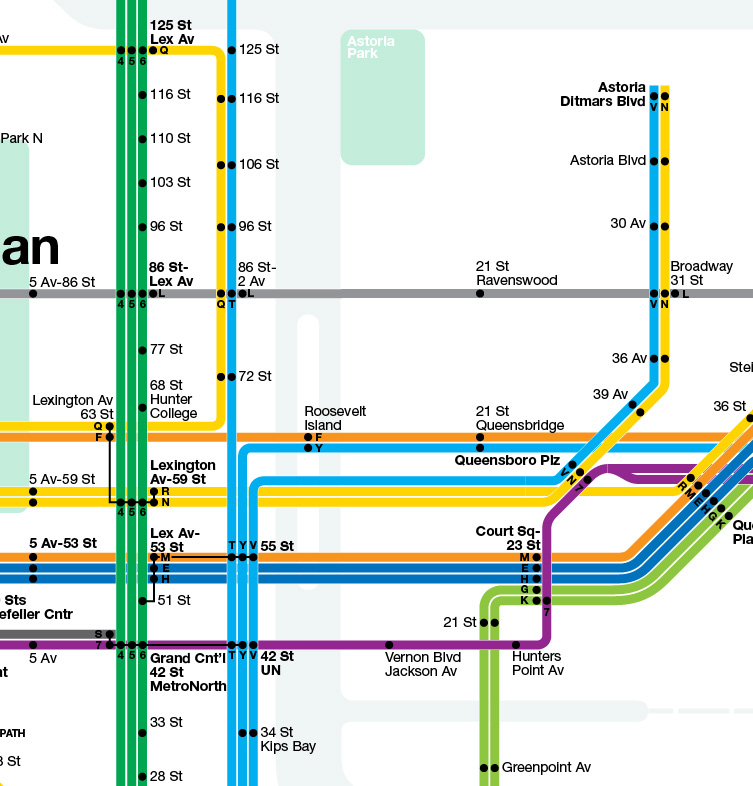
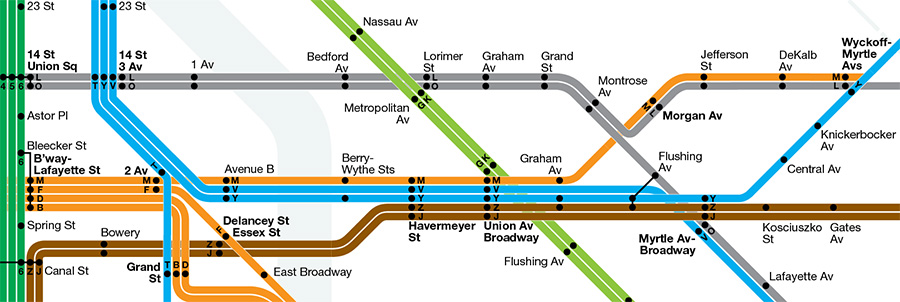
I had first gotten wind of this development earlier this fall, and today, the MTA unveiled its first night subway map. Designed with subtle shades of grey and dark blue to connote a later hour, the night map — available here as a pdf — shows how service should be after the peak hours are over. To make it an even more alluring document, the authority has released only 25,000 in its initial press run with a copy of MTA Arts for Transit’s “City of Glass” on the bank. Subsequent printings will feature different artwork as these maps slowly become collector’s items.

Beyond that aspect of the map, though, these are mostly useful diagrams of late-night service. Much like the refillable unlimited ride MetroCards, these night maps should have been available years ago as it helps late-night straphangers adjust to the vast difference in service offered once the evening rush is over, but because of constant overnight track work, even the night map won’t always be entirely accurate. It is customer-friendly, if you can find one.

“The standard subway map depicts morning to evening weekday service,” MTA Chairman Joseph J. Lhota said in a statement. “This companion night map will, for the first time, depict service for a particular portion of the day. This is the latest effort we’ve taken to improve the availability of information and detail we provide to our customers.”

For now, the map is available for free at the Transit Museum (host for my Wednesday event) and at the Transit Museum Annex in Grand Central. It was developed in house, and the MTA is also making 300 unfolded press sheets available for purchase a the Transit Museum Annex for $20 a piece. They were not yet available for sale when I stopped by the Museum Annex shortly before 2 p.m. They will be great, though, for framing.

After the jump, a bulleted list of the difference between the Night Map and the regular subway map. Read More→

Categories : Subway Maps
Comments (46)

Pentagram has designed a Vignelli inspired ampersand. (Click to enlarge)

Via my new favorite tumblr Transit Maps comes this design gem from Amsterdam. Pentagram’s Luke Hayman, working for the Dutch magazine Eigen Huis & Interieur’s New York Design Guide issue, repurposed the Vignelli subway map into EH&I’s ampersand with stations representing key players in the city’s design scene.

Pentagram had more to say about the design:

Pentagram’s Luke Hayman and his team recently redesigned EH&I and established the masthead’s ampersand as an icon of the brand. Each month a different designer is invited to interpret the ampersand for the opening of the “Interieur” section, and for the New York issue, Hayman created an ampersand inspired by Massimo Vignelli’s classic 1972 map of the New York City subway system. In the new version, the lines of the ampersand playfully connect contemporary and historic New York designers, agencies and institutions, from Milton Glaser, George Lois, Ruth Ansel and the Museum of Modern Art to Karlssonwilker, Local Projects, Dror and Pentagram (of course).

You can download a PDF of the map right here. As a subway system design, the ampersand certainly offers some intriguing crosstown subway routes too.

Categories : Subway Maps
Comments (4)

The new New Jersey Transit rail diagram brings a retro look to the Garden State. (Click to enlarge)

Geography or schematic? That is the question. In a new map showing the state’s commuter rail network, New Jersey Transit has gone with the latter. The new diagram, unveiled yesterday, is supposed to be “customer-friendly” with “more open design and new color scheme for easy customer reference,” the agency said.

“The new design is intended to be simple, familiar and inviting, not only for our regular customers, but also for those residents and visitors who have never before traveled on the State’s rail network,” NJ Transit Executive Director James Weinstein said. “We hope that customers will find the new map to be a valuable tool in their travels on our system.”

The map, designed in house, marks a move from the previous version which featured the train system in a purely geographic setting. Through color-coding and a streamlined design, the map now better highglights transfer points and routing. It also features the “completion of Hudson-Bergen Light Rail 8th Street Station, accessibility improvements at Somerville, Ridgewood and Plauderville stations, and the addition of the future Pennsauken Transit Center.”

Still, despite the upgrades, there’s no small bit of state-based protectionism involved. While the PATH system gets its day in the sun and the Port Jervis line branches into New York, New Jersey Transit pays scant attention to SEPTA’s connection from Trenton to Philadelphia and beyond. Transit networks are regional, but this map doesn’t extend far beyond the borders of the Garden State.

While I like the simplicity of the design and the idea behind it, it certainly has its flaws. Over at the Transit Maps tumblr, Cameron Booth is not a fan. Calling the map “sad, tired and amateur,” Booth finds it an unwieldy amalgam of styles: “It seems to have taken elements from many different transit maps and mashes them into one big mess. We have the thick route lines and giant circle transfer stations of Washington, DC Metro, icons for the lines similar to – but nowhere nearly as well executed – the Lisbon Metro, and different station symbols for each and every mode of transit.”

Form vs. function. Design vs. geography. The rail map battle always rages on.

Comments (19)

In fictional universes, subway systems do not have to make much sense. (Photo via Brian Donohue of The Star-Ledger. Click to enlarge.)

Via The Star-Ledger comes this glimpse at an alternate-universe subway map. Posted outside of the Newark Subway stop at Military Park late last week, this map shows how the subways run throughout Bruce Wayne’s Gotham City. Frankly, the whole thing is a bit of a mess with subways criss-crossing each other and the city at odd angles. Routes feature steep curves, some unnecessarily close stops and some zany transfer options. On the bright side, Gotham City planners have certainly managed to provide for some better inter-borough subway connections than we have in New York, and their subway system runs to Batman’s equivalent of Staten Island.

Categories : Subway Maps
Comments (21)