Archive for Subway Maps
The 1979 Map: A work in progress
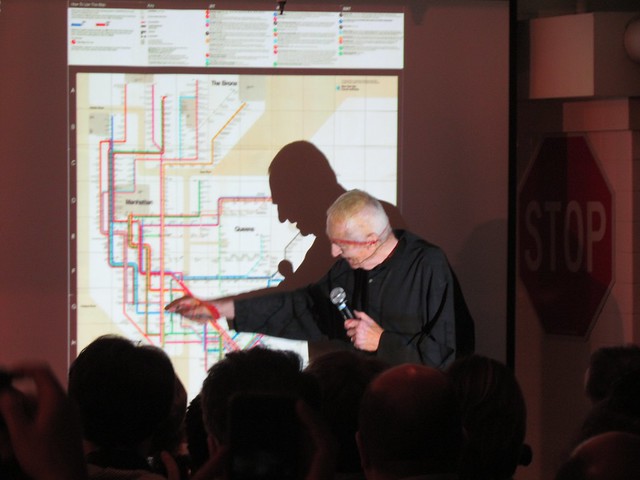
Posted by: | CommentsThe New York City Subway map, it seems, is always controversial. At a December talk at the Museum of the City of New York, designers past and present offered up their critiques, and I’ve burned many a pixel discussing elements of the current map.
Absent from the museum discussion though was Michael Hertz, the designer of the current subway map. Hertz, who says he never received an invite to the event and was not asked to speak, contacted me to offer up his defense of his subway map and his views on the controversial history of the map. What follows are his words and views (not mine). I ran Parts One, Two and Three in December, and we pick up the tale from there. Hopefully, his explanations will help illuminate the thinking behind the current subway map.

A prototype of the new map featured trunk lines that were all red with multi-colored bullets designating train routing.
As work continued on the new map, there were a few more experiments in routing display, unseen by the public, (thank God), including a two-color and a three-color routing system. I have recently seen slides of these thanks to Peter Lloyd, but cannot remember the rationale for it, other than to offer some kind of visual separation of all the spaghetti strands. Unfortunately, people have some kind of unconscious mechanism that tries to connect different line colors with some kind of difference in meaning. Whatever we accomplished or improved was without the benefit of a real color coding system. The public outcry for color-coding the routes in some fashion continued.
It was around mid 1978 that the committee’s recommendation for a trunk line color system – a recommendation that previously had gone unheeded – was finally taken seriously. Chairman John Tauranac, with his usual energy for the project, presented the committee’s proposal to MTA Chairman Harold Fisher, and this time Fischer approved the idea. Apparently, the funding issue which was the reason we had not gone forward with this scheme until then, ceased to be an impediment. The trunk lines were the cornerstone of a new map, with an excellent rationale for dividing up the route colors into logical group, that would indeed enable us to succeed in creating a map that more people were able to use.
Strangely enough, even with all the bright people, with all the expertise you can put in one room, (the committee) It took a complete outsider, a clerk In the TA’s Electrical Department, with no connection to mapping at all, to come up with this clever notion, and put it into the suggestion box. Actually, the final product that we developed, had never been publicly tested but embodied, in a logical, orderly fashion, exactly what the riders were asking for.
Chairman Fisher knew about this tail-wagging-the-dog situation, and the new map lead the way for the whole system’s station and car signage to be turned on its head. Fisher deserves a lot of credit for his vision of a new beginning of successful navigation of New York’s subways. The MTA realized that it would take a staggering amount of money to redo all the station signage. At that time, just the fabrication of porcelain enamel signs cost about $85/sq ft (roughly estimated at that time to run close to $30 million) and I never heard any actual guesses on cost for the approximately 8,000 subway cars. The cost for design and printing of the map was almost inconsequential when compared to all the other numbers.
In contrast to Massimo’s use of eight matched Pantone colors to delineate 25 different subway lines, we elected to go for 11 matched colors for 11 lines, condensing the lines running down 8th, 7th, 6th (Ave of Americas at the time), Broadway, and Lexington, respectively, as a trunkline for each avenue of operation. You can see why Vignelli ran into problems with criss-crossing of identical colors on lines with no family relation to each other. For example, the N on Canal intersecting with the 6 on Lex, both PMS 130 (yellow-orange) is a typical ‘conflict’ spot, as is the 4 and the F at Houston, both PMS 239 (magenta).

Where route lines of the same Panatone color overlapped on the Vignelli map, navigating the system became difficult.
Massimo was forced to compromise the purity of his color palette by tinting (lightening) one of the conflicting colors in each case so as to minimize the color collision. This happens all over the map. This situation also gave me the big heads-up about considering signage and mapping as part of a continuum, not to be conceived as separate entities at separate times, but both as part-and-parcel of a master program.
The ‘tinting’ that I speak of, not only departs from the actual color specs, but was not even that reliable when printed on uncoated stock, creating less of a tone shift than will work as a difference maker. Also PMS 185 (red) does not always print with enough difference from PMS 239 (magenta) when viewed with the different light sources that must be encountered.
Concerned about our proposed yellow-orange for the ‘N’, ‘QB’, ‘R’ lines with small white ‘drop-out’ letters, I sent our tentative color palette to an ophthalmologist, specializing in color issues, who was recommended to me by the American Foundation for the Blind in Manhattan. He cautioned me about the tiny white letters, and furthermore, was dubious of the color itself when viewed in the subway cars under fluorescent lighting.
This evaluation provided the impetus for A) deepening the color, originally PMS 116, to PMS 130, and, B) changing the route designation letter to black, for this one trunk line, to the chagrin of at least one prominent designer of the 1970s. More about him next time, but if you’ve ever driven to La Guardia Airport looking for the Delta terminal (yellow-orange with a white ‘D’ and nearly invisible in the morning sun) you’ll have to acknowledge the correctness of this design decision.
Michael Hertz is the designer of many transit maps, illustrated airport directory maps and other wayfinding devices around the U.S. He designed the 1979 NY City Subway Map and has handled all of the revisions since. In 1976 he was awarded this design contract after creating five borough bus maps, and a Westchester bus map that were praised by the press and the public.
From the express tracks: The MTA Visitor’s Guide
Posted by: | CommentsThe New York City Subway map, it seems, is always controversial. At a talk two weeks ago at the Museum of the City of New York, designers past and present offered up their critiques, and I’ve burned many a pixel discussing elements of the current map.
Absent from the museum discussion though was Michael Hertz, the designer of the current subway map. Hertz, who says he never received an invite to the event and was not asked to speak, contacted me to offer up his defense of his subway map and his views on the controversial history of the map. What follows are his words and views (not mine). Part One of his piece ran on Friday, and I published Part Two on Monday. In Part Three presented here, Hertz talks about redesigning the map. Hopefully, his explanations will help illuminate the thinking behind the current subway map.

The MTA Travel Guide helped spur on a redesign for the subway map.
I first met John Tauranac, when he was newly hired by MTA about 1974. At the time I was working on the first official bus maps of the city’s five boroughs, driven by the the 1973 Arab-Israeli War and the subsequent oil embargo.
He began working on an MTA Visitor Guide which was to include a subway map in atlas form. MTA and Tauranac directed that this new map be geographic in style and to exact New York City scale. This was the pendulum winging the other way — all the way from the Vingelli map — and when assigned to the project, I began by cookie-cutting pieces of the NY City Planning Commission’s borough street maps and the so-called ‘stick map’ (single line street grid) to see how many pages would be required to fit the whole city’s subway station diagram. I was able to figure out the number of spreads we would need for the book but I soon realized that it would be far too large and would not work on one single sheet of paper. It could never be considered a ‘prototype’ for a new subway system map for public distribution. It might, however, have been used as the 46″x 59″ station wall map, but any new map we would develop should look the same and must be useable in all sizes.
At this time we were locked in to the Unimark color coding for the service disks and were trying to avoid so many colored lines down Manhattan which forced the very distortion we wanted to cure. So we opted for a single line in a single color: bright, red Pantone 185 (the same color we currently use for the 7th Av Line ). I think it worked fine in this atlas format but comments arose from all over, demanding some system of color coding for an eventual (one-piece) system map.
The Vignelli map was still the official MTA map, and at about this time, Arline Bronzaft, a psychology professor at Lehman College and Steve Dobrow, professor of engineering at Fairleigh Dickinson University, began to make their voices heard in the press, radio, and inside the towers of MTA and TA administrations. They felt that the riders’ inability to utilize the map satisfactorily and the consequent public opposition to the severe abstraction of their city was justified. Bronzaft was probably the single, most vocal and respected force, moving what was to be the 1979 map into the realm of reality. A world class expert in the effects of noise in the classroom and public venues, she was tireless in her efforts to push a new, more useable map closer to fruition. She was virtually the ‘Mother’ of the new map-to-come and was one of the first appointed to the TA’s (not MTA) Subway Map Committee under Passenger Services Executive, Fred Wilkinson.
There is a common misconception, perpetuated in print and in the blogs that this was an MTA committee, formed in the Spring of ’76, with MTA personnel aboard. This is not at all what happened. There were no MTA employees on board in November 1975 when the committee was formed at TA Headquarters, 370 Jay Street, Brooklyn, in the 12th floor conference room. There were TA employees, transit advocates from outside, and me. When the Mark Ovenden/Peter Lloyd book on Subway Maps of New York is out in 2011, many of the myths and erroneous information that now prevail will be addressed and should be permanently rectified.
The MTA was included only after the authority agreed to fund and administer my contract rather than deal with the lumbering and lengthy procurement provisions necessitated by the TA’s rulebook procedures, which would only slow the progress. Since my MTA contract for bus maps was still in force, there would be no problem in amending it or drafting a new one with the same provisions for this new work.

The prototype for the new subway map included red track routes and the Unimark-designed multi-colored subway bullets.
It was at this point, that MTA decided that there must be some MTA presence on the committee. Dean McChesney, John Tauranac and Kevin Doherty were then brought in. The fact that a new member, Joe Korman from the TA, was added to the committee late in 1977, confirms my notion that it was still a TA committee under Wilkinson as much as two years into its creation. The MTA folks, as well as I, had never heard Korman’s name before, so how could he wind up there unless he was a TA/Wilkinson appointee? Only after Fred Wilkinson left the TA, in the fall of 1977 for a top job at American Express, that the committee became an MTA entity and began meeting at MTA Headquarters in Manhattan, under Tauranac, the new chairman.
We prepared drafts for a new map with one color, red Pantone 185, for brightness and legibility of the track route but still used Unimark’s color coding for the route bullets. We tested it along with Vignelli’s among two groups of high school students. On Long Island we chose Sanford H. Calhoun High School (Merrick), the school my kids attended, and in Brooklyn, John Dewey High School, where Arline’s daughter attended.
The Dewey High students were generally subway savvy, but upon interviewing them and reading their comments, I, for one, was very disheartened. It seemed that about eight-to-one, the students preferred Vignelli’s map. But after all the test scores were tabulated, our new map, minus route-color coding actually engendered better results in spite of their very pronounced preferences.
Michael Hertz is the designer of many transit maps, illustrated airport directory maps and other wayfinding devices around the U.S. He designed the 1979 NY City Subway Map and has handled all of the revisions since. In 1976 he was awarded this design contract after creating five borough bus maps, and a Westchester bus map that were praised by the press and the public.
From the Express Tracks: Massimo’s Metro Maps Milanaise
Posted by: | CommentsThe New York City Subway map, it seems, is always controversial. At a talk two weeks ago at the Museum of the City of New York, designers past and present offered up their critiques, and I’ve burned many a pixel discussing elements of the current map.
Absent from the museum discussion though was Michael Hertz, the designer of the current subway map. Hertz, who says he never received an invite to the event and was not asked to speak, contacted me to offer up his defense of his subway map and his views on the controversial history of the map. What follows are his words and views (not mine). Part One of his piece ran on Friday, and Part Two follows. Hopefully, his explanations will help illuminate the thinking behind the current subway map.

Massimo Vignelli's diagrammatic map still inspires discussion nearly forty years after its debut.
Afflicted with a confirmed case of chronic Europhilia and after seeing Milan’s subway graphics, MTA Chairman Dr. William Ronan was duly impressed with the Vignelli/Noorda team. Surely, this was the impetus for their being hired.
Massimo’s 1972 map, still the all-time Number One in classiness and esthetics — and its recent 2008 update — embody the same problems which prompted MTA to go for a new look back in 1975 (in our 1979-2010 map and updates). Unfortunately, Massimo was a victim of the zeitgeist that hovered over New York City in the early 70s. Crime, graffiti and filth were a great disincentive for traveling around the city by subway, and when riders did venture forth, they wanted to be as close as possible to their above-ground destination, since everyone has an above-ground destination.
Vignelli’s map so distorted the positioning and spacing between stations, streets and landmarks that the uninitiated rider could not trust it to assure that he was where he wanted to be. Everyone instinctively knows that no city could ever be constructed with a 45-, 90-, and 135 degree-only street grid, and this created a mistrust and public objection. Also, because Vignelli had to deal with an already existing color coding used in the Unimark signage program a few years before, he had no choice but to use 17 different colored lines running down the avenues of spindly little Manhattan Island. This instantly forced the geography into an unreality with which visitors and inexperienced riders apparently felt uncomfortable.
Another impediment to working out a really viable system was the lack of state and federal funding for transit related programs, which eliminated the possibility of implementing another part of Massimo’s plan: the development of station-mounted local Neighborhood Maps to orient the rider to his actual street destination. We were much luckier in the eighties when with adequate funding and an MTA administration that favored good passenger relations, we were able to develop 83 large maps of New York City neighborhoods, replete with points of interest, landmarks, parks and more.
Of course this still would not have aided Massimo’s map in the planning of a trip from home or other non-subway venues. I used his map for seven years with no problem and had a little pleasure every time I opened it and studied it until it was so tattered that I had to pick up a fresh one. I had another advantage by seeing the map really close-up due to the fact that I worked on updating this map in one of its latter iterations. The absence of actual mechanicals to effect the revisions gave me the opportunity to work on the actual films and get an understanding about its construction.
I think the Unimark Signage System was exemplary, white-on-black or black-on-white, with Standard or Helvetica. None of this mattered too much because they had developed a true, unified system, not present in earlier subway signage. I appreciated it all the more when I was contracted to create a new sign manual, using the new ‘trunk-line’ color coding. Noorda and Vignelli’s previous work gave me a great starting point.
We had another advantage in that some of us were thinking ahead to possible issues regarding signage color problems when budgets were in place to do a new signage program and we discovered one significant one: Pantone ink colors v. colored glass ‘beads’ melted onto porcelain enamel panels. The red violet we chose for the 7 line could not be matched satisfactorily to the colors available in porcelain. We opted for Pantone Purple, a better choice for this situation with a close equivalent in porcelain.

These neighborhood maps were originally part of Massimo Vignelli's unified system design. Hertz was able to implement them in the 1980s. (Click to enlarge)
Another advantage was the availability of funds for this massive system-wide signage changeover as well as MTA’s initiation of the series of 83 wall-mounted Neighborhood Maps encompassing every station, still there and updated periodically. This is one of Massimo’s regrets about the implementation of his own program.
Still another advantage comes to mind: We were retained to draft the full-sized shop drawings of station signage for all stations being renovated by the TA in-house. We also supervised the shop drawings of station signage done by architects retained by outside engineering firms that had station renovation contracts. Were we luckier than Massimo in having our signs placed correctly? Yeah, right! The installation crews seemed to hunt down the worst places for signs per some corollary to Murphy’s Law.
An example is the entry and exit signs over the turnstiles in one of the 7 line stations, where within a week after being carefully placed and installed, another crew came in and covered them up with Off-Hour Waiting Area signs, being installed by a different crew under another contract.
But back to Vignelli: Together with his wife and partner, Lella, the Vignellis have secured their rightful place in the Pantheon of greatness in American Design. His map will surely live on as the best example of this mapping methodology, surpassing Beck and London and all the other cities around the world where Beck’s offspring have emerged. Perhaps with circumstances going a little differently, Massimo’s map might still be improving the look of our subway system today.
Next: The 1974-1979 MTA maps
Michael Hertz is the designer of many transit maps, illustrated airport directory maps and other wayfinding devices around the U.S. He designed the 1979 NY City Subway Map and has handled all of the revisions since. In 1976 he was awarded this design contract after creating five borough bus maps, and a Westchester bus map that were praised by the press and the public.
From the express track: A defense of The Map
Posted by: | CommentsThe New York City Subway map, it seems, is always controversial. At a talk last week at the Museum of the City of New York, designers past and present offered up their critiques, and I’ve burned many a pixel discussing elements of the current map.
Absent from last week’s discussion though was Michael Hertz, the designer of the current subway map. Hertz, who says he never received an invite to the event and was not asked to speak, contacted me to offer up his defense of his subway map and his views on the controversial history of the map. What follows are his words and views (not mine). I’ll be running his posts as a series with Part One today, Part Two on Monday and subsequent pieces over the next few weeks. Hopefully, his explanations will help illuminate the thinking behind the current subway map.

According to Michael Hertz, designer of the subway map, the bus flags are among the 'warts' the map has picked up as it has aged.
The current MTA New York Subway Map is still being debated despite of its three-decade lifespan. It seems that it has taken on a life of its own with no credit to me. I learned recently of a sighting in a college dorm in Serbia.
I have been — and still am — the designer-of-record for the Subway Map since 1979 and have lived with and performed all the revisions — mostly additions — to this venerable document for the past 32 years. It has taken thousands of hits over the years for design issues, from the “Designiacs,” and for service display issues, from the ‘Foamers’ a disparaging description (not mine) of rail fanatics. So the blogs and the print media are always full of criticisms, many of them harsh. But this is a free country, at the moment, and their complaints and observations are always welcome. But what of the millions of visitors over the years, who do not continually document their feelings online, but simply use the map for guidance in getting around? They generally succeed, with none of the problems that all the ‘experts’ seem to find.
What I find strange is that after 26 years of having my large Neighborhood Maps (83 in all) posted in every station, I have yet not been made aware of ANY complaints. I’m sure that if designers ever counted the number of different families and fonts that I used (Optima, Helvetica and Century on the same map), my mug shot would posted on the entry wall of the Type Directors Club, with orders to stab me with the nearest available goose quill.
It also appears that there is no end to the number of ways that the map could be improved significantly by the bloggers, or replaced by designers banging on the MTA’s doors for a shot at the big city’s official logo on their work. It’s really amazing that New York’s tremendous system with its convoluted service patterns, such as full-time, part-time, rush-hour, night, weekend, running on different tracks at different times, along with its crowded, overlapping lines, and multiplicity of colors, is constantly being compared unfavorably to every system in the world — including a new one to me: Sweden’s Gothenburg Transit System — with the recommendation of employing graphics that seem to work well everywhere else in the world.
But which city is it, outside of NY, where the physical center of the city is not the transit hub? Which city is it that has three major hubs — lower Manhattan, Midtown, Downtown Brooklyn — and many other minor ones such as Broadway-Nassau-Fulton, Roosevelt Av-Jackson Heights, etc.?
Which city is it, outside of NY, that was comprised of three competing systems, all vying for the same little piece of real estate in the Wall St area and with different stations on different lines with different service, all within steps of each other? Nowhere. This city is unique. It should not be compared, ever, to London, Paris, Tokyo, or any other system.
When people get old, the number and type of unwelcome additions that appear on their bodies grows geometrically. The warts, moles and varicose veins on people are the service changes, the bus-connection flags, and the Staten Island inset that appear on the map. Every new MTA administration — and this is my tenth, working under successively, bidded awards — has its own vision of how the map should aid the rider in his navigation. As a designer I did not welcome the addition of all the bus ‘flags’ — recently removed from some versions — but I did the best I could with it because it came from a desire by the CLIENT to improve the map’s utility. I was surprised by how well it was received by a significant number of riders, although hated by many others. This is, by most standards, a very old map and is subject to ‘death by improvement’, unless carefully managed.
I capitalized ‘CLIENT’ because that’s who calls the shots. If Massimo Vignelli, John Tauranac or Eddie Jabbour were told that the bus connection ‘flags’ must be added to their design, would they refuse and simply walk away, or would they do their best, like I have done, to deal with this issue professionally, and without designers’ ego getting in the way?
The guys out there with their sometimes handsome designs, are creating maps, as of now, for themselves, not a real client. They approach the MTA, whom I have always found to be supportive of legitimate improvements, and show them their entries into the murky pool of wannabee maps.
When one of KickMap’s major contributions turned out to be a revisit of Massimo’s problematic seventeen-lines-through-Manhattan scenario, a methodology that has been proven over and over again to force more elements into the eyeballs of the rider, he touted it as an improvement. The MTA spent many millions in the eighties on station and car signage to inaugurate a simpler, trunkline color coding that reduced the number of lines. Why would he expect a warm welcome?
But more on this in upcoming segments.
Michael Hertz is the designer of many transit maps, illustrated airport directory maps and other wayfinding devices around the U.S. He designed the 1979 NY City Subway Map and has handled all of the revisions since. In 1976 he was awarded this design contract after creating five borough bus maps, and a Westchester bus map that were praised by the press and the public.
Debating subway map form and function
Posted by: | Comments
Massimo Vignelli's diagrammatic map still inspires discussion nearly forty years after its debut.
After listening to the current iteration of the New York City subway map called everything from bilious to muddy to messy to a mongrel, I almost felt bad for the thing. Almost. It’s been insulted, beaten, torn apart and called everything under the sun, but it still looks ugly.
Last night, the Museum of the City of New York hosted an All Star panel of subway map men. Massimo Vignelli, John Tauaranc, Eddie Jabbour of KickMap fame and historian Paul Shaw took turns exploring the evolution of the form and functionality of the New York City subway map. The MTA’s map folks were invited but apparently declined the invitation. While the various designers disagreed on the proper appearance for a map, the one thing that united the evening was an obvious disgust with the current iteration. “Clarity is the key,” Tauranac, one of the designers of the 1979 subway map, said. “The MTA simply does not do that.”

The design shortcomings of the current map are evident in Lower Manhattan where station names overlap subway route lines and information isn't easy to comprehend.
The venerable Vingelli took the floor first. While the angular subway schematic that divided the city’s subway riders remains Vingelli’s most iconic New York piece, the subways are replete with the 79-year-old Italian designer’s imprint. The relatively clear signage and the unified use of Helvetica was a part of Vingelli’s Graphics Standard manual that the TA adopted in the late 1960s.
To introduce his idea for a subway map, Vingelli spoke about merging form and function. The two aren’t mutually exclusive, and in fact, a good designer will figure out a way to incorporate both. A map, he said, is a geographical representation of an area designed to get around at street level. A subway map should be a diagram used to show how routes interact with each other. “When you try to mix the two things, you’re just making a mongrel,” he said of the current subway map.
Vingelli, who understands the impact his map had on form and function in the public realm, didn’t set out to design something for MoMA. “Designing a diagram is not just a piece of art,” he said. “It’s really a logical thing.”
His original plans included three different schematics for subway stations. His diagramatic map would hang next to a geographic map of New York City and a neighborhood map. “From the beginning, we knew one map could not do the job,” he said.
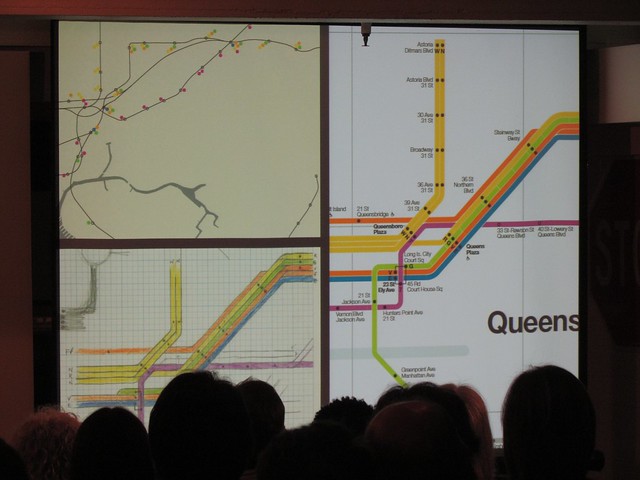
Today, MTA stations feature neighborhood maps — decades after they were first proposed — but the authority decided to merge the geographic map of the city with the subway map. Vingelli did not approve. Showing high-res images of the subway, he detailed the typographic problems with the map and its cartographic shortcomings. The current map, he noted, features call-out balloons and haphazard text. “It covers the information it’s supposed to provide,” he said.
Ultimately, Vingelli, who seems not bitter but upset that the MTA discarded his map, blamed the authority for meddling with the map to the point of incomprehension. “You don’t need a good designer,” he said. “You need a good client.”

The 1979 iteration begat complexity on a map.
Following Vignelli, Tauranac took the mic. He was a member of the MTA’s map committee in the late 1970s and helped lead the effort to replace the Vignelli map with something more “quasi-geographic.” But he said, “over the years, it has become more quasi and less geographic.”
Unlike Vignelli’s map, Tauranac’s representation of the subway map attempts to provide geographic context. The key change between Tauranac’s and Vingelli’s map involved a consolidation. While Vingelli used different lines for each subway route, Tauranac’s committee with help from the design team led by Michael Hertz used trunk lines instead to remove clutter. But the MTA has added more and more extraneous info, and it’s too hard to see the important stuff.
Today, Tauranac offers up his own map for sale. It’s a semi-schematic, semi-geographic meld that features type face that doesn’t run at angles or cover subway lines and shows the difference between night, day and weekend service. It is a far cry from the current iteration of the official map, and Tauaranc’s disgust with The Map showed. “Land got a color I can only describe as bilious, and Just ask any 5th grader what color a park is.” he said of the latest MTA map refresh. “The MTA map has deteriorated. It’s messy in form and less valuable in function.”
For Tauranac and for Kickmap’s Eddie Jabbour, the current MTA version isn’t informative enough in the right ways. Tauaranc spoke at length about the service guide, once a key feature of the Vingelli map and now relegated to the Internet. Without it, the map is only half useful. “When does the Q go to Astoria?” he asked. “Rush hour? Weekdays? Weeknights only? Weekends only? And when does it stop at 49th Street?” With the current map, you just can’t tell.
The KickMap, which first came to my attention back in 2007 and is now available in app form for iPhones, tries to solve those problems. Jabbour’s map borrows elements of Vingelli’s map and tries to produce an easy-to-follow schematic with geographical underpinnings. The mobile version will automatically show nighttime service after 11 p.m., and it is, says its creator, more user-friendly. “There’s a cynicism in that map,” Jabbour said of our subway map. “It’s almost as though someone said, ‘That’s where Atlantic/Pacific is going to go. Tough. Figure it out.’”
As the speakers wrapped up their presentations, the lesson from the evening was one of visual simplicity and information presentation. The Map with its intermodal balloon boxes despised by all has tried to do too much with too little, and the MTA seems content to let the quasiness win out over visual simplicity or a form that serves a function. “Our map is a mongrel,” Jabbour said. “It’s an actually barrier to understand the system.”
Event of the Day: A talk on the subway map
Posted by: | Comments
Massimo Vignelli will discuss his iconic and controversial subway map tonight at the Museum of the City of New York.
I’ve got a soft spot for subway maps. The history of the subway map traces the history of the city, and as with everything else in New York, we’ve seen controversy emerge out of the map as well. Should the subway map be geographical? Schematic? A work of it? The debate is endless.
Tonight, at 6:30 p.m. at the Museum of the City of New York, various cartographers will gather for a talk entitled “The New York City Subway Map: Form v. Function.” The museum’s website describes it as such:
Massimo Vignelli’s 1972 New York City subway map, produced by the Metropolitan Transportation Authority, was considered a design triumph—earning itself a place in the collection of the Museum of Modern Art—but it was also criticized as confusing to passengers. A new version of the subway map was released earlier this year, re-raising the enduring dilemma of how best to achieve both functionality and beauty. Join the creators of several subway maps, including John Tauranac and Massimo Vignelli, for a discussion about designing for the riding public, featuring Eddie Jabbour, creator of Kick Map and the NYC subway app; and Paul Shaw, author of Helvetica and the New York City Subway System: The True (Maybe) Story.
I’m looking forward to this one, and if you’ve got a few hours free tonight, check it out. The Museum of the City of New York is located at 1220 Fifth Avenue between E. 103rd and E. 104th Sts., a short walk from the 6 train stop at 103rd St.
Map of the Day: A culinary subway ride
Posted by: | CommentsNew York City is a culinary capital of the world, and nothing underscores that better than the subway. Take the Q from the Russian enclave of Brighton Beach to the Greek-influenced Astoria. Journey on the 7 from Flushing’s Chinatown past some of the best Thai restaurants, taquerias and Indian joints around.
Today’s map of the day celebrates that rich tradition. From illustrators Rick Meyerowitz and Maira Kalman comes “The New York City Sub Culinary Map.” Originally created in 2004 for The New York, the pair’s map is on display through November 6 at the Pratt Gallery as part of the exhibit “You Are Here ? Mapping the Psychogeography of New York City.” I visited the gallery last weekend, and as you can guess, it’s heavy on the subway.
But first, back to Meyerowitz and Kalman. Rick explains the impetus behind this creative re-imagining of the subway map:
September 2003: I was on an A train headed downtown. I was absentmindedly staring at the subway map and thinking about lunch, when all the station names on the map suddenly rearranged themselves in my mind to become food-related names. “That’s interesting,” I thought. “What if I redid the subway map to make it a food map?”
It seemed a daunting prospect; so many places to rename! So I went to Maira Kalman, my brilliant partner in wordplay and funny names. “I love it but I don’t know if it’s doable,” I told her. Maira knocked the doubt right out of my head with characteristic subtlety: “You’re an idiot!” She told me. “It’s brilliant! We’re doing it, Mister, and we’re doing it right away.”
…We spent months doing nothing but choosing the funniest names and moving them around a pencil sketch of the map. We renamed all 468 stations and added sixteen for the Second Avenue line, which may never even be built. We renamed all the neighborhoods, parks, cemeteries and waterways – 650 names in all.
You can click on the image atop this post to see the larger version, but it’s tough to capture the creativity and originality without taking in the entire wall-sized map. The exhibit runs at the Pratt Gallery at 144 W. 14th St. between 6th and 7th Aves. through next Saturday. The gallery is open from 11 a.m. to 6 p.m. Tuesday-Saturday, and it gets the SAS seal of approval. Check it out.
* * *
As a bonus map of the day, check out Asma Ahmed Shikoh’s Van Wyck Boulevard. Also a part of the Pratt Gallery exhibit, Shikoh’s version of the subway map is hand-painted and in Urdu. He explains, “Painting the subway map and translating minute, tiresome details has been therapeutic for an estranged person who is trying to identify with a new city, its streets, its landmarks, its avenues. The subway map is an integral part of New York city life, a very familiar image, without which no one would have any sense of direction. I have chosen to make the translated subway map, a ‘painting’, so that its status of just being an object of functional value, can be elevated.”
A glimpse of the subway map past
Posted by: | CommentsAn artifact of the subway system pokes through at 57th St. (Photo via flickr user Nicholas Hall)
The subway station at 57th St. and 6th Ave. is an oddity in midtown. Opened in 1968 as part of the massive Chrystie St. project, it served as the northern terminal for the Train to the Plane, a Grand St. shuttle and various other Sixth Ave. locals until 1988 when the 63rd St. station finally opened. Today, it is one of Midtown’s lesser trafficked stations and the system’s 105th most popular station with only 4,237,742 passing through its turnstiles last year, and it plays home to a unique piece of history.
The above image was captured earlier this week, and it shows one of — if not the — system’s last remaining Vignelli maps still on a Transit billboard. While the map is worse for the wear, it appears to be from the mid-1970s, and one Subchatter puts it from 1974. Based on the damage to the map, my guess is that it resurfaced after Transit workers peeled another advertisement off of the board.
In related news, the Design Observer is celebrating Vignelli Week, and as a part of their coverage, they reran a 2004 piece Michael Bierut wrote on the Vignelli map. He offers it up as an ode to the artistry of Vignelli but highlights its shortcomings as a map:
In 1968, Unimark International was commissioned to design a sign system for the subways, and out of this chaos came order. Two Unimark designers, Bob Noorda and Massimo Vignelli, developed a signage plan based on a simple principle: deliver the necessary information at the point of decision, never before, never after. The typeface they recommended, the then-exotic, imported-from-Switzerland Helvetica Medium, was unavailable; they settled for something at hand in the New York City Metropolitan Transit Authority train shop called Standard Medium. The designs they proposed assumed that each sign would be held in place at the top with a black horizontal bracket; the sign shop misinterpreted the drawings and simply painted a black horizontal line at the top of each sign. And so the New York City subway signage system was born.
Four years later, Vignelli introduced a new subway map. It was based on principles that would be familiar to anyone who appreciated the legendary London Underground map designed in 1933 by Henry Beck. Out with the complicated tangle of geographically accurate train routes. No more messy angles. Instead, train lines would run at 45 and 90 angles only. Each line was represented by a color. Each stop represented by a dot. What could be simpler?
The result was a design solution of extraordinary beauty. Yet it quickly ran into problems. To make the map work graphically meant that a few geographic liberties had to be taken. What about, for instance, the fact that the Vignelli map represented Central Park as a square, when in fact it is three times as long as it is wide? If you’re underground, of course, it doesn’t matter: there simply aren’t as many stops along Central Park as there are in midtown, so it requires less map space. But what if, for whatever reason, you wanted to get out at 59th Street and take a walk on a crisp fall evening? Imagine your surprise when you found yourself hiking for hours on a route that looked like it would take minutes on Vignelli’s map.
The problem, of course, was that Vignelli’s system logical system came into conflict with another, equally logical system: the 1811 Commissioners’ Plan for Manhattan. In London, Henry Beck’s rigorous map brought conceptual clarity to a senseless tangle of streets and neighborhoods that had no underlying order. In New York, however, the orthoginal grid introduced by the Commissioners’ Plan set out its own ordered system of streets and avenues that has become second nature to New Yorkers. Londoners may be vague about the physical relationship of the Kennington station to the Vauxhall station: on the London underground map, Vauxhall is positioned to the northwest of Kennington when it’s actually to the southwest, and it doesn’t seem to bother anyone. On the other hand, because of the simplicity of the Manhattan street grid, every New Yorker knows that the 28th Street number 6 train stops exactly six blocks south and four blocks east of Penn Station. As a result, the geographical liberties that Vignelli took with the streets of New York were immediately noticable, and commuters without a taste for graphic poetry cried foul.
Today, Vignelli’s map is but a museum piece. Out of commission for 31 years, his map still inspires debate about the proper role of a subway map, and those on eBay sell for a pretty penny. Yet, one exists, in bits and pieces, on display for now, in the subway system. Catch it before it’s all gone.
After the jump, a view of this map via Max S. from July. Clearly, Transit has losed an opportunity to preserve some of this bit of New York City subway history. Perhaps the Transit Museum should have stepped in. Read More→
Building a better subway map: frequency diagrams
Posted by: | Comments
I live in an area of Brooklyn rich in transit options. If I want to get into Manhattan, I could take the 2 or 3 from Flatbush Ave. or the B and Q also from Flatbush Ave. I could walk to 4th Ave. and grab the R (and then switch to the D or N one stop later) or I could head south to catch the F at 7th Ave. If I’m going to the Village or Midtown, none of these four rides are that much quicker than any other. How then do I know which ride is the best?
The answer to that question is an easy one for people familiar with the subway system and a complicated one for underground novices. From experience, I know that F and R are the worst options, that the B and Q dump me into Midtown quickly and that the 2 and 3 are usually the best bet. Perhaps someone not used to the system could eliminate the F and R based on the map, but the current subway map doesn’t hold the key to my decisions. That key is frequency.
The 2 and 3 are generally my trains of choice into and out of Brooklyn because of their frequencies. During peak hours, the trains each run every four-to-six minutes during the peak hours, and no train is ever that far behind. The B and Q, on the other hand, each run only every eight-to-ten minutes during peak hours, and thus, the wait is longer. Because it generally takes the same amount of to get to, say, 34th St., it makes sense for me to take the train that arrives more frequently, but only those with a close familiarity with the subway system will know that.
Last month, Jarrett Walker at Human Transit considered the frequency map. He is critical of the way maps do not differentiate between routes based on frequency. “A transit map,” he writes, “that makes all lines look equally important is like a road map that doesn’t show the difference between a freeway and a gravel road.” While my example in this post marks the difference of only a minute or two, Walker’s point applies more to service that runs less frequently than every 15 minutes, bus routes and the way subways and buses can interact. He writes:
I contend that transit agencies have an obligation to push back against that complexity, to make their systems look as simple as possible, to give their citizens (not just their riders) the clearest possible image of how their system works. We may not need this understanding to follow your website’s directions, but it will help us if our trip is disrupted and we have to improvise, and it’s essential if we ever want to feel free to use the transit system spontaneously, for our own purposes.
OK, but how to we decide which routes are “major”?
This question may sound like a recipe for decades of focus groups, but in my experience, the answer may not be so complicated if we just consider the basics: frequency, span of service, speed, reliability and ease of access.
The rest of Walker’s post explores the theory in detail and applies it to the Minneapolis-St. Paul transit system. A few weeks ago, Cap’n Transit offered up his frequency map of Queens’ bus routes. It is a very simple idea that brings clarity to what can be a very confusing aspect of the transit system. Have you ever tried to make heads or tails of the Brooklyn bus map? It’s nearly incomprehensible.
For subway maps — and, in particular, for New York City subway maps, a frequency map could strike at the heart of the current version’s biggest shortfall: It provides a schematic of only peak-hour and midday service. It’s true that the map admits as much in the upper corner, but Transit doesn’t make available a map of weekend or overnight service. The changes — from shuttered lines and shortened routes to express trains making local stops — are significant enough to warrant one. A frequency map would be a great step in the right direction as the subway map would become even more user-friendly.
A New York City cartographer’s dream job
Posted by: | Comments
Via Kottke.org comes a link to a job description fit for a New York-based cartographer. New York City Transit is looking for a map manager. Here’s your chance to reimagine the subway map as you see fit. Job responsibilities include:
…the design and timely updating of NYCT’s printed and online map products, including the extensive service schedule panels on the reverse side of all “pocket” bus maps; researching and responding to map design and information issues; identifying, researching, recommending, and adapting evolving map drawing and production technologies; adapting Transit’s map products to the agency website and providing modified products for third party publications; advising on or producing custom maps for major agency initiatives and proposals; advising and assisting on other product design, graphics technology procurements and related staff training for all graphics services in Marketing and Service Information.
Related responsiblities include interfacing with the Planning and Schedules departments to obtain, understand and verify service information and changes; interfacing with MTA HQ for direction on product cover and other style changes; supervising press runs; etc. Annual output includes approximately 5 million printed pieces.
I’d love to pick the brains of the person who lands this job. After all, who doesn’t have their own views on the design and purpose of the city’s ubiquitous map?