Archive for Subway Security
Ten years later, better security or just theater?
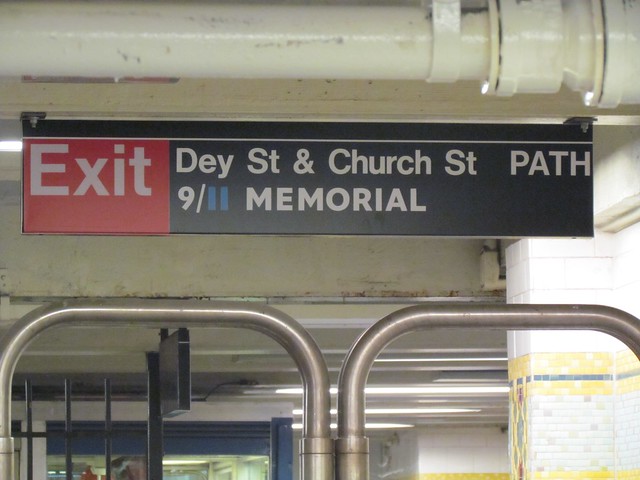
Posted by: | CommentsIt’s impossible to escape the spectre of September 11 right now. As much as I would rather not dwell on the uncertainty and emotion from that terrible day, it is now pervading New York life. New signs at Cortlandt St. point the way to the 9/11 momument, and news outlets of all stripes are covering the decade from every angle.
New York City’s subways were, of course, not at all immune from the impact of 9/11. Physically, the city’s subways were altered. Trains had to be re-routed and stations rebuilt as the falling towers crashed into the subway tubes below. Those weren’t, however, the only changes as security underground became a renewed focus.
Around the world, other cities have seen their subways come under attack. Since September 11, Moscow, Madrid, London and Tokyo have all suffered terrorism-related bombings in their subway systems, but New York’s has so far remain unscathed. That isn’t to say it’s a relatively protected system though. While the MTA has focused its security efforts on high-volume stations and train lines that pass under key infrastructure, the system is porous. Anyone can board a train anywhere and ride it to another destination for the simple swipe of a MetroCard.
With 9/11 looming, the MTA’s security efforts have creeped back into the news lately. New York 1 today offers up a few pieces. One looks at the authority’s increased security efforts while another praises the MTA’s seemingly successful “See Something, Say Something” campaign. According to that report, over 10,000 people called the NYPD to say something in 2010, an increase of over 7000 over 2009. The constant reminders to notice every suspicious plastic bag has at least given the police something to do.
“If there is an event in the the news, people will call more, they’ll see more, they’re paying more attention,” Police Commissioner Ray Kelly said. “If you don’t have any recent events, terrorist events, it’ll seem to fall off some. But generally speaking, I think it’s working well. People are aware of their changed situation.”
Now, the New York 1 pieces are designed to make us feel safer. The MTA, they say, is monitoring thousands of points throughout the system with cameras while some in high-traffic areas — Grand Central, Times Square, Penn Station — provide real-time streams to the NYPD’s high-tech monitoring system. These are necessary measures, but I sometimes wonder if it’s only for show. After all, someone intent on attacking the city’s transit network might know that the busiest stations are also the ones most heavily guarded.
Outside of the city, suburban dwellers are less comfortable with their security. The Daily New Canaan recently questioned Metro-North’s preparedness. As some riders noted, if cops had difficulty locating a stalled train a few weeks ago, how will they respond to a terrorism-related emergency?
Of course, these types of stories simply inspire more theater. People talk about bag inspections for commuter rail passengers, increased police patrols and on-board K-9 units. By stroking fears, lawmakers can push toward an increased police state in our rail network. No one really wants to experience that reality either.
Ultimately, it’s a balancing act. The NYPD and the MTA have to strike a balance between security and theater. They have to project an air of protection without seeming overbearing while working behind the scenes to ensure that the system is protected. We don’t like to think about subway security because we don’t want to think that the subways aren’t safe. We need them; we ride on them; we don’t want to fear them. But this week, security and terrorism are in the news, and subway security remains as it often is — a work very much in progress.
NYPD Transit Chief: Gadgets fueling increase in crime
Posted by: | CommentsEvery three or four months (January, April), those who cover the subways get to dust off the same old story about crime underground, and today, we have the August edition of that tale. Courtesy of John Doyle and The Daily News, we learn that subway thieves are still targeting electronics as grand larcenies — defined as the theft of a cellular communication device — have risen 28 percent this year, offsetting any gains due to the decrease of more serious subway crimes. “The system is as safe as it’s ever been, but you need to be mindful,” Joseph Fox, the new head of the NYPD’s transit bureau, said. “Be aware when the doors are closing; there are still some people who will reach in and snatch [your belongings].”
As the News notes, felony assaults are down this year, but robberies and grand larcenies mostly concerning iPods, smart phones and iPads are up. Some riders say they won’t use their eReaders underground, which defeats the purpose of carrying them around, but the simple solution is vigilance. Hold onto your stuff; keep an eye on those around you; and use common sense on some of the less crowded subways. “I don’t take my phone out or take a Kindle or iPad out,” Amy Kirkhem said to The News. “I could see it being easy for someone to grab. You don’t want to be careless.”
Subway Security: The ‘new normal’ or just theater?
Posted by: | CommentsTen years ago this month, I set out with a friend of mine on a trip to baseball stadiums around the eastern half of the United States. We spent three weeks seeing the country and enjoyed games at 12 stadiums in 10 cities. We took backpacks into the games, and it was, despite the clichéd nature of the phrase, a carefree time.
And then in September of that year, things changed. Backpacks were viewed suspiciously and banned at sporting events. Passenger screening at airports grew tougher, and armed guards starting popping up everywhere: Penn Station, Grand Central, even sometimes in subway stations. After the 9/11 attacks, the mood changed as security of our nation’s transportation network became a paramount concern.
Over the next few months, we’re going to hear a lot about 9/11 and its implications. With the ten-year anniversary of the attacks looming, retrospects on past decade will emerge to the forefront, and already, we see this trend happening. Yesterday, the AP, in a long-form piece, explored how security underground in the New York City subways has changed since 2001. With armed NYPD officials leading police dogs and carrying radiation detectors fronting the story, the piece is heavy on the surveillance.
For police officers and city officials, armed cops in Penn Station and Grand Central are the way of things now, and we are constantly told to say something if we see something. “This is the new normal,” Inspector Scott Shanley of the NYPD’s Counterterrorism Division said to the AP. “The only people who sometimes get raised up are tourists.”
The piece highlights what we know: Madrid, London, Moscow and Minsk are among the cities whose subways suffered terrorist attacks. The cops are diligent in New York, but the system is very porous. “It’s really a potentially very vulnerable environment — one that you can’t totally protect,” William Bratton from Kroll Security said. “That’s the reality of it. … It’s a unique challenge.”
As the article talks tangentially about civil liberties concerns that were quashed by the courts — random bag checks still aren’t very popular — it glosses over the bigger issues: Is all of the outward display of security for good or for theater? “I look at people and who’s to judge?” Robin Gant, a commuter heading to Grand Central said. “You just never know who might be the one. No matter how safe you feel, you’re always on yellow alert.”
There’s a line between a cultivating a culture of fear and working behind the scenes to ensure security. Just how well is it working? Yesterday, a reader sent me the following description of incident that happened to this weekend. I’ll share it in the original:
“I was just on a subway train and there was a brand new backpack, all alone in the car I entered into at 14th St. By the next stop I got off and told the conductor. She listened but didn’t seem to care. That 1 train traveled for OVER 20 MINUTES uptown til the MTA actually did something about it. Finally at 103rd Street, an MTA official came on to the car and just casually took the bag off.
“I imagine the MTA must have some sort of protocol to deal with this type of situation. When they constantly ask us to “say something” if we “see something,” what good is it if a train makes 13 stops before someone inspects a potential bomb? Do you think the train conductor followed protocol? And if so, is that protocol at all effective?”
Over the next few months, I’m going to spend some time exploring those questions. What is the proper protocol? Is it effective? Those are questions that need answering. We see television commercials and a print advertising campaign from the MTA based around exactly the scenario described above, and a backpack sitting alone in a subway car is a red flag. Those are the types of incidents that should be taken more seriously than police officers with guns at Penn Station. Are they or is the security theater just for show?
MTA going to the dogs
Posted by: | CommentsIf you smell something, bark at something. That could be the newest MTA slogan after their K-9 unit took him first place at the U.S. Police Canine Association 2011 trials for explosives detection. The authority announced that Officer Kevin Pimpinelli and his pup Mullen won the crown last month. The trials tested human/canine enforcement teams on the speed and accuracy with which they can locate explosives while “adhering to accepted searching practices and procedures.” The team beat out 28 others at regionals and seven pairs in the finals.
Pimpinelli spoke glowing off his dog. “I’ve been working with him for five years, and right from day one he’s had an excellent temperament for a police canine,” he said. “I could bring him into a classroom full of kindergarteners and he’d be the gentlest dog you can imagine. And then if I gave the command, he’d instantly be searching for explosives.”
The MTA, meanwhile, praised its K-9 unit overall. “Canines are invaluable partners with capabilities that no human or machine can duplicate” Douglas Zeigler, MTA Director of Security, said. “This national honor helps to confirm that the efforts we have made since 9/11 to create a strong anti-terror canine force have been effective. But the real confirmation can be seen every day on the front lines, where our canines help to keep our railroad customers and employees safe and secure.” So there you go.
From the Annals of Bad Ideas: A ‘no-ride’ list
Posted by: | Comments
Let’s try this one on for size: Nine days ago, when President Barack Obama announced the capture and killing of Osama Bin Laden, the intelligence materials gathered from the terrorist’s Pakistani hideout revealed nascent plans to attack the United States’ rail system at some point in the indeterminate future. For terrorists looking for an easy strike, rail attacks aren’t a new idea. We’ve seen them in Moscow, Tokyo, Madrid and London, to name a few, and rail systems that cover vast expanses remain relatively porous.
So what would you say an appropriate response from the Senior Senator from the state with the most commuter rail passengers would be? Do you think he would propose shoring up weak access points? Or do you think he’d rather go in for the quick score that would bring travel headaches, higher costs and few real safety upgrades to the trains? As you can imagine, Chuck Schumer picked the security theater found in the latter.
In interviews with reporters on Sunday, Schumer called upon Amtrak to implement a “no-ride” list similar to the airlines’ no-fly list. The Department of Homeland Security would share its database with the train operator, and all they would have to do is check the ID of every single person who buys a ticket and boards a train. According to Schumer, this plan would come at “virtually no extra cost” to the government.
“Circumstances demand we make adjustments by increasing funding to enhance rail safety and monitoring on commuter rail transit and screening who gets on Amtrak passenger trains, so that we can provide a greater level of security to the public,” Schumer said.
As Gawker noted, that’s a pretty out-there claim by our Senator. Schumer, wrote Jeff Neumann, “of course failed to explain how that statement is even remotely true. He wants Amtrak employees to cross-reference names from the list with passengers. Amtrak alone last year had 28.7 million passengers. Now, just add all of the commuter rail lines across the country and that’s a whole lot of cross-referencing. Well, thanks for fighting the good fight, Chuck. And good luck with that!”
Schumer’s plan for Amtrak also doesn’t address the system’s real vulnerabilities. Terrorists boarding trains shouldn’t be our primary concern right now. Rather, thousands of miles of exposed tracks and bridges and tunnels that remain easy to access should be the focus of the government’s security efforts and dollars.
While Amtrak promised to “review Schumer’s proposal,” DHS seemed lukewarm. A spokesman told Newsday that the Department has expended over $1.6 billion on security enhancements over the past five years, and they’ve done so in a way that isn’t as confining as airpot security. It is the difference between a plan designed to make us feel safer and one that actually makes us safer.
Despite the uproar today — Schumer’s statements have gotten play from virtually every media outlet across country — his idea isn’t a new one. It was originally put forward by the 9/11 Commission back in 2004, but Amtrak has never acted on the “no-ride” list. It also comes at a time when the federal government cut rail security spending by $50 million.
Meanwhile, what of our commuter rails, equally as vital and equally as vulnerable? Schumer says passengers on carriers such as the LIRR and Metro-North wouldn’t have to show IDs, but he would like to see security expenses increased for commuter railroads across the country. It’s always just a matter of money.
After Osama, security ramped up underground
Posted by: | CommentsThe MTA, two weeks ago, revamped their security campaign with the release of a few new ads urging commuters to say something if they see something. It was an almost-prescient move by the transit authority as the city, after Osama Bin Laden’s death on Sunday, ramped up security across the board. As the Daily News noted briefly earlier this week, the subways are one area that will see increased police patrols. “We’re a little more visible today,” an MTA police officer said. “We have dogs out, guys with machine guns. They’re always here but we have more out. This is a major target.”
With the increased security comes more vigilance from the city’s straphangers as well. As ABC News reported, the added police presence will continue for some time as U.S. officials attempt to discern the fallout from Bin Laden’s death. So far, the city has noticed an increase in the number of people seeing something and saying something as well. On Monday, they fielded 60 calls — not all from the subways — and that total represents a figure higher than usual. Underground, the transit system remains porous, and striking the right balance between fear and vigilance remains necessary.
Smartphones still powering bump in subway crimes
Posted by: | CommentsEvery few months, as the MTA releases its crime statistics, we’ve seen a few themes recycled through the news coverage. As I wrote in October and again revisted in January, straphangers’ obliviousness underground has resulted in an uptick in subway thefts as those who flaunt their smartphones and tablets are getting robbed.
Today, as The Wall Street Journal reports, those numbers are again on the rise. Grand larcenies — defined, in part, as the theft of a cell phone — are up 17.8 percent in 2011 as compared with the same time period last year, and police officials are blaming the iPhone 4. “We’ve been seeing an incredible trend of young people snatching those cellphones,” Raymond Diaz, head of the NYPD’s transit department, said to MTA officials today.
According to Diaz, most thefts occur on crowded trains when pickpockets can be most active, and the lines most frequently targeted included the East Side IRT in Manhattan, the J and L trains in Brooklyn and the M, R and 7 lines in Queens. The thieves, the cops say, are reselling most of the phones, and the NYPD is planning a sting. Still, despite this news, crime underground is well below levels from even the late 1990s, and Diaz warned against straphangers who are too complacent. “We feel good that people feel comfortable using their devices,” he said. “But they’ve just go to be a little cautious, especially when they’re sitting by the door.”
Still seeing something, still saying something
Posted by: | CommentsAs the tenth anniversary of the Sept. 11 terrorist attacks loom over the fall of 2011, the MTA has released new print and TV ads in its award-winning security campaign. Still urging those riders who see something to say something, the authority has released a series of new commercials and placards that will appear later this month. The new ads show what the MTA is calling “potential terrorists” leaving bags on subways, buses and commuter rail trains.
“The safety and security of our customers is our top priority,” MTA Chairman and CEO Jay Walder said in a statement. “We are hardening our infrastructure and conducting enhanced policing in coordination with our regional law enforcement partners. But these ads reinforce the important role our customers will always play in ensuring the safety of transit users throughout the entire MTA system.”
The latest public awareness campaign will cost the MTA $10 million, but the Department of Homeland Security is footing the bill. In return, the MTA granted DHS the license to use its slogan — “If you see something, say something” — in nationwide anti-terrorism ads. The latest spots, which include these print ads, were designed by Korey, Kay & Partners, an ad agency with long-standing business ties to the MTA.
Subway ejections down precipitiously in 2011
Posted by: | CommentsAs I was browsing through the upcoming MTA Board committee meeting books this evening, I came across a surprising number. After ejecting 2676 straphangers from the system in March of 2010, police officers removed just 668 folks for misbehaving. That’s a decrease of 75 percent, and at a time when arrests are up a few percentage points, this drop in ejections is surprising.
It is, in fact, so surprising that Erik Ortiz of amNew York wrote an entire article on the topic. Riders speaking to the free daily spoke anecdotally of the atmosphere underground. “It’s a problem late at night. Recently there was a man speaking loud getting close to people. You can tell he was inebriated and that makes you feel unsafe,” one rider said.
Of course, drunk, loud people seem to be the least of our worries. Homeless people inhabit subway cars, and panhandlers are supposed to be removed from the subway system. Ortiz tried to determine the cause of the decrease, but answers weren’t forthcoming. He reports:
While authorities would not speculate why there are fewer people being kicked out of the subways, the transit union yesterday said the loss of station agents is a “critical factor.”
“Passengers in stations without an agent really have nowhere to complain other than the emergency call (boxes) that most people don’t even realize is there,” said Jim Gannon, a spokesman for the Transit Workers Union 100.
The union said the MTA has about 480 fewer agents than a year ago. An MTA spokesman declined to speculate on the ejection numbers. The NYPD was unable to say why officers are booting fewer riders, even as they cuff more crooks. Transit arrests are up, and increased nearly 8 percent from 2009 to 2010.
Gannon’s point seems to be the union’s rote response, but it also doesn’t hold up to scrutiny. Even if a station agent placed a call to a police officer — a rare occurrence indeed — it would take more time to find the perp and remove him from the system than is worthwhile. Usually these ejections occur during cops’ routine rounds underground, and the presence of station agents shouldn’t cause a 75 percent year-to-year drop.
Furthermore, recent months suggest a pattern is emerging. As Ortiz reported, “In the first three months of 2011 compared to 2010, the number of riders being booted out of the subways dropped 66 percent, 7,794 to 2,631.” That seems fishy.
So what’s going on here? It seems to me as though the cops are scaling back their quality-of-life enforcement efforts underground. As the article notes, offenses for which one may be ejected include jumping a turnstile, panhandling, drinking or smoking, playing a radio audible to others (hah!) or carrying bulky items that interfere with subway operations. If cops are no longer patrolling for these offenses, ejections will decline.
Now someone just has to figure out why the cops aren’t on the case. After all, we’ve all seen instances undergound of ejectionable offenses, but rarely are people removed from the system. Instead, summons and arrest totals have increased, and the word “quota” somehow winds its way through my mind. After all, no one gets credit for an ejection when a ticket or arrest will do, and as NYPD staffing numbers are reduced, the quality-of-life violations undergound will likely increase.
For strident enforcement against subway groping
Posted by: | Comments
Over the past few years, the MTA has noticed an uptick in a certain type of crime. I’m not talking about technology thefts but rather groping incidents, and today, the issue earned itself some much-deserved prominent press. In his Monday transit column, Daily News reporter Pete Donohue focused on subway perverts who grope unsuspecting women.
He writes:
On average, there are about 600 reported incidents of riders being groped, flashed, grinded or similarly assaulted in the subway every year, according to the police. But NYPD brass and advocates say that’s just a fraction of the misdemeanor sex crimes taking place on trains. In reality, the number of incidents annually is probably in the thousands, some say.
“Oftentimes when people are being harassed, they’re scared, they’re not thinking, ‘Let me find a police officer,’” said Emily May, an R train rider and co-founder of the anti-harassment advocacy group Hollaback! “They’re thinking, ‘Let me get out of this situation.’”
…The NYPD has some undercover officers on the lookout for perverts, but the size of the subway force has shrunk due to budget cuts, just like the number of aboveground cops. Over the last three years, police have averaged 450 arrests for misdemeanor sex crimes, according to NYPD stats. Many creeps who are busted have been around the seedy subway block before. Approximately 15% have been handcuffed previously for similarly loathsome behavior, a police spokesman said.
In his article, Donohue talks about how few defendants face sexual assault-based charges and how the city needs to “wage an all-out war against these two-legged rodents.” He’s right, and over the years, the MTA has tried, with little success, to fight the tide of groping. The agency unveiled a new PSA campaign — one they currently overhauling — in 2008, but sexual harassment remained the leading quality-of-life subway crime. That behavior should not be tolerated.