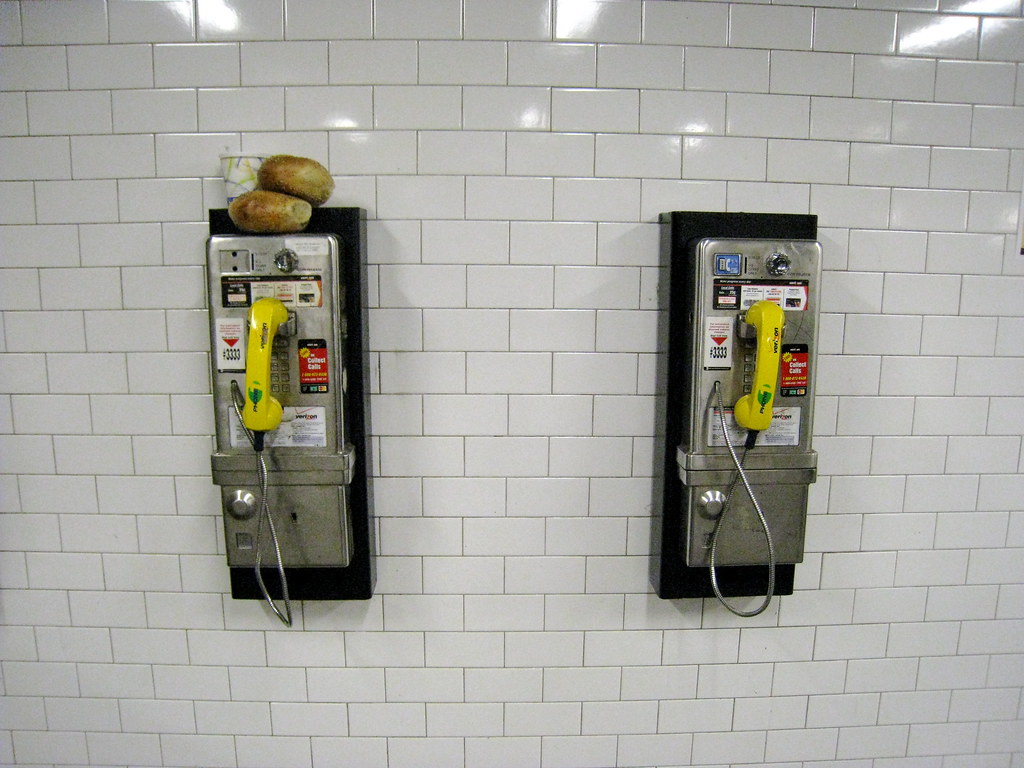
On Tuesday, the MTA announced plans to open their own 311-styled call center. A press release announced this innovation:

One of the customer needs identified by the MTA’s Customer Service Initiative is easy access to streamlined information. As MTA customers increasingly use more than just one of the MTA’s operating agencies on a regular basis, information should be centralized and seamless. The MTA is exploring a plan to create one designated customer service phone number, similar to 311, where MTA customers would reach a call center that could provide seamless transportation information for all MTA services.

I can only imagine what the calls between a confused straphanger-to-be and the MTA’s 3-1-1 would sound like…

————————-

Caller: Hello? Hello? I’m at Union Square and I want to get to Central Park. What’s the fastest way?
MTA 3-1-1: Take that train.
Caller: Which train?
MTA 3-1-1: That one. The express.
Caller: We’re on the phone. I can’t see you pointing. And there are four different express trains here.
MTA 3-1-1: Ok. Hold on.
Pre-Recorded Hold Voice: We apologize for the unavoidable delay.
MTA 3-1-1: Ok. Take the L.

————————-

Caller: Help! Help! I’m being attacked!
MTA 3-1-1: ::Does Nothing::
Caller: Help! I’m being dragged!
MTA 3-1-1: ::Presses panic button::
Caller: HEEEEEEELLLLLLLLLP
MTA 3-1-1: ::Cowers in silence::

————————-

Caller: I’ve been standing out here in Astoria waiting for the train for 20 minutes. Can you tell me what’s going on?
MTA 3-1-1: Stand clear of the closing doors please.
Caller: There’s no train here! I can’t stand clear of the doors.
MTA 3-1-1: We apologize for the unavoidable delay. The train will be moving shortly.
Caller: What train?
MTA 3-1-1: We are being held in the station by the train’s dispatcher. We should be moving shortly.
Caller: WHAT $*#@#* TRAIN?!
MTA 3-1-1: We apologize for the unavoidable delay.

Categories : MTA Absurdity
Comments (1)

That Gene Russianoff, always keeping us on our toes. Today, Russianoff’s Straphangers Campaign issued a warning about the state of the MTA’s finances. Without a fare raise, a new study conducted by the Independent Budget Office said, the MTA could see deficits rise to the billions by the end of the decade.

On the surface, the situation sounds drastic. The fares, the report estimates, would have to go up to $2.40 by 2010. Those $76 Unlimited MetroCards would cost a whopping $92. The commuter rail prices and tolls would spike. The Times summarizes:

The Metropolitan Transportation Authority will have to raise revenues significantly to stave off looming deficits in the next several years, increasing pressure on the authority to increase transit fares and bridge and tunnel tolls, according to a study by the city’s Independent Budget Office.

Unless it can substantially cut costs, the authority will need to increase total revenues by about 20 percent over the next three and a half years, the report said.

Over the last few years, we’ve heard proclamations similar to this one, and each year, the MTA’s tax windfall has staved off what seems to be an inevitable far hike. But in their report (available here as a PDF), the IBO warns that the MTA should not be relying on unplanned taxes to cover their operating expenses and possible debt.

For many, though, this IBO report is nothing new. Back in February, the MTA issued its own report that arrived at a similar conclusion. And as he did in February, MTA CEO Elliot “Lee” Sander stressed yesterday that the state of the subways will not degrade on his watch. “The one thing that we will not do is let the system go to hell, as it did in the late ’70s and early ’80s,” he said, “and so we must ensure that the system remains viable in terms of its infrastructure.”

This all sounds well and good, but haven’t we heard this before? Hasn’t the MTA issued dire warnings of debt and higher fares? Well, as The Times notes, this new report however is different from these other warnings because the Straphangers actually agree with the MTA. The independent auditors see the need for a fare hike. No more cooked book scandals; no more unnecessary fare hikes. Like the boy who cries wolf, every now and then the MTA is right about the state of its economics. And maybe Sander has this organization turning a corner in terms of the face it presents to the public.

Now, astute riders may wonder, “But what of the congestion fee? Isn’t that supposed to go to the subways?” And that, my dear readers, is a very good question. While the Straphangers acknowledge that the $900 million in anticipated revenue from the congestion fee will go toward the MTA’s coffers, the City and the MTA are working on a deal that would earmark some of the congestion fee to the Second Ave. subway, a multi-billion-dollar project that doesn’t even factor into the debt crisis the MTA could face by 2010.

The IBO believes that a combination of fare hikes, slight property tax increases and federal and state contributions could help the MTA cover its debt, but the stars will have align just right for this dream to be realized.

So where does that leave us, the not-so-meek riders of the MTA’s grand system? We should steel ourselves for a fare hike. We should pray for another tax windfall. We should ask the state legislatures to do the right thing and send the MTA more money. And we should support Mayor Bloomberg’s congestion fee. We can avoid the direst of predictions such as that $2.40 fare, but as the Straghangers are now echoing the MTA, subway armageddon may be upon us next year after all.

Categories : MTA Economics
Comments (2)

Preliminary sketches of the new station show the shifting sidewalks and traffic patterns on Broadway. (Click to enlarge; Courtesy of the MTA)

Please note, the hearing mentioned below is scheduled for Wednesday, June 6, and not Tuesday as the post originally implied. My fault.

Nearly one year ago, Community Board 7, the lords of the Upper West Side, overwhelmingly supported a plan to overhaul the northern entrances of the 96th St. stop on the IRT. Tomorrow, these plans — a drastic reconstruction of one of the system’s oldest stations — will inch one step closer to reality as the MTA hosts a public hearing on the proposed Station Access Changes.

Currently, the 96th St. station entrances are a bit of a disaster. Passengers have to enter on either the southwest or southeast corners of Broadway. They must walk down one narrow staircase to reach the turnstile area. After swiping through, riders then have to walk down another set of narrow staircases to each a tunnel underneath both the uptown and downtown platforms. Then, straphangers have to walk up yet another staircase to reach the platform.

Additionally, the entrance on the southeast corner of Broadway and 96th St. is open only during the day. Any nighttime passengers heading north must cross the street to get to an open entrance and then walk back that length to reach the uptown platform.

The plans to streamline station access and to make this high-volume station handicapped-accessible are, according to the MTA, as follows:

NYC Transit proposes to close the sidewalk stairs on the southwest and southeast corners of 96th and Broadway and to replace these entrances with a head house built on an expanded Broadway median between 95th and 96th Streets. The new head house will have stairs and elevators leading directly to the uptown and downtown platforms. This entrance will be open and staffed full time.

The sidewalk entrances need to close because the Broadway median must be expanded to make room for the head house. To allow for the widened median the Broadway sidewalks will be narrowed and the sidewalk area where the stairs are now will be eliminated.

This is an interesting plan, and it’s hard to come out against it at first brush. Most notably, these plans will provide elevator access (that is, handicapped access) to the first (or last) transfer point on the West Side IRT lines. It will also reduce the total elevation change for passengers from 43 feet (down-down-up) to just 19 feet (down). Furthermore, the four seven-foot wide staircases to the platform will replace the current two five-foot wide staircases thus reducing station congestion.

But on the other hand (or the “disbenefits,” as the MTA terms it) are the additional walking people will have to do above ground. The new structure will be fifty feet south of the current entrances and in the center of Broadway. The MTA claims that the two out of every three passengers who have to wait at a red light to cross Broadway will be delayed a whopping 26 seconds.

As a native of the Upper West Side, though, I’m much more concerned with the decrease in available sidewalk space. The new plans call for moving Broadway nine feet on either direction to compensate for the wider island in the center of Broadway. While the sidewalks would be 15 feet wide, that’s a big decrease from their current width of 23 feet.

But the benefits of the station house should outweigh one shorter block. It will be easier and faster to enter one of the more crowded stations on the West Side. Meanwhile, above ground, the station will resemble the new structure at 72nd St. The same firm is signed on for this project, and the plans call for a wider median with a seating area at 96th St. leading to the station entrance in the middle of the block. That sounds good to me.

MTA Public Hearing: Station Access Changes, Wednesday, June 6, 6 p.m., MTA Headquarters, 347 Madison Avenue – Fifth Floor

For more images of the plans for the rehabilitated 96th St. station, click here

Categories : MTA Construction
Comments (13)

The guy driving this truck ain’t the brightest crayon in the box. (Oscar Hidalgo/The New York Times)

When I first read this story on Friday, my reaction was simply, “This guy is an idiot.” Here’s the story: A truck driver from Texas drove his 13 foot-6 inch tall truck through the 13-foot tall Lincoln Tunnel even though the warning sirens had rung and police had warned him to stay out of the tunnel.

Once inside the tunnel, as the roof of his truck scrapped tiles off the roof of the tunnel, the driver, Gilberto Cantu, continued to drive from New Jersey to Manhattan. Here’s what The Times said:

Mr. Cantu drove the entire 1.5 miles of the tunnel from Weehawken, N.J., to Manhattan, tearing his way under the Hudson River in the tunnel’s center tube and peeling back the roof of his tractor-trailer as if it were a tin can. No one was injured, but an undetermined number of decorative tunnel ceiling tiles were ripped off.

It was unclear why Mr. Cantu did not heed warnings from flashing signs and a loudspeaker in New Jersey, said Steve Coleman, a spokesman for the Port Authority of New York and New Jersey, which operates the tunnel. “There were enough bells and whistles going off that this should not have happened,” Mr. Coleman said. “He told the officers he didn’t know where he was going.”

According to the Port Authority, trucks are turned back around once a week. Usually, drivers heed the warning bells and police loudspeaker. But not Mr. Cantu.

And why, might you ask, would Mr. Cantu ignore these sirens? Well, Cantu, a four-year veteran of a trucking company that professes to run frequent routes to New York, told police he was confused and didn’t know where he was going. Newsflash, Gilberto: You’re at the Lincoln Tunnel. It goes one way from New Jersey into Manhattan.

Cantu now faces charges of nine moving violation misdemeanors which, according to The Times, include reckless driving, failure to obey a traffic signal and failure to obey an officer’s command.

U.S.A. Logistics, Cantu’s employer, hasn’t yet decided on this driver’s future with the company. They will however have to pick up the tab for the tunnel.

Meanwhile, I would like to belatedly award Gilberto Cantu with the Idiot of the Week award. It takes a special kind of person to drive through the Lincoln Tunnel for 1.5 miles while scrapping the roof off your truck and the tunnel without noticing. Nice going, Gilberto.

Categories : PANYNJ
Comments (4)

Local 100 of the Transit Workers Union draws out some of the most vehement debates about labor unions in New York. Clearly one of the strongest chapters of the AFL-CIO in the city, opponents of the TWU 100 claim it holds the MTA hostage during labor negotiations while pro-labor proponents defend the workers to the death.

Now, as a result of sanctions leveled against the Transit Workers Union in the aftermath of the illegal December 2005 strike, the Union could be facing an economic crisis that may threaten its very existence. NY1′s transit beat reporter Bobby Cuza notes that the loss of “dues check-off,” the Union could lose much of its $20 million it draws in through this system. Cuza writes:

With every paycheck that NYC Transit sends its employees, it automatically deducts union dues, and sends that money directly to Transport Workers Union Local 100. But effective June 1st, “dues check-off” is being revoked as punishment for the December 2005 strike…

Without “dues check-off,” the union will have to convince each individual worker to pay their dues voluntarily, whether by check, credit card or through an automatic payment program. So far only about half have pledged their commitment to pay, but Toussaint says they are still reaching out to many of the 35,000 workers.

According to the report, the situation may not be as dire as it first sounds. Even Toussaint’s opponents within the TWU are working to convince the members to donate their dues even without the dues check-off procedure in place. Furthermore, the TWU can apply for dues check-off reinstatement 90 days after this penalty goes into effect.

In addition to this sanction, Toussaint spent a short time in jail and the Union had to fork over $2.5 million in fines as a result of the strike. As word gets out about these sanctions, the debate over the future of the TWU in New York City is bound to be bitter. It always is.

Categories : TWU
Comments (0)

Inspired by the news that the MTA isn’t banning alcohol and these commercials

Second Ave. Sagas presents Real Men of Genius
(Real Men of Genius)
Today we salute you Mr. Really Drunk Metro-North Commuter

(Mr. Really Drunk Metro-North Commuter)

Facing a long commute the end the day, you board the train clutching three cans of Bud Light, announcing to everyone that you can’t just wait until you’re at home.

(It’s really just a few more stops)

Pelham, New Rochelle, Larchmont, Mamaroneck
Ten more stops to go, and you’re already out of beer.

(We’re only at Port Chester)

Now you can keep on drinking even though you, like 286 other people last year, already got a ticket for creating a disturbance on the train.

(It’s not even a bar)

So crack open an ice cold Bud Light Mr. Drunk Commuter.
Watching the medics at Danbury treat your alcohol poisoning just adds to the excitement of a trip home.

(Mr. Really Drunk Metro-North Commuter)

Categories : MTA Absurdity
Comments (7)

I’ve got some good news for you commuters that can’t stomach the thought of a sober ride home. The task force convened to examine the MTA’s alcohol policy has returned a verdict: You can keep on drinkin’ on Metro-North and LIRR trains.

The MTA issued a press release just a few hours ago detailing the task force’s decision:

The final report unanimously recommended that the current policy should not be changed. Upon review of the report, Chairman Kalikow and Executive Director and CEO Sander agreed with the recommendation…

The report based its conclusion on four main findings:

- Based on MTA Police Department testimony and data, State DWI/DUI statistics, and the polling of police departments along MTA railroad Rights-of-Way, no correlation was able to be drawn between the sale or consumption of alcohol on MTA facilities and DWI incidents in or around either railroad (since 2003, only four DWI cases were reported on commuter rail property, and not a single one was attributed to drinking on MTA trains or facilities);

- The sale of alcohol, beverages and snacks were considered an amenity for customers, particularly for those traveling longer distances;

- Alcohol was readily available for purchase in multiple locations in or around LIRR and MNR stations/terminals; and

- Preventing the consumption of alcohol prior to arrival at or on commuter railroad trains was not feasible.

MTA Executive Director and CEO Elliot “Lee” Sander uttered the understatement of the year in announcing this decision. “Many of our customers enjoy this amenity, and I am pleased that the Task Force confirmed that the current policy provides a benefit without compromising safety,” he said. It’s safe to assume that a whole bunch of white-collar, suburban commuters may just have taken their eyes off of their Blackberries long enough to riot had the MTA banned alcohol on these trains.

Meanwhile, The Times reports that alcohol-related medical cases are far from uncommon on commuter rails:

The police issued 287 tickets on the Long Island and Metro-North lines last year to people on trains or in stations who were drinking alcohol and creating a disturbance. Far more prevalent, the police said, were instances of people on commuter lines who needed medical help because of extreme drunkenness. There were 994 such cases on the two railroads last year, but officials said that in virtually every case, the riders appeared to have done most or all of their drinking before they ever got on a train.

I’d hate to think what these folks who drink themselves into a stupor on Metro-North or the Long Island Railroad do for a day job. Maybe it’s just too hard to travel back to North White Plains and face yet another night in suburbia with the family.

But anywhere, there you have it, folks. The MTA will allow you to keep on drinking yourself silly on the way home. Now, if only we could enjoy some booze on the subways. Just imagine how nice that would smell on Sunday morning.

Comments (3)

An architectural rendering of the IRT platforms with a connection to the IND platforms below. (Courtesy of Lee Harris Pomeroy. Click for a bigger view.)

Is there a more annoying station than the Broadway-Lafayette St./Bleecker St. disaster? Because you can’t transfer from the uptown 6 platform to any other train in that station, you have to know which entrance you want well ahead of time. And good luck explaining to lost tourists on the IND lines that they can’t switch to an uptown 6 without leaving the station and paying the fare again.

Over two years ago, word came out that the MTA was preparing a station rehabilitation plan for this relic of the era of dual systems and competing, separate subway lines. At the time, these plans were to cost $50 million. Since that announcement, this great idea has gone nowhere. The station is a still an odd labyrinth sort of connecting two tunnels that used to be parts of competing corporations — one owned by the Interborough Rapid Transit company, the other by the City of New York.

But all of this may change soon. In a few weeks, the MTA will hold a public hearing on a whole slew of capital projects. Since the MTA is eligible to receive nearly $1 billion in federal funds for these projects, the list is rather extensive. Buried among the more mundane station rehabilitation plans however is a three-tiered request for the Bleecker St. station and the Broadway-Lafayette St. connector.

Here, in a nutshell, is what the MTA hopes to do with this station:

  • Extend the northbound platform on the IRT line 290 feet to the South.
  • Construct a new mezzanine under the IRT platforms that would provide a connection from the uptown and downtown platforms to the uptown and downtown IND lines.
  • Install five elevators and an escalator as part of the Authority’s need to fulfill the ADA requirements for this station complex.

The rest of the plans for this now-$60 million rehabilitation include the standard overhaul: Restored tile mosaics, new floors, a paint job, etc. It’s a shame that inflation and higher costs will lead to a $10 million price increase, but that seems to be business as usual for the MTA’s Capital Construction department.

Personally, I love this plan. This station — unique among all of the city’s transfer points — has long been an oddity in New York. At no other point can you transfer to or from a train heading in just one direction. The companies that oversaw the Union Square rehabilitation are — Weidlinger Associates and Lee Harris Pomeroy — in charge here, and it looks like they plan to produce a snazzy looking station for the East Village/SoHo area.

The New York City subways will once again be safe from dumbstruck and confused tourists. Or at least at Bleecker St.

Click here for more pictures of the station renovation plans.

Comments (31)

I (along with Catherine Dent from The Shield!) entered the subway at 96th St. this evening at around 9:30 p.m. From the Upper West Side to Park Slope, I rode on two fairly crowded trains. Considering it was late-ish on Memorial Day Monday, the trains were teeming with people.

This is, as New York City Transit president Howard Roberts noted on Friday, now an everyday occurrence. New York City is more crowded than ever with residents and tourists, and these people take the subway to get around. Ridership numbers should soon surpass record highs, and subways, crowded at all hours of the day, are beginning to bear an increasingly heavy load.

Which brings us to an editorial in The Post that got lost over Memorial Day Weekend. In a rare moment of candor from New York’s favorite Murdoch-owned tabloid, The Post urged the MTA to get thinkin’ already on tomorrow’s problems. Let’s tackle them today, as the cliché goes.

The Post took its cue from Roberts’ comments on Friday that maybe the subway system could use longer (and faster) trains to carry more people throughout the city it a quicker fashion. While two commenters on SAS and I both agreed that Roberts’ proposal sounds ludicrous, his main point is on the money. Over the next five, ten, twenty years, more and more people are going to be riding the subway. If you think the F line is crowded now, wait until Kensington and Borough Park fill up with even more people.

The obvious solution to these problems revolve around running more trains. But some lines are at capacity. The IRT lines can’t handle more trains. Even the IND and BMT lines are mostly maxed out. The tunnels can only hold so many trains if the MTA wants to keep the trains moving at a steady pace. There’s nothing worse than waiting in a tunnel for the train ahead of you to clear out, and if more trains are added to most of the lines in the city, wait times would increase dramatically.

While lines like the L will see more subways in three years, many lines are already at that peak of 26-30 trains per hour during rush hour. Roberts claims that extended subway platforms would cost less than building new lines, but I don’t buy it. Stations that are already too close together would have to close, and no one would like that. Furthermore, station extension projects involve excavation and renovation beyond anything we’ve seen in the subways in a long time.

In my view, the solution to the city’s subway problem — or future problem — is to build a more comprehensive grid. We need more trains running from Brooklyn to Queens without crossing into Manhattan. We need more crosstown trains through Manhattan and more stops on the far East and West Sides.

Opponents may question the cost and infrastructure needs for such an expansion, but I point to London and, more recently, Beijing as cities that have built new subway lines in built-up areas. The need was there; the money was there; the lines were completed.

Considering the long and tortured history of the Second Ave. subway, a line that promises to be New York’s first new subway route in nearly eight decades, I’m not going to hold my breath waiting for the MTA to adopt my plan. But any discussion about the efficiency and overcrowding on the subway should start and end with new lines. If those in charge of the city are serious about maintaining its sustainability, new subway lines must be a part of this plan.

Categories : MTA Politics
Comments (5)

So the word in The Post today is that New York City Transit head Howard Roberts wants longer trains to run faster to ease the overcrowding now seen on the subways. This sounds like a horrible idea.

Faster, longer subway trains may be needed to handle the anticipated crush at the turnstiles as the city’s population grows by 1 million over the next two decades, [Roberts] told The Post.

Platforms could be lengthened to allow for a shift from 10-car trains to 12-car trains – a 20 percent increase in capacity, he said.

Roberts claims that building longer platforms would be cheaper than building new tunnels. Stunningly, what Roberts proposes would involve renovating all 468 stations. This idea doesn’t account for stations such as the West Side IRT stop at 72nd St. where it would be impossible to extend the platform.

This may be the dumbest idea I’ve ever heard relating to the subway. I hope this isn’t indicative of things to come under Roberts, and if you think weekend service delays are bad now, imagine if the MTA had to redo every single station.

SUBWAYblogger notes that the MTA should just update its 1930s technology. I couldn’t agree more. He also has your weekend service updates. And remember, trains run on Sunday schedules on Monday due to Memorial Day.

Have a great three-day weekend. I’ll see you back here on Tuesday.

Comments (5)
Page 415 of 430« First...413414415416417...Last »