
Just in case you missed it when the Daily News ran an easy-to-understand graphic showing that ridership on the Staten Island Railway was up 12.8 percent this year, amNew York’s got your back. New York’s free daily profiled the SIR yesterday, focusing on the exploding ridership and the quirks of the free train line. While the line could still support an increase in capacity of another 25 percent, hardly anyone pays the $2 fare that the MTA collects only at the St. George Ferry Terminal stop. In fact, many riders opt for a seven-minute walk to avoid that fare as well. I have to wonder if perhaps, with ridership on the climb, the MTA should consider trying to capture fares in Staten Island. Every dollar helps. [amNew York]
When the MTA elevator story broke in The Times yesterday, I was struck by the candor in the reporting. William Neuman spoke to some high-level MTA employees — including NYC Transit President Howard Roberts and the agency’s own elevator and escalator guru — as he pieced his story together.
The MTA workers were generally candid in their critiques of their agency. “This organization is very, very good at subway car maintenance; it’s very good at bus maintenance. But maintaining auxiliary equipment it hasn’t done as well,” Roberts said. “I think that we are in the process of trying to create the same competence in elevator and escalator maintenance that we have in buses and subway cars.”
Joseph Joyce, the general superintendent of elevators and escalators, was equally forthcoming.
“I’m trying to get these guys to think that, you know what, that could be your mom that’s walking with a cane and needs that escalator,” he said to Neuman. “Nothing in this world is guaranteed. It could be one of us in a wheelchair next month. And if you want to enjoy the city, you want to be able to utilize our public transportation system. You need that elevator to work.”
It’s tough to find fault with the MTA for their honesty. Instead of hiding behind a bunch of “no comments,” the people in charge responded to an obvious problem and are seemingly willing to confront it head-on. Later in the day on Monday, NYC Transit released an official statement on elevator and escalator service problems. It read, in part:
To help better train our workforce, NYC Transit recently opened a specialized training annex aimed at teaching the maintenance and repair of elevators, escalators and moving walkways. The facility offers extensive hands-on training so employees will be as prepared as possible as they work to keep the subway system’s nearly 370 elevators and escalators in a state of good repair. Prior to the annex’s opening, all instruction was done in the field. The annex is now a vital tool in maintaining the reliability of the system’s elevator and escalator equipment. It should also be noted that in most instances, elevators are being installed in a system whose original designers never planned or provided for their installation.
Modeled after the program that helped dramatically boost subway car reliability, we have also begun a program that forecasts the expected service lives of escalator and elevator parts, and then replacing them prior to the point of failure. The system that houses maintenance records has been upgraded and fully computerized for easy reference and retrieval. Early improvements in reliability figures indicate that the move to the Scheduled Maintenance System is already having a positive impact. To visually check elevator and escalator operation, personnel from the Division of Stations check the equipment in their stations three times a day. In yet another move forward, NYC Transit has installed a $1.3 million electronic monitoring system to alert maintainers when an elevator or escalator stops working…
These aggressive shifts in our philosophy have earned some improvement in the reliability of escalators and elevators. Though we are still coming online with the training annex, escalator reliability rose from 97.1 percent to 98.1 percent from the first quarter of 2007 to the same period this year. Likewise, elevator reliability rose from 97.9 to 98.8 percent.
Part excuse, part explanation, but from the sound of it, NYC Transit is working hard to ensure elevator and escalator reliability, and they should be working hard. These services go beyond simple measures of efficiency and wasteful spending. For many wheelchair-bound straphangers, these elevators — although sparse — are the only means of entry and exit from the train systems. An unreliable system is doing no one any good.
In the end, it will be probably be a challenge for the MTA to keep these elevators running smoothly all the time. They are, after all, in use 24 hours a day, 7 days a week, 365 days a year. Some people use the privacy of the elevators for inappropriate bodily functions; some people use them as their own personal drawing boards or garbage cans. They’re trod upon and abused during all hours of the day.
But as The Times story has drawn attention to a problem that is getting increasingly harder to ignore — someone think of the privately owned escalators! — it is comforting to know that the MTA is working to improve service. Hopefully, those measures will be successful.
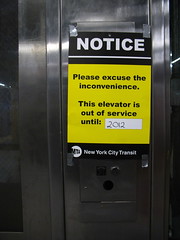 One of my least favorite subway trips begins (or ends, really) at Clark St. in Brooklyn. Nestled just past the New York harbor in Brooklyn Heights, the Clark St. station is so far underground that one must use an elevator to reach the platform. While there is an 80-foot staircase in case of emergencies, the elevators — the creaky, lumbering, claustrophobic elevators — are the MTA’s recommended means of getting to and from the 100-foot deep platform.
To residents of the area, the terrible conditions of this elevator are not a secret. Brooklyn Enthusiastic bemoaned the sorry state of the elevators over a year ago. The MTA’s problems with auxiliary equipment stretch well beyond one elevator in Brooklyn. As I’ve detailed over the last few weeks, the MTA’s escalators have garnered a lot of attention lately, and the Straphangers Campaign called upon the MTA to fix the system’s numerous broken escalators.
But today, the dam broke. In a stunning indictment of the MTA’s non-rolling stock, non-track-related equipment, William Neuman in The Times explores the extent of the subway elevator and escalator problems. After $1 billion in investment since the mid-1990s and $1 billion more planned for the next 10 years, the MTA’s elevators are rife with problems. Neuman notes some of the issues:
¶One of every six elevators and escalators in the subway system was out of service for more than a month last year, according to the transit agency’s data.
¶The 169 escalators in the subway averaged 68 breakdowns or repair calls each last year, with the worst machines logging more than double that number. And some of the least reliable escalators in the system are also some of the newest, accumulating thousands of hours out of service for what officials described as a litany of mechanical flaws.
¶Two-thirds of the subway elevators — many of which travel all of 15 feet — had at least one breakdown last year in which passengers were trapped inside.
“This organization is very, very good at subway car maintenance; it’s very good at bus maintenance. But maintaining auxiliary equipment it hasn’t done as well,” NYC Transit President Howard Roberts said to The Times. “I think that we are in the process of trying to create the same competence in elevator and escalator maintenance that we have in buses and subway cars.”
The problems, however, go well beyond simple breakdowns. It is, according to Neuman’s sources, a problem of institutional inadequacies.
The more than 200 mechanics who maintain and repair the subway’s elevators and escalators receive as little as four weeks of training, a fraction of what they would receive in other transit systems or in private industry. And transit officials concede the system is so inefficient that many elevator and escalator mechanics spend barely half of their shifts actually working on troubled machines.
Managers often rush balky elevators and escalators back into service without identifying the underlying causes of mechanical problems, leading to more breakdowns.
Many problems occur because of basic design flaws or mistakes made during the construction of the machines, when contractors worked with little or no oversight. Those conditions left many of the machines virtually broken from the outset.
“They don’t have enough competent people with the proper training,” said Michele O’Toole, the president of J. Martin Associates, which the transit agency hired in 2006 to evaluate its elevator operations. “It all reflects back to qualifications, training, capabilities.”
Transit officials offered the typical excuses: The subway system is too large with elevators at disparate corners of the city; the 24-hour-a-day nature makes it impossible to police public elevators-cum-restrooms; and so on.
The rest of Neuman’s piece is anecdotal. He examines numerous elevators and escalator in various stages of decline. We have elevators at West 4th Street that don’t fit the space; escalators that fall apart when people step on them and start up again suddenly. We see inadequate training and subpar emergency response times.
In the end, for those straphangers long used to relying on and avoiding the MTA’s elevators, these findings come as no surprise. For others, Neuman’s stellar piece will be a shocking reminder that the MTA can run subway cars but not a subway system too well. Hopefully, it will begin the process of change so badly needed as the MTA struggles to maintain its auxiliary equipment underground.
Photo by flickr user fmsparis.
Despite prognostications that the collapse of the Tishman Speyer Hudson Yards agreement would lead to a lesser development deal, word is that the MTA is going to get its $1 billion after all. As Charles V. Bagli reports on The Times’ City Room blog, Stephen M. Ros, CEO of Related Companies and one of the runners-up in the original bidding process, has inked a deal worth $1 billion to develop the Hudson Yards area. This is, of course, good news for the cash-strapped MTA, and there is, as yet, no word on how long it will take this deal to collapse as well. [City Room with a hat tip to my friends at Impatient Sufferance]
Update 2:55 p.m.: For the official MTA statement, head on over to this press release. It has more details that you could ever want.

The Times diagrams a subway tunnel suspended in midair. Click to enlarge.
About two weeks ago, The Times checked in on the Ground Zero construction and the rebuilding of the IRT subway tunnel that skirts the former World Trade Center site. While at the time, I didn’t have a chance to write about it, the article, still timely, warrants a look. It’s a fun little piece of engineering reporting about a unique stretch of the subway tunnel.
David Dunlap’s piece focuses around the engineering challenges facing work crews as they work in, around and even under the IRT tunnel. Dunlap tells us about the work:
The people don’t always ride in a hole in the ground. Those aboard the No. 1 train in Lower Manhattan are now riding part of the way through the air.
There is no view to admire. The trains are still well below street level, on tracks running within a box-shaped concrete tunnel that bisects the World Trade Center site. But instead of soil, the south half of that 975-foot stretch of subway rests on a newly built network of brawny steel beams atop a forest of minipiles reaching down to bedrock.
And in recent weeks, workers have dug out so much soil from around those minipiles that they have created an underpass beneath the subway large enough for construction machinery to pass through. In the reconstruction of the trade center, it is a significant milestone of east meeting west.
Eventually, as Dunlap tells us, the entire subway box for the 1 train will be resting on minipiles and will last as such while the construction crews fill in the gaps around it with various parts of a subterranean structure.
Now, I’m no engineer, but I love reading stories like this. There are so many unique aspects to the subways and the veritable city that exists under ground. Millions of riders on the 1 won’t ever know or notice that their trains are traveling over the ground while under the ground, but for those that do, it’s just another quirk in the New York City subways. And that, despite all of their problems, is what makes the subway so great.
 For baseball fans in New York, this is as big a weekend as any three-game set in May can be. The Yankees and Mets square off for city-wide bragging rights in a three-game set in the Bronx.
This year, the two New York teams are decidedly mediocre, and both are coming off of weeks to forget. The Yankees dropped three of four to the first-place Tampa Bay Rays, scoring six runs in the process. The Mets dropped three of four to the last-place Washington Nationals and find themselves just a game over .500 as rumors of a managerial dismissal for Willie Randolph swirl.
For all of your Subway Series coverage — at least from a Yankee perspective — you can check out River Ave. Blues, my Yankee blog. For the weekend service advisories, keep on reading.

1 trains skip 28, 23, and 18 Sts in both directions
May 17 – 19, 12:01 AM Sat to 5 AM Mon
No 1 trains between 14 St and South Ferry
Take the 2 or 3 between 34 and Chambers Sts
Free shuttle buses run between Chambers St and South Ferry
May 17 – 19, 12:01 AM Sat to 5 AM Mon

Manhattan-bound 2 trains skip Jackson Av
May 18, 5 AM to 12 noon Sunday

2 and 3 trains run local between 96 and Chambers Sts
May 17 – 19, 12:01 AM Sat to 5 AM Mon

Manhattan-bound 4 trains skip Mosholu Pkwy, Bedford Park Blvd, Kingsbridge, Fordham Rds, and 183 St
May 17 – 18, 7 AM to 7 PM Sat and Sun

No 5 trains between 149 and East 180 Sts
Take the 2 instead
May 18, 5 AM to 12 noon, Sunday

The last stop for some Bronx-bound 6 trains is 3 Av
May 17 – 18, 4 AM Sat to 10 PM Sun
Bronx-bound 6 trains run express from Hunts Point Av to Parkchester
May 17 – 18, 4 AM Sat to 10 PM Sun

Uptown A trains skip Spring, 23, and 50 Sts
May 17 – 19, 12:01 AM Sat to 5 AM Mon
Free shuttle buses replace A trains between Far Rockaway and Beach 90 St
May 16 – 19, 11 PM Fri to 5 AM Mon
Free shuttle buses replace A trains between 168 and 207 Sts
Transfer between the Broadway or Fort Washington Av shuttle bus and the A train at 168 St
May 17 – 19, 12:01 AM Sat to 5 AM Mon

No C trains between 168 and 145 Sts
Take the A instead
May 17 – 19, 12:01 AM Sat to 5 AM Mon
Uptown C trains skip Spring, 23, and 50 Sts
May 17 – 19, 12:01 AM Sat to 5 AM Mon

Queens-bound E trains run on the V from 2 Av to 5 Av
May 17 – 19, 12:01 AM Sat to 5 AM Mon
No trains E between West 4 St and World Trade Center
Take the A instead
May 17 – 19, 12:01 AM Sat to 5 AM Mon
E trains run local from Queens Plaza to 71-Continental Avs
May 17 – 19, 12:30 AM Sat to 5 AM Mon

Queens-bound F trains run on the V from 47-50 Sts to Roosevelt Av
May 17 – 19, 12:30 AM Sat to 5 AM Mon

No G trains between Court Sq and 71-Continental Avs
Take the E or R instead
May 16 – 19, 8:30 PM Fri to 5 AM Mon

Queens-bound J trains run express from Myrtle Av to Broadway Junction
May 17 – 18, 4 AM Sat to 10 PM Sun

L trains run in two sections:
1. Between Union Sq and Bedford Av every 16 min, skipping 3 Av in both directions
2. Between Bedford Av and Rockaway Pkwy every 8 min with this exception: from 11:25 PM Fri to 1 AM Sat, trains run approximately every 30 min
May 17 – 19, 12:01 AM Sat to 5 AM Mon
No L trains between 8 Av and Union Sq
Use the M14 bus instead – Or walk. It’s faster.
May 17 – 19, 12:01 AM Sat to 5 AM Mon

Coney Island-bound N trains run on the D from 36 St to Stillwell Av
May 17 – 19, 12:01 AM Sat to 5 AM Mon
N trains run on the R between Canal St and DeKalb Av
May 17 – 19, 12:01 AM Sat to 5 AM Mon

Q trains run on the R between Canal St and DeKalb Av
May 17 – 19, 12:01 AM Sat to 5 AM Mon

No R trains between Queens Plaza and 71-Continental Avs
Take the E instead
May 17 – 19, 12:30 AM Sat to 5 AM Mon

That dome is actually pretty ugly, no? (Source: MTA Capital Construction)
The Fulton St. Transit Hub sure has a long and tortured history. The MTA is halfway through building…something…at Fulton St. and they’ve nearly completely run out of money for the project based on their budget projections.
As I’ve detailed — sometimes painstakingly — the fun started in January when the MTA announced that the transit hub would be scaled back because of skyrocketed costs. Fulton St. residents objected and the MTA promised something in March and then, um, something in April. The only problem was that they didn’t say what they were promising, only that something would come, and they would tell us real soon.
Today, Julie Shapiro of Downtown Express picked up on the growing absurdity of this process and the MTA’s promises. Her article is a hilarious microcosm of bureaucratic ineptitude:
For the Metropolitan Transportation Authority, answers on the Fulton St. Transit Center continue to be 30 days away.
That’s how many days the agency said it needed back in January, after announcing that it ran out of money to build the Fulton St. Transit Center. Within 30 days, the M.T.A. promised, a revised plan would be on the table.
But at a City Council hearing in April, the M.T.A. again deferred all questions about what would be built over the hole in the ground at Broadway and Fulton Sts., where the M.T.A. demolished a row of buildings to make way for the glass-domed hub. City Councilmember John Liu demanded answers, and the M.T.A. repeated assurances that answers were coming — in 30 days.
Then, at the Community Board 1 World Trade Center Redevelopment Committee Monday night, the M.T.A. gave another update on the project. In response to specific questions about what the M.T.A. is planning to build, Uday Durg, the project manager, said he didn’t know yet, but he’d have answers in three to four weeks.
And that, folks, is why few big projects are completed in New York City anymore.
Meanwhile, check back sometime soon for the next round of updates on the Fulton St. Transit Hub. I’m sure you’ll be hearing from me on this again in, oh, 30 days.
 When the MTA introduced the new fare scheme and new 15 percent bonus system in March, the authority also revamped their prepackaged MetroCard program. Chief among the new pre-paid options were two pay-per-ride cards — one for the odd total of $17.39 and the other for the off-kilter sum of $52.17.
When a Racked reader got wind of these new fares, this person tried to find a conspiracy, and Racked bought into it. On Friday, they posted on what they called “The MTA’s ‘Brilliant’ Scam.” Their reader wrote:
Was wondering if you’d noticed the brilliant scam in progress at the MTA. They’ve changed the ‘prepackaged’ Metrocard values, such that you’re always left with a value less than one fare on the card. Whereas you used to be able to buy a $10 card, get $2 free (6 rides, exactly) and just throw out – I mean recycle – the used cards when done, now you have to save them because they’ve got values of .05 or $1.05 or $1.50 on them. They’re banking on people leaving this loose changed unused, right? WTF was broken about offering cards with an exact number of rides on ’em?
Racked itself was equally puzzled: “Though others have no doubt realized the new card policy is a bum deal for riders, we’re still puzzled as to what you are supposed to do with the left-over change on your Metrocard. Answers, anyone?”
Well, here’s your answer: There is no scam. The MTA just requires MetroCard buyers to have an advanced understanding of multiplication.
Under the new fare scheme, straphangers using pay-per-ride cards begin to accrue a bonus on purchases totaling $7 or more. Unlike the old scheme, when paying for 10 rides bought two free swipes, the new bonus is a good old fashioned 15 percent. With this convoluted math scheme in place, those odd amounts seemingly left over on the prepackaged cards disappear. It’s magic.
As you could guess, 15 percent of $17.39 is $2.61 cents, and 15 percent of $52.17 is $7.83. Therefore, those cards end up offering up $20 (or 10 rides) and $60 (or 30 rides) respectively. There is no scam: The cards still have the exact number of rides on them, and there is your answer to a non-controversy (for once) surrounding the MTA’s fare hike.
For the mathematically confused among us, online MetroCard bonus calculators abound. You have your choice of the NYC MetroCard Bonus Calculator, the New York City MetroCard Refill Calculator and the New York City MetroCard Calculator. A handy image of the amounts on the new pre-packaged MetroCards — only available at select Pay-O-Matics and other retailers in the city — is below.

 Oh, The Post. There’s nothing like it for a little bluster with your morning coffee. While one of my sites has sworn off sensationalized tabloid coverage, I haven’t done the same thing here, and Steve Cuozzo’s ripe for the picking today.
In a piece that brings up some very valid points, Steve Cuozzo rips into the MTA and Mayor Bloomberg for its approach to the Second Ave. Subway. Calling the project “traumatizing,” “farcically underbudgeted,” and “a joke,” Cuozzo rips into the MTA for pulling budget numbers out of thin air — which they didn’t — and calls on the agency to ensure adequate protocols are in place to finish the project.
Now, the latter point is a valid one. The city and the MTA should do everything under their combined powers to finish the job. But Cuozzo’s point is obscured by some need to be That Angry Guy and his over-the-top statements lessen the impact of his editorial. Take, for instance, this claim:
The MTA’s capital-budget summary (released in February) farcically underbudgets all that work at $4.34 billion. And it takes only common sense to appreciate what a pittance that is.
The MTA says it needs $1.1 billion for the Fulton project – not to lay an inch of track, buy new subway cars or build new stations, but just to rearrange underground platforms and build a pedestrian tunnel to Ground Zero. And in all likelihood, $1.1 billion won’t be enough, thanks to galloping building-trade inflation (as much as 5 percent, by some estimates).
By that light, it doesn’t take an engineer or an accountant to grasp that $4.34 billion for the Second Avenue Subway Phase 1 is a joke.
Cuozzo omits the fact that a segment of the Phase 1 tunnel already exists, and he fails to note that the MTA has already revised their budgets for the project upward. When the original budgets were released five years ago, those numbers made sense. Today, they don’t, and no one is claiming otherwise.
Meanwhile, his conclusion is a little absurd considering the historical tale of the Second Ave. Subway. “If they can’t come up with a viable plan, then work should stop before Second Avenue turns into a mess worse than Fulton Street – one from which a huge slice of Manhattan might never recover.”
A huge slice of Manhattan has recovered from three other attempts at building the Second Ave. Subway. If the MTA had to call it quits for a fourth time, I think once they patched up the streets, the memory of a fourth failed effort would simply enter city lore as another sad chapter in the Second Ave. Subway.
Cuozzo makes some good points: The MTA and the city have not been kind to merchants along Second Ave., and it’s been hard to assess the progress on the project with many residents saying they don’t see much happening above-ground. Of course, subway construction happens below-ground too, but that’s a conceptual leap people find hard to make. They want to see progress.
The MTA and the city should, as Cuozzo says, work out a way to 100 percent ensure the future of this subway line. But make your point without all the bluster, man.

The MTA is going your way at a record pace this year. (Graphic courtesy of The Daily News).
Just last week, I wondered how the fare hike would impact MTA ridership figures. Through February of this year, ridership was on pace to set a modern-day record, but the fare hike loomed.
Well, the numbers are out, and ridership continued to increase in March at near-record levels despite the fare hike. Through the first quarter of 2008, ridership on the commuter rail lines and the subways is up around 5 percent over the same time period from 2007. By the end of March, 393.7 million riders had swiped into the subways this year. The Daily News blames rising gas prices.
“Obviously, there’s been an enormous push by gas prices moving people from cars to mass transit, but that’s not the only factor,” Christopher Jones, vice president of research at the Regional Plan Association, said to the News. “The economy is getting weaker, tolls are going up and traffic congestion is getting worse.”
As the News notes, conditions are ripe for drivers to eschew their cars. The average price of a gallon of gas in the city is $3.97, up nearly 80¢ from last year; and with tolls up as well, the MTA saw a drop of nearly 2 percent in the volume of cars passing through their tolls. The Port Authority saw a drop of 1.5 percent. (The Tri-State Transportation Campaign has noted a similar decrease in the volume of cars on the New Jersey Turnpike.)
All of this brought the Daily News to a logical conclusion: Despite the moans from the anti-congestion pricing forces, charging drivers would actually get them off the roads, and the MTA would have had a dedicated revenue stream to address the higher ridership demands being placed on the system. In fact, the paper editorialized on that exact point yesterday:
The trends prove that the theory of congestion pricing was valid: When the cost of driving rises, people actually do switch to mass transit.
Opponents of imposing an $8 fee to cross the untolled East River bridges scoffed that motorists would never leave their cars. But the opponents were wrong, and mass transit riders are suffering for the error.
Had Silver and the Assembly passed congestion pricing, as the City Council did, the MTA would already be using that $354 million in federal aid (which has now been disbursed about the country) to make more bus and subway seats available.
Then, the congestion fee would have given the MTA a half-billion dollars a year to pay for big projects like completing the Second Ave. subway and extending LIRR service to Grand Central Terminal. When that money vanished, the MTA’s building plan was eviscerated.
The News takes an appropriately strident tone toward the Assembly, but I don’t think it’s a clear cut issue of dead or alive anymore. As gas prices continue to rise — What? You think they’re ever going back down? — MTA ridership will increase, and as public education campaigns continue, public sentiment will shift in favor of congestion pricing.
Congestion pricing isn’t dead; it’s simply dormant with many people working behind the scenes to plot the plan’s next move. In all likelihood, Richard Ravitch’s commission will recommend a form of congestion pricing to fund the MTA. And when that time comes, the plan’s proponents will have the facts and the knowledge to get this necessary improvement off the ground. It’s only a matter of time.