
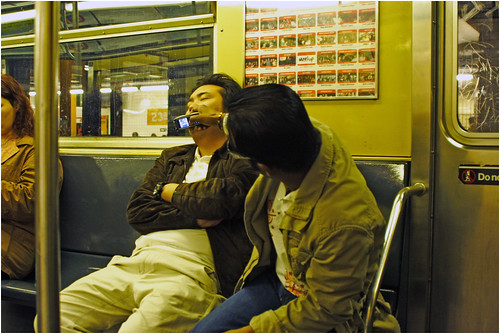
Abusing sleeping people is just one of the many things you can already do with your cell phones in the subway. (Photo by flickr user Dr Joolz)
When last we saw the underground cell phone service plan, the MTA had just announced a $46.8-million deal with Transit Wireless to equip the subway stations with cell service. But what if you install a cell service system and no carriers come?
That’s the question Scott posted in his comment, and that’s the question Crain’s New York Business pondered as well. The business journal noted that “it remains to be seen” if cell service providers are going to pony up the dough to provide customers will snippets of cell service in areas where customers spend a relatively minimal amount of time.
Amanda Fung reports:
Some question how Transit Wireless will recoup all the money it has to spend on building the network. While it will be technically challenging to wire the stations, once a network is set up and operational, the success of it is riding on the wireless carriers’ participation. Carriers will have to determine if offering cell phone service on the subway platforms and stairwells will generate more revenue per user or reduce churn rate, analysts said…
A spokesman for Sprint Nextel said the company will review the fees and determine if it makes sense for the company to participate.
Verizon Wireless and T-Mobile would not comment on their plans. AT&T Wireless, which led a competing consortium made up of the other major carriers, declined to comment because it said the MTA had not informed the company of its decision.
Supposedly, Transit Wireless has already fielded inquiries from at least one wireless provider, but without AT&T on board, the MTA’s and Transit Wireless’ plan will lose much of it luster. Right now, AT&T, Verizon and T-Mobile duke it for the top spots. If AT&T users — including those using the iPhone — can’t take advantage of the system, you’ll end up with a poor excuse for a cellular system.
For a comparison there, look no further than Washington, D.C. When I lived in D.C. from August 2005 until June 2006, I could never use my then-Cingular/now-AT&T cell phone in the Metro because AT&T hadn’t opted to sign on to the service terms for underground signal retransmission. To tell you the truth, I wasn’t missing much.
This Holy Grail of subway cell service may just end up as another idea that sounded good on paper but didn’t work out economically. If the carriers don’t sign on, kiss that late-night underground phone call good bye.

 Fade in on a nearly-empty subway station. It’s 2:30 a.m., and you’re stuck at the 2nd Ave. subway stop waiting for an F train that never shows up. Mostly drunk and dead tired, you just want to sit there quietly until the train rolls up to shuttle you back to Brooklyn.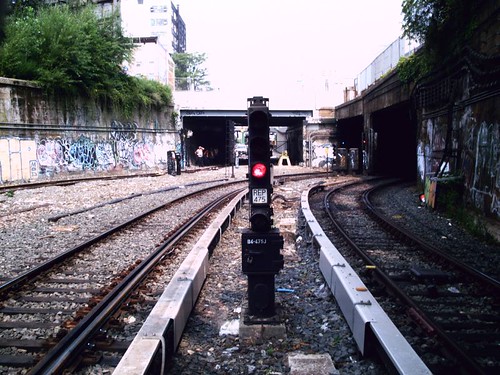


 One of the more annoying parts of modern technology these days are those buildings with the Captivate Network television sets embedded into the elevators. If you haven’t seen them yet, check out 250 W. 57th St. to experience the joys of being bombarded with stupid news, stock quotes, the weather for Santa Fe and other nearby cities and, of course, advertising.
 Following last week’s communications debacle on Wednesday, the MTA is looking to establish a real-time text message alert system for service delays, amNY