Archive for March, 2010
Transit service cuts to go into effect on June 27
Posted by: | Comments
Mark your calendar for a transit funeral: The last V and W trains will roll down the line on Friday, June 25.
After the MTA voted to approve sweeping service cuts that will save just $91 million while inconveniencing millions, the authority announced today that all bus and rail changes will go into effect on June 27, 2010. Because that is a Sunday, the V and W trains, the two weekday-only lines slated for elimination, will run their last regular service ride that Friday. The M will turn orange and head up Sixth Ave. via the Chrystie St. Cut on Monday, June 28, and the Q, express in Manhattan, will run local north of 57th St. to Ditmars Boulevard in Astoria. The Staten Island Ball Park special will be discontinued prior to the start of the Staten Island Yankees’ June 18 season opener.
For MTA officials, the decision to cut service was not made lightly. “The extent of our deficit requires that most of the cuts move ahead, but we listened to our customers and made changes where we could,” MTA Chairman and CEO Jay H. Walder said this morning. “We were able to take a number of cuts off the table but unfortunately, many of the cuts moving ahead will be painful.”
Although these cuts will come down the pike this summer, the MTA did not vote on a proposal to eliminate the Student MetroCard plan yet, and politicians and advocates are still squaring off on the issue. The Mayor slammed the state for its failure to fund student travel. “It’s the state that has cutback subsidies to the MTA and the state that has cutback the MetroCards for kids so call Albany,” Michael Bloomberg said. “If they cut back our subsidies to the MTA, they cut back the subsidies for MetroCards for the students, I think it is an outrage but it’s not the MTA’s fault, it’s the state’s fault.”
The Straphangers Campaign, though, was not willing to let the Mayor escape City Hall’s portion of the blame. “It’s true that the State triggered the current crisis over student MetroCards when Governor David Paterson cut state funding for the program,” Gene Russianoff said in a statement. “But it is also true that the City’s contribution for moving 585,000 students each weekday on the subways and the buses has remained stagnant since 1995 at $45 million. If student MetroCards are to continue, there will have to be increased funding from both the City and the State.”
With this round of cuts, the MTA has only just started what will be a year-long deficit reduction problem. The agency had a budget gap totaling nearly $800 million for 2010 and still must come up with hundreds of millions of dollars in savings. To that end, the MTA is trying to renegotiation supply contracts and defer or eliminated unnecessary projects. The agency is going to cut internal spending my consolidating its agencies and reducing overtime, and the authority said it will meet with union leaders to identify more money-saving programs as well.
Still, on June 27, at a time of historic ridership levels, the MTA will eliminate trains and cut services because Albany has failed to provide for mass transit in New York City. “The reality is that closing the first $400 million is extremely painful, and closing the additional gap will be even harder,” Walder said. “We’ve just taken a very difficult vote, but there are more difficult choices ahead to achieve necessary cost savings.”
MTA votes to approve service cuts
Posted by: | CommentsThe MTA Board has just voted approve a sweeping package of service cuts that will save the MTA hundreds of millions of dollars while reducing bus and subway service throughout New York City. Only two board members voted against the cuts while the rest criticized Albany for neglecting transit but defended their votes on grounds of necessity. Basically, the authority’s board feels it has no choice but to cut services because the state will no longer support transit in the most transit-dependent city in the nation.
For New Yorkers, this vote means transportation pain this summer. Bus lines will be scaled back or reduced, and subway wait times and crowding will increase. The V and W trains will be eliminated, and the M will operating from Middle Village to Forest Hills via the Chrystie St. Cut and the Sixth Ave. line. The Board has delayed its vote on the Student MetroCard cuts pending the outcome of some heavy lobbying efforts by students and parents. Today is, as many Board members stated this morning, a dark day in the history of transportation in New York City, and with another $350 million deficit on the horizon, the MTA has some even tougher choices ahead.
For more information and resources about the cuts, you can check out my coverage here on Second Ave. Sagas. Earlier this week, I presented some FAQs on the board vote and what it means for New Yorkers in 2010. I also explored the latest iterations of the service cuts which included decisions to rescue some bus lines from the chopping block while saving the M train designation. For more on Student MetroCards, browse through that topic’s archives.
Liveblogging the MTA’s service cuts vote
Posted by: | CommentsThe MTA Board is on the verge of starting their debate and subsequent vote on the service cuts. I’m going to liveblog the hearing. Follow along below.
How we sometimes sit and wait for the subway
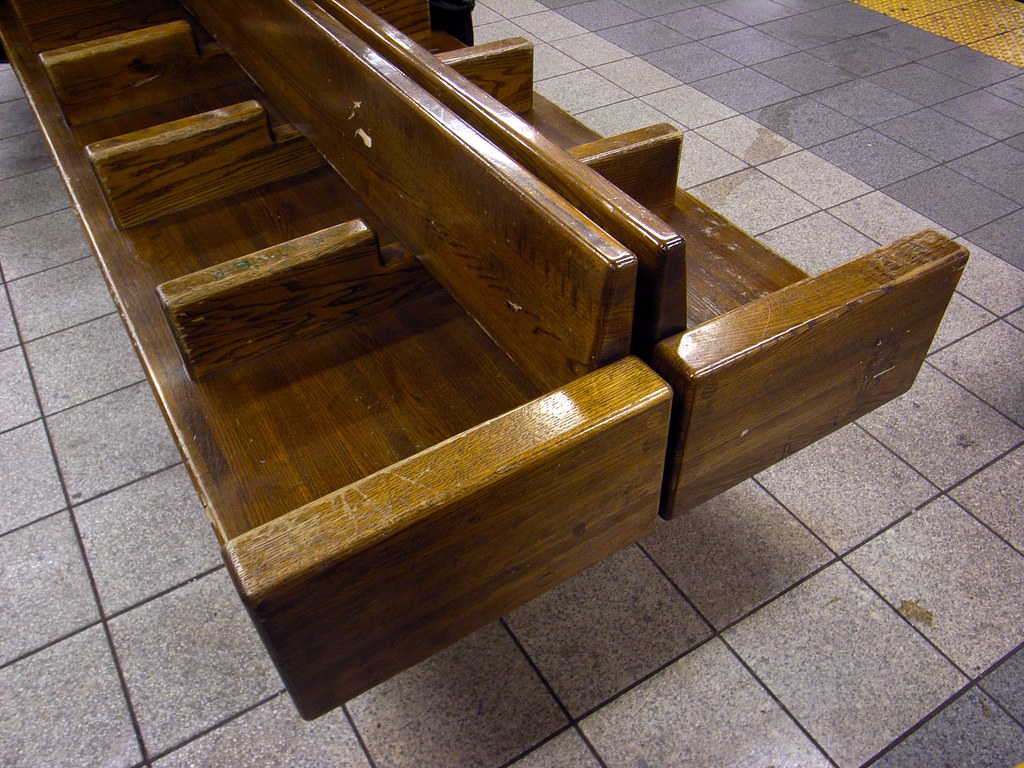
Posted by: | CommentsA glimpse of some very familiar-looking wooden subway benches. (Photo by flickr user nicolasnova)
When I ride from Brooklyn to W. 4th St. to go to class in the mornings, I often encounter a very familiar subway conundrum. Do I sit on the bench to wait for my train or do I walk down the platform so that I’m closer to the exit? If I do the former, I can rest comfortably for a few minutes; if I do the latter, there are no benches for the Manhattan-bound platform has just three benches, all clustered near the staircase.
For New Yorkers, it is a familiar problem. Although our subway stations span three blocks underground, places to sit are few and far between. At those stations with the most foot traffic — Grand Central on the Lexington Ave. IRT comes to mind — only one bench, tucked out of the way, greets weary commuters. Seats are scarce and generally nowhere convenient.
As welcome a sight as these benches often are, there’s something about them that leave them very unappealing at times too. Mostly, the disgust stems from the fact that they are made of wood. It may be treated wood, but it’s also very abused wood. Benches are battered with coffee spills and food stains, with gum and other assorted items left behind and even, at one point, with bedbugs. Used by the homeless for sleeping, the six-seaters — some with backs, some without — are often looked upon with a wary eye.
What if the benches were more alluring and what if, I’ve always wondered, there were more of them? Stainless steel would be more expensive to procure, but it wouldn’t have the same problems as wood. Some stations in New York, such as 2nd Ave., have built-in benches. Around the world, the seats vary. The Paris Metro has molded plastic; the DC Metro sports some unforgiving concrete; the London Underground has something metallic. Or try this one on for size:

Recently, Ikea took underground comfort to a new level when they started outfitting some Paris Metro stations with actual Ikea furniture as part of a system-wide ad campaign. In the City of Lights, you can wait for the train in comfort. Just don’t think too hard about who else sat there before you.
As the MTA Board gears up to approve a series of service cuts later this morning, seats will become both rarer and more precious. Part of the cuts include fewer off-peak trains, and another part increases the load guidelines so that trains are not considered to be 100 percent unless every seat is taken and a quarter of the passengers are standing. In the past, trains were considered full with every seat taken and no one standing.
These cuts will give us more time to sit at our nearest stations, more time to admire or inspect or raise an eyebrow at the MTA’s wooden benches. Sometimes while standing at one end of the platform, I think about how the seats are there only when I don’t want them, and now I think we should enjoy those seats while we can though because once we’re on board those trains, seats will be scarce indeed.
APTA speaks out against the use of stimulus funds for operating deficits
Posted by: | CommentsOver the last few months, a growing divide has emerged amongst those of us in the transit advocacy community. Some fighting for transit dollars — such as Gene Russianoff of the Straphangers Campaign — have called upon agencies to use federal stimulus dollars earmarked for capital improvements to cover operating deficits while others — such as the Regional Plan Association and I — have come out against the use of capital funds as an operating band aid. In my view, it simply sets a bad precedent and allows state legislatures to further shirk responsibility for funding transit.
Today, the divide has spread to the federal level as the American Public Transportation Association, a federal transit lobbying organization, announced its opposition to the use of stimulus funds for operating expenses. Elana Schor at Streetsblog DC covered the story today, and APTA’s statement jibes with my position. “A lot of folks look at it as a zero-sum game,” Paul Dean, the group’s government relations director, said, “that if you add a federal subsidy, that’s going to lead to state and local governments decreasing their contribution, and you’re going to be back in the same place you were — with less money available to meet your capital needs.”
In New York, MTA CEO and Chairman Jay Walder has continually voiced his opposition to the so-called Russianoff Plan as well. Since the use of stimulus dollars wouldn’t come close to covering the MTA’s gap, the authority is still trying to find the $750 million it needs via service cuts, internal belt-tightening and better state-based funding mechanisms. The need for capital money and expansion, even at a time when operating revenues are low, remains a paramount concern for an agency all too well aware about the dangers of capital neglect.
FAQs on the impending MTA Board vote
Posted by: | Comments
Tomorrow morning, the MTA Board, after hours of contentious debate, will vote on the latest round of service cuts. By all accounts, the reduction in service, designed to save the deficit-riddled MTA $93 million, will be approved, but they are just the tip of the iceberg as the agency will still have to address another $400 million budget hole that has emerged since the cuts were first announced.
To understand the impact of the Board vote and what it means for the immediate future of transit in New York City, I offer up a brief FAQ on the vote.
Does the vote mean service will definitely be cut?
When the MTA Board votes tomorrow, they are doing so well in advance of their so-called drop-dead date. The cuts are designed to go into effect in June and will be rolled out slowly over the course of the summer. If the MTA’s financial picture improves or if the state is able to address the MTA’s funding gap before the end of May, these cuts could be taken off the table. However, the state is broke, and the MTA still must, as I mentioned above, close a $400 million budget gap. One way or another, we will see service cuts this year.
What happened to the Student MetroCard cuts?
Because the introduction of a half-priced Student MetroCard won’t begin until September, the MTA has decided to postpone a vote on that part of the cuts package. Political support is growing for some sort of action on Student MetroCards, and the MTA does not want to back itself into a corner by cutting the service now before the politicians have time to respond to constituent demands.
If and when the Student MetroCards are up for a vote, the MTA has structured the plan to give Albany ample time to save free travel. During the 2010-2011 school year, the authority would offer half-price rides to students, and only in September 2011 would any student discounts be eliminated. Odds are good that someone will step up to the plate before the MTA does away with free rides for students.
Can Sen. Espada’s bridge toll plan avert the MTA’s cuts?
Over the weekend, Pedro Espada, part of the Four Hike Four, surprised everyone by announcing his support for East River Bridge tolls. The revenue would be dedicated to the MTA, and all money from tolls must be, in the words of the Senator, “earmarked specifically for the restoration of the free student MetroCard program and other subway and bus services that are being targeted with cuts or elimination.” Sounds like a rescue plan, no?
Well, Espada’s plan has some faulty assumptions. He is proposing a $2 toll on the Brooklyn, Manhattan, Williamsburg and Queensboro Bridges and claims this toll would raise over $500 million for the MTA. Those who have studied the issue in depth — such as the Drum Major Institute’s John Petro — say that Espada is overestimating by double. As Petro writes today, this plan would net the MTA around $250 million. That would be enough, for now, to save student transit and take most of the subway and bus cuts off the table.
There is, however, one final catch. If Espada’s plan delivers just $250 million annually, the MTA would still need another $500 million to cover the remaining deficit, and those cuts would probably be reinstated. Right now, the MTA is running a dangerous political game by not proposing $750 million in cuts, but that’s the way it is. Any money from Espada is better than nothing.
Will the MTA raise fares this year?
As part of the last MTA funding plan approved in 2009, the MTA will be raising fares at the start of 2011, and the agency has been vehement in its adherence to that schedule. There will be, they say, no fare hikes this year. Still, some Board members seem to be floating trial balloons on the fare hike. If the MTA does raise its fares this year, it would probably be viewed as an advance on the 2011 fare hikes, and the authority would not, barring an economic catastrophe, have to raise fares again next year.
Living in the Upper East Side’s blast zone
Posted by: | Comments
Residents of 1873 Second Ave., shown here at left next to the now-vacant Century Lumber lot, will have to be relocated for a month to accommodate subway construction. (Photo courtesy of Ben Heckscher/The Launch Box)
Building a subway through densely-populated neighborhoods replete with old buildings and infrastructure is no small feat. Construction involves digging and blasting, detours and street closures, and New Yorkers will still be waiting at least six and a half more years before just Phase I of the Second Ave. Subway is open for revenue service.
Over the last few months, as crews have nearly finished readying the tunnel boring machine’s launch box, we’ve heard a lot about life in the blasting zone. Just last week, Upper East Siders started to bemoan the late, loud blasts, and while the MTA maintained that all blasting was to wrap before 8 p.m., subsequent trips to the launch box site by Ben Heckscher of The Launch Box revealed otherwise. It’s loud; it’s dirty; it’s disruptive; it’s the slow march of transit progress as it tears up and then repairs a neighborhood.
Yet, for millions of New Yorkers, Second Ave. Subway constructive remains just an idea. We live and work far from the construction zones and do not see businesses struggling to compete with construction. Two recent bits of writing — one a news story and the other a narrative — help to shed some light on life in the blast zone.
We start with a report from The Real Deal. The MTA has informed the residents of 1873 Second Ave., a property on the west side of the avenue between 96th and 97th Sts., that they will have to be temporarily relocated for one month as the agency works to shore up the building. Next door, at the former site of the Century Lumber Co. building, the MTA will soon start work on a ventilation shaft.
The MTA in a letter says that it will pay the full cost of relocation and will attempt to do so with “as little disruption as possible.” Still, for Upper East Side residents, this is no small move. “This is devastating,” one anonymous tenant said to The Real Deal. “I don’t want to move. If I move it would have to be for good and I can’t afford that. I have been in this apartment for 10 years and have always paid my rent and I just can’t believe something like this could happen. I heard about things like this happening in Brooklyn, but never thought it could happen to me.” Not everyone, it seems, understands the costs of living on a subway construction site or the fact that the MTA will foot the entire bill.
For those who aren’t moving, though, the blasting — loud, disruptive, scary — has altered life along Second Ave. In a narrative about raising a family in a construction zone set to last for 10 years, Lisa Lawrence of the Upper East Side Moms blog writes about her young son’s reaction to the blasting. On a night of particularly loud blasting as the MTA started horizontal blasting that readies the launch box for the TBM, she writes, “my little guy came running out of his bed into our bed, scared out of his mind! My older two were very nervous and uneasy. After-all, we had begun to get used to the blasting and now this extraordinary boom?!?! My poor little ones. I am almost 31 years old, and I was scared out of my noodle! Imagine what they felt like!”
Buildings shake; businesses close; dust rises and settles; life goes on, stranger than it did for this out-of-the-way corner of the Upper East Side five years ago. One person summed it up best to Heather Haddon. Said Mike Borak, “The neighborhood would be great if it wasn’t for this.”
After the jump, video of a recent blast, recorded at 8:45 p.m. on Friday, March 19. It too comes to us via The Launch Box. Read More→
Back to the drawing board for Metro-North’s West Side stop
Posted by: | Comments
Nearly one year ago, I reported on Metro-North’s desire to build a station near Riverside Park on Manhattan’s Upper West Side. The station, eyed for 60th St. as part of Extell’s Riverside South development, would have provided for access into both Grand Central and Penn Station and could have served business, such as CBS, along the Far West Side and Lincoln Center.
While Metro-North is still looking to develop a stop on the West Side, the location at 60th St. is off the table, according to a report in The Journal-News. While the agency still plans to open a stop at 125th St. and Riverside, the authority the MTA no longer has the option to open a station at West 60th St. because development is too far along at the Extell site. Instead, the authority will explore sites at 72nd or 57th Sts. as alternate possibilities.
Metro-North Vice President of Planning Robert MacLagger spoke with Ken Valenti of the suburban-focused Journal-News to discuss the railroad’s plans, but right now, those at Metro-North seem divided over the focus of the station. MacLagger imagined Manhattan residents using the stop to commute to their jobs in Westchester, but Metro-North spokesperson Marjorie Anders believed that more suburban commuters would take the trains to their city jobs or evenings out in Manhattan.
Meanwhile, MTA reps and Extell developers have engaged in a bit of a back-and-forth over the death of the 60th St. project. MacLagger noted that the buildings were, in the words of Valentin, “built too close to the tracks to allow for a station to be built there. ” Those planning Riverside South disagree:
The Riverside South Planning Corp. worked first with Trump and more recently with the project’s current owners, Extell Development Co., to insure that the project complements the area. Paul Elston, chairman of the Riverside South Planning Corp., faulted Metro-North for missing the chance to request that accommodation be made for the station as Extell built over exposed tracks. “If they had acted two years ago, it would have been a slam-dunk,” he said.
Anders said Metro-North had told Elston two years ago that a site he pushed for, between 59th and 61st streets, wouldn’t work because the tracks curved too sharply. The Trump Organization did not respond to repeated requests for comment. An Extell spokeswoman did not return calls.
Jeffrey Zupan, the RPA’s senior fellow for transportation, questioned whether there would be enough demand for trains at the station. He expressed doubt that there would be the market for suburban-bound commuters that Metro-North expects. “There’s just not a lot of job concentration,” around the suburban stations, he said.
So what’s going on here? In a way, it sounds similar to typical MTA delays and in-fighting that have marred many of their expansion efforts. Extell had to move ahead with its construction at Riverside South while the MTA couldn’t come to terms on either a purpose or location for a West Side Metro-North station. Either way, the agency says it will select a site by the summer and begin the planning process. Some day, we’ll have Metro-North access along Manhattan’s West Side whether we need it or not.
To fund student travel, Espada proposes East River Bridge tolls
Posted by: | Comments
In a shocking move last night, Senate Majority Leader Pedro Espada — and long-time foe of most things MTA — announced a plan to toll the East River Bridges in order to prevent the MTA’s service cuts. Last year, Espada was the leader of the Fare-Hike Four, a group dedicated to avoiding sensible MTA funding mechanisms at any cost, but with Student MetroCards on the chopping block, Espada has announced his support for the tolling plan.
“The MTA’s financial problems have not dissipated and it is evident that new funding is needed to prevent service cuts,” he said in a townhall meeting from the floor of the State Senate. “Last year I opposed a toll on the ‘free’ bridges because the revenue was destined for a general fund. I am proposing that revenue generated by a toll on the East River bridges be earmarked specifically for the restoration of the free student MetroCard program and other subway and bus services that are being targeted with cuts or elimination. The MTA must agree to the specific use of this revenue, or all bets are off.”
As for the details, Espada’s proposal is a start but doesn’t go as far as we had hoped last year. He has proposed a $2.00 toll on the Brooklyn, Manhattan, Williamsburg and Queensboro bridges, and he believes this toll would generate $525 million in annual revenue, enough to fund Student MetroCards and potentially allow the MTA to expand service. This toll will not discourage drivers from taking unnecessary trips, and the Harlem River bridges — those that impact Espada’s constituents — are not included in this plan.
Streetsblog, however, questions Espada’s math. They believe the net gain would be approximately $240 million, just enough to fund Student MetroCards and avert the majority of city-based bus and subway cuts. After the state’s payroll tax calculation error, I tend to believe Streetsblog’s math over the numbers coming from Espada. Still, the money will help, but whether the Assembly and Senate will approve such a plan this time around remains to be seen.
Espada, meanwhile, doesn’t believe the MTA would balk at receiving this money even if it is earmarked for student travel. After all, MTA CEO and Chairman Jay Walder has repeatedly stressed his desire to maintain free student transit. “I am fully confident,” Espada said, “that Walder would agree to this if it means preventing cuts to vital services and the free student MetroCard program. I am encouraged by Mr. Walder’s comprehensive, long-term vision for the MTA, but he needs help now to get the agency back on track.”
Help, it seems, is going to come from the unlikeliest of unlikely allies.
Remembering the V train’s controversial origins
Posted by: | Comments
Transit’s newest train designation is not long for this world. When the MTA announced on Friday that the V train will be cut and the M extended along Sixth Ave. and Queens Boulevard during the week, they put a eight and a half-year-old train on life support. Barring an economic miracle, the V train’s tombstone will read 2001-2010, and it will be a train few will miss.
Today, we roast the V train. It runs a slow local route from Second Ave. on the Lower East Side to Forest Hills in Queens via the 53rd St. tunnel. Designed to alleviate overcrowding along the Queens Boulevard line, the train never garnered much love, and transit advocates saw a promise of express service in Brooklyn that remains unfulfilled. That bright future won’t come to pass until the MTA’s financial picture improves. Instead, let us revisit the history of the maligned V.
For years, the F train ran express in Queens to 179th St. via the 53rd St. tunnel. The MTA had long hoped to connect the 63rd St. tunnel, opened in the mid-1980s, to the Queens Boulevard line, but that 1500-foot section of tunnel would not open until December 16, 2001, nine years after designs commenced on the project. With the new tunnel connector available, some IND Sixth Ave. train could run in Queens and into Manhattan via the 63rd St. tunnel while the other could run into Manhattan via the 53rd St. tunnel. Enter the V train.
The authority first announced plans for the V train in early December of 2000. The new local train was meant to, in the words of agency spokesperson Melissa Farley, ”relieve some of the pressure on the E and F lines.” Originally set to open in August 2001, the 63rd St. Connector and new train line were meant to increase capacity along the Queens Boulevard line from 41 trains per hour to 50.
Long before the first V train hit the tracks, though, the line was beset by controversy. Some politicians wanted the train to run 24 hours and also into Brooklyn, but the going got tough when the G came under fire. At a May 2001 meeting, the MTA approved the V but slashed the G. Instead of running to Forest Hills at all times, G trains were to terminate at Court Square during the week due to capacity demands along Queens Boulevard. Brooklyn and Queens politicians were up in arms, but the MTA gave them only a moving sidewalk in return.
The V itself, making 24 stops in Queens and Manhattan debuted on December 17, 2001, five months later than scheduled due, in part, to the Sept. 11 attacks. From the start, some transit advocates threw the V under the wagon. “My instinct is the V will end up standing for ‘very little used,’” Gene Russianoff, who wanted the express to offer an in-system transfer to the Lexington Ave. IRT line, said. “New Yorkers prize speed over elbow room.”
On its first day, the V was described as both slow and empty. New Yorkers — then-Mayor Rudy Giuliani wondered “What is the V train?” — were confused by the train, and despite an extensive outreach program by Transit, commuters were baffled by the out-of-system transfer between the F at 63rd St. and the IRT and BMT lines at 59th St. The transfer from the 6 to V and E at 53rd St. was not a hit. “I didn’t know anything about the V train,” Donna Samaski said to the Daily News. “I came here looking for the F and now I don’t know where to go.”
Yet, as time wore on, the V trains became more useful. In May 2002, Transit officials noted slightly less crowded Queens Boulevard express trains. Instead of operating at 115 percent capacity during the morning and evening rush hours, the express trains were at 95 percent capacity with the V picking up the slack. Still, others wanted faster trains with better connections and thought that the 53rd St. corridor should have serviced only express trains with the local heading to Queens via 63rd St. “The V is a loser,” Russianoff said, taking a grudge against a train line to an entirely new level. “It’s slow and unpopular, and transit officials should rethink it.”
Today, though, the V is the V. It offers a slow ride from Queens into Manhattan but only by a few minutes. Those who opt for the local can often get a seat even during the peak hours, and with two different tunnels providing express service from Queens Boulevard, the route adjustments have simply became a fact of commuting life.
In a few months, the M will take over this tortured route, and the V with its controversial past will fade into subway history. Who knows what fates await the Brooklyn-based F express plan? Who knows how much more crowded the trains along the BMT 4th Ave. line — currently served by the M — will be? For now, these are the last days of the V, a slow route but one that eventually found its purpose.


