Archive for November, 2010
City unveils Taxi of Tomorrow finalists
Posted by: | Comments
The Karsan taxi was designed specifically for this project. (Read more at CityRoom)
After a lengthy RFP process, the City of New York unveiled its three finalists for its Taxi of Tomorrow contest yesterday. Designs from Karsan, Nissan and Ford that evoke the boxier history of the city’s long-gone checkers will be battling it out to earn the exclusive right to build out and service a new fleet of New York City taxicabs. No longer will Crown Victorias and a fleet of yellow hybrids roam the streets of city looking for fares.
“We are going to create a new taxi for our City that is safer, greener and more comfortable than the ones we have today,” Mayor Michael Bloomberg said at a press conference.
“Taxis are the icon of our shared urban landscape, and for more than five years the Design Trust and Taxi and Limousine Commission have enjoyed an enormously productive collaboration to improve that icon, culminating in the Taxi of Tomorrow,” Deborah Marton, executive director of the Design Trust for Public Space, a project partner, said. “This project is about much more than getting from point A to point B – the Design Trust and Taxi and Limousine Commission are pioneering an accessible, sustainable, beautiful taxi that New Yorkers deserve. No other city has tried to do this, and we want to make sure every New Yorker has a chance to weigh in and be part of this historic event.”
Right now, the city is hosting a public comment period focused around the new Taxi of Tomorrow website. New York City residents have been asked to participate in a survey about taxis. What parts of the taxi experience need to be improved? How should the city’s taxi of tomorrow incorporate technological innovation, passenger space and environmental concerns?
While London has long relied upon a custom-made taxicab, for New York, this attempt at homogeneity is a first. “Cars that are durable enough to be mass-produced are often not durable enough to be a New York City taxi,” Taxi and Limousine Commission head David Yassky said.
Michael Grynbaum, meanwhile, has more from the unveiling:
All three competing designs, submitted by Ford, Nissan and the Turkish manufacturer Karsan, have the bulky appearance of a minivan. Gone is the cramped legroom of a hybrid car: these interiors feature generously sized backseats and, in Karsan’s case, a rear-facing drop seat to encourage conversation among passengers (that, or motion sickness). The winner of the contest will receive the exclusive right to supply the cabs for the city’s fleet of just over 13,000 taxis for at least a decade. Taxi officials said the contract could have an overall potential value of $1 billion…
Ford’s entry, the Transit Connect, is a customized version of a vehicle already on the market, and Mr. Yassky said the submission benefited from Ford’s history of reliable service with the city. A design by Nissan’s North American branch, based on the company’s NV200 van, featured the most legroom and the potential for an entirely electric propulsion system.
Karsan, which builds cars for Fiat and Hyundai, submitted a design that was entirely original for the project. Its entry, the V1, is the only finalist that is fully accessible to passengers in wheelchairs, and the car could potentially include wireless Internet access. Four other submissions were rejected by the city, including a design from General Motors.
Initially, the reaction from taxi officials and city politicians has not been an embracing one. Assembly representative Micah Kellner noted how wheelchair accessibility is “only an option for the winning design, not a requirement.” Bhairavi Desai of the Taxi Workers Alliance bemoaned the focus on the car instead of the driver. “If there is money to be spent, we think it should go to improve the working conditions before it goes to beautify the vehicle,” she said.
Even the city itself isn’t sold on the need to replace its current fleet. Despite the lengthy process, New York will pick a new car only if it up to standards. “Each is promising, but none is perfect,” Bloomberg said “We are not obliged to go with anything if it does not meet our needs.”
The pictures — Karsan, Nissan, Ford — are alluring, but the designs are boring. The cars are almost too square and not very sleek, and while the bigger size will make traveling in packs more convenient, they’ll also take up more space on the roads. The vast majority of trips don’t require a car with so much extra room. But as long as the new taxis — vehicles The City Fix recently called next frontier of sustainable transportation — are as fuel-efficient as the hybrids they’ll be replacing, the city is at least on the right track here.
Career pickpockets on the wane
Posted by: | CommentsAs crime has waned in the subways and New York City has seen its return to glory and riches, petty criminals are no longer turning to a career in pickpocketing, Pete Donohue reports. Transit cops say that those folks making a career out of nabbing a wallot — or an iPhone — are not the teenagers of yesteryear. Rather, they are careerists in the 40s and 50s who aren’t training a young generation of thieves. “You don’t find young picks,” Nelson Dones, a detective with the NYPD’s transit bureau, said. “It’s going to die out.”
Donohue’s article delves into the way in which cops “keep tabs” on 40 career pickpockets including a 63-year-old and a 75-year-old who “take extreme pride” in their work. No longer though are cops seeing teenagers learning the trade — a happening thirty years ago that Donohue calls an “urban apprenticeship.” I guess today’s criminals are more content with a grab-and-run than the subtlety of a pick. Anyway, no one is going to miss getting his or her pocket picked, and there’s no reason to glamorize formerly prevalent means of subway crime.
New Jersey’s ARC loss should be New York’s gain
Posted by: | CommentsSince New Jersey Gov. Chris Christie canceled the ARC Tunnel and sacrificed over $3 billion in federal money, New York Sen. Kirsten Gillibrand has been working furiously with U.S. Transportation Secretary Ray LaHood to ensure that at least some of these dollars find their way to the city. The Wall Street Journal reported yesterday evening that LaHood has all but assured Gillibrand of the money. “He thought there could be a decision in the next 30 days or so and that New York is well-positioned to get some of the funding,” the state’s junior senator said in a statement.
So towards what will the money go? Over the last few weeks, I’ve written about likely destinations for the ARC Tunnel money, and I’ll stand by what I’ve said. Ensuring that the 7 line extension stops at 10th Ave. and 41st St. should be the top priority, and any additional funds New York can secure should go toward the Second Ave. Subway and East Side Access. Considering that the 10th Ave. station along the 7 should cost between $500 and $800 million, there’s plenty of money for everything.
Still underperforming, the F shows improvements
Posted by: | Comments
I often pity the poor F train. It reaches from Coney Island to Jamaica, Queens, with an extended local stint in Manhattan, and touches the lives of so many people. Yet, these straphangers by and large can’t stand the F. It’s slow; it’s crowded; it doesn’t offer Brooklyn express service; and the waits can seem interminable.
Last year, under pressure from State Senator Daniel Squadron, the MTA conducted an internal review of F train operations, and the results were decidedly not pretty. With old rolling stock, poorly maintained infrastructure and decaying assets, the F line was literally falling apart. A year later, a follow-up reveals that Transit has greatly improved the F, but the line still lags far behind the average subway performance.
Michael Grynbaum of The Times secured a copy of the follow-up report, and I’ve posted it in full after the jump below. It contains few surprises and perhaps a few twisted numbers as well. The F is doing better, Transit insists, but it’s still not there. “It feels like you get the diagnosis again, and it’s not specific about the solution,” Squadron said to The Times.
In general, the various metrics that tracked the F train’s performance showed marked improvement. The weekday on-time rate is now at 78.1 percent, up from 62.3 percent in 2009 but off the systemwide mark by over eight percent. The weekend and on-time assessments show similar improvements, but the MTA cautions that it has changed the way it calculates on-time performance to “improve transparency and to more closely align measures to customer experience and management priorities.” The trains aren’t necessarily more on time in an absolute sense, but they are on time if we consider only the MTA’s tracking methods.
Most notable is the vast improvement in the mean distance between car failures. Over the last year, the rolling stock options along the F declined from five — with some of the oldest cars running along this route — to two, and thus the MDBF shot up from 148,257 to 703,159 in July. “Improvements in F performance statistics over the past year can be attributed to the replacement of older R46 cars on the F train with newer R160 cars, as well as the completion of trackwork in Queens that had been underway for several months in 2009,” says the report. “The replacement of V with M service in Manhattan and Queens may also have positively affected performance of the F train.”
Ah, yes, the semi-controversial, semi-obvious M train rerouting. The report couldn’t assess the F train without contemplating the V, and it does so in depth. Transit believes the elimination of the V train and the replacement with the M between 47th-50th Sts. and Broadway/Lafayette St. can be a boon for the F. No longer with V trains interfere with F train operations at 2nd Ave. as the M bypasses that stop and trains no longer terminate there. Additionally, the reduction in the number of passengers transferring between the J/M/Z and the F at Delancey St./Essex St. has speeded up trains into and out of that station. As a result of the M train’s continuing along the 6th Ave. line, the F trains are also relatively emptier out of Delancey/Essex as well.
At some point in the near future, we’ll have enough data to assess fully the successes of the new M train, but so far, the results have been positive. Anecdotally, the northbound M trains leaving Broadway/Lafayette and West 4th St. have been more crowded than the V trains were, and with so many passengers from Middle Village and Brooklyn bound for Midtown, the one-seat ride has proven to be a welcome addition to the subway map. It’s a change that should have come sooner. But I digress.
Finally, Transit is still working to assess load demands along the F at the AM and PM rushes. The tables above show that train car crowding levels are within acceptable parameters, but again, it’s worth noting that the MTA has changed its load guidelines since the initial F assessment. In 2009, a train was considered 100 percent full if every seat was taken. Today, a train is considered 100 percent full if every seat is take and around 15-18 passengers are standing. Thus, at times when the F cars are at 80 percent capacity, there are no seats to be had.
Ultimately, the F is still suffering from years of neglect and few adjustments to the operation schedule as the train’s popularity has peaked. Transit didn’t need to add more layers of management as they threatened to do last year, and key capital improvements and signal modernization programs are still awaiting funding. Concerns over the timetable and frequency of off-peak service haven’t been addressed, and the F is still very much a work in progress.
Postscript: For those of us still holding out hope for an F Express train in Brooklyn after the interminable Culver Viaduct project wraps in 2014, Transit has promised at least a feasibility study. “The review of express service in Brooklyn will be undertaken closer to the completion of the Culver Viaduct project,” the document says. There’s hope for it yet.
After the jump, read the F train review follow-up in full. Read More→
This Week: Prendergast speaks, Arts for Transit celebrates
Posted by: | CommentsWhen it rain, it pours. For reasons known only to our Scheduling Gods, this week is heavy on the transit events, and since the festivities, as it were, kick off tonight, I wanted to highlight this week’s key events.
Monday, November 15
This evening at 6:30 p.m. DOT and MTA officials will present the Nostrand/Rogers Ave. Select Bus Service plans at a Brooklyn Open House. The event runs from 6:30 p.m. – 8:30 p.m. as planners will discuss station locations, the preliminary designs for the corridor while soliciting resident feedback. (Brooklyn College Student Center – Bedford Lounge, Campus Rd. & E. 27th St., 2nd Floor)
Tuesday November 16
New York City Transit President Thomas Prendergast will be at the microphone tomorrow evening during the New York City Transit Riders Council President’s Forum. He’ll field rider questions about the subway and address concerns straphangers may have. The event runs from 5 p.m. – 7 p.m. and more info is available on the NYCTRC website. (New York City Transit Offices, 2 Broadway – 20th Floor Auditorium, Manhattan)
Concurrent with the President’s Forum is an Arts for Transit event at MTA HQ. To celebrate the 25th anniversary of the public arts program, the MTA is hosting a Q-and-A with three artists. Anne Pasternak, president and artistic director of Creative Time will moderate a discussion with artists Ellen Harvey, Duke Riley, and Vito Acconci about the conception, realization, and installation of their Arts for Transit projects. (MTA HQ, 347 Madison Avenue, 5th Floor, Manhattan. Pre-registration and photo ID required. Space is limited. Call 718-694-1794 to reserve a spot.)
Also on Tuesday evening is a presentation in front of Brooklyn’s Community Board 2 on the streetcar feasibility study. NYC DOT officials will discuss the plans for trolley service in Red Hook from 6:30 p.m. – 8 p.m. (St. Francis College – Board Room
180 Remsen St., 1st Floor, Brooklyn)
Finally, Streetsfilms is hosting its Reel Celebration fundraiser on Tuesday night from 6:30 p.m. to 9 p.m. Randy Cohen, The Times’ Ethicist columnist and DOT Commissioner Janette Sadik-Khan will speak. Tickets are $50 and are still available. (The Penthouse, 148 Lafayette St., Manhattan)
Now if only I could figure out a way to be four places at once tomorrow night. You’ll probably be able to find me at the NYCTRC President’s Forum and, time-permitting, at the Streetsfilm fundraiser after.
Friday, November 19
At NYU’s Wanger Graduate School of Public Service, Transportation Alternatives will host a Stop Speeding Summit. The advocates want to see the speed limit drop to 20 mph in New York, and at the summit, various experts from the city will discuss the impact such a move would have a pedestrian safety. The event, which runs from 8:30 a.m. to 4:30 p.m., is free and open to the public. (The NYU Wagner Graduate School of Public Service, Puck Building, 295 Lafayette Street, Manhattan)
The Queens-Midtown Tunnel turns 70
Posted by: | Comments
Groundbreaking ceremonies with throng of flag-waving well-wishers along Borden Avenue in Astoria, Queens. Oct. 2, 1936. Courtesy of MTA Bridges and Tunnels Special Archive

An unidentified woman standing at the Queens Midtown Tunnel sign at the corner of Park Avenue and East 36th Street. Photographer unknown. 1940. Courtesy of MTA Bridges and Tunnels Special Archive
On this day in 1940: The Queens-Midtown Tunnel opened. Originally planned for the mid-1920s but shelved amidst the Great Depression, the tunnel came to life thanks to a loan from President Franklin D. Roosevelt to the tune of $58 million in 1935. To honor the tunnel, MTA Bridges and Tunnels sent out the pictures you see in the post and provided some history:
Inspired by the new Holland Tunnel on the west side, civic and business groups began lobbying in the early 1920s for an East River tunnel to help handle a steady increase in traffic at its already clogged East River bridges. The city’s Board of Estimate approved $2 million to design and construct an East River tunnel but plans were put on hold when the stock market crash occurred in 1929.
In 1935, President Franklin Delano Roosevelt’s Public Works Administration loaned the city $58 million to help build the new tunnel. Mayor Fiorello LaGuardia created the Queens Midtown Tunnel Authority, which became the New York City Tunnel Authority. That agency merged with the Robert Moses-led Triborough Bridge Authority in 1946 to become the Triborough Bridge and Tunnel Authority. Today, the agency retains Triborough Bridge and Tunnel Authority as its legal name but is known as MTA Bridges and Tunnels and is part of the umbrella of agencies that make up the MTA.
Ground-breaking for the Queens Midtown Tunnel took place Oct.2, 1936 with the push of a ceremonial button by President Roosevelt. Over the next three years, the tunnel’s two tubes were excavated using dynamite, drills and four circular cutting shields, about 31-feet in diameter, which were lowered into shafts at each end of the tunnel and hydraulically shoved through the riverbed until they met in the middle.

Sandhogs tighten a bolt in a tunnel-lining ring. Six cylindrical jacks on the back of a shield are visible behind the men. Photographer: Michael Bobco for Somach Photo Service. Feb. 26, 1939. Courtesy of MTA Bridges and Tunnels Special Archive
Sandhogs, making $11.50 a day and digging out 18 feet per week, were responsible for the dangerous construction job. As the shields dug forward, the sandhogs had to assemble the cast iron rings that line the tunnel. It ultimately took 54 million manhours to finish the tunnel, and it carried with a 25-cent toll in 1940. That equates to $3.90 in 2010 dollars, but today’s toll has outpaced that. It now costs $5.50 in cash or a $4.57 E-ZPass payment to pass through the tunnel.
In its first full year, 4.4 million cars passed through the two-tube tunnel while last year, 27.7 million vehicles did the same. The 6272-southern tube and 6414-foot Manhattan-bound tube underwent a $126 million renovation completed in 2001 that saw the original 1930s brick replaced by asphalt, among other upgrades. Today, the tunnel entrance is a subtle part of Murray Hill while the traffic is anything but. Now a part of I-495, the tunnel’s most famous moment probably came in Men in Black in 1997 as Will Smith and Tommy Lee Jones rode along the roof of the tunnel en route to Queens.
Inside a station without an agent
Posted by: | CommentsAs the MTA has engaged in a systematic elimination of station agents over the last few years, I’ve been skeptical of the impact fewer station agents would have on subway security. By and large, station agents can see only the fare-control areas and do not police platforms. Additionally, every station is still staffed at all times by at least one agent. Yet, an article in today’s Daily News shows, at least anecdotally, how fewer official personnel can have a negative impact on the straphanger experience.
Pete Donohue spent some time at the Kingsbridge Road station on the IND Concourse Line (B/D) in the Bronx and found how the MTA has “undermined that success” of the late-1980s/early-1990s security improvements. The station is dirty with liquor bottles and litter strewn about; fare evasion at the unstaffed entrance is rampant; and while robbery numbers are in line with system averages, riders say they’re concerned for their safety. “It definitely feels less safe,” Nicole Rivera said. “This is deserted.” One rider confessed to being “unnerved by the group of men who hang out near the empty booth at all hours.”
The remaining station agent, at the north end of the stop, has access to video monitors that show a nearby staircase but none that are trained upon the now-unmanned entrance. “I don’t know if anything is happening over there,” one booth worker said to the News. “If I don’t hear anything from anyone, I got to assume everything’s fine.” Much as feelings of security can drive transit ridership, so too can the illusion of an unsafe environment push those who are vulnerable away from the trains. Gene Russianoff summed it up best: “On a personal level, it doesn’t matter what the statistics say, it’s how the environment feels. If there’s no human presence, you’re more apt to be nervous. It can be creepy.” Maybe the station agents were more vital than I originally thought.
At City Hall, an old idea to use an older station
Posted by: | Comments
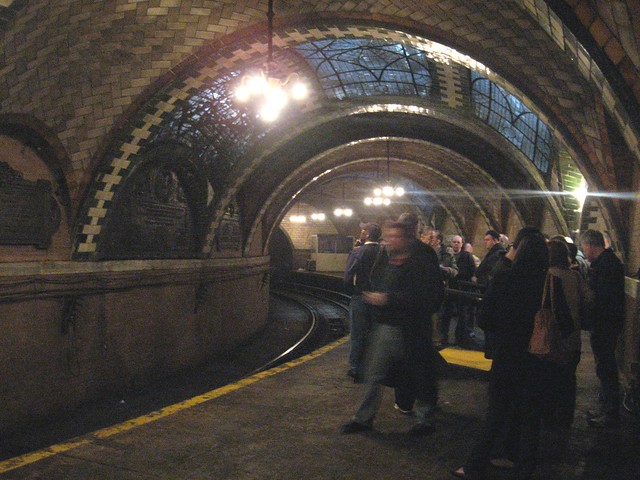
The abandoned City Hall subway stop, with its Guastavino tile arches, is open for Transit Museum tours. (Photo by Benjamin Kabak)
Every few years, the existence of abandoned subway stations becomes front-page news that somehow sweeps the nation. With the onslaught of attention paid to the Underbelly Project in the South 4th Street shell, it was only a matter of time before reporters decided to revive their old stories on dead subway stations. Even though Transit has been allowing customers to ride the City Hall loop on the 6 train since early 2007, Huffington Post, Jalopnik, Fast Company and Yahoo! News decided to splash this story across their respective front pages last week. Their coverage echoes that found in an Associated Press story from 1984.
I can certainly appreciate the fascination with which those unfamiliar with the intimate details of the New York City subway system treat abandoned stations. The City Hall stop, in particular, has been exceptionally well-restored and maintained, and it’s timelessness and emptiness serve as a window into an era of city planning lost to today’s utilitarian approach. Still, it is a crown jewel with a very public history and one that shows how planning needs change as time wears on.
In the beginning, the City Hall stop was indeed the so-called crown jewel of the nascent subway system. Designed by Rafael Guastavino and Heins & LaFarge, the station served as the launching point for construction for subway construction in 1900 as then-Mayor Robert Van Wyck celebrated the groundbreaking. Four years later, Mayor George McClellan would usher in the age of public transportation as he helmed the first northbound IRT train to depart from the City Hall loop.
Early on, though, it became clear that the City Hall station was a showy redundancy. A few hundred feet from the Brooklyn Bridge station, the loop stop featured a wide gap in between the train car edge and the platform, and once the city extended the lengths of its train cars and subway stations, the City Hall stop became entirely unnecessary. By 1945, the station was closed at night and served just a few hundred paying customers a day. To conserve resources and make better use of the park above, the city closed the station at 9 p.m. on December 31, 1945. (Of historical note at the station today are the remains of the skylights that once let in natural light. While many of the windows of the arches have since blown out, some that remain have retained scraps of blackout paint used during World War II to hide the station from spying eyes.)
As early as 1965, the Transit Authority considered using the City Hall stop as a museum. “The station is unique, and to convert it into a museum is in the tradition of preserving the historic landmarks of our city,” TA Commissioner Joseph O’Grady said. Eventually, the TA chose the IND Court St. station instead. The authority did not want to construct a new loop for the Lexington Ave. local trains and could not store old BMT and IND train cars on the City Hall loop due to the varying car widths.
But the museum idea was one that would not die. In 1987, two letters to the editor published in The Times urged the city to reopen the station as a museum. The city’s “showcase station,” said one writer, “deserves a broader patronage.” Said another “The City Hall station was designed as the highlight of the IRT line. Its fine artwork can and should be preserved, and opened to public view. This would be a fitting commemoration of the men who built the subway, a reminder of how much New York history lies buried beneath the streets.”
In 1995, the idea finally seemed to gain fiscal traction and political support. Mayor Rudolph Guiliani gave the project his thumbs up as a tourist destination, and the MTA secured $750,000 in federal funds to make the museum a reality. At the time, the authority hoped to raise $2.4 million in private donations and kick in another $350,000 for the museum. The Transit Museum planned to restore the oak token booths and construct a glass partition to dull the screeching sound of the 6 as it looped through the curved station.
By 1997, the Transit Museum still hoped to open the station as a museum by the following, but the price tag had risen to $10 million. Museum officials were predicting upwards of 200,000 visitors annually, but while the tours were ongoing, no firm plans to start construction emerged.

As seen in this blue print, the eastern-most end of the City Hall subway loop is directly beneath the Mayor's office.
Two years later, Mayor Giuliani quashed the museum over alleged security concerns. Because federal terrorism suspects were being held in the nearby courthouse and because the front end of the station is directly under City Hall, the mayor believed a museum underneath his office presented a potential target. “There would be significant security concerns about creating public access to an area that is literally underneath City Hall,” Edward Skylar, a Giuliani spokesman, said.
Both the MTA and Public Advocate disagreed. “It’s ridiculous to think that if a terrorist had a bomb he couldn’t do just as much damage from another spot near City Hall,” one MTA official said, “It would be safer for people in City Hall if there were people coming and going from the old station because crowds tend to deter terrorists.”
“That station went through two world wars,” Joe Rappaport, then-Public Advocate Mark Green’s transportation adviser, said. “There is no reason now that it can’t be reopened to visitors.”
Giuliani won that battle, but the MTA spent $2 million to shore up the station anyway. The structure, not very deep underground, had to be shored up to ensure that trains could still pass through the arches, and in doing so, the MTA allowed the Transit Museum to lead tours for members interested in stepping foot in this abandoned station.
Today, we still debate the potential uses for abandoned stations. These former public spaces lie empty and neglected as various groups have proposed using them for restaurants, art galleries, shopping areas or even just officially-sanctioned memorials to another era. Sometimes a group of street artists come along to turn a forgotten station into a front-page art gallery, and other times, concerns about terrorism — overwrought or not — work to deprive a city of ready access to a beautiful abandoned subway stop.
Free transit advocate Ted Kheel passes away at 96
Posted by: | CommentsTheodore Kheel, a long-time advocate for congestion pricing and free transit in New York City, has died at the age of 96, The Times reported tonight. Kheel came to fame in New York City as a labor mediator known for bringing together people who otherwise were at odds, and he grew to be an influential voice in New York politics for many decades. Recently, Kheel has used his resources to make the rigorous case for free transit.
In 2008, amidst the political battle for congestion pricing, Kheel unveiled his balanced transportation analyzer. Developed by Charles Koumanoff and supported by Kheel’s millions, the BTA explored how congestion pricing could restore the subway to fiscal health while reducing the fare to $0. Kheel and Koumanoff continued to refine the BTA even as Mayor Bloomberg’s plan met its political demise. Kheel, instrumental in forcing the city to examine the lack of financing available for building the Utica and Nostran Ave. subway extensions, will be deeply missed within the transit community.
The subway announcements that come from Maine
Posted by: | CommentsThe MTA produced the video atop this post back in February when the authority unveiled the cheaper (and less precise) countdown clock for the B Division. Featured at numerous times is a woman’s voice. She speaks clearly and precisely with diction that’s very easy to hear. Without any hint of an accent, her announcements drone on authoritatively.
Today, The Times posted a profile of Carolyn Hopkins, the Maine resident who has been recording subway PA announcements for 15 years. The relevant excerpt:
Mrs. Hopkins works from a windowless room in her house with sound-absorbing material on the wall — a tapestry, hung like a painting but covering foam. The microphone and recording equipment came from Innovative Electronic Designs of Louisville, which developed the system that plays her voice in the subway.
What you hear, standing on the platform, are a series of short takes, each no more than a few words, strung together by the computer. “Ladies and gentlemen” — one take. “There is Brooklyn-bound” — one take. “Local train” — one take. “Two” — one take. “Stations away” — one take. The longest take is 16 words: “Please stand away from the platform edge, especially when trains are entering and leaving the station.”
You can hear her saying much the same thing in Chicago, Washington, even Paris (where she is the voice that speaks what little English is spoken in the Metro). But subway riders are not the only passengers she talks to. She has recorded announcements for the Staten Island ferry and most of the major airports in this country, including La Guardia, Kennedy and Newark Liberty.
“Plus Incheon in Korea; Charles de Gaulle in Paris; Beirut, Lebanon; and I’m forgetting some in China,” she said. “Once we walked into the John Wayne-Orange County Airport in California. I had completely forgotten that I’d done the announcements there, and it hit me like, ‘Oh, O.K.’ I was telling myself to watch unattended bags. That’s always a good one.”
Interestingly, Hopkins says she rarely visits New York and hasn’t taken the subway since 1957 when she was a little girl. When I hear her voice fill the station, I know that a train is on the way, but I also miss any hint of personality in her voice. Instead of any hint of New York City, her announcements sound instead as though I’m in an airport in Anyplace, USA.