Archive for February, 2011

I found myself on Monday afternoon at around 1:15 p.m. confronted with a daunting task. I had to walk from 50th St. between 6th and 7th Aves. to the corner of 44th St. and Broadway. I could skirt pedestrian traffic until 48th St. by using some of the midtown mid-block cut-throughs, but that still left me with three blocks on Broadway before the glorious pedestrian plaza began.

And so I readied myself for a mash of gawking tourists, slow-moving folks ambling through Times Square and workers on their lunch breaks scurrying to and fro. It was a mostly beautiful, disorganized, urban mess of pedestrians, and all was going well until those slow-moving folk became too much. At a certain point, I could have either shoved some people out of the way or come to a dead spot until the congestion cleared. It was then that the sidewalk rage set in.

The concept is a simple one, as Shirley Wang of the Wall Street Journal explored earlier this week. Behavioral scientists have discovered that pedestrians can suffer from the walking version of road rage. She writes:

Researchers say the concept of “sidewalk rage” is real. One scientist has even developed a Pedestrian Aggressiveness Syndrome Scale to map out how people express their fury. At its most extreme, sidewalk rage can signal a psychiatric condition known as “intermittent explosive disorder,” researchers say. On Facebook, there’s a group called “I Secretly Want to Punch Slow Walking People in the Back of the Head” that boasts nearly 15,000 members.

Some researchers are even studying the dynamics that trigger such rage and why some people remain calm in hopes of improving anger-management treatments and gaining insights into how emotions influence decision making, attention and self control…

Signs of a sidewalk rager include muttering or bumping into others; uncaringly hogging a walking lane; and acting in a hostile manner by staring, giving a “mean face” or approaching others too closely, says Leon James, a psychology professor at the University of Hawaii who studies pedestrian and driver aggression.

For the cool-headed, sidewalk rage may seem incomprehensible. After all, it seems simple enough to just go around the slow individual. Why then are some people, even those who greet other obstacles with equanimity, so infuriated by unhurried fellow pedestrians?

The article delves into the psychology of sidewalk strollers. The people who want to go faster get unnecessarily annoyed at those walking too slow, and while Wang and the scientists she spoke with seem to want to graft anger management issues on to everyone annoyed with someone moving slowly, I’ve always thought it’s a matter of human nature and selfishness.

We want to get where we’re going at our pace, and we expect walking to be orderly. Fast people on the left; slow people on the right. Don’t walk four across; don’t stop suddenly. It’s common decency. Yet, we don’t see aboveground, and we don’t see it underground.

Although Wang’s story focuses on the city’s streets, the findings in her piece are equally applicable underground. While walking from the lower level platforms at West 4th to the exit every day, I see disorder on the staircases. People who can barely mount the 16 steps hover on the left while other slow walkers climb up the right. Those wishing to leave with haste can fend for themselves in the middle or huff in the back. The drama plays out at every staircase and even on the climb to street level. Slower walkers do not adhere to the rule of the right.

It would be easy to generalize this behavior. Perhaps the selfishness of speed is why straphangers blast music out of leaky headphones, why they take up too many seats and why they litter throughout the subway. The researchers Wang speaks to suggest looking up and staying calm. That’s always good advice for a frustrating walk through the subway system too.
Comments (45)

Update (11:47 a.m. Thursday): The long-awaited transfer between the 7 at Court House Square and the G at Court Square in Long Island City is one of those MTA projects that just can’t finish up on time or, seemingly, at all. Initially due for an early 2010 completion, the MTA’s own board materials released in November said the project would open in January of this year while a New York 1 report in December promised a February opening. As February goes zooming past, though, the entrance has shown no signs of opening any time soon, and straphangers are growing antsy.

Today, a source who has been in contact with the line manager of the 7 train informs me that the MTA is now anticipating a “mid-March” opening date. John Hoban, the line manager, says the the work at Court House Square is under the auspicies of a contractor working for Citibank, and the work has yet to be completed. While many who are waiting for the transfer have noted that the staircase appears ready, the MTA and Citibank apparently cannot, due to ADA requirements, open the stairway until the elevators and escalators are ready for service.

The MTA tells me that “quirks” with the testing of the escalators is the primary motivation behind this delay, and they anticipate adhering to the mid-March opening. In the meantime, Queens commuters will just keep waiting for a convenient transfer that never wants to be ready for use.

Categories : Asides, Queens
Comments (9)

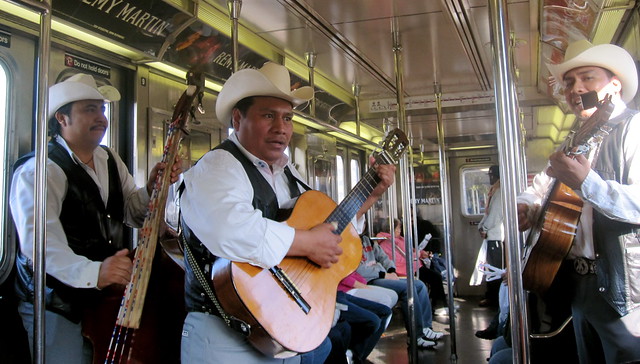
A group of norteno musicians serenade the 7 train. (Photo by flickr user ChrisGoldNY)

For many subway riders, the appearance of a Mexican band during a commute home may often be an unwelcome one. The music is loud; the panhandling aggressive. It’s a disruption to the privacy of a subway ride. Still, it’s easy to forget that these musicians are oftentimes poor immigrants looking to make a few bucks and exploit their skills.

Over the weekend, The Times ran an excellent profile of these musicians — properly known as norteños for the type of music they play — and I found the piece a fascinating glimpse into a world often unknown by most of us. Kirk Semple spoke with a variety of these norteños to draw up a picture of the bands. He writes:

The Metropolitan Transportation Authority’s rules of conduct include an array of regulations that could, and often do, snag the bands, including a prohibition on playing musical instruments on subway trains. Fines, often $75 each, are a regular part of the job, several musicians said. So is detention, often involving an overnight stay in jail and sometimes a punishment of community service, if rarely anything more severe than that. For those in the United States illegally, civil violations like those are usually not enough to prompt a check of immigration status.

But even though $75 is a good day’s earnings on the subway, the musicians seem to regard these penalties as tolerable occupational hazards. “Our babies have to eat something; we have to eat something,” Mr. Tigre, 41, who is divorced and has three American-born children, said with a shrug. “If I had a steady job, I wouldn’t play in the train.”

The groups’ growth has paralleled the rising number of Mexicans in New York and the surging popularity of norteño music. A decade ago, the musicians say, there were only a few norteño bands plying the subway system. By the estimates of several players, there are now at least 15, though nobody is sure of the exact number because the groups are continually forming, changing members and dissolving. Their paths usually cross only underground, in quick, joking encounters that allow them to swap gossip and information about police sightings.

The article delves into the ins and outs of navigating the system as well. Some bands play only on certain segments. One, for instance, avoids police by sticking to the B or D trains north of 125th Sts., and most musicians say they try to avoid the mid-afternoon when school kids “heckle and yell, push and shove.” Some adults too grow hostile and abusive toward the musicians.

It might be annoying to find these musicians in a subway car, and it might be illegal as well. But it’s annoying and illegal with a little bit of character. I’d take the norteños over a crazy preacher any day of the week.

Comments (25)

When the MTA readied its service cuts in late June of 2010, the media coverage focused on those who were going to eschew the subway for surface transit. An amNew York article found a few commuters who said they were going to bike while other stories featured interviews with people claiming they would begin to drive instead. Shockingly, that has not come to pass.

In its Transit Committee books for this week’s upcoming meeting (pdf), the MTA has released its year-end data for 2010, and the numbers show growth across the board that persisted past the date of the fare hikes. Subway ridership hit 1.6 billion in 2010, the second-highest total since 1950, and the MTA drew in over $3.3 billion in fare box revenue. Although the authority’s final ridership totals were 0.1 percent below expectations, the number represents a 0.2 percent increase over 2009.

Breaking it down, we see subways that are getting more crowded as buses grow emptier. Weekday subway ridership hit 5.2 million per day, the second highest total since 1950 and a 1.4 percent increase over 2009, while weekend ridership, despite myriad service changes and generally poor service, reached a two-day total average of 5.36 million. Saturday ridership climbed above 3 million while Sunday hit 2.3 million. That is, says the MTA, the highest weekend total in over 40 years.

Buses, meanwhile, have not been as lucky. Ridership in 2010 decreased by 2.8 percent to 696.9 million. Perhaps New Yorkers are growing fed up with bus service. When it’s routinely faster to walk over significant distances, only those physically unable to do so will hit the pavement. Pre-board fare payment systems can’t come soon enough.

The MTA attributes the increased ridership to the economy, and in doing so, they present the below graph. It clearly shows how ridership — the dashed line — tracks with changes in the city’s job figures. If ridership is going up, so too must be the city’s key employment numbers.

Subway ridership aligns closely with the state of employment in New York City.

In the fare department, the MTA saw the average cost it charges per ride go up. In 2009, the MTA drew in $1.485 per swipe while in 2010, that climbed to $1.562. That increase is directly attributable to the full-year effect of the June 28, 2009 fare increases. Interestingly, now over 33 percent of riders use the 30-day unlimited ride card. That is, I believe, a high-water mark, and I’ll be curious to see what the new triple-digit price tag does to that figure over the next few months.

Meanwhile, despite the added revenue, the fare still remains well below 1996 levels. That year, prior to the introduction of discounted MetroCards, the MTA drew in $1.38 per swipe. In numbers adjusted for inflation, they’re earning just $1.03 per swipe in 1996 dollars. As much as we bemoan the fare hikes, the subway is still a very good deal.

So what then can we see from all of us? First, it appears as though the service cuts had a negligible impact on ridership. While the pre-cut numbers in May showed ridership on the rise, so too did the months after the service cuts. In fact, the 12-month rolling averages have been increasing since July. Apparently, cutting service doesn’t impact transit usage as much as many feared. That is, however, a dangerous lesson to learn. While it highlights the inelasticity of transit demand, at some point, there will be a breaking point, and cuts will begin to impact transit usage.

Second, the city’s buses suffered a far worse fate than the subways in the cuts. While bus ridership has been declining nearly steadily since December 2008, the cuts have not stopped the bleeding. While bus ridership figures have nearly leveled out, the cuts — along with the inherent problems with bus service I mentioned above — ensured that those numbers would not increase at all this year.

Politically and economically, 2010 was a terrible year for the MTA, but New Yorkers need their transit. People are waiting longer for trains, but they’re still coming out in droves. When will our city and state politicians realize that?

Categories : MTA
Comments (1)

Photo courtesy of Jeffrey Omura

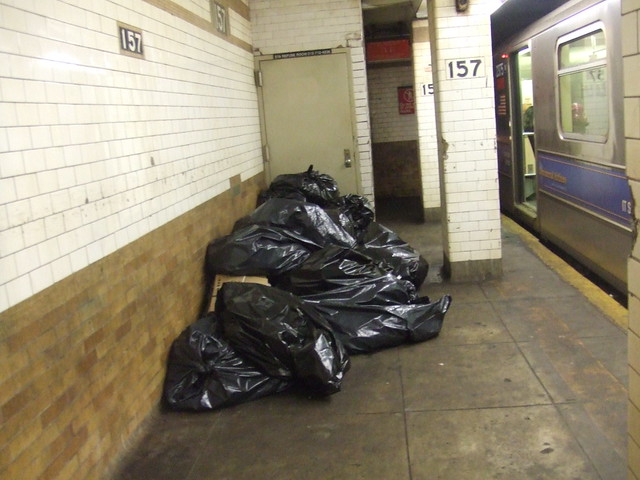
Take a look at this pile of trash. SAS reader Jeffrey Omura spotted it on at the 157th Street station on the 1 train a few weeks ago, and he noticed that it never went anywhere. For approximately a week, this pile of garbage remained at the end of the platform, neglected by all but a pack of rats that settled in for the long haul. By the time it vanished, the scene had turned disgusting.

Perhaps, then, as we have explored who is to blame for subway rat infestations and as one politician has tried to ban food in the subways, we should also keep an eye on the MTA’s garbage-collection policies. I often see workers dragged ripped and leaking bags of trash across station platforms, and I’ve noticed garbage cans overflowing with refuse. Keeping stations clean should be everyone’s responsibility, and right now, no one is picking up the slack.

Comments (14)

Eighteen months ago, in August of 2009, a large chunk of the ceiling at the 1 train’s 181st St. station came tumbling down. The station was shuttered for two weeks as MTA crews worked to clear the tracks and temporarily shore up the ceiling. As the authority dealt with the aftermath of the accident, news developments were alarming, to say the least. Initial reports noted how the MTA had a plan to fix the ceiling in 2007 but had to postpone them due to budgetary concerns while a subsequent investigation found that the MTA had known about the ceiling since 1999.

So today, has the ceiling been repaired? Of course not. As DNAInfo’s Carla Zanoni reports today, the MTA is still trying to formulate plans to repair the ceiling. The authority, which has also found ceiling weaknesses at the 168th St. station, says, according to Zanoni, that the age and initial construction of the landmarked stations is proving a stumbling block. “It seems the original architects relied on physics to keep up the archways,” the MTA’s Marcus Book said.

Right now, the authority expects to begin repair work in 2012, and the work at 181st St. alone could cost $17.5 million. Still, it will likely be three years between the initial accident and permanent repairs. A temporary solution keeps subway riders safe for now, but we can’t put band aids on long-term problems and expect everything to be fine. The system needs its economic support, and this ceiling problem is simply indicative of institutional issues at every level.

Categories : Asides, Manhattan
Comments (16)

Marcos Crespo has some zany ideas for subway safety.

By and large, the subways are a rather efficient and relatively quick means of transportation around New York City. A 24-stop ride from Forest Hills to Canal St. on the R takes 47 minutes; a 19-stop trip on the Q from Coney Island to DeKalb takes around 33 minutes; and a 27-stop jaunt from Wakefield/241st St. to Times Square runs around 50 minutes.

What would happen, though, to New Yorkers, to the city’s productivity, to their patience with the subway if the MTA were forced to add another minute per station to everyone’s commute? Suddenly, it would take almost an hour and 20 minutes to go from the Bronx to Midtown, and an end-to-end run on the 2, a 61-stop trip that normally takes 90-100 minutes, would run for over two and a half hours. It would take over 70 minutes to go from Forest Hills to Chinatown, and a trip within the same borough from Downtown Brooklyn to Coney Island would last nearly 50 minutes.

That is the worst-case scenario that could come to pass if Marcos Crespo gets his way. As I reported yesterday morning, Crespo has submitted a bill to the State Assembly that would over-legislate a non-existent safety issue. Since 0.000006 percent of subway riders are struck by train cars, Crespo would like the other 1.6 billion riders to pay the price. His bill would mandate that trains stop completely outside the station so the driver can inspect the tracks to make sure no one is in them. Then, the trains would creep into the station at 5 miles per hour before coming to a complete stop.

In expressing my incredulity at this dumb idea yesterday, I wondered if Crespo even knows what he’s talking about. After all, in the memo attached to the bill, Crespo claims the conductor would be the one to inspect the tracks, but the conductor sits in the middle of the train set. The Assembly rep should be calling for the driver to perform the visual inspection, and while I may be splitting hairs, a legislative mistake could lead to a bureaucratic nightmare. It’s just sloppy work.

Meanwhile, as commenters on this site noted, Crespo’s bill would do more than just slow down commutes to unbearable speeds. One comment highlighted how taking the rapid out of transit would reduce tunnel capacity. “The signal system is designed under the assumption that trains will generally be moving at speed, except when stopped at a station,” Andrew wrote. “Violating that assumption comes at an extreme cost to capacity – my guess is on the order of 10-15 tph. So not only will the trains be slower, but they will be much, much more crowded, since they won’t be able to run as frequently.” Brilliant!

Gothamist, in their coverage of the story, touched base with the Assemblyman, and he seemed both defensive and on the backpedal. He repeated his statistically insignificant claims of injury and defended his bill. “Over the last three years there have been an average of 60 deaths and hundreds of injuries because of trains,” he said. “I’ve taken the subway, I know how they operate. They come into stations full speed and I’m concerned about that.”

That an Assembly representative from the Bronx must state that he’s taken the subway speaks volumes of Albany. Still, as criticism rolled in, he attempted to distance himself from the idea. “This is a conversation starter,” he said. “If coming to a full stop is too much, I’m willing to address the issue.”

The problem with Crespo’s approach is that he’s picking on an issue that isn’t. If a manufacturer had a safety record akin to the MTA’s train-on-person numbers, they’d get a gold star from OSHA. If cars were anywhere close to that safe, the city would not be embroiled in a debate over how better to protect pedestrians. In fact, in 2009, there were over 75,000 car accidents in the five boroughs alone, and the accident rate was 1642 per 100,000 licensed drivers. Conversely, injuries caused by subway cars reached just 6 per 100 million straphangers. That certainly puts Crespo’s misguided legislation in perspective.

Ultimately, though, this move isn’t anything we don’t expect from Albany. We have legislators who rob from transit funds and others who never deign to ride the subway. Seeing another bad idea for the city’s public transportation network emerge from Albany is neither a surprise nor unexpected, and that is a sad commentary on the state of New York politics.

Categories : MTA Absurdity
Comments (51)

As MTA appropriations come under fire in New York State, the GOP-controlled House could attempt to take money away from New York’s transit agency as well. As amNew York reports today, a House budget proposal under consideration this week could take $1 billion in federal aid away from the city. Included in those cuts are $73 million in grants the MTA would have used for “rail and bus infrastructure and security projects.”

I’m working on tracking down the text of this bill, but needless to say, this development is not a welcome one. By and large, though, I’m surprised to see any cuts in security funding. The subway system remains one of the most vulnerable and attractive terrorist targets in the nation, and we shouldn’t wait for an attack to make sure the system is protected.

Categories : Asides, MTA Economics
Comments (32)

The Transit Museum is hosting a subway-themed Valentine's Day Party tonight. (Click to enlarge)

In the history of New York culture, the subways have often been viewed as a romantic spot. In On The Town, for instance, one of the sailors on leave falls in love with a woman on a Miss Subway poster. In Sliding Doors, a movie based in London, Gwyneth Platrow’s love life changes based upon the people she meets on the subway. Today, the craigslist Missed Connections are dominated by stories of fleeting glances exchanged on a train and of men too shy to approach women and vice versa.

As today is the day of love, the New York Transit Museum is getting on the act. From 6-8 p.m. today in their Brooklyn Heights location, the museum is hosting a Missed Connections party. “Has someone slipped through your fingers that you’ve tried to find on craiglist?” the museume’s flyer asks. Head to the museum in an effort to find them.

Meanwhile, at Transportation Nation, Jim O’Grady talks to a few people who have found love underground. His piece is a heartwarming one for Valentine’s Day, and it highlights how, often, the toughest part of spotting someone cute on the subway can be saying hello. We’re so conditioned to avoid contact with strangers on the subway that even a simple greeting can be a tall order. Today, take the plunge: If you see someone, say something. If you’re too shy to talk, perhaps they’ll be at the Transit Museum tonight.

Categories : Subway Romance
Comments (0)

Handing policymakers numbers without contextualizing them often leads to Very, Very Bad Ideas from policymakers. For instance, if I told someone that 90 people were struck by subway trains in 2009, that person might be surprised. After all, 90 seems like a good number, and the 40 people who died from the impact represent tragic deaths indeed.

But what if I said 0.000006 percent of all subway riders were struck by trains in 2009? Would your response be to propose a measure that would add 20 minutes to a trip from Coney Island to Midtown? Or 12 minutes for those who ride the D from the Bronx to Herald Square? As Pete Donohue explores in his column today, that’s what one Assembly representative has done.

Dononhue writes of this Very, Very Bad Idea:

Commuting by rickshaw would be faster than the subway under a Bronx assemblyman’s proposal to increase straphanger safety.

Before entering each and every station on the line, a train would have to come to a complete halt just shy of the platform. Only after a required pause could the train move forward to pick up passengers. The maximum permitted speed when entering would be 5 mph.

The regulation by Democratic Assemblyman Marcos Crespo – introduced in the Legislature last week – would achieve its goal: preventing people from getting hit by arriving trains.

The bill — labeled A04796 in the Assembly — is available here, and Crespo’s justifications defy logic. He seems to think that 155 injuries over three years as well as liability of between $30-$60 million a year is rationale enough for this move. Crespo wants trains to come to a complete stop while drivers — he says conductors, but the drivers would do it — inspect the tracks for people before moving ahead very slowly. The cost in lost productivity due to slower commutes alone would wipe out the savings in human life and liability payments.

Donohue believes that Crespo’s “heart is in the right place” and claims that personal accidents are “harsh realities of the subway that are either routinely ignored or quickly dismissed as unavoidable.” From the perspective of the personal, perhaps Donohue is on target, but the numbers don’t support this sentimentality. Exceedingly few people are struck by subway trains every year, and even fewer die from those accidents. In a traditional model of economic efficiency, It’s not worth robbing the subway of speed to save a handful of lives.

Where Donohue hits the nail on the head though is in his attacks against those who slammed the MTA for requesting information about platforms doors. Crespo claims that it is “unlikely the MTA will incur that expense” of installing the new technology. He seemingly ignores the MTA’s proposal that someone else foot the bill for the platform doors and doesn’t know or pay attention to the difference between the authority’s operating and capital budgets.

As I noted a few weeks ago, critics who blasted the MTA’s Request for Information were barking up the wrong tree. Donohue, who notes that at least one company — Crown Infrastructure — is interested in the MTA’s proposal, agrees. “You would think” based on the reaction, he says, “subway executives had expressed an interest in building a space shuttle from the sharp criticism that emerged.”

Citing the high cost of fires caused by track debris and the safety benefits, Donohue says the authority “should test platform doors in a pilot program and not be rattled by critics.” I have no qualms with that claim, but we should not overstate platform dangers either. One train may hit one person every four days on average, but that represents one six-millionth of one percent of all subway riders. The city would suffer tremendous were slower subways the price the other 99.999994 percent would bear in the name of false security.

Categories : MTA Absurdity
Comments (55)
  • Extended Stay

    Featuring a wide range of sophisticated furnished apartments throughout the city and surrounding areas, ExecuStay can help you enjoy a New York extended stay that's both productive and relaxing.

  • Corporate Apartments

    As a resident of ExecuStay New York corporate apartments, you'll find that getting around is a snap, thanks to the many MTA subway lines, buses and yellow cabs.