Archive for February, 2011
Beautifying a construction site along Second Ave.
Posted by: | Comments
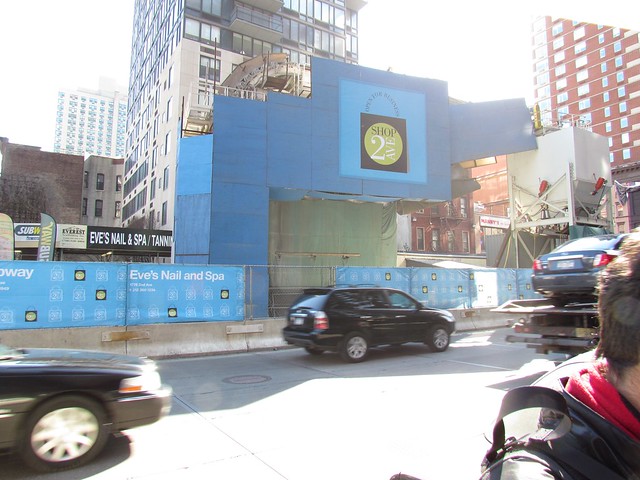
The new look for the SAS construction site tries to promote businesses along the avenue. (Photo by Benjamin Kabak)
When Adi, the tunnel boring machine hard at work beneath Second Ave., reached the end of its western end, the MTA rightly celebrated. For a project that’s been decades in the making, the end of a TBM run is cause for celebration indeed. It’s easy, though, to lose sight of the fact that the subway won’t be ready for revenue service until at least December of 2016.
The merchants and residents of Second Ave. haven’t forgotten. For years, they’ve raised a cry about the state of their avenue. From 96th on down, the bustling commercial strip has been marred by construction work, debris and a state of disarray. Crosswalks are haphazardly constructed and blocked off while dirt piles up and sidewalks trimmed to just seven feet. Nothing about it is all that welcoming for residents, shoppers or business owners, and merchants, in particular, have been asking for change for years.
At the end of last week, the MTA, the Manhattan Chamber of Commerce and various elected officials gathered on the Upper East Side to celebrate the beginning of that change. The authority announced plans back in October to beautify the construction site, and this week, they unveiled the model block between East 92nd and East 93rd Streets with more changes to come throughout the construction zone over the next few months. “We tried ask the question, ‘What can we do considering we’re going to be here for a long, long time?’” MTA Capital Construction President Michael Horodniceanu said during the press event.
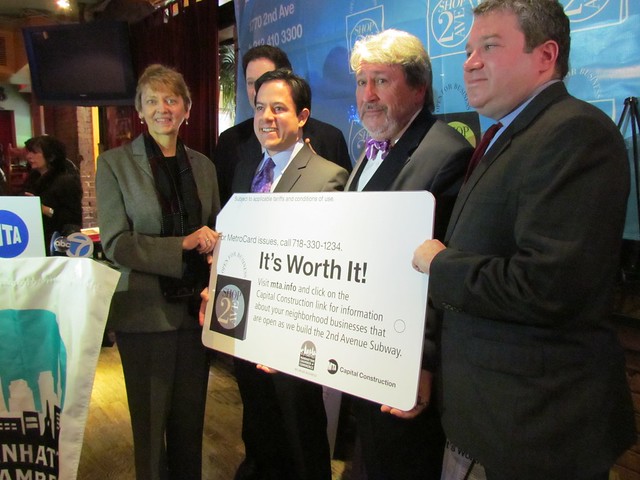
MTA officials and area politicians highlight the MetroCard urging shoppers to head to Second Avenue. (Photo by Benjamin Kabak)
Flanked by Jeffrey Bernstein, chair of the MCC, Dan Garodnick, City Council member, and Jonathan Bing of the State Assembly, Horodniceanu walked through the various upgrades. For those living in the area, the most obvious improvements are physical ones. The crosswalks will have barriers to protect pedestrians; the construction sites will be wrapped more orderly; the sidewalks will be expanded to nine feet in some areas. For merchants, each street corner will feature a wayfinding sign with information about open businesses, and the construction site will broadcast those businesses that are behind the netting as well. It’s all about improving the quality of life.
“The goal of this renewed marketing strategy and the model block is to allow New Yorkers to look past the construction and see the vibrant businesses that are here,” said Council Member Dan Garodnick. “This area has been neglected for too long, so we welcome the MTA’s commitment to work with the merchants and the Manhattan Chamber of Commerce to make the entire corridor more presentable and help us send the message that Second Avenue will always be open for business.”
Beyond the construction site itself, the MTA is helping to promote shopping along the avenue. It will distribute two million MetroCards in vending machines along the Lexington Ave. IRT with a message about supporting local businesses on the back, and it is working to revamp the Shop Second Ave. website. The new slogan — “Shop Second Avenue…It’s Worth It!” — is a work in progress.
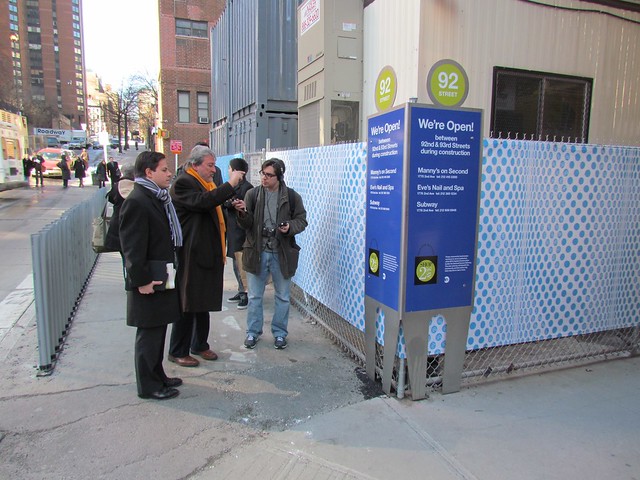
New signs at every corner will highlight businesses open on blocks obscured by construction. (Photo by Benjamin Kabak)
Of course, it’s a positive that politicians and the MTA have finally been able to come together to help merchants. As Bing noted, he has tried to win grants and tax breaks for Second Ave. businesses but had been met with resistance from both the State Senate and former Gov. David Paterson. Stil, I have to wonder what took the MTA so long to get these improvements off the ground.
During the press conference, Horodniceanu addressed that question. “We were really not doing enough,” he said. “Our contracts are not geared toward this length of time.” So to solve these problems, he, his staff and the MTA contractors tried to figure out “what small things we can do to make a difference.”
For now, as construction moves ever onward, politicians will continue to pressure the MTA to improve the work site. “We have six more years of construction,” Garodnick noted. “It’s a safe bet business owners will encounter new challenges.”
As the representatives and business owners look forward to the day when Second Ave. has both Select Bus Service and a subway, they know it will, in the words of Assemblyman Bing, have “the best transit options in the city.” The construction will disappear; the shoppers will return; and everyone will prosper. But that day is a long way away, and for now, minor changes are much appreciated. “It’s brining order out of chaos,” Garodnick said while standing across the street from the launch box. “It’s an improvement.”
Click through for more photos from the model block and press conference. Read More→

Map of the Day: The 1950s as a whole cloth quilt
Posted by: | Comments
A 1950s-era subway map served as the inspiration for this whole cloth quilt. (Photo via flickr user the workroom)
I always love seeing what other people are doing with the New York City Subway Map. From dresses to sunglasses, various iterations of the map serve as inspiration for the both the commercial and the artistic.
Today’s map draws its inspiration from the 1950s, and it is that map on a whole cloth quilt. Amusingly enough, it comes from a workshop in Toronto, and the stitcher even made sure to get the color coding as accurate as possible. For more on the map, check out Make Something’s post about it. With the subway map, an iconic image of New York City, anything is possible.
Countdown clocks and weekend service advisories
Posted by: | CommentsThe above photo comes to us via Rolando Pujol. The managing editor of amNew York spotted this at Penn Station and shared it on Twitter. It is, as you might guess, the activated countdown clocks at Penn Station.
I’m an unabashed fan of the countdown clocks. They make waits more palatable and help people plan their travel. This one at Penn Station is particularly useful because of the track configuration. Since the local and express trains do not share a platforms, the clocks allow straphangers to pick their trains ahead of time without playing the Penn Station guessing game.
Anyway, enough fan-boyism. It’s Friday, and you know what that means. Here are your weekend service advisories. Take note of the 42nd St. shuttle. Due to track work, it’s completely out of service this weekend. As always, these come to me from New York City Transit and are subject to change without notice. Listen for on-board announcement and check the signs at your local station. Subway Weekender has the map.

From 11 p.m. Friday, February 11 to 5 a.m. Monday, February 14, uptown 1 trains skip 50th Street, 59th Street-Columbus Circle and 66th Street due to switch renewal north of Times Square. Customers traveling to these stations may take the 1 or 2 train to 72nd Street and transfer to a downtown 1. Customers at these stations traveling uptown may take a downtown 1 or 2 train to Times Square-42nd Street and transfer to an uptown 1 or 2.

During the weekend overnight hours from 11 p.m. to 6:30 a.m. (to 5 a.m. on Monday), uptown 2 trains skip 50th Street, 59th Street-Columbus Circle and 66th Street due to switch renewal north of Times Square. Customers traveling to these stations may take the 1 or 2 train to 72nd Street and transfer to a downtown 1. Customers at these stations traveling uptown may take a downtown 1 or 2 train to Times Square-42nd Street and transfer to an uptown 1 or 2.

During the weekend overnight hours from 12:01 a.m. to 6:30 a.m. (to 5 a.m. on Monday), downtown 4 trains skip Astor Place, Bleecker, Spring and Canal Streets due to work on the Broadway/Lafayette-to-Bleecker Street transfer connection.

From 5:30 a.m. to 11:30 p.m., Saturday, February 12 and from 7:30 a.m. to 11:30 p.m., Sunday, February 13, 5 trains run every 20 minutes between Dyre Avenue and Bowling Green due to work on the Broadway/Lafayette-to-Bleecker Street transfer connection.

From 12:01 a.m. Saturday. February 12 to 5 a.m. Monday, February 14, downtown 6 trains skip Astor Place, Bleecker, Spring and Canal Streets due to work on the Broadway/Lafayette-to-Bleecker Street transfer connection.

From 12:01 a.m. Saturday, February 12 to 5 a.m. Monday. February 14, there are no A trains at Fulton Street in either direction due to work on the Fulton Street Transit Center.

Beginning Monday, February 14 until early summer, Manhattan-bound A trains skip Beach 36th Street and Beach 60th Street due to station rehabilitation.

From 12:01 a.m. Saturday, February 12 to 5 a.m. Monday, February 14, Manhattan-bound A trains run on the F line from Jay Street-MetroTech to West 4th Street, then local to 59th Street due to cable, platform edge, tile and stair work at the Fulton Street Transit Center. Manhattan-bound trains skip High Street, Chambers Street, Canal Street and Spring Street. Customers traveling to these stations should take the A or C to West 4th Street and transfer to a downtown A or C. Customers traveling from these stations may take the A or C to Jay Street-MetroTech and transfer to the Manhattan-bound A or C.

From 6:30 a.m. to midnight, Saturday, February 12 and Sunday, February 13, there are no C trains at Fulton Street in either direction due to work on the Fulton Street Transit Center.

From 6:30 a.m. to midnight, Saturday, February 12 and Sunday, February 13, Manhattan-bound C trains run on the F line from Jay Street-MetroTech to West 4th Street due to cable, platform edge, tile and stair work at the Fulton Street Transit Center. Manhattan-bound trains skip High Street, Chambers Street, Canal Street and Spring Street.

From 4 a.m. Saturday, February 12 to 10 p.m. Sunday, February 13, Brooklyn-bound trains run on the N line from 36th Street to Stillwell Avenue due to track panel installation between 50th Street and 55th Street. There are no Brooklyn-bound D trains stopping at 9th Avenue, Ft. Hamilton Parkway, 50th, 55th, 71st, 79th Streets, 18th and 20th Avenues, Bay Parkway, 25th Avenue and Bay 50th Street stations.

From 12:01 a.m. Saturday, February 12 to 5 a.m. Monday. February 14, Manhattan-bound D trains run express from 36th Street to Pacific Street, then skips DeKalb Avenue due to repair of pumping equipment.

From 12:01 a.m. Saturday, February 12 to 5 a.m. Monday, February 14, D trains run local between 34th Street and West 4th Street due to work on the 5th Avenue Interlocking Signal System.

From 12:01 a.m. Saturday, February 12 to 5 a.m. Monday, February 14, E trains run on the F line between Roosevelt Avenue and 34th Street-6th Avenue due to work on the 5th Avenue Interlocking Signal System. The platforms at 5th Avenue-53rd Street, Lexington Avenue-53rd Street and 23rd Street-Ely Avenue are closed. Customers may take the R, G or shuttle bus. Free shuttle buses connect Court Square (G)/23rd Street-Ely Avenue (E), Queens Plaza (R) and the 21st Street-Queensbridge (F) stations. Note: There are no E trains at or between Queens Plaza and World Trade Center stations.

Overnight, from 11 p.m. Friday, February 11 to 6 a.m. Saturday, February 12, G trains run in two sections due to cable replacements:
- Between Court Square and Bedford-Nostrand Avs and
- Between Bedford-Nostrand Avs and Hoyt-Schermerhorn Sts.
There are no G trains at Bergen St, Carroll St, Smith-9th Sts, 4th Av-9th St, 7th Av, 15th St-Prospect Park, Ft. Hamilton Parkway, and Church Av. Customers may take the A and F instead.

From 6 a.m. to 8 p.m., Saturday. February 12 and Sunday, February 13, M trains skip Fresh Pond Road in both directions due to platform edge repair. Customers should use the Forest Avenue station instead. Free connections are available to the Q58, B13 and B20 buses.

During the overnight hours from 12:01 a.m. to 6:30 a.m. (to 5 a.m. on Monday), N trains run over the Manhattan Bridge between Canal Street and DeKalb Avenue due to repair of pumping equipment south of DeKalb Av. and installation of platform tiles at Cortlandt Street.

From 4 a.m. Saturday, February 12 to 10 p.m. Sunday, February 13, Manhattan-bound N trains skip 30th Av, Broadway, 36th Av and 39th Av due to track panel installation from Astoria Blvd to 36th Avenue.

From 12:01 a.m. Saturday, February 12 to 5 a.m. Monday, February 14, Manhattan-bound Q trains run on the R line from DeKalb Av. to Canal Street making station stops at Jay Street-MetroTech, Court Street, Whitehall Street, Rector Street, Cortlandt Street and City Hall due to the repair of pumping equipment south of DeKalb Av.

From 6:30 a.m. to midnight, Saturday, February 12 and Sunday, February 13, R trains run over the Manhattan Bridge between Canal Street and DeKalb Avenue due to repair of pumping equipment south of DeKalb Av. and installation of platform tiles at Cortlandt Street. There are no N or R trains at City Hall, Rector Street, Whitehall Street, Court Street, and Jay Street-MetroTech stations. For Brooklyn-bound service, customers should use the 4 at nearby stations. For Manhattan-bound service, customers should use the Q instead. Note: Manhattan-bound N and R trains run express from 36th Street to Pacific Street, then skip DeKalb Avenue.

From 12:01 a.m. Saturday, February 12 to 5 a.m. Monday, February 14, the 42nd Street S Shuttle is suspended due to switch renewal north of Times Square. Customers should use the 7 instead.
NJ Transit delays hit six-year peak
Posted by: | CommentsAs snow and ice knocked out the MTA’s full service at points during January, New Jersey Transit suffered as well. As Mike Frassinelli of The Star-Ledger reports today, the commuter rail service saw trains delays hit a six-year peak as January’s winter onslaught led to more and more late trains.
Noting that New Jersey Transit considers trains late if they arrive at least six minutes after the scheduled time, Frassinelli offered up the gory details: “Trains were late six or more minutes 8.8 percent of the time last month, the worst showing since January 2005, when the number was 11.1 percent. Last year, only 4.1 percent of trains were tardy for the same month.” To make matters worse, nearly 25 percent of all peak-hour Northeast Corridor trains were delayed.
New Jersey Transit officials were quick to point fingers at the weather. “January’s on-time performance is what you’d expect in a month of extreme weather,” Dan Stessel, agency spokesman said. “We played the hand we were dealt as best as we could. We believe the system performed better in January than similar extreme-weather months in past years.” That said, I can’t help but think that a new cross-Hudson tunnel built for the benefit of New Jersey Transit would go a long way toward alleviating these constant delays. As the trains grow more crowded, after all, it’s only going to get worse.
Video of the Day: A glimpse at the New Haven Line
Posted by: | CommentsLast week, due to extreme weather and an aging fleet of cars that are bad need of maintenance, Metro-North had to scale back service on the New Haven Line. Nearly half of its current M2 rolling stock is laid up in the shop, and while the M8s are still undergoing testing, commuters are left with crowded trains in danger of breaking down.
To better maintain the fleet, the New Haven Line saw its service cut by 10 percent through at least early march. “The service we have been providing has been far less than what our customers have come to expect from us and we strive to provide for them,” Metro-North President Howard Permut said in a statement last week. “It is time for us to take these additional steps to improve our service reliability and minimize further inconvenience.”
Today, the MTA takes us inside the M2 shop to explain the problem with the fleet and the work that must go into it. This breakdown along the New Haven Line is a clear sign of what happens when states stop investing in mass transit. Hopefully, the M8s will be up and running soon, but for now, commuters from Connecticut are paying the price.
In D.C., a debate over closing times
Posted by: | Comments
A glimpse at when U.S. heavy rail systems operate. (Courtesy of Matt Johnson/Track Twenty-Nine)
As New York’s MTA struggles to make sure it has enough money to avoid future service cuts and fare hikes, the WMATA is considering changes to America’s Subway in Washington, D.C. As Greater Greater Washington reported earlier on Thursday, to save money and add, in essence, 45 days to its maintenance schedule, the authority may end weekend service at midnight instead of 3 a.m. As the vast majority of District residents and some WMATA Board members are incensed by the idea, it is one to which the WMATA Board often turns in times of fiscal crisis.
The hours of the D.C. Metro and the way the system is run has always been a bit perplexing to me. It’s full of contradictions and highlights a tension between those who live in the District and those who live in the suburbs. Anyone from New York would probably find it infuriating as I often did when I lived in D.C. a few years ago.
Generally, the Metro’s peak-hour trains arrive very frequently as workers — many of them federal employees — shuttle back to Virginia or Maryland. Much like with New York, D.C.’s roads aren’t extensive enough to — and should not — support the auto traffic the thousands of people who work in the District would generate, and so the Metro is a prime necessity during peak hours.
During off-peak hours, though, the service becomes this hybrid mix of a subway and a commuter rale. During rush hour, the red line trains would roll in quite frequently, but as soon as 7 p.m. hit, the headways slowed to 10 minutes. By 9:30, the wait grew to 15 minutes, and the last red line trains passed through Dupont Circle and Metro Center at midnight or shortly thereafter. On other routes, headways can reach 20 minutes as early as 9:30 p.m., and people coming back from Kennedy Center shows, late nights at work or after-dinner movies often grumble about the poor service.
In July of 2008, Matt Johnson at Track Twenty-Nine tackled the issue of the Metro’s hours. The DC subway system, he noted, is one of the first in the nation to close entirely and the first to begin the closing process during the week. It creates, Johnson says, some tension in the area. He wrote:
It would seem on the surface to be essential for the subway to stay open late in Our Nation’s Captial. While it is true that Washington has long held the distinction of being known as an early-to-bed, early-to-rise sort of town, they don’t exactly roll up the sidewalks at 11:30. They do start rolling up the Metro, though. They start shutting it down at 11:24 every evening Sunday through Thursday.
And while the party-goers and clubbers have the benefit of an extra 3 hours of service on Fridays and Saturdays, this strategy leaves out the idea of equity. After all, it’s not just clubbers who are out after midnight. All of those service workers have to get home somehow, and many of them don’t get off until late. Besides, do we really want to be known as the city that has the first subway to retire each night? Even Baltimore’s Metro starts to close later than WMATA.
In its coverage of yesterday’s WMATA Board Meeting, Greater Greater Washington’s David Alpert pondered the same conflict. The debate over closing times, he says, “risks pitting rush-hour only riders, more often those who drive to stations and don’t live in walkable areas with ready transit access, against people for whom transit is a 24-7 mobility tool.”
As this debate unfolds in D.C., it certainly allows me to appreciate New York’s system, warts and all. Ours might not look as nice as the Metro’s vaults. It certainly isn’t as clean as D.C.’s system with its draconian enforcement of food and beverage limits. But it keeps running late. Most routes are covered by more than one train so even as, say, B train headways reach 10 or 12 minutes after the evening rush, that a D will show up makes the wait shorter. Even the R train with limited off-peak headways is still supposed to arrive every 12 minutes.
In New York — as in D.C. — too many people work off hours for the subway to shut down. The City that Never Sleeps can’t afford to see its transportation lifeline cut off. That does mean more inconvenient changes for necessary maintenance and a less clean system, but ultimately, that’s a trade-off I’m willing to make.
Is Gateway a victory for Gov. Christie?
Posted by: | Comments
The Gateway Tunnel provides for nine fewer peak-hour trains than ARC did. (Click the image to enlarge.)
When Amtrak and New Jersey’s two Senators announced the Gateway Tunnel this week, Chris Christie, New Jersey’s in-your-face governor, decided to take credit for it. Even though the federal officials intentionally cut Christie out of the initial loop on this project, New Jersey’s chief executive used Gateway as a vindication of his decision to cancel ARC.
“I said: Why don’t we do this? Why doesn’t Amtrak build the tunnel? We were getting it stuck to us by the state of New York and the federal government. And I said, ‘No, no, no. You’re not going to stick it to the state of New Jersey while I’m governor — no chance,’” Christie said yesterday.
Christie, of course, famously canceled the ARC Tunnel when its projected price tag rose from $8 billion to somewhere in the $9-$13 billion range. Despite the fact that the Gateway Tunnel includes a replacement of the Portal Bridge while ARC did not, Christie claims that the $13.5-billion project costs for Amtrak’s tunnel justify his decision. “They told me I made up the cost overruns,” Christie said.
He doesn’t, however, hold a grudge. “As the plans become more clear, if they want New Jersey to become a partner with New York, with the federal government, I’ll consider a fair deal for New Jersey,” he said. A fair deal, of course, would mean that someone else foots the bill for the cost overruns even as New Jersey stands to benefit.
Christie, meanwhile, isn’t the only one claiming victory for himself. Commentary, the neo-Conservative magazine, proclaimed it a victory as well. “While no one in New Jersey is happy about the dismal service offered by New Jersey Transit or the fact that it will be many years before things get better, those who predicted that his tunnel decision would sink Christie were dead wrong,” Jonathan Tobin wrote. “Voters wanted a governor would treat the state treasury as something other than a bottomless piggy bank for bondoggles like the tunnel (whose bloated costs were unhappily reminiscent of plot lines in The Sopranos) when they elected Christie. He stuck to his principles and then forced the rest of the political establishment to follow his lead.”
Never mind the factual inaccuracies or how Christie is taking out the same loans to pay for road repair — much to the chagrin of The Times — the Xanadu Project and an Atlantic City bailout that could have gone toward ARC. If a bunch of folks from New Jersey wants the benefits of a rail tunnel but none of the costs, well, then that’s just what they’re going to attempt to say they got.
Of course, the truth is far from what Christie is promoting, and it’s worth it to revisit how the Gateway is not the ARC Tunnel. As Jeremy Steinemann noted here on Tuesday, the new tunnel is weighted toward interstate travel and not commutes into the city. New Jersey Transit will enjoy nine fewer peak-hour trips through Gateway than through ARC, and it won’t offer a one-seat ride from the Bergen and Passaic Lines. That one-seat ride was one of the key selling points for ARC, and it made that tunnel truly revolutionary.
Ultimately, I can’t say for sure that Christie was or was not vindicated. As with many topics, the truth comes in shades of grey. Christie didn’t try to keep costs down; he didn’t work hard to find funding partners; he’s not being honest with the leftover money; and the new plan doesn’t benefit New Jersey commuters — his constituents — as much as the old. But it seems as though he’s shifted the costs away from his state and has placed the onus on federal policymakers instead. Politically, it’s a win for him even as those who chose him for office would have been better off with ARC.
Great use of the MTA API or greatest use of the MTA API?
Posted by: | CommentsWarning: F-word ahead: Making the rounds today is a website so pure in its simplicity that it needs no further introduction. Presented for your approval is IstheLtrainf**ked.com. It is the brainchild of Jonathan Vingiano, a programmer who often relies on the L train, and in a short post introducing the concept, he explains how he used the MTA API to provide real-time updates one everyone’s favorite subway line. “Almost every day,” he says, “I find myself asking one question: ‘Is the L train f**ked?’”
As he explains how the site work, the post ends up being one praising the MTA’s new focus on working with developers. Vingiano, who posted his source code, writes, “The website’s info is no more than 60 seconds old and is a good way to find out if maybe you should be taking a cab home instead of waiting around for 45 minutes or so. The app is using the MTA’s official API (which is great btw), Sinatra, Heroku, and GitHub. These awesome tools let people like me release fun apps.” So there you have it. This is the MTA API at its most simple and direct. Would L train riders have it any other way?
From Austin, another go at transit naming rights
Posted by: | CommentsOver the past few months, as transit agencies have tried to eke dollars out of everything under the sun, I’ve become fascinated by the drive to secure naming rights deals. Some transit executives speak of these as the Holy Grail of alternate revenue streams while others, including the MTA’s own Jay Walder, are wary of overstating their impact. Today’s story comes out of Austin where the Capital Metro board is looking to sell system naming rights.
For the last few years, Cap Metro has seen its revenue streams dry up. It’s in the transit-unfriendly state of Texas and has had to slash service to keep itself afloat. Now its CEO and President thinks she knows the answer. “The reason to do it is revenue for the system,” Lisa Watson said. “You can have a multiyear revenue stream. It can help you plug holes in budget gaps. That’s what a lot of systems across the country are doing instead of cutting service. They’re doing naming rights to cover their operating funds. If we were to do this with our commuter rail line, we could possibly use revenue to cover the subsidy for the system.”
Of course, talk is cheap, and naming rights deals aren’t. As I wrote just two weeks ago, while transit agencies around the nation have tried to find corporate partners and sponsorships, the money just isn’t there. Transit agencies talk about selling the names of their properties, but deals are few and far between. When I have a bit more time, I hope to explore the economics of this fascinating area a bit more, but for now, we can keep an eye on Austin as we are Boston to see which, if any, transit agency can sell these rights for any appreciable amount of money.
NJ Transit tabs Clever Devices for bus tracking
Posted by: | Comments
While the MTA has decided that Clever Devices’ price tag is simply too steep for the city, New Jersey Transit is moving ahead with the company’s equipment to institute a real-time bus tracking system, the agency announced yesterday. The Board of Directors of voted to authorize a $22 million deal that will outfit the so-called smart bus equipment on around 1040 buses, and New Jersey Transit bus riders will finally have a real-time bus-tracking system at their disposal.
“The use of smart bus technology will enable NJ TRANSIT Bus Operations to improve the quality and reliability of service while reducing operating costs,” Transportation Commissioner and NJ TRANSIT Board Chairman James Simpson said in a statement. “This technology will act as the central nervous system for New Jersey’s buses, transmitting critical data pertaining to ridership, vehicle condition, bus location and more, which will allow for greater efficiency in terms of scheduling, planning and maintenance.”
In announcing the deal, New Jersey Transit played up the total package of upgrades that Clever Devices will supply. These include “automatic bus stop announcements, vehicle condition monitoring, passenger counting, and real-time location reporting.” As the agency noted, these upgrades will allow it to provide real-time bus location and arrival information for “any web-enabled device.” Customers will now know how much longer they must wait for their delayed buses. The agency’s new order of 1145 buses is already equipped with this technology.
“By equipping the entire NJ TRANSIT bus fleet with smart bus technology, we are laying the foundation for providing real-time bus service information to our customers,” NJ Transit Executive Director James Weinstein said. “Smart bus technology will drive improvements like ‘Next Bus’ signage at key locations and new customer information tools on the web, such as maps that display graphic representations of buses as they move across the system.”
The timing of this announcement — just over a week after the MTA unveiled its in-house real-time bus-tracking solution along the B63 — allows us to make an apt comparison between the two agencies’ approaches to real-time information. From the get-go, it’s easy to see why the MTA went in-house with their plan. To outfit 1040 buses, Clever Devices is charging over $21,000 a bus while the MTA’s pilot — 30 buses at a total of $265,000 — costs around $8000 per bus. As the MTA’s bus fleet numbers in excess of 6000, the costs associated with Clever Devices — estimated by the authority at $140 million at one point — would have been substantial, and retrofitting an aging fleet for the Clever Devices array was cost-prohibitive.
Yet, as the New Jersey Transit deal shows, there is a certain allure about Clever Devices. The computerized bus system isn’t only about real-time tracking. It also provides for internal systems diagnostics and an array of other upgrades. Since New Jersey Transit’s newer buses come equipped with the technology, it made sense for the agency, flush with money that should have gone to ARC, to spend for the best of the best.
Of course, as with any technology, if Clever Devices doesn’t outlive its system’s shelf life or if the company decides to hold its contracting partners fiscally hostage, the agency could be stuck with a steep deal. The MTA, for instance, has learned about the high costs of maintaining a proprietary system throughout the lifespan of the MetroCard, and it has determined that open systems with open-source development components are both cheaper in the long term and better for customers and private developers.
Still, despite these concerns, BusTime will arrive across the river, and the 800,000 people who use New Jersey Transit buses on a daily basis will stand to benefit. Real-time tracking, it’s the way of yesteryear finally arriving in the northeast.


