Archive for July, 2011

The saga of poor Cortlandt St. on the BMT Broadway line is a decade-long one. Seriously damaged by the collapse of the Twin Towers on Sept. 11, the station remained closed for a year before opening again in 2002. For three years, the station remained open as work at the WTC site stalled out. When the MTA began to prep for the Fulton St. project, the station closed in August 2005, and it has remained a work in progress since then.

With the tenth anniversary of those terrorist attacks just two months away, the MTA has vowed to reopen the two Cortlandt St. stations, and work on the R line is coming down to the wire. Christine Haughney examines the station in a Times piece today, and while workers are patching up the walls, the station may not be entirely ready by early September. “There are two pieces to the puzzle. Some of it is cosmetic and some of it’s structural,” Michael Horodniceanu, head of MTA Capital Construction, said. “This part of the work is much more time consuming because finishes always take longer.”

The station, Horodniceanu said, will be open to the public on the tenth anniversary of the attacks, but it won’t be finished. The Dey Street connector will not be ready until 2014, and escalator repair and elevator installation won’t happen until after the grand re-opening. Still, it will good for Lower Manhattan that passenger service on the southbound platform will be restored to Cortlandt St. Ever so slowly, the pieces are being reassembled.
Categories : Asides, Fulton Street
Comments (6)

As the hot summer days melt away, the MTA and its unionized workers are rushing headlong toward a labor battle. The authority, as we know, wants to keep labor costs steady, cap what it views as runaway pension spending and, if possible, halt or curtail wage increases. The union wants the polar opposite. While the two sides recently worked together to push Albany to approve a Transit Lockbox bill, the fall negotiations will be long and bitter.

In the build-up to these negotiations, battle lines are being drawn, and Monday’s Daily News featured the first salvo. In what was frankly an odd piece, Pete Donohue highlighted the perils of being a transit worker. Starting with the story of a 1995 station booth torching and mentioning a recent attack, he noted the incidents of violence perpetrated against transit workers by irate customers. These included token booth torchings in 1979 and 1988 as well.

Meanwhile, the article mentions some long-term statistics as well. Since 1947, 239 track workers were killed on the job, Donohue reports. It also, he writes without citing actual numbers, “seems a day doesn’t go by without someone jumping or falling in front of a train entering a station.” It all builds to one conclusion: “Straphangers shouldn’t be outraged that transit workers will at least ask for a cost-of-living increase. There should be outrage that the MTA will make a strong push to deny them one.”

If only it were that simple. This labor battle isn’t really about cost-of-living increases or worker safety. It’s going to be about worker productivity, job flexibility and personnel staffing levels. It will be about securing maximum efficiency from dwindling numbers of workers, and if the MTA is able to wrest the concessions it wants from the union, it will be far more likely to consider that cost-of-living wage that Donohue holds in such high esteem. (Anyway, as Larry Littlefield noted in the Streetsblog comments, it would help the argument to at least explore how transit workers’ wages have increased vis-a-vis other workers over the past few years. That’s an argument missing from the early discussions.)

So what then exactly are the real issues? Regular SAS readers will now them well. The lasting image of station agents is that of a worker fast asleep in a deserted station. The MTA will likely want to expand the role of those remaining station agents. Should they be required to leave their booths? On the flip side, what extra safety precautions can the MTA can guarantee? The overarching concern though is one of use: Do we even need as many station agents as we have?

Next come concerns over staffing levels. Do trains need a conductor and a driver? When will New York City embrace OPTO? Why have two people do the job of one? In a similar vein, why are the individual labor roles so limited? People who clean stations don’t clean trains and vice versa. The MTA will look to exact more productivity out of its labor force.

Finally, what of escalating pension costs? Should the MTA expect to sustain a slew of workers who can retire at 55 with full benefits but then live for another 25-30 years? The agency isn’t operating with much fiscal leeway, and if it has to pay a current labor force and a retired labor force, operating budgets are going to suffer.

In the right context, a cost-of-living adjustment and more safety precautions should be non-issues, and in that sense, Donohue is right on the money. Negotiations, though, are a constant give-and-take, and until both sides recognize that reality, the divide between them may be a deep one indeed.

Categories : Transit Labor
Comments (34)

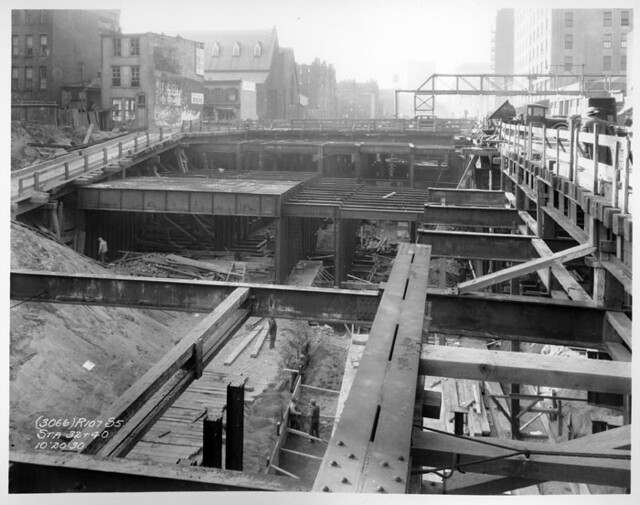
Construction progress for the IND Crosstown line (looking east toward the Court Street Station, now home of the Transit Museum) on Schermerhorn Street, Brooklyn, NY. October 20, 1930. (Photo courtesy of the Transit Museum)

In honor of its 35th Anniversary year, the Transit Museum — New York’s must underrated playground for subway enthusiasts — published a photoset to flickr today of scenes from the past three and a half decades. As a tantalizing glimpse at what lies in its archives, it fronted the set with the above shot from 1930 of the construction of the IND Crosstown line at Court and Schermerhorn Streets in Brooklyn. Looks like a mess, eh?

This historic shot got me thinking about the complaints surrounding construction along Second Ave. Once upon a time in New York City, subway construction was the norm. For 35 years in the early decades of the 20th Century, New Yorkers expected torn up streets cutting through neighborhoods in various states of development, and the resulting benefits included a vast new subway system. Yet, now, the last time cut and cover construction was employed in New York City, residents protested when parts of Central Park were dug up to make way for the 63rd St. tunnel.

Today, the Second Ave. Subway has turned a once-vibrant commercial and residential strip into a dust bowl of noise and construction fences. The MTA is trying to work with community groups to minimize the impact, but the authority has, to put it charitably, been less than successful in doing so. Now imagine if the scene from Court and Schermerhorn were transplanted to Second Ave. at 85th St. in 2011. That’s an unpleasant image, to say the least.

Many advocates for subway expansion have pointed to the costs of a deep-bore tunnel as an impediment to those projects, but the truth is more complex than that. Deep-bore tunneling isn’t significantly more expensive than cut-and-cover to justify what would arguably be a neighborhood-destroying project. It’s politically infeasible to propose cut-and-cover right now, and these scenes from the past remind us why.

Comments (13)

In its original incarnation, the East Side Access project was to be completed by the second quarter of 2012. As we well know, that timeline has been pushed back by over four years to September 2016, but according to an MTA report, the agency is concerned that they may need to further delay the projected substantial completion date for the Long Island Rail Road connection into Grand Central.

In a document presented last week at the MTA Board committee meetings, MTA Capital Construction officials said “our confidence level in meeting the September 2016 revenue service date is low without significant mitigation.” Because of “on-going contractor delays in Manhattan and Queens” as well as some back-and-forth with Amtrak over the Harold Interlocking work, the MTA has nearly exhausted its schedule contingency, and thus, without mitigation work, the project is in danger of missing the September 2016 date.

According to the brief report, available here as a PPT document, Capital Construction is going to work with the LIRR to reassess construction sequencing and timing for the final sections. The Capital Program Oversight Committee will hear the suggestions and potential cost impacts in September.

Comments (32)

A view of the Fulton Street Transit Hub from 19 stories up. (Photo courtesy of Jeremy)

Before the long weekend, SAS reader Jeremy sent me the above picture via his Twitter account. It is, as the caption says, a view into the Fulton Street Transit Center from 19 stories above, and it reminds me of the numerous photos of sports stadium construction that dot the Internet. Clearly, work has a long way to go, but the future $1.4 billion hub is quickly taking shape.

In its most recent update, the MTA still says the transit center will wrap in mid-2014, and the budget is still set for $1.4 billion. Even as the MTA struggles to keep the East Side Access project on schedule, it’s hard to believe it could miss the Fulton St. revenue date. After all, this is a project that was supposed to be completed years ago for $700 million, and it’s now talking twice as long and twice as much money to realize a glorified subway station amidst the streets of Lower Manhattan.

Every time, then, that I see images of this structure, I’m both impressed and disappointed. The Fulton St. hub will certainly be a pleasing addition to the downtown landscape, and the station rehabilitation at that location is a badly needed one. Yet, it’s a money sink. At a time when the MTA has to fight for dollars from Albany for capital projects that keep the trains moving, the feds are lavishing over a billion dollars on a glorified subway stop. This isn’t some regional hub that connects passengers entering and leaving New York; it’s a subway stop.

So what would I do with $1.4 billion? Adding a PA/CIS system along the B Division lines would greatly improve the rider experience. Pushing the CBTC program with more funding would allow for more trains at peak hours. Think about what $1.4 billion could do for the next phase of the Second Ave. Subway or how many basic station rehabs it could fund. The possibilities are endless.

Ultimately, the Fulton Street expenditure is a problem I’ve often highlighted. Politicians like to spend money on things that are living examples to their generosity. A Senator can’t point to a specific piece of equipment with pride when he or she starts to cull votes, but that same representative can discuss his or her efforts at securing federal dollars for a gleaming new downtown transit hub. The problem is that New Yorkers need more of those behind-the-scenes improvements that make the subways more pleasant or easier to ride. We don’t need a $1.4 billion subway stop at Fulton St.

Categories : Fulton Street
Comments (73)
  • Extended Stay

    Featuring a wide range of sophisticated furnished apartments throughout the city and surrounding areas, ExecuStay can help you enjoy a New York extended stay that's both productive and relaxing.

  • Corporate Apartments

    As a resident of ExecuStay New York corporate apartments, you'll find that getting around is a snap, thanks to the many MTA subway lines, buses and yellow cabs.