
Yesterday afternoon, in my post on foolish track-jumpers at 9th Avenue, I mentioned the abandoned lower level platform. Hidden at the bottom of some casually roped-off staircases, the lower level platform at 9th Avenue has sat unused for nearly forty years and is a testament to another age. This piece from the archives originally ran back in August of 2010, and I thought now would be a good time to revisit it. It’s way more fun to ponder the lost corners of the subway system than it is to risk life and limb for a pointless YouTube video so without further ado, some history on the Culver Shuttle, the train that once used that abandoned platform.

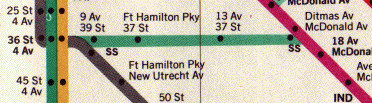
The 1964 subway map shows the Culver shuttle's connecting the 4th Avenue lines with the 6th Avenue lines well north of Coney Island.
Over on Subchat this morning, Newkirk Images posted a photo of the now-abandoned lower level of the 9th Ave. station in Brooklyn. Sitting in the center of the photo is a two-car train that has largely been lost to the history of the New York City subway system. That trainset is the Culver Shuttle.
The Culver Shuttle, as Joseph Brennan details at his Abandoned Stations site, had its origins in the late 19th Century steam-powered railroads that would take vacationing New Yorkers to the seaside resorts at Coney Island. With various elevated lines providing access throughout Brooklyn, the immediate history of the shuttle, says, Brennan is “fairly complex.” He writes:
Up to 1931, 5 Ave El trains provided all the service, and 9 Ave must have been busy with Culver passengers changing to the West End subway trains for a faster ride and access to many more places. The wooden el trains were slow and ran no farther than the end of the Brooklyn Bridge at Park Row, Manhattan.
When the Nassau St loop in lower Manhattan finally opened in 1931, the BMT began operating a mixture of subway and el services to the Culver line. Subway service ran Monday to Saturday, to Kings Highway in rush hours and summer Saturdays, and to Coney Island midday and other Saturdays. El service went to Coney Island rush hours, nights, summer Saturdays, and all Sundays, and otherwise ended at 9 Ave station. Is that clear? The BMT didn’t have enough subway cars for full service, so at rush hours and summers, the el had to pick up the service to the end of the line, so the subway trains could shortline. 9 Ave lower level saw its peak train service in these years, with both el and subway trains, and el trains reversing in the middle track during some hours…
The Transit Authority fulfilled a longstanding Board of Transportation plan in October 1954 when the IND subway was connected to the Culver line at Ditmas Ave station and took over all service to Culver stations beyond that point. BMT Culver service from a single track terminal at Ditmas Ave continued as before on weekdays, but nights and weekends it was a shuttle to 36 St. Ridership dropped, and in May 1959, it was made a shuttle full time, between Ditmas Ave and 9 Ave only.
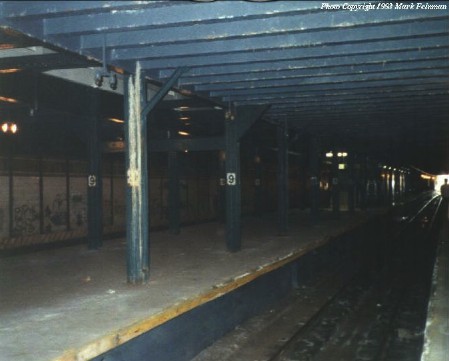
As the subway system decayed throughout the 1960s and early 1970s, the Culver Shuttle keep chugging along. It ran the BMT standard subway cars up through the early 1970s, and Brennan notes how the way Transit didn’t maintain this little-used station echoed the collapse of the system as a well. “The dark, deteriorating lower level at 9 Ave, and the partly dismantled elevated line gave it a mood of decay,” he writes. “There was just one track, the center at 9 Ave and the west side on the el, and one train operated all the service. The end was obviously in sight, but it somehow hung on until 1975.”
That year — 1975 — saw the demise of the Culver Shuttle amidst the now-familiar refrain of budgetary problems. Only 1000 people a day used the shuttle, and most of those were making the round trip to and from work. The MTA estimated it would cost $1 million it didn’t have to rehabilitate the elevated structure, and the shuttle, which once ran into Manhattan via the 4th Ave. line and Nassau St. loop, would be shuttered instead, with residents offered a free bus transfer as a replacement service.

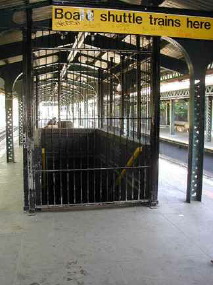
The abandoned 9th Ave. platform as seen in 2002. Photo via NYC Subway.
 These days, not much remains to remind New Yorkers of the Culver Shuttle. A sealed staircase leads to an abandoned platform, and the platform itself is in terrible shape. The rails too are but a memory as they were demolished in 1984. The rights of way between 9th Ave. and Ditmas Ave. have generally long since been sold to private developers, and houses in Brooklyn now mark the tracks of the old Culver Shuttle. Today, only stub tracks remain, a remnant of this rich history of rail travel in Brooklyn.
24 comments
… and what lovely buildings went in on the right of way (from what I can tell, this is the right of way, some of it still has surface tracks).
http://goo.gl/maps/B1l5
Can’t believe the ROW was just sold off. That kind of asset is irreplaceable, even if it seems unnecessary at the time.
That no doubt occurred to them, except they probably saw it as a liability, or at least a blight. Future generations were supposed to agree for their own good.
I get sad every time I go by on the F train and see the spot where it use to branch out and go towards 9th ave.
I rode this shuttle a few times as a kid. I remember very other passengers.
The unused elevated tracks remained up there for years after the service ended.
I’m always sad to see a train go, but discontinuing this line was the right call.We don”t have the resources to be running nearly empty trains that no longer provide a needed service.
Eliminating the shuttle was probably the right call but I had to laugh at this: the TA eliminated the line in 1975 saying that repairs would cost around $1 million. In 1984, the estimated cost for tearing it down was $2 million. Yes, I’m aware of inflation, but still…
Check inflation during that time period. You also have lead paint removal.
The Culver Shuttle is an example of subway services that were duplicated once the IND came along. The 9th Av El is in the same category (8th Av IND provided the essential service). It could be argued that the only two really essential subway services that were lost (where the bus replacement was clearly inadequate) were the Third Avenue Elevated in the Bronx and Second Av Elevated and Manhattan (with only a short part of the Second Av subway finally arriving in 2016) and the Myrtle Av Line in Brooklyn (which I would like to see resurrected with new service as a subway to Metrotech Center).
If there had been a way to reverse the connections at both ends of the Culver Shuttle — so that the tracks connected Church Avenue on the F with the West End line — it actually would have been useful during the period when the Manhattan Bridge was undergoing its repairs, since it would have allowed for B (now D) train access to the West End line via the Rutgers tunnel and the express tracks from Bergen to Church. But there wasn’t, and while it was the last of the three elevated lines in the period from 1969-75 to bite the dust, after lower Myrtle and the Third Avenue el, it was the least missed.
Just saw you being interviewed at TS by FOX. Looking forward to seeing the clip of it!
My parents and I moved to Brooklyn in 1953, and I was a regular rider of the Culver line when it still went somewhere. As I recall, the trains ran from Coney Island to Chambers Street in the Nassau Street loop; I think there was even some express service during rush hours. The station on the lower level at 9th Avenue was in very good shape, and saw a lot of traffic.
By 1954, the long-delayed connection to the IND at Ditmas Avenue was complete. The D train took over the Culver route, and the remains of the line became the Culver shuttle. Sadly, all most people know of the line is the decaying station at 9th Avenue and the stub where the three tracks of the Culver line used to make the turn off McDonald Avenue, heading for Manhattan.
This history is very interesting
Though the line ended service in 1975 the el tracks stayed in place till 1985
Culver’s Travels
http://forgotten-ny.com/2003/0.....ated-link/
[…] is known for more than just the place where crazy kids fling themselves across the tracks. As Second Avenue Sagas points out, it’s also home to one of the city’s many ghost subway stations. Located […]
I wish they would restore the shuttle to replace the F when they are working on the Culver viaduct. They should operate when the F is not running full line.
alek
There are houses where the elevated shuttle once ran. No can do. Besides, hardly anyone rode the shuttle when we had it, so there is hardly a compelling need to rebuild it now.
Maybe you’re right, but a lot of things that were destroyed back then could be useful today. The Myrtle El might actually be nice to have back, given the difficulty getting from northern to downtown Brooklyn. The B54 is a disaster, and the G hardly parallels the route.
If I had my doubts about any one piece of infrastructure, it’s the Third Avenue El, at least as it was left when it was demolished.
I always thought that it could be reopened if proposed IND Fort Hamilton Line was partially built and connected to the Fourth Ave and West End line:
https://maps.google.com/maps/ms?msid=203171029392575284947.000462cff8a1cd8941125&msa=0&ll=40.646099,-73.987384&spn=0.027319,0.038581
I remember the wicker seats on the Culver shuttle. It was like the oldest trains on the system. In the 60s it ran with the conductor in the car working the buttons and using his key to make it operational. Ah – the good old days before drugs and the Republican party destroyed America!
I remember taking the culver line to ditmas ave.and changing there for the main line that would take me to 18th ave where i would go play baseball for Holy Ghost Church .and do the samr thing for the return trip back home.Wicker seats and the fanshad a wicker center in them if they did work at all.The trains if i remember correctly were red and i think they called them red birds what a great ride behind the house on the el.While below it they played bocci ball and played cards those were the days.THANKSFOR THE MEMORIES.
who are you guys talking about the el….
i remember the open cars–thats right cars that were open like a conv…1945—-their was a conductor between the cars(3)
that was the day—what is wrong with being a rep……
did not b graduate harvard but i am 2%
The demise of the Culver Shuttle is a reminder that the IND was mainly a destructive force in the subway system. With the exception of Queens boulevard and the Crosstown line, they built no new routes, the IND simply existed to put the private companies out of business by competing with and taking over their lines. The BMT Culver Line was doing just fine running into Manhattan via the BMT 4th Avenue Line. The IND terminated their line at Church Avenue with distinct plans to take over the culver line in the future. What a waste of time and taxpayer resources. Instead of building new subways in parts of the city that badly needed it, they instead were used as a weapon to fufill Mayor John Hylan’s fantasy of no private subway companies in the city.
6th Avenue already had an el and the Hudson &Manhattan RR (what is now the path). We already had a 9th Avenue El. And their plans to build the 2nd Avenue subway weren’t necessary at a time when we had a 1st and 3rd Avenue el. The most egregious example is the Fulton Street Line. Literally tore down a perfectly functioning elevated route and replaced it with a subway, the only difference being one extra track. All while areas of Queens, Brooklyn, the far West side of Manhattan, and of course, Staten Island, completely lack subway service. Misallocation of resources at its finest.
Imagine if the private companies weren’t driven out of business by the IND. Despite the 5 cent fare restriction, BMT made a profit through the end of its days in the Great depression, and was one of the most innovative when it came to rolling stock (BMT triplex, Standard, etc). The IRT admittedly wasn’t doing so great in its later years, but that probably would not have been the case had the fare been able to adjust properly for inflation, which it did by the way, shortly after unification. I don’t think that’s a coincidence. The 5 cent fare regulation was to keep them out of business. Anyway, imagine if we had that innovation in the subway of today, the incentive to compete? The incentive for a profit? I know profit is a bad word in today’s day and age, but that’s actually a good way to keep down costs (read: wasteful general spending the MTA does on a regular basis.
A lot of people may say the MTA is technically private, and this is true, I think. However, they are monopoly so the market forces don’t affect them. Especially after all the legacy private bus companies were taken over. And especially that private bus companies can’t run city busses because getting a permit is basically impossible.
Is this a long rant from one small tidbit? Yes. But that one small tidbit has a lot more implications than one may realize.
When I was a child growing up in Brooklyn in the 50’s, my grandfather would always take me on subway excursions, since he lived near the Bay Parkway station. Many times we would get off the “D” train at Ditmas Avenue and take the BMT Culver line to Chambers Street. The sign on the Ditmas Avenue southbound platform read “BMT trains to city”. I remember making occasionally making the return trip to Brooklyn in the late afternoon via the Culver Express. It ran southbound through the Nassau Street Loop and Tunnel, then ran express on the 4th avenue line to 36th Street. It didn’t remain at Ditmas Avenue very long before it left on its return trip to the “city”, and shortly thereafter another train arrived. After the IND connection was built, there was a switch on the BMT segment enabling city bound BMT trains to cross over to the Northbound track. This configuration was in place until the May 1959 “BMT Massacre” cuts that resulted in the shuttle using just the center track at 9th Avenue connected to the former South (East) bound track to Ditmas. Most of the time the standards were used. I do remember riding weekend shuttle to 36th Street which used modified IRT “Low V” cars and former SIRT passenger cars.