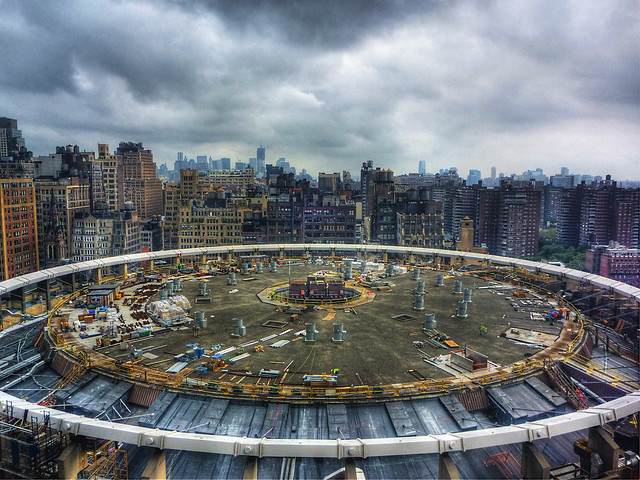
As the movement to reimagine and replan Midtown West takes shape and calls for some solutions to the Penn Station morass grow, the Department of City Planning is considering limiting the renewal term on Madison Square Garden’s occupancy permit to 15 years. The move — not without controversy — comes after a recommendation of 10 years from the Community Board and a request of an unlimited term from the Garden’s owners. A 15-year term would force the city to confront the problems of Penn Station before the end of the 2020s.
“While Madison Square Garden maintains that the arena special permit should continue in perpetuity, we believe the term is warranted due to the uniqueness of the site and the importance of Penn Station to the city,” Amanda Burden, director of City Planning Department and chair of the City Planning Commission, said.
Matt Chaban of Crain’s New York broke the story following the vote this morning, and his reporting provides some context on the next steps:
It’s been nearly a decade since efforts to move the Garden surfaced. Early talks involved city, state and federal governments, the three railroads that use the station, two developers and the Dolan family, which controls the Garden. Under that plan, the Garden would have moved across Eighth Avenue into the old Farley Post Office. It fell apart in 2008 under bureaucratic inertia and the wreckage of the real estate bubble. “We are recommending today that the commission call for a renewed, multiagency initiative to improve Penn Station,” Ms. Burden said.
Her notion of a 15-year permit drew vocal support from fellow commissioners, who will officially vote on the plan later in May. “I think 15 years, in my view, was a good decision and the minimum of what we could do because 10 years is too short and does not give the Garden enough to relocate,” said Commissioner Angela Battaglia, who had been skeptical of a limited term during past commission hearings…
Manhattan Commissioner Anna Levin reiterated the need to use the permit to jump-start the negotiations around the arena. “I’m fully in support of the general direction of the 15-year permit,” she said. “But we’ve got to rally the troops to get this to happen. It goes beyond these walls.”
Should a deal fall through, the special permit calls for a commission to reassess the area around the arena, perhaps creating more entrances on the plaza surrounding the Garden. The arena would not be responsible for such changes, but it would have to make way for them. “If such a plan does not come to fruition, making improvements to the station with Madison Square Garden at its current location will become critical to the future of Penn Station,” Ms. Burden said.
Various stakeholders expressed varying degrees of acceptance. The Municipal Art Society, which is seemingly more concerned with a great public space than a train station that can meet demand, still hopes for a 10-year permit while Madison Square Garden lashed out at the Commission’s decision. “Adding an arbitrary expiration for reasons unrelated to the special permit process or requirements would not only set a dangerous and questionable precedent, but would also hinder our ability to make MSG and New York City the long-term home of even more world-class events, and would harm a business that has served as a significant economic driver for the city for generations,” the arena’s owners said in a statement.
If the late-May vote upholds the 15-year permit and if the City Council does as well, the next decade and a half becomes a critical one for the region’s rail infrastructure. As I’ve mentioned a few times this year, the fight over MSG and, subsequently, Penn Station should not be about the above-ground elements. We can’t resurrect the old Penn Station, and we shouldn’t be sinking billions of dollars into a station house as we are with PATH at the World Trade Center site.
Rather, as Scott Stringer carefully elaborated, Madison Square Garden’s future must be tied to underground improvements. We need more track capacity, bigger platforms and a train station not interrupted by support columns that hinder passenger flow. MSG, already one of the country’s oldest arenas, has moved in the past, and it can move again if better transit connections warrant it.
Today’s announcement is the first real salvo in this fight, and the permit has clear a few hurdles before becoming law. Then, the battle of form vs. function over Penn Station will start to play out as well. For now, though, the move is a welcome one if we are to expand rail access into Manhattan, and the City Council should follow suit.
Leave a Reply