Archive for 7 Line Extension
Video of the Day: Inside the 7 extension
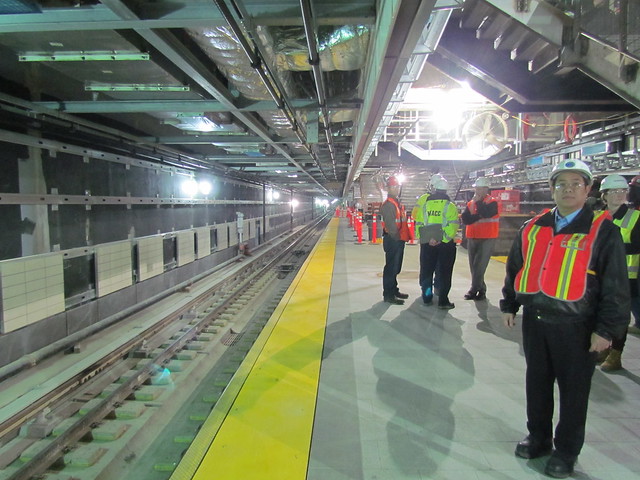
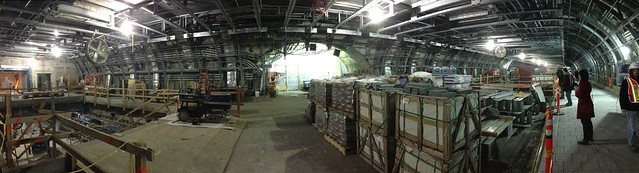
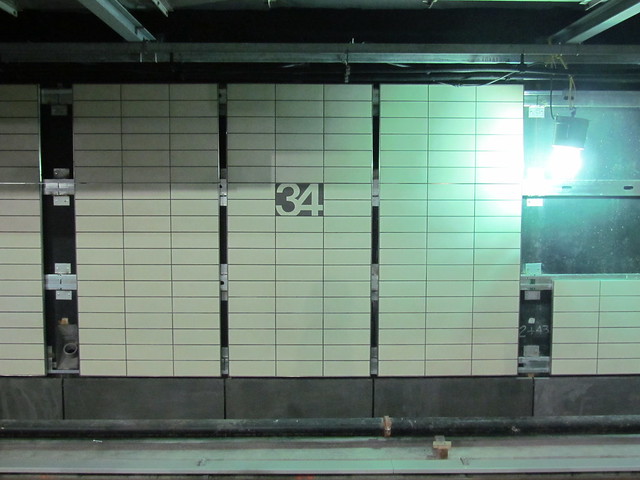
Posted by: | CommentsAs we while away this sunny and warm Friday, eagerly looking forward to the weekend, take a few minutes of your day to check out the latest from the MTA’s YouTube account. In this clip, we see just how much progress has been made on the 7 line extension, and it’s pretty stunning to see just how far along the project is. Tunnel walls are being finished; the cavern at 34th St. and 11th Ave. is beginning to resemble a station.
The extension, part of the mayor’s plan to develop the Far West Side, is still on pace for revenue service by the end of 2013. Unfortunately, due to budget wrangling, the plans for a second stop at 10th Ave. and 41st St. had to be scrapped, and the MTA and city were unable to find the funds for even a shell station which would have made future expansion easier. Even as we gawk at the infrastructure work going on underground, I fear that we will regret the short-term budget decisions made without truly considering the long-term ramifications.
Stirrings of development at Hudson Yards
Posted by: | CommentsWork on the 7 line extension is moving quickly, but the same cannot be said of development at Hudson Yards. Photo by Photo by Clayton Price for the Metropolitan Transportation Authority.
Over the past four and a half years, I haven’t smiled upon the 7 line extension. A pet project of Mayor Michael Bloomberg’s that serves as a living relic of the city’s failed Olympics bid, the $2.1 billion extension has seen useful elements — such as a station at 41st St. and 10th Ave. — eliminated. While the new stop at 34th St. and 11th Ave. is one that will benefit an eventual neighborhood, at a time when subway expansion dollars are very limited, this Subway to Nowhere isn’t the best use of funds.
Yet, the project is, as we learned recently, moving forward. Just last week, the MTA unveiled photos from inside the station cavern, and the authority has maintained that the 7 will head to the Far West Side by December 2013, nearly 32 months from now.
Unfortunately, nothing will be there when the 7 train extension opens. Sure, the Javits Center will still host conventions and the few people who live and work in the undeveloped area will have quicker access to the rest of Manhattan. But Related Companies, the real estate developer who agreed to purchase the land above the rail yards from the MTA, doesn’t anticipate opening a building there until 2015 at the earliest. Things, though, may be moving forward on that front.
According to article in Monday’s Wall Street Journal, Related is attempting to convince Time Warner to anchor the Hudson Yards development. Apparently, Time Warner’s still-new corporate headquarters above Columbus Circle could now command such a high price that it would make more sense for the telecom giant to sell its space and move west. While talks, according to the Journal, “could fizzle,” Time Warner wants to move but “isn’t close to a decision.”
Eliot Brown and Lauren Schuker report:
If Time Warner makes the jump, it could finally open up a long-planned frontier in Manhattan development by the Javits Center. Related has been pushing a long-term plan to deliver a city-within-a-city to be built over the Long Island Rail Road storage yard. It’s slated to include 12.9 million square feet of new office, retail and residential development
The deal would be a major boost for Related Chairman Stephen Ross, who agreed in 2008 to a $1 billion long-term lease with the Metropolitan Transportation Authority to become the site’s developer. Related has said it needs a large tenant to begin construction and has pledged to make space available to the first tenants at the cost of development…
Time Inc. and HBO, both divisions of Time Warner, lease more than two million square feet of space in Manhattan that expires in 2017 and 2018, according to research firm CoStar Group Inc. It is unclear if those divisions would be part of a move to Hudson Yards. But the timing of the lease expirations would allow for it. Related has said it could deliver the first phase of the development by 2015.
The two reporters note that Related has yet to secure a tenant for its planned buildings but believes it will lease out around 3.5 million square feet this year. The company is targeting Coach as a potential anchor tenant as well.
Meanwhile, the subway moves forward. Optimistically, construction will be completed at least two years before the buildings start to grow above the rail yards that abut the Hudson River, but the Subway to Nowhere will go west nonetheless.
Photo of the Day: Inside the 7 line extension
Posted by: | Comments
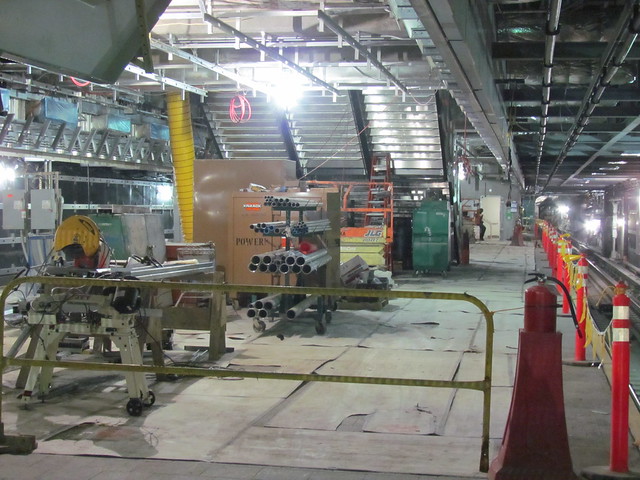
Progress of station cavern construction for No. 7 Extension as of April 2011. Photo by Clayton Price for the Metropolitan Transportation Authority.
As progress underneath the Far West Side proceeds apace, the MTA sent its photographer Clayton Price underground to snap some photos of the 7 line extension. The photos focus on the excavation of a three-block-long station cavern at 34th St. and 11th Ave. that is 85 percent finished and on target for a September 2012 completion date.
As the extension stretches toward its December 2013 revenue service date, the MTA’s contractors have completed the concrete pours that create the main cavern arches. A systems contract, which will cover rail track, all mechanical, electrical and related systems throughout the tunnels, station, ventilation buildings and the main subway entrance at 34th Street, will be awarded this July. This is the final contract for 7 line extension as the secondary station entrance is, in the words of the MTA, “not necessary” for the 7 to start serving the Hudson Yards area.
Unfortunately, the station at 41st and 10th Ave. seems to be a lost cause right now. It’s no longer part of the dialogue and attempts to secure funding for a feasibility study failed. While this one-stop, $2.1-billion extension will bring subway service to an area of the city badly in need of it, failing to include that other station near Hell’s Kitchen will go down in city history as yet another missed transit opportunity.
For more photos from the station cavern, check out the MTA’s flickr photoset.
City tabs Parsons Brinckerhoff to study 7 extension to NJ
Posted by: | CommentsThe Bloomberg Administration has asked Parsons Brinckerhoff to conduct an engineering and cost study as it pushes forward with a plan to explore extending the 7 line to Secaucus, the Daily News reported this morning. The engineering firm will conduct a study that explores how many people would use a subway to New Jersey and how much a potential extension might cost. Parsons Brinckerhoff earned the no-bid $250,000 contract due to its previous work on the ARC Tunnel, the current 7 extension and the Secaucus Junction train station, and its report is due in three months.
Still, even as the city pushes forward with this plan Bloomberg first floated in November, it is facing a certain level of skepticism from its potential partners. As a source said to the News, “City Hall really does want to explore it. “They have an incredibly reluctant MTA partner, and an incredibly wary New Jersey state government. Jay Walder doesn’t have enough money to finish what they’re already doing.”
The city hopes that PB will come back with a price tag in the $5 billion range. At that point, it will begin to pressure the MTA and New Jersey to sign on for this ambitious expansion of the subway system across the Hudson River and state borders. I’d rather see the money go toward furthering the Second Ave. Subway, but we can’t ignore the cross-Hudson congestion forever.
Sounding off on the 7-to-Secaucus plan
Posted by: | Comments
A rough sketch of the proposed 7 line extension to Secaucus. (Via The Wall Street Journal)
As the city’s plan to extend the 7 line to Secaucus gains support from the real estate lobby and, nominally, from N.J. Gov. Chris Christie, this far-fetched idea has stayed in the news for a few weeks. As intriguing as a cross-Hudson subway tunnel would be, the dollars aren’t there yet. Whether they ever will be remains to be seen, and many in the outer boroughs would rather see spending on underserved areas of New York City before the subway crosses state lines.
Today, The Times, which first broke the story nearly two weeks ago, has some reader feedback in the form of letters to the editor on Bloomberg’s plan. Let’s see what people are saying.
The first letter comes from Spero T. Leakas, a New Jersey lawyer. He writes:
Considering that Manhattan is the commercial hub of New York City and the metropolitan region, why would the subway system extend 20 or so miles east of the region’s center into Queens but not extend at all west?
From a transportation perspective, the region is currently a very unbalanced scale, and I am very happy to see that this is seriously being discussed.
Municipal or state boundaries are no excuse for not uniting a region’s populated areas into one cohesive transportation system. Under the proposal, the areas of Hudson County, New Jersey, are certainly worthy of having the No. 7 line.
Bob Previdi, a former planner with Transit, supports the measure from a transportation point of view. “The line,” he says, “should either continue on to Newark, where it can link to passengers from the Morris and Essex and Raritan Valley lines, and Newark Liberty Airport as well, or the tunnel should go to Hoboken. Hoboken is closer than Secaucus and is the second major hub for New Jersey Transit service.”
Michael Rogovin, another former Transit planner, says the 7 line extension idea is “deeply flawed.” He writes:
Trains bringing commuters from Queens already discharge huge crowds into stations at Grand Central, Fifth Avenue and Times Square, beyond the capacity of these stations to efficiently handle the volume of people. The extension of the No. 7 train to the West Side that is already under construction will add to these crowds.
Adding thousands of New Jersey commuters to the same narrow platforms and limited stairs, ramps and escalators (with little or no chance of expansion at these stations), would create unbearable crowding and a safety nightmare.
Rogovin believes increasing capacity at Penn Station should remain the primary objective for any cross-Hudson rail tunnel. Using the subways to achieve the ends of the now-deceased ARC Tunnel should be a last resort only.
Right now, there’s no firm proposal for the 7 to head to Secaucus, and the money isn’t in place. But if it keeps people talking about ways to solve a problem, perhaps it can become a real possibility for increasing trans-Hudson rail capacity.
Is the 7 line extension on time and on budget?
Posted by: | Comments
By eliminating the station at 41st St. and 10th Ave., the city ensured that the 7 line extension would come in at budget.
With the Mayor’s proposed subway to Secaucus garnering headlines, the 7 line extension is back in the news again. This $2.1-billion capital plan, whose construction is funded entirely by the city but whose rolling stock is not, has progressed largely under the radar as it heads toward its late 2013 completion. Sure, the city and MTA never came to terms on a station at 10th Ave. and 41st St., but at least it’s moving forward trouble-free.
That, at least, is the narrative Eliot Brown at Capital New York puts forward in a piece that explores how the 7 train is winning. Unlike the Fulton St. transit hub debacle and long-aborning Second Ave. Subway, the 7 line extension is ostensibly on time and on budget. This potential “bargain-basement gateway to Secaucus,” as Brown calls it, has emerged as the city’s model in subway construction. He writes:
Whatever happens to the long-shot bid for the new Hudson River connector, the No. 7 extension is still within its $2.1 billion original budget and its physical progress is going swimmingly, in the context an industry where cost overruns routinely go into the billions. It also stands in stark contrast with another historic transportation project, and he only other subway extension to be undertaken by the city in the past half-century: the Second Avenue Subway.
The Second Avenue project has not gone as planned. Since ground broke in April 2007, its completion date has been pushed off repeatedly (an average of a year each year), back from 2013 to 2016 (and counting), with the budget growing from $3.8 billion to at least $4.4 billion…
The No. 7’s easy ride can be attributed to a variety of factors, one of which certainly is luck—the tunneling simply went faster than expected—and another of which is the benefit of doing a project in what is effectively the Wild West. The area is filled with low-rise warehouses and garages, not residential skyscrapers filled with vocal residents and merchants who deplore the proliferation of rats and other noxious side effects of construction. There is less of a jumble of infrastructure underground to contend with, and, with only one station, there are fewer surprises than on the three-stop Second Ave line.
But is this fawning over subway construction true? Because the 7 line is going to open what Brown terms the Wild West of Manhattan, it has escaped the same level of scrutiny to which news organizations and politicians have subjected the Second Ave. Subway. Little outrage has emerged over plans to cancel the station at 10th Ave. and 41st St. — a station that would have brought badly-needed subway service to the rapidly growing and currently underserved Hells Kitchen area. That alone is why the 7 line extension, originally budgeted for $1.9 billion, doesn’t cost $3 billion, and not fiscal control by the Bloomberg Administration, as Capital New York alleges.
In a report issued in late 2009, the Citizens Budget Commission laid bare the truth about MTA capital projects. The 7 line extension, noted the report, was first due to open in summer 2012 to coincide with the Olympics. Delays in the design phase have since pushed the revenue-service opening date back to June 2013, and the entire project won’t be completed until November 2014.
Perhaps I’m just arguing a technicality. Perhaps Brown is right to highlight the 7 line extension because it’s more of a model for future subway expansion than the delay-rife Phase 1 of the Second Ave. Subway. Perhaps progress is indeed “going swimmingly.” But I see a project in which the costs were controlled by scaling back the scope by half, and the timeline, while not suffering recent delays, is still a year or two off its original pace. Other than that, Mrs. Lincoln, how was the theater?
The Subway to NJ: A history of futility
Posted by: | Comments
A 1931 rendering of proposed expansion of the New York City subway system into New Jersey. (Click to enlarge)
In January 1926, The New York Times discussed a report from the North Jersey Transit Commission on the state of travel across the Hudson River. “The report,” said The Times, “declared that congestion in the Northern New Jersey zone near New York City was becoming so great that measures for relief must be taken immediately.” To combat congestion, the NJTC unveiled a sweeping array of plans to bring subway service from Manhattan to New Jersey. Eighty-four years and two auto tunnels later, we’re still waiting for those tunnels to materialize.
The planing for such an extensive undertaking had started in 1924 when New York transit officials and New Jersey representatives met to map out a region-wide transit system. The initial proposal involved extending the two IRT trains to New Jersey via the local tracks from City Hall on the East Side and South Ferry on the West Side. The plan was trumpeted as a great one for everyone. It would relieve overcrowded commuter rail lines and bring more passengers — and more revenue — to the subway system.
Almost immediately, this plan drew opposition from within New York City. Before engineers had a chance to put their pens to paper, the Queens Borough President spoke out against it. “The Transit Commission, which comes begging the New York City taxpayers for millions to keep its existence has had the brazen effrontery to broadcast in the newspapers a plan it has to extend subways to New Jersey by way of City Hall and the Battery so that the traveling public may easily be carried to New Jersey while 60 per cent of the land in Queens remains undeveloped,” Maurice E. Connolly said.
Still, the Transit Commission and NJTC moved forward, and their initial engineering were immense in scope. As articles from the Electric Railway Journal and available on NYCSubway.org detail, the commissions outlined a plan that was cost-prohibitive but was to serve as a guide for future generations:
As the result of the study of these problems the commission has recommended a program consisting of six principal parts. Listed in the order of their importance, they are as follows: (1) Construction of a new North Jersey rapid transit system. (2) Hudson & Manhattan Railroad extensions in New Jersey. (3) Interborough extensions of its Manhattan lines to New Jersey. (4) Brooklyn-Manhattan Transit system extensions from Manhattan to New Jersey. (5) Extension of North Jersey rapid transit system, listed as part one of this program, to serve a larger area. (6) Electrification of existing steam railroads…
The North Jersey rapid transit system, part one of the program, would consist of the following five lines: (1) Interstate loop line, running north and south between the Hackensack River and Bergen Hill in New Jersey, passing under the Hudson River via a tunnel at the Battery, up through Manhattan to 57th Street and back through another tunnel to New Durham. Its length would be 17.3 miles. A so-called Meadows transfer station would be located near the intersection of the Erie and D., L. & W. Railroads. (2) A line from Paterson through Montclair and Newark, following the interstate loop route through Manhattan to New Durham and thence to Rutherford and Hackensack. The length of this route would be 41.9 miles. (3) A line from Ridgewood via Paterson, Passaic, Rutherford, New Durham, the interstate loop route in New York City, to Newark and Elizabeth. Route mileage would be 39.8. (4) An intrastate route from Elizabeth through Newark and Rutherford to Hackensack, 18.8 miles in length. (5) Another intrastate line from New Durham to Newark, 13.0 miles in length.
The commission stuck a price tag on it that seems laughably low today. This entire plan was to cost $382 million in 1926 or around $4.6 billion in today’s money. That’s the current cost estimate for only Phase 1 of the Second Ave. Subway.

Various loop plans, including an extension of the 7 line to New Jersey, are show on this 1926 illustration. (Via NYCSubway.org)
The proposed loop garnered the most attention. In addition to the Battery Loop described above, the commission offered numerous other possible points of expansion. Among those were discussions to extend the Queensboro subway — today’s 7 line — under 41st St., the Hudson River to a stop along Franklin St. between Boulevard and Bergenline Aves. in Union City; and a plan to send the BMT 14th St. line — today’s L train — from its then-terminal at Sixth Ave. to Hoboken and Jersey City before terminating at the planned transfer station at the Meadowlands. “This is a very logical extension,” the New Jersey planners said of the 14th St. extension, “and should be made at the earliest opportunity. Conference has revealed that such an extension would be acceptable to the New York Rapid Transit Corporation.”
Over the next few years, these plans never went anywhere. To fund them would have required a fare hike to ten cents, a substantial bond issue and special taxing powers. The Transit Commission debated the idea in January 1927, and New Jersey kept working toward it that February. By then, the most realistic portion of the NJTC’s proposal would have involved sending the 7 from 41st St. to Dumont, New Jersey. As the current 7 line extension to Secaucus has the backing of real estate interests, that plan in the late 1920s had the Forty-Second Street Property Owners and Merchants’ Association.
When the Great Depression hit, these nascent plans all but disappeared from public view. New Jersey tried to revive its subway connection in early 1931 in an effort to draw WPA money to the region, but that idea went nowhere. The mayor of Newark tried again in March 1937 with no support from our side of the Hudson River, and that would be that for nearly two decades.
For the next 17 years as automobiles arose to remove congestion from the rails — and create their own on the roads — and the region turned its attention to vehicular tunnels, the New Jersey subway plans languished. In 1954, the Regional Plan Association briefly issued a call to extend the BMT 14th St. line to Jersey City. Instead of building another motor vehicle crossing for $100 million, the RPA believed a subway tunnel would cost just $40 million — or around $315 million today. Neither the New York City Transit Authority nor the Port Authority would ever act on that call or a plan to build a vehicle tunnel to Hoboken from 14th St.
And so today, 56 years after the subway to New Jersey last reared its head, these plans are back. Yet again, as The Times details today, no one knows how much it will truly cost or who will foot the bill. The $5.3 billion figure floated by the Bloomberg Administration hasn’t been explained away, and it seems only tenuously based in reality. “It’s a nice idea, but you don’t see dollar signs attached to the commitment,” Martin E. Robins, an early ARC advocate, said. If history is any guide, I wouldn’t expect those dollar signs or a subway to New Jersey to materialize any time soon.
Christie endorses 7 line extension to Secaucus
Posted by: | CommentsUpdated (1:55 p.m. with Sen. Lautenberg’s reaction): Now that he doesn’t have to pony up much state money for a rail project, New Jersey Gov. Chris Christie has hopped aboard the 7 expansion plan. In an appearance yesterday on 101.5′s Millenium Radio, Christie endorsed New York City’s nascent plans to send the 7 to Secaucus and even pledged some New Jersey dollars to the project. “I think it’s a much better idea than the ARC,” he said, citing the supposed $5.3 billion price tag.
During the radio appearance, Christie spoke out against his detractors who claimed that his actions in killing the ARC Tunnel would lead to decades of stalled progress on a cross-Hudson rail tunnel. “They said nothing was going to be done for generations, nothing would happen, there’s no other way we could do this,” Christie said.
“Within weeks,” he continued, “we have New York City coming forward with an idea. You know why? Because it’s good for New York City. And once they knew that New Jersey wasn’t going to be the stooge that paid 70% of the cost of this project with no contribution from them, and they weren’t going to get that access of New Jerseyans going to New York, now they decide to step up and come forward with another idea.”
Of course, Christie is all in favor of a plan that doesn’t require his state to fund a project that, by and large, is a benefit to his constituents. If someone else is, as he put it in a similar context, willing to be “played for a patsy,” why not have them foot the bill and offer nominal political support and minimum economic aid?
Christie, who bashed N.J. Sen. Frank Lautenberg for his ARC support, wanted to hear capitulation from his political foe but got only a perfunctory statement. Said New Jersey’s federal representative via a statement, “The senator strongly supports expanding rail across the Hudson River and is closely examining the 7 line proposal.”
Lautenberg calls for firm fiscal support
In a letter sent today from Lautenberg to Gov. Christie, the New Jersey Senator urged the governor to pledge New Jersey dollars to the project. Noting that he’ll continue to fight for federal dollars, Lautenberg writes, in part:
While the No. 7 Subway proposal is not perfect — for example it does not offer New Jerseyans new direct rides to New York City from their local trains — it merits serious consideration…As I’m sure you’re well aware, before Federal transit funds can be sought for a new transit project, state and local funding sources need to be identified first. Under U.S.C. § 5309(d)(2)(C), the law governing Federal funding of new large transit projects, local financial commitments of funding must be identified before these projects are eligible for federal fudning. Therefore, please inform me of the amount and nature of New Jersey’s financial commitment to this project. Specifically, please verify that the $1.25 billion in New Jersey Turnpike Authority funding that was slated for the ARC Tunnel would be available for this new project.
I anticipate that you will aggressively seek comparable local commitments from New York City and/or State as well. Together with Federal resources, if local sources fo revenue are identified, an impressive financing package could be put together to make the No. 7 Subway proposal or another trans-Hudson crossing a reality.
I’ve posted the full letter after the jump, but it’s worth noting two aspects of it: First, it’s clear that Lautenberg and Christie have a chilly relationship at best. Second, if New Jersey ponies up some dough — and that’s a big “if” — and if Lautenberg can again secure federal financing for a cross-Hudson tunnel, this crazy 7-to-Secaucus idea just might have wings after all.
After the jump, the letter from Lautenberg to Christie in full. Read More→
Real estate lobby embraces 7 plans as feds do not
Posted by: | Comments
A rough sketch of the proposed 7 line extension to Secaucus. (Via The Wall Street Journal)
In writing yesterday about the city’s nascent plan to extend the 7 train to Secaucus, New Jersey, I touched briefly on those who stand to benefit the most from the plan. As with the current iteration of the city-funded 7 line extension, real estate interests — in particular, those of Related who are in line to develop the Hudson Yards — have the most riding on this project. By connecting a new mixed-use center with both New Jersey and the popular 7 line, Related would be able to draw thousands of people to an area of the city that’s currently among the least transit-accessible in Manhattan.
In fact, on Monday night, before the story broke in The Times, Stephen M. Ross, the CEO of Related, endorsed this project in a conversation with Secretary of Transportation Ray LaHood. “I think it’s a great idea and it could save a ton of money,” Ross said to The Times.
The Real Estate Board of New York has also embraced the idea, and this influential group is now lobbying hard for fast action. “Every developer I’ve spoken to thinks it’s a terrific, simple idea,” REBNY President Steven Spinola said. “They all think it will be wonderful…“It sounds like a real solution [to the cross-Hudson capacity problems]. You’re able to provide the transportation needs, yet at a substantially lower cost.”
I’ve written before about the way transit advocates need real estate interests but need to be wary of them, and that certainly applies here. You won’t see REBNY advocating for a Nostrand Ave. subway or the Triboro RX plan which will lead to improvements but not of the same potential that we see here.You will see them advocating for a 7 line extension when the benefits to their interests are obvious. They have the political clout though to be heard in Washington, City Hall and Albany, something with which advocates have not been overly successful lately.
The real estate lobby isn’t the only one embracing this plan. Both the Daily News and New York Times editorial boards supported this project today. “The benefits,” says the News, “would include expanded bistate rail capacity, a potential easing in auto congestion and a spur to growth on the West Side and construction of a new No. 7 station at 42nd St. and 10th Ave.”
The Times highlighted how this seems to be a natural extension of the 7 line. “What makes the Bloomberg concept intriguing is that much of the drilling for this subway tunnel is already being done in Manhattan,” the Gray Lady says. “For the other tunnel that was scrapped by Governor Christie, known as ARC, the biggest cost would have been for a new corridor deep under Manhattan’s Far West Side. ARC’s total cost was edging up to $11 billion before it was canceled. ‘ARC-lite,’ as some city officials are calling the Bloomberg tunnel, has an estimated cost of about $5.3 billion.”

A rougher sketch of the proposed 7 line extension to Secaucus. (Via Subway to Secaucus)
Now, while Bloomberg’s proposal has garnered headlines, it’s not the first time the idea of a subway to Secaucus has been floated. A few years ago, Ralph Braskett and Steve Lanset put forward their Subway to Secaucus proposal, and it appears that Bloomberg has drawn from it. Questions remain concerning funding. Will the feds pay for this subway extension?
According to various transit advocates, if the feds do fund part of this project, it won’t be with ARC Tunnel money. “The $3 billion has disappeared,” the RPA’s Jeff Zupan said to the Daily News. “They’re not going to turn around and say, ‘okay, you have a better idea now, we’ll give you the money.’ It’s not going to happen.”
Federal officials believe that the FTA will not work too hard to keep this money in the northeast because of anger over Christie’s decision-making process. Rather, it will go to other New Starts projects, and one Daily News source said that the odds are “slim to none” that the Secaucus subway will get ARC money.
Mayor Bloomberg though remained hopefully that other money could find its way to this grand idea. “It’s very early,” he said, “but we’re certainly talking to Gov. Christie’s office, to Governor-elect Cuomo’s office, to the MTA, to Ray LaHood and his people.”
It’s going to take a lot of talking to get this ambitious plan off the ground.
MTA just as shocked as the rest of us by 7-to-Secaucus plan
Posted by: | CommentsWhen news broke late yesterday of the city’s very preliminary plans to extend the 7 train to Secaucus, New Jersey, everyone was taken by surprise including, it seems, MTA Chair and CEO Jay Walder. In remarks to the press after this morning’s MTA Board meeting, Walder said that Bloomberg officials told him of the plan only “hours” before The Times broke the story. For its part, the city said it had not yet involved MTA officials in its talks because, as Michael Grynbaum put it, “the idea remained in its infancy and that the discussions had not progressed to a point where other agencies would be consulted.”
For his part, though, Walder, speaking as a transit technocrat, embraced the idea. He called it “very exciting” and expressed his belief that the transit system for the New York Metropolitan region must transcend state borders. “One of the things that it really says to us is that the region continues to look at the importance of public transportation to further the economic growth and the prosperity that we want to see,” he said.
Still, we shouldn’t start counting down the days until the MTA readies a tunnel across the Hudson. In addition to the planning challenges, the authority stressed how the dollars for such a project just aren’t there, and the MTA won’t begin the process until other capital plans are realized first. “There is no money,” Walder said, “in our capital program for any megaprojects except the three we have under way.” Until the dollars materialize, this extension will remain a tantalizing idea on paper only.