Archive for Arts for Transit

The Overlook

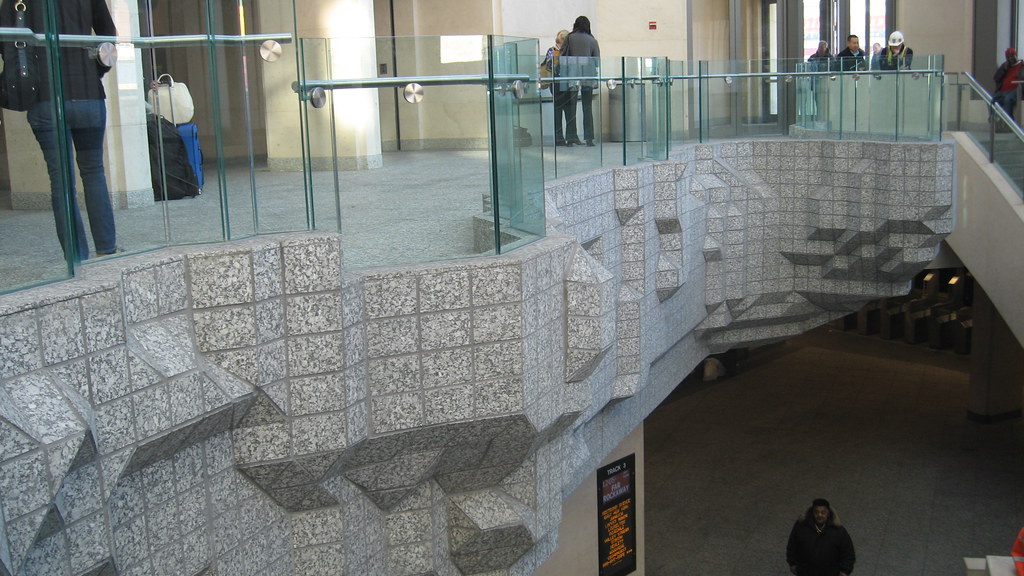
At ground level at the new Atlantic Ave. Terminal, Allen and Ellen Wexler’s “Overlook” inspires an outdoor pause. (Photo by Benjamin Kabak.

Grand train terminals have long been prime people-watching areas. The buildings are alive with those who scurry to and from trains, those who are waiting for friends and loved ones to arrive, those counting down the minutes until they can head home and those simply enjoying a public space. Stepping back to observe the pace of life in motion is one of the pleasures of commuting life.

A few weeks ago, the MTA finally cut the ribbon on its new terminal building at Atlantic Ave. in Brooklyn. Over budget and past deadline, the new building garnered praise for its airy inside and state-of-the-art facilities. Inside the terminal, at ground level but overlooking the lower level is the MTA’s latest Arts for Transit installation, and it is evocative of that people-watching tradition of train terminals.]

Early last week, I took a tour of the building and spoke to the artists behind the “Overlook,” a granite-and-glass installation that brings a sense of calm and tranquility to an otherwise busy building. It is, in the words of Allen Wexler, half of the husband-and-wife team behind the piece, supposed to represent “the intersection between nature and city” in an urban environment.

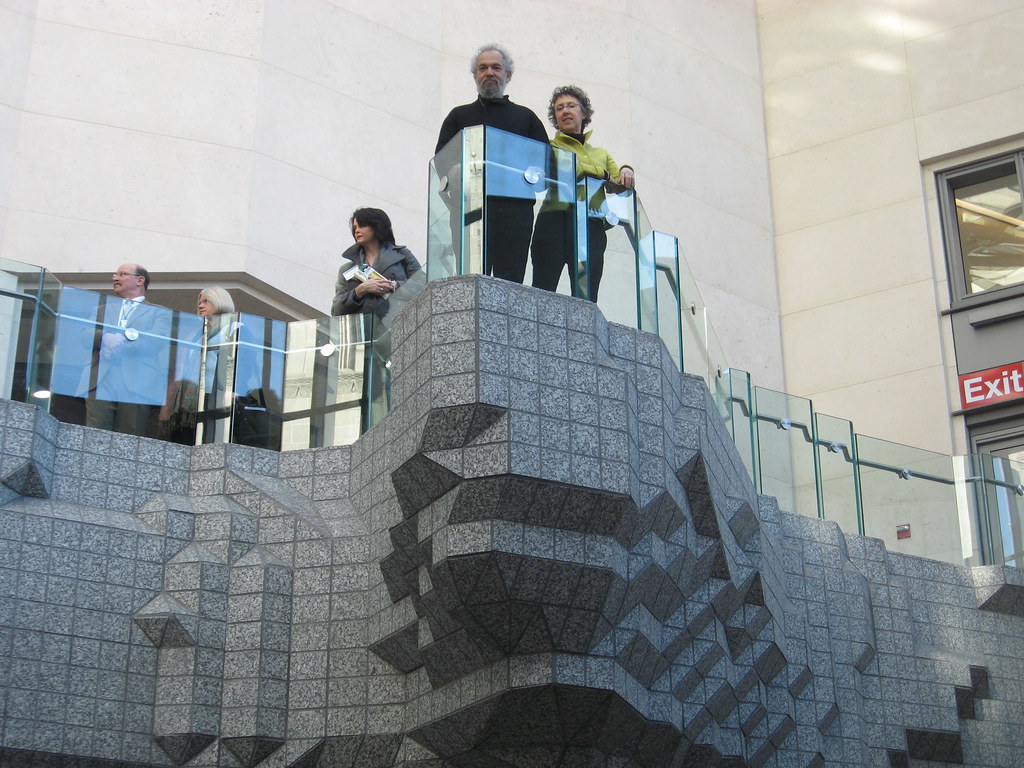
Artists at the Overlook

The artists, pictured above, talked to me about their design process and the inspiration for the piece. The two of them worked closely with John di Domenico, the architect behind the new terminal building, to construct something that would seem both natural for the terminal but also unique for the space. It is a site-specific installation meant to evoke a scenic overlook at a national park, and it transforms the upper level into a spot for simply watching urban nature.

The Wexlers took images of national park overlooks and came up with a fractal computerized design. Each granite panel is connected to the others via straight lines to turn this into what the artists called “a pxilated iconic scenic overlook.”

“We sought to create the experience of viewing an urban public space as if it were a nature setting, using granite tiles mathematically pixilated to create nooks and crannies similar to those found in rock walls,” Allan Wexler said. “Our public work seeks to engage the people who use the space, creating a rich experience that resonates over time.”

An Observation Point In the end, the MTA hopes that their new installation creates a meeting space at the station as well. With over 25,000 LIRR passengers and 31,000 subway travelers passing through the new terminal each day, the “Overlook” is ready to become a local landmark. “This vantage point was created as a collaborative effort combining our design that placed the wall between two sweeping stairways and the artists’ vision of morphing that structural wall into an outcropping of rocks,” di Domenico said.

Hanging above the ticket area, the waiting room and two grand staircases, it’s bound to become the terminal’s prime people-watching spot as well.

After the jump, a slideshow of scenes from the new Atlantic Ave. Terminal. Click on any of the photos in the post to enlarge. Read More→

Categories : Arts for Transit
Comments (0)

MTA Arts for Transit, Permanent Art Program

The Sol LeWitt installation at 59th St./Columbus Circle. (Photo courtesy of Metropolitan Transportation Authority/Rob Wilson. Click to enlarge.)

Taking a walk through the Columbus Circle station right now is one of the least pleasant experiences in the subway. Undergoing a complete rehab that is behind schedule, the station is hot and dusty. Platforms are cut off; walls are exposed; staircases are closed.

Eventually, the station will be completely transformed, but for now, it is in a perpetual state of construction. On Wednesday, a glimpse of color appeared amidst the construction as the Sol LeWitt Arts for Transit installation opened on a double-wide wall on a mezzanine in between the A/B/C/D and 1 train platforms.

The piece, shown above and again at the bottom of the post, was commissioned in 2004, and LeWitt, who passed away two years ago, selected the site himself. The work is 53 feet wide by 11 feet tall and is made of 250 porcelain tiles of six varying colors. It is called “Whirls and twirls (MTA)” and is one of the more vibrantly-colored entries in the Arts for Transit program.

“LeWitt’s genius comes through in this artwork, which is a major work of precision with its curves and bands in vibrant color that completely fills the space,” MTA Chairman H. Dale Hemmerdinger said. “It will become a landmark and is a great tribute to one of our major artists.”

Sadly, LeWitt is no longer with us to see the piece’s grand unveiling. He died in April 2007, but the artist is enjoying much posthumous success. As his obituary says, LeWitt was known for “deceptively simple geometric sculptures and drawings and ecstatically colored and jazzy wall paintings.” An exhibit of his works, recently named one of the top art shows in the nation, is on display for 25 years at Mass MoCA in North Adams, Massachusetts, and LeWitt was very much looking forward to his collaboration with the MTA.

“When an artist uses a conceptual form of art, it means that all of the planning and decisions are made beforehand and the execution is a perfunctory affair. The idea becomes a machine that makes the art,” he said in an Arts for Transit interview a year before his death.

After LeWitt’s death, Sandra Bloodworth, director of Arts for Transit and Facilities Design, worked closely with the artist’s family to ensure that his vision would be realized. “This project,” she said, “was filled with challenges, as we prepared several samples of tile and glazes to meet with Mr. LeWitt’s approval and found a facility that could produce large tiles mandated by the design. Working with Arts for Transit, his family and colleagues helped bring the project to completion. It is a very special and unique creation because it is a permanent public installation of a wall drawing, executed in porcelain tile. Usually the wall drawings are executed in paint or pencil based on exacting instructions by the artist.”

While some may criticize Arts for Transit as a superfluous use of money in tight economic times, LeWitt’s piece brings some color and levity to our normally serious commutes. It lightens up a once-dull space and should be recognized and embraced as a leading example of underground art.

Click through for another view. Read More→

Categories : Arts for Transit
Comments (15)

Susie Tanenbaum

Susie Tanenbaum


Arguably the definitive book on musical performance in the spaces of public transportation, Underground Harmonies: Music and Politics in the Subways of New York, by Susie Tanenbaum, presents an insightful and fascinating portrayal of the culture of music that has existed for decades in the stations of New York’s subway, adroitly drawing research techniques from urban anthropology, sociology, social history, cultural studies, constitutional law, political theory, urban planning, folklore, and urban ecology. Earlier this week I met with Ms. Tanenbaum in her office at Queens Borough Hall and had the opportunity to ask her about Underground Harmonies and the work she has been doing on behalf of local musicians and artists since the book’s completion.

It’s been nearly 15 years since Underground Harmonies was published. Are you happy with the book’s reception?
At the risk of sounding cliché, writing Underground Harmonies was an absolute labor of love. It meant a lot to me to be able to write about subway music as this incredibly special public space phenomenon, one that makes a difference to countless people as they go through their daily urban routine, one that legitimates the subways as a cultural venue, one that places value on subjective experience, and one that encourages people – complete strangers – to communicate across ethnic/racial boundaries without the need for advertising or other corporate packaging. It’s gratifying to know that UH was the first book written about NYC subway music; 15 years later, I’m thrilled to get contacted from time to time by researchers (like you) and documentarians.

Do you think it had an effect on conversations about public transportation and the arts?
I’m not sure I can gauge UH’s impact on conversations about public transportation and the arts. In January, I was invited to speak at a national transportation conference, and I was told that this was the first time the association (with membership in the tens of thousands) had organized a panel on arts in transit. Maybe work like mine, and yours, will become more relevant as transit experts and mavens pay more & more attention to aesthetics. The Know Your Rights Guide that I wrote after the book, in collaboration with City Lore: The Center for Urban Folk Culture, which is now on City Lore’s web site, may have had a greater impact on conversations between subway performers and police.

Have you noticed any changes in the situation of live musical performance in the New York subways in the past fifteen years?
The truth is, I don’t spend as much time in the subways as I did in the 1990s. But my own impression, and that of some of my friends, is that there isn’t as much live music in the subways as there used to be. If not, why not? Maybe it’s because subway music is no longer a novelty, and musicians have moved on to other venues and callings. Or maybe it’s because many transit police officers are still under the impression that the MTA’s Music Under NY members are the only ones who have a legal right to perform underground, so they (the transit police) shut down the freelancers. In reality, all performers, whether freelance or MUNY, have a constitutional right to perform in subway stations. Steve Zeitlin from City Lore has been getting a lot of emails lately from freelance musicians who say that the transit police have told them they’re not allowed to perform on subway platforms. Unless the MTA/NYCT rules were amended recently, this is untrue.

It’s strange…. Rudy Giuliani was a bully, obsessed with Police Commissioner Bill Bratton’s “broken windows theory” and determined to render our public spaces orderly by clearing out any meaningful human activity. But Mike Bloomberg is quite different. He really values public art, and in the summers he organizes these vehicle-free Saturdays to encourage people to come out and engage in all kinds of spontaneous play. Is this a situation where the sentiments of the folks in charge haven’t trickled down to what’s happening on the ground in the subways? Is it a situation where the priorities of the NYCT (getting people from point A to point B) conflict with the priorities of the Mayor & the MTA (making public spaces hospitable)? Or is it a situation where spontaneous play only matters when the city schedules a day for it – in other words, does the city still either not trust or not care very much about spontaneous, freelance street and subway performances?

How did you initially get interested in musical performance and doing an ethnographic study of people in the subway?
I enrolled in the Urban Studies Master’s program at Queens College-CUNY in the late 1980s, mainly to study with Dr. Roger Sanjek, an urban anthropologist who was doing fieldwork at the time in Elmhurst and Corona, Queens, the epicenter of the new immigration to New York at the time. Roger and his team were documenting the relationships between long-time residents and recent immigrants, and I deeply appreciated his approach to understanding the multiple layers of race relations in our borough and city. I arranged to do an independent study with Roger and, for reasons that remain unconscious to me, I wanted to explore how traditional music helped new immigrants to settle into their new society. After a few attempts at visiting particular communities in this part of Queens, Roger asked me why I don’t write instead about the guys I’d become friends with who were playing music in the subways. I’d been getting to know the members of Antara, one of the first Andean bands underground. I took Roger’s advice, and with guidance from another professor, Candance Kim Edel, I continued my fieldwork for the next four years. It became my Master’s thesis, then Roger helped me to get my work published by Cornell University Press. I’m still good friends with some of the original members of Antara.

If you were to republish the book today, what changes would you make?
Truthfully, I don’t think I could write the same book today. For one thing, transit police officers and NYCT employees probably wouldn’t grant me interviews as they did back then. Whether it’s post-911 security or a general trend toward bureaucratizing & controlling information, it seems our government agencies prefer not to have researchers document the subjective experiences of their employees. I really hope I’m wrong about this. In any event, if I were to write the book today, I would certainly include copies of the questionnaires that I used (the New York Times criticized me for leaving them out!). I’d love to know if people have suggestions on what else to include in a book like this!

What other projects have you been working on since you wrote the book?
In the 1990s I worked as Program Director and later Associate Director of the Jackson Heights Community Development Corporation. Among other things, I started LACE, the Local Arts Collaborative & Exchange, a network of 60 – 100 visual, literary and performing artists. Together we organized exhibits, concerts, readings & Open Mics throughout western Queens. Several of the members & my co-organizers were subway musicians. Currently I work for Queens Borough President Helen Marshall, and two of my areas of responsibility are immigrant and inter-cultural affairs. I plan cultural heritage events with various religious and ethnic communities in the borough, and I organize cross-cultural dialogues, which still often incorporate music. I really enjoy bringing people together across cultural lines and creating spaces in which they build relationships; to me, this is a quiet but meaningful form of political empowerment, one that I actually get to do out of a political office (because I have a wonderful boss who is an integrationist and a veteran of the civil rights movement)! On the side, Steve Zeitlin and I are in touch with subway musicians and we’re hoping to revive what we call our Street Performers Advocacy Project. I’ll keep you posted on that.

Jul
07

The sounds of a gentler commute

Posted by: Benjamin Kabak | Comments (3)

96thstart

The art installation at the new 96th St. stationhouse has been designed by Antenna Design and Urbahn Architects.

The New York City subway system is not known for its gentle sounds. Rather, the screech of metal on metal, the incessant whir of air conditioners struggling to work, the feedback loops produced by sub-par public address systems and the constant exhortations to “stand clear of the closing doors” provide a dissonant soundtrack to our daily trips underground.

What if, though, our wait for a train wasn’t marked by the rush of an express but rather the chirping of crickets and the sounds of the good old outdoors? Can art in the subways actually serve to calm harried New Yorkers? If the MTA gives its approval to an Arts for Transit plan, the new stationhouse at 96th St. and Broadway set to open late next year will feature a soundtrack of sounds from nature and other elements designed to slow down frantic straphangers.

Michael Grynbaum, new transit writer for The Times, has more on this unique installation:

By the fall of 2010, when construction on the station is expected to be complete, subway riders will enter an arched glass-and-steel structure housing an exhibit that is a striking contrast to the traditional tile mosaics and sculptures that populate the underground rail system.

Nearly 200 stainless-steel flowers will hang 12 feet above the turnstiles, mounted in staggered patterns across seven ceiling beams. The flowers, weighing about three pounds apiece, will be allowed to sway slightly, creating the effect of a shimmering garden levitating above the stairways that lead down to the platforms.

The nature noises, which are pending final review by the authority’s staff, would be focused by directional speakers on small areas of the station, allowing riders to “walk through” the sounds.

The modern garden and its accompanying soundtrack are a tribute to the geographic provenance of the 96th Street station, which was built in 1904 in a neighborhood known as Bloomingdale, after a Dutch word translated as “vale of flowers.” Although the station now sits amid rows of high-rise apartment buildings and noisy intersections, the hilly area was once known for its picturesque natural landscape.

“The installation is a memento of nature past, so that subway riders may be reminded of a time before the area became an urban neighborhood,” the designers, Sigi Moeslinger and Masamichi Udagawa, wrote in an introductory note.

Now, before New Yorkers not used to change in their morning routines get all bent out of shape, the two designers — working under the name Antenna Designs — are veterans of the subway system. They have designed the R142, R142A and R143 cars currently in use on various Transit lines, and for better or worse, they produced the MetroCard Vending Machine designs as well. They promise that this new exhibit will fit in perfectly.

Before the MTA can sign off on it, they have to ensure that the chirping crickets are ADA compliant. The sounds can’t be too loud so as to block out important — and not-so-important — public address announcements in the station, and the visually-impaired must be able to hear the MetroCard Vending Machines’ automated instructions.

Still, with a sound installation in place on the B/D/F/V platform at Herald Square, this latest proposal is probably heading for approval. After all, we could use a few more crickets in New York City anyway. A screaming siren and the screech of brakes aren’t the most comforting of sounds.

Categories : Arts for Transit
Comments (3)

1980installation500

restoration1 coveredpanels brandrestoration

Top: Bill Brand in 1980 poses with his recently-installed Masstransiscope. (Courtesy of Bill Brand. Click the images to enlarge.)

When Bill Brand’s Masstransiscope, a zoetrope hidden behind a slitted wall at the long-abandoned Myrtle Ave. stop just north of DeKalb Ave., first debuted in 1980, straphangers could view it from the Manhattan-bound QB train. One of those things, it seems, is ready for a revival. After an extensive restoration that involved removed layers of graffiti, the Masstransiscope is back.

“When I made the piece,” Brand, a film and video artist, said to me this week, “I didn’t even have a VCR. I’m just really happy to have it back.”

The recent saga of the Masstransiscope goes back about five years, according to Brand. The piece, designed as a zoetropic image, had been lost to time. Many of the lights had burned out, and the hand-painted panels had long been vandalized. It had become a rather of New York subway lore, forgotten to time by all but a few.

Brand, giving a talk to a group of film archivists, threw in a mention of the Masstransiscope as what he called one “an unusual cinematic work.” The response from the audience was immediate, and these archivists urged Brand to restore it. “Do I spend the time restoring this or do I make the next piece?” Brand questioned.

In the end, Brand decided to contact the MTA about restoring the piece. While Arts for Transit was initially resistant mainly due to the price, Brand secured some funding through a grant from the Albers Foundation. When development above ground allowed for temporary access to the remnants of the Myrtle Ave. station, Brand headed underground to survey the damage.

What he found was not pretty, but with the grant in hand, volunteer labor from some of his NYU students and some good old trial-and-error, Brand eventually figured out the best approach to cleaning and repairing the unique work. “I was interested in restoring it,” he said, “but not sure how.”

At first, Brand consulted with Metroclean Express, the company tasked with power-washing the city’s bus shelters. While the original work contained an anti-graffiti film, Brand was unsure how kind the years had been to his now-28 -year-old piece. Four hours into the work on one of the Masstransiscope’s 57 segments, just half of the panel had been cleaned, and the cleaning was taking its toll on the panel. “I thought this isn’t going to work this way,” he said.

Back in his studio, Brand experimented with a variety of commercial paint cleaners and eventually discovered a combination that did the trick. In a few weeks, all 57 panels had been stripped clear of what Brand guessed were between 20 and 30 layers of graffiti. While the piece still has some minor damages, as Brand said, “that was dust and hair.” Riders espying it from the windows of a passing B or Q train won’t be able to notice the damage.

Newly restored, the Masstransiscope has enjoyed something of a soft launch. Randy Kennedy profiled the piece in a Times article on New Year’s Day, but the MTA has not held any sort of formal unveiling ceremony. It is now including on Arts for Transit’s permanent artwork website as well. “It’s really exciting to be able to present it again,” Amy Hausmann, assistant director at Arts for Transit, said.

Now relit with longer lasting lightbulbs, the Masstransiscope will be in the minds of MTA officials. Hausmann and Lester Burg, a curator at Arts for Transit, told me that they plan to keep on eye on it. Conservation is indeed an issue for the arts-minded side of the MTA.

Over the next few months, Brand is hoping to give a Transit Museum-sponsored lecture about the work, but in the meantime, he is quite content to let riders discovery it for themselves. In fact, just a few weeks ago, I overheard a couple wondering just how long that “flip-book type thing” had been on display. The two could not agree as they spent the ride across the Manhattan Bridge talking about it.

“I’ve been really tickled by how much self-generated interest it’s generating this time around,” Brand said of his piece that offers riders a 20-second glimpse at a zoetrope live in the subways.

Click for a video of the Masstransiscope and an old quote that still rings true.

Categories : Arts for Transit
Comments (11)

The 86th St. station on the West Side IRT has long been decorated with mosaic versions of paintings. While the third graders’ art at 59th St. have long been removed, these tiled paintings at 86th St. still give the station a more artistic feel. Today, Times reporter Martin Espinoza chats with some of the artists about the origins of the paintings and what these drawings mean to them 20 years later. It’s a nice New York story about some good that came out of an Arts for Transit program.

Categories : Arts for Transit, Asides
Comments (4)
Dec
15

More on the South Ferry art

Posted by: Benjamin Kabak | Comments (1)

In my illustrated tour of the new South Ferry terminal, I talked extensively about MTA’s $1 million Arts for Transit investment in the new station. Today, The Times talked with Mike and Doug Starns, the 47-year-old, Brooklyn-based identical twins responsible for the decorations, about their vision for new stop. They talk about the trees, the map and the difficulties of working with fused glass on a subway station-sized scale. Check it out.

Categories : Arts for Transit, Asides
Comments (1)
May
06

From the subways to the airwaves

Posted by: Benjamin Kabak | Comments (1)

Last week, Music Under New York — the MTA arm responsible for many subway performers — held their annual auditions. (I wrote more about MUNY last year.) The auditions were a rousing success, and now one lucky performer will hit the NPR airwaves, just not, ironically, in New York. The Bryant Park Project is holding a vote: Pick your favorite MUNY audition tape. The winner will get to play a set live on the airwaves on a show WNYC has opted not to carry in New York. [The Bryant Park Project via SubwayBlogger]

Categories : Arts for Transit, Asides
Comments (1)

When the Washingotn Post published the Tom Toles cartoon above on July 3, a few loyal Second Ave. Sagas readers e-mailed it to me and noted how the idea can apply to the MTA also. The MTA, often more concerned with putting on a pretty face, spends money on luxuries instead of on more frequent service, some might contend.

I’m particularly intrigued by the notion here that station art may come at the expense of more reliable travel and service. In my opinion, station art and the MTA’s Arts for Transit programs are positives. They beautify stations that may otherwise may appear dour and depressing. The cost outlay is minimal compared to the amount the MTA spends on station upkeep, and scraping the program wouldn’t automatically provide the entire city with frequent service at all hours of the day.

Every weekend, when Friday rolls around and these weekend service advisories mount up, we complain about the the slow and hard-to-follow service. While I agree with others that service has seemed less-than-exceptional lately, I don’t think the answer to the MTA’s service woes is to scrap the Arts programs. The answer, instead, lies in securing adequate funding for the system through the congestion fee. As the odds of that worsen, we’ll just have to deal with a system strained to its economic limits.

And now your weekend service summary: New changes on the Q; still no 4 service between Brooklyn Bridge and Atlantic Ave.; and the West Side IRT express trains are running local. As always, everything else is here.

Safe travels this weekend.

Comments (2)

muny051507.jpg

Someone let the musicians out. Music Under New York takes to the streets. (Courtesy of the MTA)

We’ve had some serious weeks around here at Second Ave. Sagas. Resignations and track worker safety make for somber posts. But today, we’re all about music because it’s time, once again, for the Music Under New York Auditions.

All day today, from 9 a.m. until 4:30 p.m. in Grand Central Terminal’s Vanderbilt Hall, musicians will take to the stage an in effort to win one of the coveted spots in the Music Under New York program. The MTA announced this morning that over 70 musicians and musical groups will take to the stage during the seven and a half hour gala with poet Bob Holman, the self-proclaimed Ringmaster of the Spoken Word, serving as emcee.

The Music Under New York program is either a great way for musicians to reach an audience or, if you’re trying to navigate through the passages of the Times Square labyrinth, a major annoyance. Either way, it’s a welcome addition to the subway tunnels, and 2007 marks the program’s official 20th birthday. (It began as a two-year pilot program in 1985.)

As part of Arts for Transit, the MTA’s award-winning arts program that is supposed to increase the attractiveness of the otherwise-drab subways, Music Under New York licenses over 100 musical artists of varying genres and styles. According to the program’s Website, MUNY holds open auditions once a year, and the five-minute time slots feature some highly competitive artists and a tough slate of judges.

“A panel of professionals,” the Website reads, “consisting of representatives from the music industry, cultural institutions, MTA station operations, fellow musicians and others, judge each of the five minute performances based on the criteria of quality, variety, and appropriateness for the mass transit environment.”

The lucky ones who pass the audition gain acceptance into the program. They receive one of those personalized banners with their name that sanctions the performance and permission to play in one of the designated Music Under New York locations.

If you’re around the Grand Central Terminal area today, duck in for a few minutes and catch some of these bands. You’re bound to see something off-the-wall, and while I’m sure some of the musicians are terrible, others are quite qualified. A glance through the list of last year’s crop of new artists accepted to MUNY reveal an urban jug band called Brotherhood of the Jug Band Blues, a dance artist going by the name Little Michael Jackson and the Renaissance Street Singers, a group performing early sacred music.

So much like a ride on the subways, you never what sort of eclectic entertainment you’ll come across at these auditions. No matter; it’s gotta be better than a mindless 9 hours in the ol’ cubicle anyway.

Categories : Arts for Transit
Comments (3)