Archive for Arts for Transit
Thoughts on the art-vs.-service debate
Posted by: | Comments
When the Washingotn Post published the Tom Toles cartoon above on July 3, a few loyal Second Ave. Sagas readers e-mailed it to me and noted how the idea can apply to the MTA also. The MTA, often more concerned with putting on a pretty face, spends money on luxuries instead of on more frequent service, some might contend.
I’m particularly intrigued by the notion here that station art may come at the expense of more reliable travel and service. In my opinion, station art and the MTA’s Arts for Transit programs are positives. They beautify stations that may otherwise may appear dour and depressing. The cost outlay is minimal compared to the amount the MTA spends on station upkeep, and scraping the program wouldn’t automatically provide the entire city with frequent service at all hours of the day.
Every weekend, when Friday rolls around and these weekend service advisories mount up, we complain about the the slow and hard-to-follow service. While I agree with others that service has seemed less-than-exceptional lately, I don’t think the answer to the MTA’s service woes is to scrap the Arts programs. The answer, instead, lies in securing adequate funding for the system through the congestion fee. As the odds of that worsen, we’ll just have to deal with a system strained to its economic limits.
And now your weekend service summary: New changes on the Q; still no 4 service between Brooklyn Bridge and Atlantic Ave.; and the West Side IRT express trains are running local. As always, everything else is here.
Safe travels this weekend.

Someone let the musicians out. Music Under New York takes to the streets. (Courtesy of the MTA)
We’ve had some serious weeks around here at Second Ave. Sagas. Resignations and track worker safety make for somber posts. But today, we’re all about music because it’s time, once again, for the Music Under New York Auditions.
All day today, from 9 a.m. until 4:30 p.m. in Grand Central Terminal’s Vanderbilt Hall, musicians will take to the stage an in effort to win one of the coveted spots in the Music Under New York program. The MTA announced this morning that over 70 musicians and musical groups will take to the stage during the seven and a half hour gala with poet Bob Holman, the self-proclaimed Ringmaster of the Spoken Word, serving as emcee.
The Music Under New York program is either a great way for musicians to reach an audience or, if you’re trying to navigate through the passages of the Times Square labyrinth, a major annoyance. Either way, it’s a welcome addition to the subway tunnels, and 2007 marks the program’s official 20th birthday. (It began as a two-year pilot program in 1985.)
As part of Arts for Transit, the MTA’s award-winning arts program that is supposed to increase the attractiveness of the otherwise-drab subways, Music Under New York licenses over 100 musical artists of varying genres and styles. According to the program’s Website, MUNY holds open auditions once a year, and the five-minute time slots feature some highly competitive artists and a tough slate of judges.
“A panel of professionals,” the Website reads, “consisting of representatives from the music industry, cultural institutions, MTA station operations, fellow musicians and others, judge each of the five minute performances based on the criteria of quality, variety, and appropriateness for the mass transit environment.”
The lucky ones who pass the audition gain acceptance into the program. They receive one of those personalized banners with their name that sanctions the performance and permission to play in one of the designated Music Under New York locations.
If you’re around the Grand Central Terminal area today, duck in for a few minutes and catch some of these bands. You’re bound to see something off-the-wall, and while I’m sure some of the musicians are terrible, others are quite qualified. A glance through the list of last year’s crop of new artists accepted to MUNY reveal an urban jug band called Brotherhood of the Jug Band Blues, a dance artist going by the name Little Michael Jackson and the Renaissance Street Singers, a group performing early sacred music.
So much like a ride on the subways, you never what sort of eclectic entertainment you’ll come across at these auditions. No matter; it’s gotta be better than a mindless 9 hours in the ol’ cubicle anyway.
Murder at the Canal Street station
Posted by: | Comments
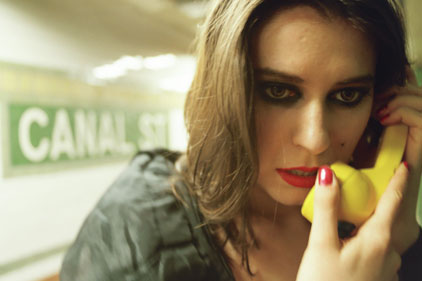
Kill or be killed as you wait endlessly for the Q at Canal Street. (Photo courtesy of 31 Down Radio Theater)
Well, that caught your attention, eh? Someone’s been killed at the crowded Canal Street stop? Well, not quite. I’m sad — or happy — to report that no one was murdered at the underground entrance to Chinatown.
The murder is part of an interactive performance by the public artwork troupe 31 Down Radio Theater called Canal Street. The action takes place in labyrinthian tunnels of the Canal Street Station, and you, the detective-cum-straphanger, are supposed to solve the mystery. For $2 — or less — you too can be a New York detective. Time Out New York wrote about this intriguing work last week:
For all the improvements over the past decade or so, the transit system is still kind of creepy, which makes a new interactive public artwork by the group 31 Down Radio Theater all the more diabolical. With just a swipe of your MetroCard, it puts you in the middle of a murder mystery unfolding in the Canal Street subway.
According to creator Ryan Holsopple, the piece, titled Canal Street Station, consists of a toll-free number you can dial from any of the pay phones there. The voice of one Niki, an archetypally breathy French girl, comes on to say that she’s just committed a murder, and that you need to find her somewhere in the labyrinth of platforms and tunnels connecting the J, M, Z, N, Q, R, W and 6 trains. “Basically, it’s a big game,” says Holsopple, who adds that depending on where you are, you’ll be asked a specific question about that location—maybe for a detail from a nearby mosaic or which train goes to Fresh Pond Road in Queens. You hang up, snoop, then call back with your answer. If correct, you’ll be told where to go for your next call.
I love this idea; I can’t wait to do it, and a few things leap out at me. First, this game relies on the payphones in the New York City subways. Wait a minute, you might be thinking, do those payphones actually work? Well, about a quarter of them don’t work. So part of the game is finding a working payphone at Canal Street. (The other part involves finding one you want to touch. Good luck with that.)
Next, I think this game is best played at rush hour. That Canal Street station is a zoo during the day; why not really go for the “confusing masses of harried commuters” theme that would so enliven the game? You can push against the tide of humanity as you dash from the Brooklyn-bound N/Q platform to the uptown J/M/Z tracks.
So there you have it. You can spend an hour, as the theater troupe suggests, running around Canal Street trying to find out minutiae about the subways in an effort to solve a murder. Test the payphones; test your patience. And have fun. It’s the best $2 or Unlimted Ride swipe you’ll spend this month.
And who knows: Maybe she would have gotten away with it if it weren’t for you meddling kids and your dog too.
To get started, head to the Canal Street station; pay the fare; find a payphone and dial 1-877-OR-WHAT-31 (1-877-679-4283). Canal Street will be in the Canal Street station until October.
Restoring a zoetrope in an old abandoned Brooklyn station
Posted by: | Comments
Riders of the Manhattan-bound B and Q trains know there’s something out there. Shortly before the trains go above ground on the Manhattan Bridge, alert riders can spot a glimpse of…something. It’s not a solid tunnel wall; daylight streams through a series of slits in a temporary wall blocking whatever it is that’s there.
Well, that something is actually a very old and long-abandoned subway station. It is an old elevated subway stop at Myrtle Ave. that hasn’t seen passengers since July of 1956, over 50 years ago. While abandoned stations dot the subway system — and alert passengers on the East and West Side IRT trains know where to stop them — the Myrtle Ave. station is unique because it once served as the staging grounds for a work of art:
Two hundred twenty-five hand-painted panels sit behind those mysterious slits. When viewed properly and at the right speed, those panels form a picture. It’s a life-sized subway zoetrope.
But the Masstransiscope has fallen on hard times. Installed in the 1980s by filmmaker Bill Brand, the piece, as any astute rider may notice, is completely obscured by graffiti. Now, Brand wants to restore his zoetrope. Originally installed at a price tag of $60,000 and through the aid of the NEA and the New York state Council on the Arts, Brand estimates it could cost up to $40,000 to restore it, and the MTA’s Arts for Transit program can’t cover the restoration costs.
“Around 1990, we fixed it up,” said Sandra Bloodworth, director of the MTA’s Arts for Transit program. At that time only the light bulbs needed to be replaced, and the MTA received a donation of bulbs. Now, however, the electrical work needs to be entirely redone. Arts for Transit isn’t willing to shell out the estimated $35,000-$40,000 for restoration.
“I need to produce works that will be here 30 or 40 years with that kind of money,” Bloodworth said. Masstransiscope, she added, “gets damaged so quickly. It gets painted over with break-ins.”
While twenty years ago, Brand convinced graffiti artists to tag elsewhere simply by asking nicely, times have changed. Graffiti in the subways is no longer about the art of graffiti; instead, it’s about tagging a name on as much MTA property as possible. And Brand knows he would face an uphill battle to keep the Masstransiscope viewable.
The MTA will coordinate the restoration. Now, Brand just has to raise some money to restore an interesting work of art that would lend some color to an otherwise sluggish ride from Brooklyn to Manhattan.
Hat tip to Brooklyn Record.