Archive for Brooklyn

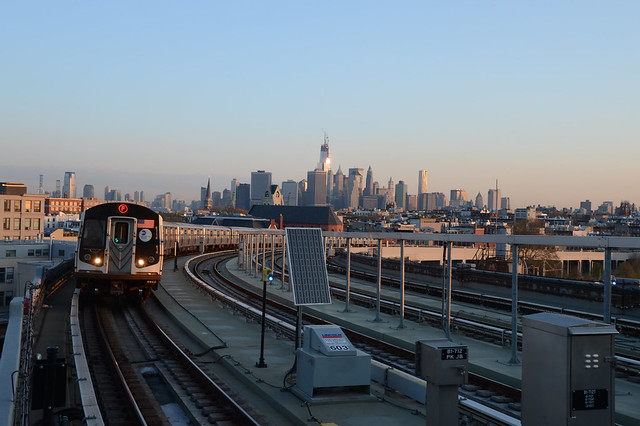
Manhattan-bound F riders are gearing up for months of inconvenience. (Photo courtesy of @JeffreyNYC)

One of my main themes at Second Ave. Sagas over the past four years has involved New Yorkers’ relationship with transit news. I’ve looked at how the millions of people who rely on the MTA for travel don’t pay attention to the news, how the news doesn’t do an adequate job explaining certain transit stories and how the MTA’s own approach to customer service oftentimes compounds the problem. Nowhere is that more evident than in today’s developing outrage over the upcoming shutdown of stations along the F line in Brooklyn as part of the Culver Viaduct rehab project.

The basis for this tale is a simple one: After three years of planning and the start of Phase 1 of the Culver Viaduct rehabilitation plan, the MTA announced this week that, beginning January 10, Phase 2 shutdowns will begin. In other words, from January 10 through May, as part of a $275.5 million rehab on a structure that’s falling apart, the following changes will be in effect:

  • No Manhattan-bound F or Queens-bound G service at 15th Street Prospect Park and Ft. Hamilton Parkway Stations.
  • No Manhattan-bound F service at Smith-9th Sts Station. Queens-bound G service stops at a temporary platform.
  • All Manhattan and Queens-bound trains stop on the express track at Church Avenue and 7th Avenue stations.
  • Manhattan-bound F and Queens-bound G trains stop at a temporary platform accessed via the Coney Island-bound platform at 4th Avenue-9th Street station.

Somehow, despite years of warning, the locals are outraged. Popular neighborhood blog Fucked in Park Slope is too beside itself for snark while Gothamist is fielding some priceless emails. “We’re new to Windsor Terrace (2 months) and fairly new to New York (6 months),” one Brooklyn resident said. “I’m absolutely livid that this is happening with a week’s notice, especially in the winter. This is the first we’re hearing of this and is part of a chain of the F train messing with us. I’ve lived in cities for the past 10 years and I can tell you this level of fuckery wouldn’t fly in LA or Boston.”

So where to begin? Where to begin? Should we point out that subways in Los Angeles and Boston, you know, shut down over night so that people can’t get home via public transit after midnight? It certainly would be worse living in Windsor Terrace if the last F train departed from midtown at 11:30 p.m. every Friday and Saturday.

But instead, let’s look at some history. In late 2007, New York City Transit unveiled their plans for the Culver Viaduct, and while the timeline has been pushed back and the project slightly scaled down in the intervening years, the same service changes apply. In fact, in a presentation to Community Board 6 in 2007, Transit presented the exact same service patterns going into effect next week. Take a look:

A presentation from 2007 shows plans portending next week's F/G service outage in Brooklyn.

That 2007 presentation wasn’t the only one Transit has delivered to Brooklyn. Take a look at a similar one from 2008. It’s just another in a long line of slideshows Transit’s community relations officials have given to Community Boards. In fact, as recently as this past fall, I sat in on a meeting at which officials discussed these exact service changes.

Furthermore, the MTA has released its own video on the project; and crews have been working on the viaduct for nearly ten months. In other words, since 2007, then, Brooklynites knew or should have known that their service was going to be cut for a few months, and if people moving to the area or already living their failed to do adequate research, that’s on them.

Of course, oblivious locals who don’t seek out transit news aren’t the only ones to blame. In fact, I don’t expect people to attend Community Board meetings and few non-members do. But New York’s various news outlets pay people to attend and report on those meetings, and over that last few years, that’s just what they’ve done. Newspapers ranging from The Daily News to the Brooklyn Daily Eagle have covered the work.

My site is but a small fish in the giant sea of New York media, but unfortunately, Brooklyn news outlets haven’t done a thorough job of explaining the impact of the Culver Viaduct rehab. Take a glance through the Brooklyn Paper search results of stories relating to this work. The paper mentions that service to and from Smith-9th Sts. will be impacted, but it doesn’t explore how the need to run F and G trains on the express tracks will lead to trains bypassing 15th St. and Fort Hamilton Parkway. That’s a failure of media.

Finally, the MTA isn’t absolved of all blame either, and in fact, the authority hasn’t upheld its end of the deal. At a Community Board 6 Transportation Committee meeting earlier this fall, committee members specifically asked the MTA to warn the neighborhoods well ahead of time. Instead, the MTA started hanging up signs portending a four-month service outage just seven days ahead of time. Even though the MTA had warned community groups and received a far amount of press coverage, Transit should be papering stations well ahead of the service outages. The authority can’t force news down people’s throats, but it can do a better job of getting the word out ahead of time. One week is not enough lead time for a warning of this magnitude.

This day of outrage in Park Slope and Windsor Terrace highlights how people simply take the transit system for granted. They’d rather every station but theirs get rehabbed and are content to let infrastructure age if it means they aren’t inconvenienced. The millions of New Yorkers who ride the subway every day are also content to ignore the news that impacts their lifeline to the economic hubs of the city, and the media that covers these areas is content to do a half-hearted job of it. The MTA too doesn’t make it any easier. This is outrage that has been in the works since November 2007, and with a little more effort from everyone, it should have been completely avoidable.

Categories : Brooklyn
Comments (101)

A simmering conflict between the FDNY, DOT and Robert Diamond, the main force behind the Brooklyn Historic Railway Association and the Atlantic Ave. tunnel tours boiled over this afternoon as DOT revoked Diamond’s permission to conduct tours. Citing fire safety concerns brought to light by recent FDNY investigations, DOT announced its decision in a letter to Diamond at 4:45 p.m. this afternoon.

The recent battle between the city and Diamond started around 10 days ago when the Fire Department forced him to cancel a movie screening inside the tunnel. Rooftop Films had planned to air a few films inside the tunnel as they had done in August, and National Geographic was set to film inside the tunnel. Due to concerns over ventilation and the space available for entrances and exits into and out of the tunnel, the FDNY sent a letter to DOT expressing its safety concerns, and today, DOT pulled the plug on the tours.

Diamond, who has been conducting tours inside the 165-year-old tunnel since the early 1980s, was apoplectic. FDNY has urged him to build a second entrance to the tunnel, but for years, DOT has dragged its feet on granting permission to open another entrance to a few feet further down Atlantic Ave. For now, then, the tours will stop at Diamond figures out his next move. He does not have kind words for the city.

“This entire debacle has occured because the City of New York for the past 30 years has failed to address the status of this historical treasure,” he said to me. “The City, especially DOT, has ignored my pleadings for the past 30 years to come together and formulate a policy for the preservation and utilization of this remarkable historical resource. Now that the Bloomberg Administration’s ‘couldn’t care less’ attitude towards historic treasures has been exposed for all to see, I hope the next city administration, which is only around the corner, will have more common sense than to destroy a proven tourist attaction and historical resource.”

Categories : Asides, Brooklyn
Comments (3)

When the Nets new arena opens at the Atlantic Yards complex in a few years, it will bring with it traffic to a few of Brooklyn’s quieter residential neighborhoods. With Park Slope to the south, Prospect Heights to the east and Fort Greene to the north, the area doesn’t lend itself to the multitude of cars that will throng its streets on game days. Unfortunately, despite sitting atop one of the city’s busiest subway hubs and a Long Island Rail Road, the project will come with more parking than we’d like. To encourage mass transit use then, one advocate has proposed an idea for the masses: free beer.

At a Prospect Heights Neighborhood Development Council meeting held last week to attack the traffic problem, Ryan Lynch of the Tri-State Transportation Campaign called upon Forest City Ratner to subsidize a free beer for those who take the train to the game. “Give people a free beer. They’re not driving,” Lynch said. “There needs to be more incentives from the developer and events promoters to encourage event-goers to get on mass transit. You could show your Metrocard or LIRR ticket and get a discount at the concession stand.”

A spokesman for the developers issued a very spokesman-y statement. “We’re working on a fully integrated transportation plan that will look at a variety of ways of using mass transit instead of driving to the arena on game nights or event nights,” Joe DePlasco said. Ultimately, though, the Nets and Forest City Ratner should figure out a way to encourage transit use. Whether that includes supporting a residential parking permit program for the neighborhood’s streets or offering MetroCard- and LIRR-based discounts, driving to this arena should be discouraged. I’d drink to that.

Categories : Asides, Brooklyn
Comments (11)

MTA CEO and Chair Jay Walder, with scissors, celebrates the opening of the new station as Brooklyn politicians join in. (Photo by Benjamin Kabak)

At the ribbon-cutting ceremony celebrating the completion of the Jay St.-MetroTech station rehab and a new connection between the IND and BMT, MTA officials spoke of the thousands of people who will now enjoy the new station. For the first time since 1933, passenger will enjoy a free in-system transfer between the R and the A, C and F trains. It was a distance of barely more than 100 feet that took nearly eight decades to bridge.

“The work we’ve done here acknowledges this station’s importance to Downtown Brooklyn,” Transit president Thomas Prendergast said to a crowd of contractors, politicians and reporters at the station this morning. “From day one, this is going to be a vital transfer point for our customers, creating another transit hub in Downtown Brooklyn.”

A new escalator leads the way up from the old Lawrence St. station on the R. (Photo by Benjamin Kabak)

With the new connection comes a new name, and while the signs across the complex now say Jay St.-MetroTech, it might be tough for the locals to forget about Lawrence St. and Borough Hall. Still, a new moniker is nothing compared with the overall enhancements at the station. Jay St. is now fully ADA-compliant with three elevators and two new escalators. The fare control areas have been reorganized to better facilitate passenger flow, and a massive Arts for Transit installation adorns the mezzanine level.

“We don’t just do the bare minimum,” MTA CEO and Chair Jay Walder said. “We put in the work, effort and art that will allow us to walk in here and smile when we enter the station.”

For the MTA, this connection is, as Walder says, part of an effort to “correct[] a mistake that was made back in 1933.” As the original tripartite subway system went up, lines operated by different companies crossed, but because of the competition between the IRT, BMT and IND operators, transfers were often omitted. Now, with various projects around the city, the MTA is working to integrate an old system. “The opening of this link as well as two other new transfers to be placed into service next year continues the physical consolidation of a subway originall built and operated as three separate systems,” Prendergast said.

The politicians who took part in the ceremony echoed this drive and pushed for more. Letitia James, City Council representative for the area, called upon the MTA to connect the G with the IRT. Both Borough President Marty Markowitz and Joan Millman, while praising the MTA for finishing the $164 million rehab on time and under budget, urged the authority to address the issues surrounding the former Transit headquarters above. “370 Jay Street,” Markowitz said. “That’s our next chore.”

This morning, they celebrated. This afternoon, they went back to work. “Finally,” Markowitz said, “we have a station worth of Downtown Brooklyn and all Brooklynites.”

Departures and Arrivals fills an artistic gap

Departures and Arrivals (2009), Ben Snead, Jay Street-Metro Tech Station, A, C, F, R lines, MTA New York City Transit. Commissioned and owned by Metropolitan Transportation Authority Arts for Transit. (Photo: Collin LaFleche. Click to enlarge.)

As part of the station rehab, the MTA’s Arts for Transit division has installed a 103-foot-long mural along the newly renovated mezzanine. Designed by Ben Snead, the piece is called Departures and Arrivals, and it is a metaphor for the melting pot of the Borough of Kings. It features species of animals that have migrated to Brooklyn and one that is departing.

Snead, who works extensively with animals, had applied to design an installation for two other stations in the Bronx, but the MTA finally came knocking for the space at Jay Street. It is, Lester Burg of Arts for Transit told me, one of the largest installations in the system. It is made out of glass mosaic and ceramic title, and it undulates as the wall does. The art adds another welcoming touch to a station much improved.

After the jump, a slideshow from the unveiling. Read More→

Categories : Brooklyn
Comments (26)

Where: On the platform at the station currently known as Jay St. – Borough Hall

Via loyal SAS reader Jeffrey, who sent this photo in via his Twitter account, comes a snapshot of things to come in Downtown Brooklyn. As I reported over the weekend, the connection between the Jay St. – Borough Hall stop on the A/C/F and the Lawrence St.-MetroTech station on the R will open at 1 p.m. tomorrow, and the MTA wants everyone to know about the station’s new name. I’ll be at the ribbon-cutting in the morning, and I’ll try to take some photos of the new passageway. So far, all we’ve seen is a video. The changes should be reflected on the subway map in the upcoming weeks.

Comments (12)

As far as minor subway construction projects go, none generate more interest among riders than the long-awaited transfer between the 7 at Court House Square and G at Court Square. The project was supposed to be completed in early 2010, and it has stretched ever onward. Today, though, NY1′s John Mancini brings word that the connection will finally open in February. Riders will now have an in-system transfer between the E, M, G and 7 and will no longer have to cross Jackson Ave. or pay two fares.

Meanwhile, Mancini tells us that another new subway connection — the pedestrian tunnel between Jay St. and Lawrence St. in Downtown Brooklyn — will open on December 10, ahead of schedule. This new transfer point between the A/C/F and R trains is part of a $108 million rehab of the Lawrence St.-MetroTech and Jay St.-Borough Hall Stations. When the project is completed, the new station complex will be called Jay St.-MetroTech. For a video on the new transfer point, check out this July post. Now if only Transit would connect the L and 3 trains at Junius and Livonia.

Categories : Asides, Brooklyn, Queens
Comments (58)

Could a solar-panelled canopy cover the BQE Trench? (Courtesy of Starr Whitehouse)

New York City has long had a love/hate relationship with the BQE. Built by Robert Moses, the road is dug into a trench along Hicks St. in Carroll Gardens. This cacophonous highway has cut off much of Brooklyn from the waterfront district and created an array of dead-end streets and constant pollution. While some city planners would love to bury the BQE underneath Brownstone Brooklyn, a new plan to green the Carroll Gardens trench and reconnect the disjointed neighborhoods is gaining steam.

Last week, the Economic Development Corporation presented three proposals to better integrate the BQE trench into the surrounding area. The plans range in price from $10 million to $85 million and include a focus on green energy. If implemented, they would truly beautify an ugly part of the eastern edge of Brooklyn.

Developed by Starr Whitehouse Landscape Architects and Planners, the plans are as follows:

  • Maximum Green: For $10-$18 million, the city would plant 412 new trees along the trench that would “help buffer the mayhem below.” Plans also include a market at Union St. and sound barriers.
  • Connections: For $20-$45 million plus an additional $123,000 in annual upkeep, the city would build six pedestrian and bicycle bridges over streets that dead-end at the BQE. Those streets included Warren, Baltic, Degrew, President and Carroll.
  • Green Canopy: The $85-million proposal is of course the most luxurious. As The Brooklyn Paper’s Gary Buiso describes: “A latticed, steel canopy is constructed over the trench to shield the view of traffic and provide environmental benefits by reducing noise and creating its energy from the sun, thanks to photovoltaic panels. Retail uses are also possible at Union Street, including an aptly named Trench Café.” Upkeep on this canopy would cost $477,000 a year, but it would offset costs by generating at least $300,000 in solar energy.

For improved access and safety, six pedestrian and bicycle bridges could span the BQE. (Courtesy of Starr Whitehouse)

From the outset, the city raised immediate concerns about the cost of both installing these green projects and maintaining them. “This would be a challenge to maintain additional bridges,” DOT’s Christopher Hrones said. “We think this is compelling, but we are clear that maintenance funds have to come along with this to make it successful.”

Brad Lander, though, the councilman for the area, believes in the project. “It’s not just a pipe dream,” he said. “We can work to make it happen.”

Essentially, the EDC and the neighborhood groups are hoping to achieve five goals for an area whose growth has been stunted by the highway that passes through it. The ideal project will feature noise reduction, pollution mitigation, beautification, improved connectivity and pedestrian safety. The BQE, which is a testament to a time in which Moses was allowed to build without regard for surroundings, has long been a blight on Brooklyn, but perhaps, if the money materializes, access to the waterfront will improve as an ugly trench turns into a swan. It might not be a plan as dramatic as a tunnel, but it’s far more feasible.

For just $10 million, trees planted along the Hicks St. trench could beautify the area. (Courtesy of Starr Whitehouse)

Categories : Brooklyn
Comments (15)

Here’s an intriguing announcement that came out of today’s MTA Board committee meetings: Transit is restoring bus service through the MetroTech complex in Downtown Brooklyn for the first time since Sept. 11, 2001. The agency press release notes that “due to security measures adopted by the New York City Police Department following 9/11,” Transit had to reroute the B54 around the MetroTech Center, but now that the tenant that “required these security measures” is vacating the area, the B54 will resume service through the center.

The new routing will remove the B54 from the Flatbush Ave. extension and Tillary St. and send the bus down MetroTech Walk instead. The MTA believes this change will “improve reliability and provide a more direct route” for those traveling to the subway. The stops along Jay St. at Tillary St. and Mrytle Ave. will be discontinued, and the B54 will stop at MetroTech walk and Lawrence St.

Speaking of the subway, The Brooklyn Paper speaks with Transit officials this week about the upcoming renaming of the Jay St./Borough Hall subway stop. When the extensive renovations are finished within the next few months and the Lawrence St. R stop connects with the A/C/F station at Jay St., the complex will be renamed Jay Street-MetroTech. “The Jay Street station is much closer to MetroTech than it is to Borough Hall,” Deirdre Parker, Transit spokesperson, said to the paper. “So the entire complex, including Lawrence Street, will be called Jay Street-MetroTech when the project is finished.”

Categories : Asides, Brooklyn
Comments (10)

Last week, I reported on a trolley-based transit-oriented development plan for Red Hook and the Brooklyn waterfront. Spurred on by years of advocacy by the Brooklyn Historic Railway Association, the NYC Department of Transportation will spend $500,000 on a feasibility study that will examine a proposal to send a trolley from Downtown Brooklyn to Red Hook via Atlantic Ave. and Columbia St. For an area of Brooklyn that doesn’t enjoy ready access to the subways, such a route could connect a disconnected neighborhood.

While a streetcar nostalgia with an emphasis on 21st Century transit-oriented development appeals to some, others see the flaws in the BHRA’s plans. Over at The Transport Politic, a site that has long advocated for an extensive Brooklyn streetcar network, Yonah Freemark questions the city’s goals here. Latching onto the aspect of the BHRA proposal that would restore old trolleys to the borough’s streets, Freemark condemns the plan: “These mobile museums are more about tourism than they are about meeting typical commuting needs. Unlike modern buses, these old streetcars are not handicap-accessible, nor are they air conditioned. Even more problematically, they often carry fewer passengers than the buses they’re supposed to replace.”

On a macro scale, Freemark wants the city to address some fundamental questions: ” How can the existing transit network be improved? What routes are missing or need to be reinforced? Where should future development be oriented?” Basically, he says, “if streetcars cannot provide improved operations over typical buses, why should cities spend millions of dollars installing them?” With an appropriate nod to Bob Diamond’s tireless and badly-needed advocacy work, Freemark notes that streetcars can certainly be useful in improving transit access, but a modern rolling stock and a sense of purpose behind the route might be required before the city should restore streetcars to Brooklyn.

Categories : Asides, Brooklyn
Comments (8)

The Brooklyn Historic Railway Association’s trolleys, seen here at the Brooklyn Navy Yard, disappeared without a trace in sometime after mid-2005. (Photo via BHRA)

For decades, the word Brooklyn was synonymous with the trolley. Throughout the early years of the 1900s, the borough became known for its extensive streetcar system, and its baseball team now the property of Los Angeles still carries with it shortened form of the Trolley Dodger. Ripped up by the auto industry in the 1950s, the trolley tracks remain a buried part of Brooklyn’s past, but now they could be inching closer to being a part of the borough’s transportation future as well.

The New York City Department of Transportation and House Representative Nydia Velazquez announced yesterday evening a new feasibility study that will explore a long-proposed trolley route in Brooklyn. The URS Corporation will conduct a five-month study on a route that would run from Ikea in Red Hook to either Atlantic Ave. at Pier 6 of the new Brooklyn Bridge Park or the Borough Hall subway stop. The study will cost $295,000 and will be funded by a grant Velazquez has had in her pocket since 2005.

“A streetcar system in Red Hook has the potential to reconnect this neighborhood with the rest of the city and greatly improve transit options for residents,” the Congresswoman said. After the study, DOT plans to meet with local groups to explore how a streetcar route would impact the neighborhood.

This announcement is not without controversy however. It stems from a long-standing dispute between the Brooklyn Historic Railway Association, New York City and Representative Velazquez. Over ten years ago, the BHRA received approval and funds to establish a streetcar route from Red Hook to the Borough Hall subway stop. They built part of the route on private land and purchased 17 streetcars, some of which remain parked behind the Red Hook Fairway today.

But after Phase I — the private construction — wrapped, the city pulled the plug on the project and revoke the consent it had granted BHRA. Bob Diamond, the group’s head, was rightfully outraged, and a long-term standoff followed. Velazquez succeeded in securing the grant nearly half a decade ago but refused to release the funds for a feasibility study. The streetcars languished in storage in the Brooklyn Navy Yard and then disappeared without a trace in mid-2005. Diamond grew frustrated with the city and as a recently as last week, threatened to cease his Atlantic Ave. subway tours, close up shop with the BHRA and leave New York.

Since that flurry of press coverage over Diamond’s outrage, the city has seemingly embraced the streetcar idea, and the study will proceed apace. Velazquez has requested $10 million in funds for construction of a Red Hook route, and the money is pending approval in the House. Considering the state of Congress and the upcoming midterm elections, that grant is no sure thing, but the politicking behind this plan is moving forward.

So what then would the trolley route look like? Diamond and the BHRA recently published an updated route to include the new Ikea and other destinations in Red Hook. Click the image below for more details.

The questions harder to answer are the ones URS will examine. Someone will have to be best positioned to own and operate this trolley route, be that the MTA, NYC DOT or a private group. URS will have to determine the operational and maintenance costs and whether or not this route would enjoy ridership. It will explore demographic and economic development data as well as current transit patterns and needs. It will assess technology and construction issues as well as the economic impact a streetcar route would have on the neighborhood.

As BHRA is pushing the street car as an impetus behind transit-oriented development, the Columbia Street waterfront and Red Hook could use better public transit access. Still, as presented this streetcar plan is only slightly more than a glorified feeder route that would mirror a bus route and deliver residents to a subway route. Progress, though, is progress, and it’s about time that Velazquez’s office release the money for the study. It might not lead to a new borough-wide trolley network, but it is forward progress nonetheless.

Categories : Brooklyn
Comments (36)
  • Extended Stay

    Featuring a wide range of sophisticated furnished apartments throughout the city and surrounding areas, ExecuStay can help you enjoy a New York extended stay that's both productive and relaxing.

  • Corporate Apartments

    As a resident of ExecuStay New York corporate apartments, you'll find that getting around is a snap, thanks to the many MTA subway lines, buses and yellow cabs.