Archive for Manhattan
Bleecker St. rehab now set for June completion date
Posted by: | Comments
A cross-section of the new connection between Bleecker Street and Broadway-Lafayette.
Once upon a time back in 2005, the MTA announced an unfunded plan to move the uptown 6 platform at Bleecker Street south a few hundred feet, connect it to the IND station at Broadway-Lafayette and make the entire station ADA-accessible all for the cost of a cool $50 million. By the time money materialized for the project in 2007, costs had reached $60 million, and and in 2009, the MTA said the $94 million station rehab would wrap in November of 2011. November has come and gone with many signs of construction but none of the new transfer in place, and many straphangers have been wondering what exactly is happening there.
We now have an update and a revised overall price tag. According to MTA documents from the last board meeting, work is set to wrap at Bleecker St./Broadway-Lafayette by the end of this June, and the combined price tag for the entire project is now over $109 million. The price estimates come from the MTA’s capital dashboard (1 and 2). The increase — from $50 million in 2005 to $109 million in 2012 — isn’t as bad as it seems as the earlier figures were rough estimates based on conditions before any design or engineering work has begun. Still, this project is massively over budge and will be seven or eight months late.
The current delay is only three months. At some point within the last two years, the MTA had pushed back the expected completion date to March 2012. Now we’ll wait until June because the MTA has found that contingencies related to ADA accessibility have been expended. The work to relocate tunnel lighting equipment necessary for placement of the elevator has been slower and more expensive than anticipated. Furthermore, contractors ran into problems relocating a water main at Houston St. as well.
And so we wait. We’ve waited decades for this transfer to become a reality. Now we’ll wait some more. What’s three more months among friends anyway? After all, where would be if it didn’t take nearly as long to rehab one of the original IRT stations as it took to build an entire subway line from City Hall to 145th Street?
Idea: The L train to the United Nations
Posted by: | CommentsOne architect has a plan to send the L train to the United Nations. (Via nybydzine. Click to enlarge)
Via DNAInfo, here’s a fun one for a Friday afternoon: Architect David Wright, while dreaming up plans for future subway expansions, has proposed sending the L train to the United Nations via Hudson Yards. It’s an ambitious plan that carries with it numerous engineering and operational challenges along with astronomical costs, but it’s an entertain one to ponder nonetheless.
Here’s his explanation:
Suppose that L to 7 Hudson Yards Extension actually happens. The platforms are offset so the L Train could eventually extend east to Penn Station and directly connect to Grand Central Terminal.
From there, there’s a very convenient connection with the 2nd Avenue Subway and First Avenue – UN Plaza. Add in a new Herald Square L Train Station, and 3 of the busiest transit hubs become connected. There isn’t a 34th Street tunneling conflict since Penn RR lines are under 32nd & 33rd Streets.
Maybe this becomes a reversed “C” shaped SAS revised route. It would include a Harlem Crosstown extension connecting west to the 1 Train. This would greatly improve horrible bus traffic on 125th Street and provide connections with all existing subway lines across Harlem…And maybe this Crosstown L just heads north up 2nd Avenue and west across Harlem and we’re done!
A few days ago, Michael Horodniceanu, president of MTA Capital Construction, spoke vaguely of extending the 7 train if the popular will and political muscle is in place to do so. Wright’s plan, a dream more than anything else, certainly could capture public imagination. It’s thinking big, and I like thinking big.
69th St. NIMBYs rear their ugly heads again
Posted by: | Comments
Upper East Side NIMBYs are worried that shady folk might 'hang out' at a planned subway entrance at 69th Street and Lexington Ave.
Remember how the MTA wants to make the 68th St. station along Lexington Ave. ADA-accessible and easy to navigate by adding an entrance with elevators at 69th St.? And remember how a bunch of entitled East Side residents (along with their fireplaces) threw a fit about the plan back in October? Well, they’re back.
At last night’s Community Board 8 meeting, those overly elitist and out-of-touch residents of 69th St. once again spoke out against the MTA’s plans. This time, they brought along lawyers who threatened to defend their so-called “bucolic” lives on 69th St. between Lexington and Park Avenues in the very heart of the nation’s densest urban area.
DNA Info’s Amy Zimmer was once again on the scene. She wrote:
Residents on the tony block, many of which came to a Community Board 8 meeting Wednesday night, are worried the entrances would ruin their quiet residential enclave. “Sixty-ninth Street is a really bucolic street,” said Charles Salfeld, a resident of the Imperial House at the southwest corner of East 69th Street and Lexington Avenue. “But [by] putting this subway entrance in front of our building, you turn 69th Street into 68th Street, which is a busy commercial street…The idea of spending $57 million because you want to put in an elevator, and that elevator is going to change the character of our buildings, is madness.”
…Residents are teaming up — and hiring legal muscle — to stop the project. “The co-ops on 69th Street have gotten together and formed a block association and retained counsel,” resident Bill Roskin said, with his lawyer from Davidoff Malito & Hutcher sitting next to him.
Roskin told MTA officials that owners on the “pristine” block were hopeful to have a discussion about changing the entrances…Transit officials said it would be more complicated and expensive to build the entrances on East 67th or 70th streets, and that they have already spent a lot of time looking at alternative scenarios and narrowing them down to the most feasible ones.Roskin told DNAinfo he was particularly concerned that the unmanned station would “attract people looking to hang out.”
Few locals seemed to care about alleviating the crush of straphangers coming on or off the platforms. “So it’s congested,” Salfeld said. “Manhattan is a congested place.”
People might hang out. At a subway station. On Lexington Ave. and 69th St. If that’s not NIMBYism acting as a front for veiled classism or racism, I don’t know what it is.
According to sources who were at the meeting, this group of residents could charitably be described as an unpleasant bunch, and now they’re going to sue. Much like the residents of 86th St. who objected to subway entrances on their less “bucolic” and “pristine” block, they’re going to lose. They should be ashamed of themselves, but they’re not. It’s the ugly, ugly side of New Yorkers rearing its head. It’s NIMBYism, and it should not be tolerated.
A future for Roosevelt Island, but what of transportation?
Posted by: | Comments
Roosevelt Island will soon be transformed into an applied sciences campus run by Cornell.
Much like wide swaths of New York City outside of Manhattan south of 96th Street, Roosevelt Island has long been fetishized as a strange “other” amidst the urban life of New York City. Cut off from both Manhattan and Queens by water, the largely residential island with a few hospitals sits amidst the East River. The 59th St. Bridge passes over it, and only the F train, the Q0102 and a tram — how neat! — service the island. Its residents love it for its access and idyllic qualities amidst the hustle and bustle of the Big Apple.
With the announcement earlier this week, though, of a brand new applied sciences campus run by Cornell University on the souther end of the two-mile landmass, life could change on Roosevelt Island. The school will start to open in 2017, and city officials expect it to be fully built out by 2027. The plans call for housing for 2500 students and another 280 faculty members, and the Economic Development Corp. says the campus alone will create 8000 new jobs. For an island with 12,000 residents, those totals represent a large influx of people.
Already, transportation advocates are casting a wary eye on the project. In a lengthy press release on the campus, the word “transportation” appears just once, and it’s unclear at this stage how Cornell will improve accessibility to the southern part of the island. It’s a manageable half-mile walk from the F train, but that walk is a relatively long one compared with how close, say, Columbia, NYU and Fordham are to their nearest train stops.
In a post yesterday, Cap’n Transit wondered how Roosevelt Island would remain relatively car-free. The infrastructure on the island can’t really support a huge influx of cars as it is even as the current hospital areas near where the campus will go up are relatively car-heavy. “Let’s hope,” the Cap’n writes, “that the Cornell and Technion designers have more vision than they showed in that lame fly-through, and that they build something urban and scholarly, with really narrow streets, like in Paris’s Latin Quarter. Let’s hope that they don’t think they’re too good to take the train to work, or at least to park at the Motorgate and take the bus. But if they do, let’s hope that Bloomberg, Steel and the RIOC will make them do the right thing.”
One potential “right thing” could involve exploring a new subway stop for the island. The 53rd St. tunnel passes directly underneath what will be the southern end of the Cornell campus. There’s no station right now, and I have no idea if one is even technically or economically feasible. But it would serve to anchor the campus and would nearly eliminate the need to drive to Cornell-on-Roosevelt. Currently, while the F train itself at Roosevelt Island is very crowded, the station is only the 180th most popular. That figure is a bit deceptive though as the 37.6 percent increase in ridership from 2009 to 2010 was the second highest in the city. Over 2.5 million riders a year use the station, and that number will jump considerably with the campus.
It is, at least, an idea. With the Cornell campus, the city could be sending upwards of 10,000 people a day to Roosevelt Island, and the transportation infrastructure improvements must be a part of the conversation before the project moves too far along. Will transit play the proper role or will it, as Stephen Smith worries, turn into yet another academic Corbusian nightmare in New York City?
Learning from the Select Bus Service success story
Posted by: | Comments
During yesterday’s Transit Committee meeting, the topic of conversation between the assembled MTA Board members and agency president Thomas Prendergast turned to bus ridership figures. As I’ve detailed here before, bus ridership is suffering from a slow, steady and long decline. As subway ridership nears record highs, the buses just aren’t drawing passengers.
Under fire from Charles Moedler and others, Prendergast reiterated the MTA line that the 2010 service cuts, in which numerous bus stops were eliminated and service was pared down across the board, were not the main drivers behind this decline in bus service. Rather, Prendergast said, the weak economy has stiffled discretionary trips and the MTA is recapturing many former bus riders through the subway system instead. After all, who wouldn’t rather have a ride faster and more reliable than a New York City bus?
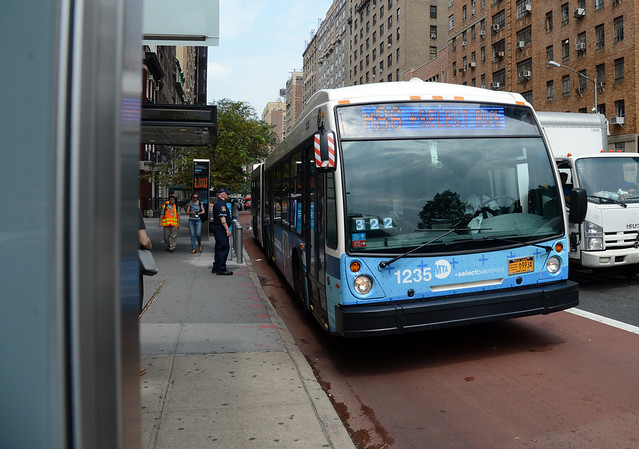
As a contrast to this doom-and-gloom back-and-forth over the steady decline in bus ridership, city and MTA officials launched the latest Manhattan Select Bus Service route along the 34th St. corridor, and NYC DOT issued a progress report praising the M15 SBS. Regular old local bus service may be on the wane, but New Yorkers are flocking to the Select Bus Service routes, and the differences in service could provide an easy path to a better bus network throughout the city.
The story along 34th Street is a familiar one to us. After a rancorous debate amongst residents who did not want an ambitious Transitway in front of their lobbies, the city settled for a typical SBS route instead. Buses along the corridor will feature pre-board fare payment (with proof of receipt), dedicated and off-set bus lanes and camera enforcement of those lanes. Despite the reduction in plans with the death of the transitway, city officials are trumpeting SBS success stories anyway.
“Select Bus Service is proving to be a success wherever we install it,” said Mayor Bloomberg. “Travel times go down, ridership increases and safety improves with Select Bus Service. We expect to see the same positive results here on 34th Street and we will continue to look for more opportunities to expand this great service. We all know that when mass transit works well, more people use the service, which helps to free up our streets – a boost for our economy and our environment.”
At the 34th St. unveiling, DOT and the MTA also revealed a progress report on the SBS M15. So far, the new bus service is a success. Ridership along the SBS corridor from around 25,000 limited bus riders per day in 2010 to 35,000 SBS riders per day in 2011. Although some of that increase has come from riders shifting from the M15 local to the SBS routes, overall M15 bus ridership is still up by around 11 percent per day as overall bus ridership drops by 5-8 percent.

Meanwhile, travel times are dropping as well. An end-to-end run on the M15 Limited would take nearly 81 minutes. Forty of those were spent traveling while 19 were spent stopped at the bus stop, 18 at red lights and three minutes spent at other delays. The M15 Select Bus Service takes 68 minutes end-to-end. Of those, 35 are spent in motion and just 12 are spent at bus stops while the delays due to red lights remain the same. That drop — from 19 minutes to 12 at bus stops — is the key. By removing the line at the point of payment, the MTA doesn’t even need flashing buses to improve service.
So then can we see the key to better bus service in the stories of the SBS? By improving frequency along 1st and 2nd Avenues and speeding up the on-boarding process, the MTA has made bus service attractive, and it was rewarded with increased ridership. Elsewhere, buses run less frequently and involve long waits to board. Thus, ridership is down, and the MTA seems to know it. “If we are able to further reduce travel time through faster boarding and improved fare collection, we can expect an additional increase in ridership of five to ten percent,” Darryl Irick, the Senior Vice President at the Department of Buses, said.
If the authority is intent on improving bus convenience and combatting declining ridership, the answers are in Select Bus Service. Pre-board fare payment and regular and predictable service would go a long way toward improving the bus network. The buses simply must be treated as something more than second-class transportation. Otherwise, ridership will decline on every route but the glorified Select Bus Service.
On the allure of Manhattan-centric transit growth
Posted by: | Comments
The Triboro RX line would improve transit access in Brooklyn, Queens and the Bronx but skips over powerful Manhattan.
Historically, the New York City Subway system has always focused on delivering people into the heart of Manhattan. It grew out of the need to bring people from the north, south and east to Wall St. and spread it tentacles through midtown, upper Manhattan and the Outer Boroughs always shuttling people to what we now know as the Manhattan Central Business District. The alluring draw of Manhattan still dictates the city’s expansionist transit policies, but should it?
The MTA likes to tout its megaprojects, and since the start of the century, they have embarked on a rather ambitious expansion plan to grow the transit network. The Second Ave. Subway will alleviate congestion on the Lexington Ave. IRT while better providing transit access from the Upper East Side to Midtown and Lower Manhattan. The 7 line extension will open up a new frontier of development along Manhattan’s Far West Side while East Side Access will bring LIRR to Manhattan’s East Side. The Fulton St. Transit Center and the new South Ferry station are all a part of the comprehensive effort to develop Lower Manhattan.
Take a deep breath because that’s a lot of Manhattan. At a time when areas in the Bronx, Brooklyn and Queens are undergoing rapid transformation as residential neighborhoods, job centers and desirable places for growth, the New York City subway system remains singularly focused on bringing people into Manhattan, its own job since the early 1900s. On the one hand, it should be concerned with Manhattan because most commuters want to get to and from Manhattan every day, and since Manhattan is an island, it has only so many entry points.
On the other, the Manhattan-centric nature of the subway system makes interborough and some intra-borough travel quite complicated or convoluted. It’s nigh impossible to travel from Bay Ridge to JFK Airport on the subway without a considerable investment in time, and many of the job centers focused around health care remain frustratingly out of the way for straphangers. Yet, the only non-Manhattan projects involve some Select Bus Service corridors that take forever to go from planning to reality.
Meanwhile, city officials starting at the top are making noises about another Manhattan-centric subway project. Mayor Bloomberg, as we know, wants to build an extension of the 7 train to Secaucus. Doing so would funnel more workers from Hudson County, New Jersey, into Midtown via the Hudson Yards development. It’s a developer’s dream and one that would improve both mobility and desirability west of the Hudson.
That said, I don’t blame Staten Island politicians who feel slighted over the rumored plans. The city would rather build the subway to New Jersey than ponder Outer Borough expansion plans. After all, those expansion plans wouldn’t have the same impact as a subway that funnels commuters straight into midtown would. Still, as Bloomberg draws responses to his proposal for a new high tech campus somewhere in the city, the push to add jobs outside of Manhattan will inevitably lead to demand for better transit options.
The short wishlist of Outer Borough transit projects is centered around the Triboro RX line. Last mentioned by the MTA in 2008 as part of Lee Sander’s 40-year plan, the Triboro RX line would use preexising rights-of-way and tracks to connect Brooklyn, Queens and the Bronx while staying clear of Manhattan. It would pass through job hubs and offer connections to at least 17 other subway lines. It could be amended to cross the Narrows to Staten Island and would extend somewhere into the Bronx.
Beyond that, the city could use better transit access to LaGuardia, a Nostrand and/or Utica Ave. subway extension and service past Flushing/Main St. on the 7 line. None of these projects offer the sexy political allure of Manhattan, but they would do wonders for mobility in and around the region. The dollars and the will though just aren’t there, and we’ll watch as Manhattan remains, for better or worse, the center of attention.
Addendum: As the good Cap’n just reminded me, he offered up his take on Manhattan recently. Check out this piece for a different view on why Manhattan has all the fun.
Link of the Day: The decline of Manhattan’s gas stations
Posted by: | CommentsHere’s a fascinating infrastructure story from Crain’s New York’s Brian Chappatta: Manhattan is running out of gas stations. Chappatta profiles the dying breed of fill stations on the isle of New York county. Once upon a time back in 2009, there were 58 gas stations in Manhattan, and now there are just 41. Only four gas stations remain that are both south of 96th Street and east of 10th Avenue.
As Crain’s notes, two factors have driven gas stations out of business: midtown real estate value and the high costs of delivering fuel to the island. “It’s just a sign of the times,” Faith Hope Consolo, chairman of retail leasing at Prudential Douglas Elliman, said. “Selling off gas stations accelerated at the height of the market before the downturn, and now it’s picking up again. As money gets freed up and development moves forward, once again we’ll see some of those sites being bid on.”
Eventually, more gas stations will close as the land they sit on grows more valuable, and gas prices will increase in Manhattan. As long as cars (and non-hybrid taxis) remain a prominent part of the city’s transportation network, consumers will have to pay more as gas prices increase. The decline of gas stations should, however, create an opening for New York to become a potential leader in the electric vehicle field. After all, plug-in stations are far more flexible and take up far less real estate than a traditional filling station.
At 69th Street, a new entrance and NIMBYs
Posted by: | Comments
According to Upper East Side residents, only criminals and marauders would use the proposed subway entrance at 69th Street and Lexington Ave.
There ain’t no NIMBY like an Upper East Side NIMBY, and an Upper East Side NIMBY don’t stop.
Let’s take a trip to 68th St. on the 6 train. There, we will find one very crowded subway station and one very loud and particularly arrogant group of NIMBYs ready to face down the MTA. It’s not a very pleasant stop during most of the hours of the day. Last year. It was the 30th busiest station last year as over 10 million people entered the station, and with hospitals, Hunter College, Central Park and a densely populated residential neighborhood surrounding the station, it is a very popular destination for exits too (although those numbers are not available). For years, people who use that station have cried out for better exits and a handicapped-accessible station, and the MTA is ready to oblige.
Last week, at a Community Board 8 meeting, the MTA along with a joint venture between Urbahn and Dewberry presented plans to make the 68th St. station ADA-accessible. These plans include, of course, the installation of elevators at 68th St. and a slew of other changes that will make the station a more pleasant one to enter and exit. The authority plans to widen the staircases leading up to the street at 68th St. and will add entrances to the back of the platform at 69th St. as well. At a station famous for its exit time — some riders say it can take around five minutes during peak hours to leave — these changes would make it better for everyone.

Plans for 68th Street include wider stairways, elevators and some back entrances on 69th Street.
But wait! As this is the Upper East Side, home of the people who want better subway access as long as it’s not going to disrupt their precious isolated existence, a group of folks on 69th St. say a subway station entrance will ruin their block. They don’t, as some residents at the meeting said, want increased foot traffic on a street on the Upper East Side in the middle of Manhattan. “It would ruin the fabric of the neighborhood,” Nancy Friedman, who lives on East 69th St. (with a roaring fireplace), told a reporter after the meeting. “It’s the most beautiful block in the city.”
DNA Info’s Amy Zimmer had a bit more from the meeting:
Particularly on the west side of the street, the entrance wasn’t needed, [Friedman] said, because “people to the west don’t take the subway. Not to be elitist, but they don’t.”
The MTA’s plans spurred one man from the ritzy block to accuse the transit agency of using the ADA requirements as a “charade.” Board members bristled at the accusation, with the committee’s co-chair calling the comment “offensive to disabled people.”
In support of the MTA’s plans, CB 8 member A. Scott Falk…told the residents at the meeting, “New York City is not a gated community. The whole idea of putting an entrance on 69th Street is going to open you up to marauding down the street seems a bit reactionary.”
But CB 8 member Teri Slater took umbrage at those remarks. “This is not an elitist argument,” said Slater, who believes that there is simply more crime concentrated around subway entrances. She didn’t think there was a “mandate” for the new entrances on East 69th Street and thought the MTA should redesign the plaza on East 68th Street in front of Hunter College to increase the size of the entrance instead. “There’s a fundamental disconnect between the MTA and the neighborhoods of the Upper East Side,” she said.
So here we have Upper East Side residents from East 69th Street between Lexington Ave. and Park Ave. bemoaning one subway entrance at the rear of the train because “people to the west don’t take the subway.” They think ADA accessibility is a “charade” and insist that “this is not an elitist argument.” And these people apparently
Now Teri Slater, for one, isn’t new to this fight. She’s been in the news for decades fighting ostensibly for Upper East Side preservation. Elizabeth Ashby, a preservationist who founded the group with Teri Slater, gave the first toast. “We’re here to protect the Upper East Side from bad ideas,” she said to The Times in 2004. “We want you to be part of our army.” Bad ideas, apparently, include anything which may draw attention to her block whether it be good or bad.
Now, the Upper East Siders claim that because their buildings are landmarked, so too must their street corner. It’s hard for me to find any compelling grounds though for giving heed to their argument (which one observer termed 28 Days Later rage rather than good old NIMBYism). They don’t want a subway entrance on their corner because they think only criminals are subway riders, and they don’t want to introduce unsavory elements to the Upper East Side. That is an insult to everyone else. It’s a slap in the face to subway riders and the handicapped. It is, truth be told, an elitist argument, and it’s why urban planning policy is stuck in a rut in New York City.
Dyckman St. accessibility suit settled
Posted by: | Comments
A rendering of the refurbished Dyckman Street station where an elevator will one day service the southbound platform.
When the MTA announced a comprehensive rehab at Dyckman St. — not one of the stations on their original list of 100 for ADA compliance — the United Spinal Association filed suit to halt the project until it was deemed ADA-compliant. Today, the U.S.A. announced a settlement in the suit, and as such, the MTA will install an elevator servicing the southbound platform at Dyckman Street.
“Installing elevators during scheduled station renovations goes far to promote transportation access for people who use wheelchairs. This is a significant resolution that will enhance subway access for all users of the station with mobility challenges,” James Weisman, SVP & General Counsel of United Spinal Association, said. “More mass transit access decreases the demand for Access-A-Ride, MTA’s expensive alternative.”
The elevator is still a few years away though. The current Dyckman St. rehab, at a cost of $24 million, is set to wrap in phases. The uptown platform will reopen this August, and the downtown platform will close for 10 months. It is likely that the MTA will put the elevator out to bid in 2012 with an expected opening date in 2014.
Still, advocates are thrilled with the resolution. “We want to commend the MTA for working with us to improve accessibility for our clients who use wheelchairs, particularly as transportation options for the disabled in New York City are scarce,” Julia Pinover, an attorney with the Disability Rights Advocates and a former classmate of mine, said. “The settlement will truly benefit everyone in the community. In addition to accessibility for people using wheelchairs, an elevator will also provide vital transport access for people who have age or injury related mobility impairments, people carrying unwieldy bags, and caregivers with strollers.”
The MTA, in a statement, expressed its commitment to improve accessibility as well, how ever slow that progress may be. “We are pleased that we will be able to improve accessibility for our customers at Dyckman Street,” Transit said. “MTA New York City Transit has always included ADA elements in station rehabs and remains committed to enhancing the accessibility of our stations to the extent that funding allows. To that end, we will continue to review the feasibility and need for elevators in connection with future station rehabilitations.”
On 181st St. and being afraid of bus lanes
Posted by: | CommentsFor three years, the New York City Department of Transportation has been working with the Washington Heights community to address 181st St. Spanning from one bridge to another, the upper Manhattan thoroughfare plays host to two subway stations, five bus routes and a Hudson River Greenway entrance. A few blocks north of the cross-Bronx, this street would be ripe for a transit- and pedestrian-focused overhaul, and yet it’s not getting one.
When DOT unveiled its designs for the street less week, it presented what Streetsblog called a plan “far less ambitious than what could have been.” What was a road once under consideration for a fully protected bus lane has turned into yet another compromise in which a loud but vocal minority with trumped up concerns over access have triumphed over the safety and mobility of pedestrians and transit riders.
Noah Kazis has more:
For bus riders, the curbside parking on the south side of 181st Street would be replaced with a dedicated eastbound bus lane from 3:00 p.m. to 7:00 p.m., improving reliability by clearing the way for Bronx-bound buses at the very beginning of their routes. On the block between Audobon and Amsterdam Avenues, which a DOT spokesperson said was where buses suffered the biggest delays from congestion, the bus lane would be in effect from 7:00 a.m. to 7:00 p.m.
The entire project is part of DOT’s Congested Corridors program, and the plan includes left-turn bays to help traffic move more smoothly. Curb parking will be replaced with loading zones during designated times, intended to minimize the rampant double parking along 181st. By keeping the through lanes clear, said the DOT spokesperson, these features will also keep buses moving smoothly…
That’s a fair number of changes to a stretch barely over half a mile long, but it’s much less than what was on the table in October. One option, for example, would have built New York City’s first physically separated bus lanes on 181st. With one in each direction and a raised bus stop mid-street, that plan would have provided one fewer traffic lane and one fewer parking lane than the current plan, but done much more for transit riders.
Another option was an approach that would have made 181st a real multi-modal street. With large sidewalk extensions on the whole corridor, a buffered bike lane and a bus lane, this discarded option would have redistributed space from drivers to every other user of the street.

A glimpse at what should have been.
So why did DOT compromise at the expense of the many? According to Kazis, Denny Farrell, an Assembly representative known for his personal collection of convertibles and corresponding windshield perspective, but the heat on the Department of Transportation. He claims some locals expressed concerns over a one-way street while others wondered how buses would turn into a protected lane — a concern that doesn’t exist in the myriad locations around the world with dedicated and physically separated bus lanes.
To make an omelet, one must break eggs, but unfortunately, NYC DOT has pulled back from that approach. Instead of angering small but powerful people who don’t represent the demographics and needs of the community, DOT has decided to build slowly on the status quo. There’s no harm in incremental improvements, but at some point, those incremental improvements need to take the next step. The 34th Street plan, more ambitious than this one, fell to NIMBYs, and the 181st St. plan has seemingly fallen to those who live to drive around Upper Manhattan in their cars.
For New York City to become a more mobile area, buses will need to become a priority. Someone will be inconvenienced; someone else won’t like the buses. But more commuters and more New Yorkers will benefit from faster surface transit and travel. After all, cities are about people, not their cars, and while cars do have a place in an urban environment, road space should be prioritized appropriately. Right now, the people are losing the fight.