Archive for Subway Advertising

Via Twitter user @alvlee

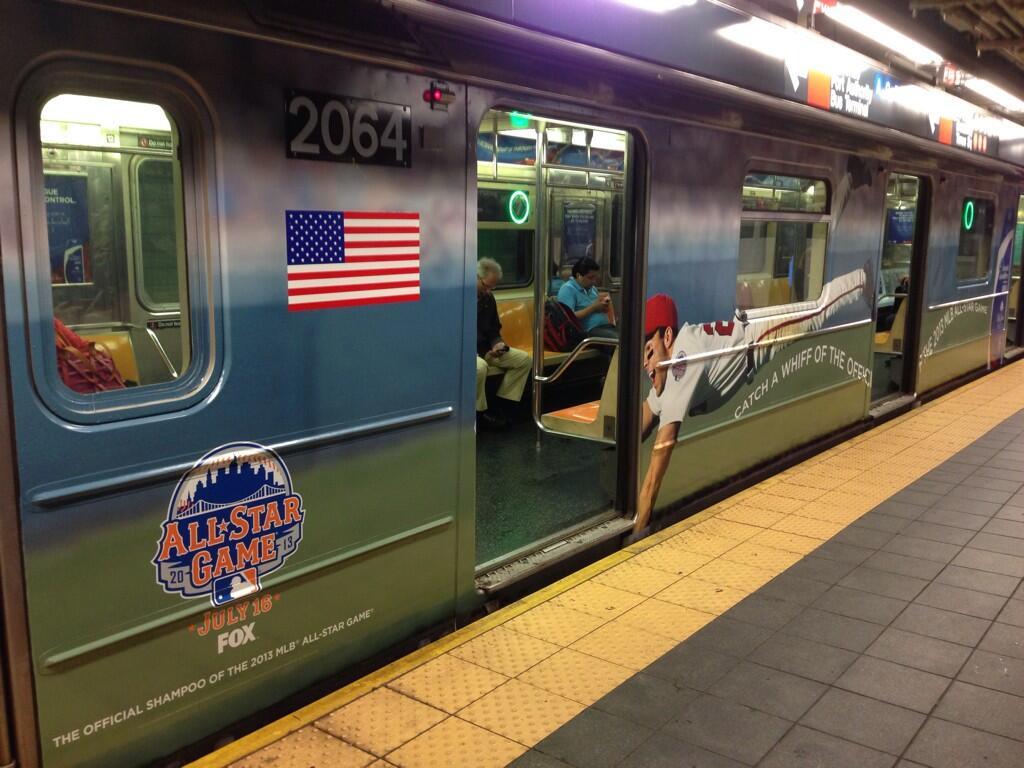
With Major League Baseball’s All Star Game returning to New York City this year, advertising focusing around it is starting to ramp up. This week, a fully-wrapped 7 train — the first of its kind on the IRT Flushing Line — made its debut. The current sponsor is Head & Shoulders, and the advertisements decorate both the inside and outside of the cars.

For many New Yorkers — those who haven’t seen the Shuttle become an advertising testing ground — the 7 train is a novelty. The MTA had secured a sponsor for a wrapped 6 train a few years ago, but this marks the first full-car opportunity for the 7. The MTA wouldn’t tell me how much money this car generates, but there will be another one sponsored by T-Mobile making an appearance beginning in July.

Over the years, the MTA has ramped up its advertising efforts, boosting revenues in excess of $120 million, but it still seems like an untapped market. Video boards have started showing ads above station entrances, but in-system advertising has remained static. The video screens on some of the new rolling stock are supposed to be able to show ads, but the only clips in rotation have been MTA PSAs. Metrocards now carry ads as well, but those rates are relatively modest.

After the jump, a look at the inside of Head & Shoulders’ MLB 7 train, and for more on Head & Shoulders’ ad strategy with regards to the subway wraps, check out this AdAge piece from March. Read More→

Categories : Subway Advertising
Comments (6)

When the MTA lost its court ruling over Pamela Geller’s anti-Jihad advertising on First Amendment grounds, Judge Paul Engelmayer told the authority to amend its advertising policy or else. The MTA Board didn’t have a chance to address the issue until yesterday, a few days after the ads debuted and were defaced. With one person in jail over the ads, the MTA announced yesterday a revised advertising policy.

Faced with the need to eliminate the “no demeaning ads” standard due to its lack of constitutionality, the MTA has instead opted for a more inclusive policy, albeit on with a disclaimer. With board members speaking out against limiting both the revenue from advertising and the use of public space to express unpopular, but constitutionally protected, viewpoints, the MTA will allow viewpoint advertising. The agency will require a conspicuous disclaimer that says, “This is a paid advertisement sponsored by [Sponsor]. The display of this advertisement does not imply MTA’s endorsement of any views expressed.”

While the MTA could still appeal the district court’s ruling, it does not plan to do so. Such a case would likely not be a winning one, and litigation costs would be steep. The MTA further clarified its new position:

To be clear, the MTA does not believe the First Amendment compels the MTA to open up its ad spaces in this way to a wide range of expressive communications. MTA could, for example, adopt a narrower commercially oriented ad policy, one that limited the range of ads it will display to those selling a product or service, and by doing so, avoid having to run demeaning or divisive ads such as the AFDI ad that resulted in litigation. But the MTA for decades has permitted its ad spaces to serve a broader communicative function than mere commercial advertising, and the Board, today reaffirms that tradition of tolerating a wide spectrum of types of ads, including ads that express views on a wide range of public matters.

With that choice also come First Amendment limitations that constrain the MTA’s ability to disallow particular ads because their messages are uncivil or divisive. We had thought this did not mean having to run divisive ads that demeaned others, but the recent litigation tells us otherwise. A cost of opening our ad space to a variety of viewpoints on matters of public concern is that we cannot readily close that space to certain advertisements on account of their expression of divisive or even venomous messages.

We deplore such hate messages and remain hopeful that the vast majority of advertisers in our buses,subways, trains and stationswill remain responsible and respectful of their audiences. And when, as there inevitably will be, a very few sponsors of ads stray from civility, we have every confidence that our customers will understand that in our enlightened civil democracy, the answer to distasteful and uncivil speech is more, and more civilized, speech.

In response to the new policy — which still limits a wide array of false or misleading ads and offensive and mature content — the Straphangers Campaign sent out a list of questions: ” How will MTA determine if the ad contains “religious, religious, or moral” expression?, they asked. “What is the definition of a “conspicuous” legend? How much of the ad space would be devoted to the legend? What should be done in the case where there are many sponsors?” In 2000, the Straphangers were involved in another legal fight over MTA advertising when the authority refused to run an ad comparing subway crowding to cattle cars.

Gene Russianoff’s questions do seem reasonable, but so too does the MTA’s new policy. This should, for now, allow everyone to move forward with a policy that protects free speech, whether the reader agrees with it or not, and protects against future litigation as well.

Categories : Subway Advertising
Comments (5)

After a year of legal wrangling over First Amendment concerns, Pamela Geller’s anti-Jihad ads went live yesterday. Transportation Nation tracked down enough people to draw out a mixed reaction to the ads which have popped up in ten stations throughout the city. “It’s hard for me to look at this poster and actually take it seriously,” one Muslim woman said.

True to New York spirit though, the ads lasted barely a day before someone took to editing them. As Mondoweiss reports in pictures, someone or someones have taken to placing stickers over the ads with their own message. So far, ads in at least seven stations — 57th Street and 5th Ave, 28th Street, 23rd Street, two on 42nd street, 34th street and Grand Central — have been defaced. Take that for what you will. In the meantime, the MTA has yet to announce a new policy for evaluating advertisements that better adhere to the spirit and letter of the Constitution as they cash Geller’s checks nonetheless.

Comments (16)

Pamela Geller’s controversial anti-Islam ads will begin appearing in 10 subway stations throughout the city, the MTA announced yesterday. These ads have been the subject of much litigation over the past few years as Geller’s American Freedom Defense Initiative group successfully sued the MTA over its advertising practices. After Geller won her case on First Amendment grounds, the same judge chided the authority over its slow response to the ruling, and thus, in advance of next week’s board meeting, the authority’s hand has been forced.

As The Times reported yesterday, the MTA is essentially being forced by a judge’s order to accept and publish the ads. The MTA had asked for a stay pending the September 27 board meeting, but the judge told the MTA it had two weeks to revise its policy or appeal. Instead, the MTA will run the ads as the references to Muslims as “savages” do not constitute “demeaning” language under the current guidelines.

The MTA said that, in spite of the geopolitical events in the Middle East, it must accept the ad, but it could have appealed or revised its policies. The judge’s initial ruling gave the authority enough of an out to reject the ad had it worked to restructure its advertising guidelines, but the Board hasn’t met since the ruling came out. So the ad will arrive, amidst controversial and fanfare. Hopefully, a new ad policy isn’t too far behind.

Comments (51)

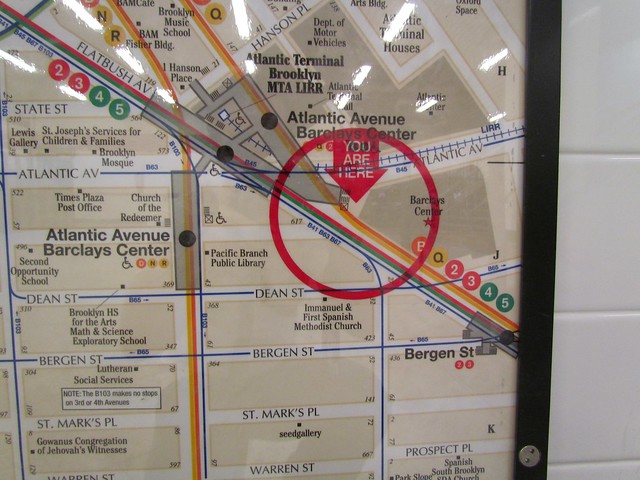
You Are Here…inside a giant advertisement for a sports arena. (Photo by Benjamin Kabak)

As I took a walk through the new subway entrance at Atlantic Avenue on Monday, the fact that I was essentially strolling through a giant advertisement was not lost on me. Barclays is paying the MTA $4 million in 20 installments over the next two decades to keep its name on the Atlantic Ave. station complex and the subway map. Even as it serves as an identifier of what will become a major destination for Brooklyn-bound subway riders, it’s still advertising.

Over the years — actually the decades and even the century — New Yorkers have grown accustomed to advertising in the subways. Billboards have long decorated the station walls, and while old advertisements in vintage trains seem quaint by comparison to today’s staid placards, they’re still ads nonetheless. They’ve been there since nearly Day One, and they’ll continue to be there long into the subway future.

Lately, the MTA has beefed up its advertising offerings. With a lucrative deal in place with CBS Outdoors, the MTA has expanded advertising tremendously. Video boards outside of stations flash dynamic ads while station takeovers — particularly at Times Square and Grand Central — see the walls plastered with posters. A Shuttle train gets its monthly wrapping, and even staircases and turnstiles carry corporate sponsorships. Now, Metrocard fronts and backs are for sale, and for the MTA, this means dollars.

A staircase at Grand Central in 2011 promoted Simply Orange. (Photo by Benjamin Kabak)

Earlier this week, David Dunlap of The Times explored the proliferation of advertising underground. The MTA, he found, has upped its advertising revenue to $120 million from $106 million five years ago and just $38 million 15 years ago. As the subways have been slowly modernized, ridership has spiked and safety has improved in leaps and bounds, advertisers are willing to spend dollars to attract captive underground audiences. Advertising dollars, Dunlap notes, now make up one percent of the MTA’s budget.

Not everyone, though, is happy about it. As Transit hopes to expand its digital advertising footprint while keeping ads somewhat reasonable — buses, for instance, are not fully wrapped due to safety concerns — critics voiced their concerns. “We’ve gotten to the point now where the M.T.A. doesn’t respect its own environment and is filling it with sight pollution,” Siva Vaidhyanathan, a UVA professor who once taught in New York, said “A bright yellow subway car, branded to sell something, is not comfortable, it’s not respectful and it’s not dignified. Environmentally, the city should be paying attention to dignity as a quality-of-life indicator.”

That is, of course, a complaint put forward since the dawn of the age of subways. As the first operators of the subway argued, advertising was an integral part of their plan. As long as billboards didn’t obscure station names, August Belmont wanted ads, to the chagrin of the City’s Rapid Transit Commission and William Barclay Parsons. Belmont successfully defended a lawsuit against the ads brought forth by the Manhattan Borough President, and Squire Vickers uttered a classic line: “It is hoped that the revenue will prove to be an efficient balm for hurt minds.”

That is, once again, where we are. The ads are indeed everywhere, and we accept it. Some become conversation pieces of parts of New York City lore — Dr. Zizmor, anymore? All in all, they have endured as a balm for hurt minds. We pay in ads or we pay in dollars. The choice is an easy one.

Categories : Subway Advertising
Comments (35)

For nearly 12 years, an AIDS awareness campaign comic story was a familiar sight in subway cars.

Old advertisements have the power to transport us back in time. An old jingle remembered only on YouTube or a glimpse at a magazine spread from decades past often scream out an era in history. Subway ads are no different. While Dr. Zizmor still survives as youthful as ever, subway car advertising has changed a lot over the past few decades. We no longer see cigarette billboards or anti-graffiti placards. Today, we see floor-to-ceiling ads for NBC’s fall lineup as we walk through Times Square, fully wrapped trains promoting London tourism or Swiss watches, or entire cars replete with of Budweiser placards.

Some ads though stick with you even as the years tick by. One that definitely lives on in the collective memories of New York’s straphangers was a serious campaign, aimed at a public health crisis that defined the era. It was a Department of Health PSA starring two Hispanic 20-somethings named Julio and Marisol. For many, just the names will bring back memories of The Decision or La Decision, as they started out first in Spanish. In 1990, these ads made their debut as the AIDS epidemic had reached a crisis. The first black-and-white strip involved a spat between Marisol and Julio when Julio balked a using a condom. From there, they took a darker turn as friends died and conversations grew more candid. This was heavy stuff for a subway ad campaign.

Over the years, Julio and Marisol garnered a fair amount of press in the city’s papers, and a Times article from 1993 offered up some background on the campaign. A $60,000 grant from the Federal Centers for Disease Control and Prevention spurred on the PSAs in 1989, and the NYC Department of Health tabbed Connill Advertising to set the story. Targeted at first to higher-risk communities, the story seemed to resonate with the public at large.

After six years, though, a new MTA ad policy torpedoed the soap opera. It was then, 17 years ago, that the MTA announced a new policy that would see the vast majority of subway car ads limited to one major advertiser per side. The MTA figured to earn an extra $3 million per year, but the DOH wouldn’t be a part of it. They didn’t want their campaign lumped in with the Dr. Zizmor’s and toe carbuncle removal ads underground and couldn’t afford the higher rates.

The agency standoff lasted two years, and in 1997, Julio and Marisol made their triumphant return. “Many New Yorkers have told us that they appreciate the Decision series not only for the practical information about HIV/AIDS which it provides, but also for the deep emotional feelings, questions, and concerns expressed by the characters in the story,” then-Health Commissioner Benjamin Mojica said. “The situations in the story are the kinds which people may see themselves in, situations which people can relate to. The great value of the Decision campaign is that, because it is fun and because people can relate to it, they will read it and internalize the more detailed messages we target each issue to — especially the importance of safe sex and the alarming dangers of drug abuse.”

The second iteration of The Decision, not nearly as widespread as the first, lasted until the early 2000s when one of the characters died and another found out a previous lover was HIV positive. As a Daily News piece from 2002 notes, by then, AIDS deaths in the city had dropped from 7000 annually to 2000. In 2010, that figure stood at under 1700, and Julio and Marisol live in on the Smithsonian but not the subways, remnants of another era in New York City history.

Categories : Subway Advertising
Comments (5)

An MTA ban on demeaning advertising has been overturned by a federal judge.

On and off over the past two years, the MTA and Pamela Geller, head of a prominent anti-Islam organization, have squared off over bus ads. Geller wanted to run a series of placards on the outsides of buses that the MTA claimed violated its advertising policies, and although the MTA seeming faced a tall legal order, the agency turned down the ads anyway. Late last week, a federal judge ruled that effort unconstituional and enjoined the MTA from enforcing its advertising policy.

In a way, the outcome of this case preordained. Geller opted to try to buy bus placards because the Second Circuit had previously declared them to be designated public forums and thus subject to strict scrutiny and sweeping free speech protections. In a 35-page opinion [pdf], that’s exactly what District Judge Paul Engelmayer decided on Friday.

“MTA does not offer any justification for selectively allowing demeaning speech to appear on the exterior of its buses, let alone demonstrate that its content-based restriction on transit advertising is narrowly tailored to serve a compelling governmental interest, as is necessary to survive strict scrutiny,” he wrote. “Whatever weight might be assigned to the governmental interest in banning demeaning speech on the exterior of New York City buses on an even-handed basis, there is no good reason for protecting some individuals and groups, but not others, from such abuse. MTA’s nodemeaning standard, as currently formulated, is, therefore, inconsistent with the First Amendment.”

The MTA’s problem is one many government and quasi-government agencies face. How do you craft a policy that does not run afoul of the First Amendment when your advertising space spans various public spaces and audiences? The MTA, whose own internal guidelines prohibit ads that demean an individual’s or group’s “race, color, religion, national origin, ancestry, gender, age, disability or sexual orientation,” has not achieved this goal. “It is unavoidably clear that MTA’s nodemeaning standard differentiates based on the content of the proposed ad,” Engelmayer wrote. “Outside of these ‘specified disfavored topics,’ MTA’s standard permits all other demeaning ads.” Such a content-based determination violates the First Amendment.

So what happens next? Does Pam Geller run her ads calling all Muslims uncivilized savages on buses across the city? Not quite. Engelmayer stayed his decision for 30 days, and the MTA is currently assessing its advertising policy and whether or not it wishes to pursue an appeal. Meanwhile, the judge seemed to leave the MTA with something of an opening:

In holding today that MTA’s no-demeaning standard violates the First Amendment, the Court does not impugn in the slightest the motives of MTA and its officials—either those who put the standard into place or those who applied it to the AFDI Ad. Quite the contrary: From the testimony and evidence, it is apparent that, in promulgating and applying the no-demeaning standard, MTA has aspired to hold ads on public buses to a standard of civility. Its goal of preventing ads on city bus exteriors from being used as a medium for abuse and division in this diverse metropolis is entirely laudable. It appears likely that MTA drafted the standard in question with an eye toward the groups it felt most likely to be targeted by demeaning ads, without adequately considering the First Amendment implications under R.A.V. of such a selective prohibition…

Today’s ruling does not disable city authorities from adopting rules that hold ads and commentary on the exteriors of buses to a standard of civility. And in resolving this case on the narrow ground that the no-demeaning standard as currently drafted is impermissibly content-based, the Court pointedly does not reach any of the broader grounds for invalidation urged by AFDI under the First Amendment. Today’s ruling instead leaves—and is intended to leave—MTA the latitude to investigate and experiment with alternative mechanisms for using ad space on the exteriors of city buses productively, profitably, and constitutionally, while ensuring that this space is not used as a tool for disparagement and division.

And so that’s where we leave things. The MTA has been temporarily enjoined for enforcing its policy, and the case moves forward as the authority searches fo a constitutionally permissible standard and procedure.

Categories : Subway Advertising
Comments (20)

Ads could soon begin appearing on the front of your MetroCard.

Everyday, millions of New Yorkers run a flimsy piece of plastic through a prickly card reader as they head to and from work, school and play. Since the middle of 1997 when the gold card made its debut, these MetroCard have looked the same — a logo on front and an ad or PSA on the back. My current card urges me, tirelessly so, to say something if I see something.

Now, though, the MTA, in an effort to milk some more dollars out of the MetroCards, is willing to change the front. For the right price, the authority will accept advertising for the MetroCard fronts. “Millions of New Yorkers carry MetroCards with them everywhere they go, and use them multiple times a day,” MTA Chairman Joseph J. Lhota said in announcing the move today. “For those with a message and a desire to reach millions of people in a novel, attention-getting way, there is no better way to advertise.”

The MTA is billing this as a relaunching of an advertising program, and as such, they have unveiled new rates. Depending upon the number of cards purchased, the authority will charge between 18 and 51? per card for those who wish to utilize the back of a MetroCard. They expect to realize between $25,500 and $450,000 per ad campaign. While rates for the front were not released, the MTA said such deals would be “offered at a premium.” Ads that include a Transit-sponsored campaign will be 20 percent off.

It’s tough to see this as anything but a positive for an agency searching for cash. I could care less about the sanctity of the MetroCard. It’s hardly iconic, and in a few years, it’s going to be replaced anyway. Plus, most of us already carrying advertisements for whatever company sponsors our credit card bonuses or the banks that issue our debit cards. So we’ll be bombarded with one more ad in the subway, and the gold and blue card may look a bit busier on the front. It’s the price to pay.

Comments (20)

An ad campaign for the upcoming Prometheus movie has taken over a ghost station in the Paris Metro. (Via FirstShowing.net)

I grew up at 91st and Broadway, and for the city’s subway buffs, that intersection holds a special place in our hearts for it is the location of the one of the city’s abandoned subway stops. Once a local stop along the West Side IRT, the TA shuttered this station in 1959 when the southbound extension of 96th St. left 91st St. as an unnecessary relic of another age. While the Transit Museum once offered tours of the station, these days it is a dimly lit gallery for graffiti artists and history buffs who know where to look as the 1 travels between 86th and 96th Streets.

This station at 91st St. is hardly New York’s only abandoned platform still visible to the general public. Along the East Side, Worth St. and 18th St., both of which met a similar fate as 91st St., remain in place, covered by decades of neglect. The City Hall loop is visible for those who ride around the loop on the 6, and the Hoyt-Schermerhorn platforms are on full display for another waiting for an A, C or G train. Joe Brennan’s site has everything you’ve ever wanted to know about these abandoned stations and more.

The MTA has, now and then, debated what to do with these stations. Due to safety and liability concerns, they remain off limits to the general public, and a plan to turn City Hall into a Transit Museum annex were quashed by Mayor Giuliani over security concerns. Instead of anything, they are nothing but barely remembered parts of subway history. They could however find a second life with some creativity.

The ad campaign has taken out space on the Line 9 route maps in Paris.

New York’s isn’t the only subway system with abandoned stations. In Paris, in particular, the twists and turns of their tunnels are laden with ghost stations, and now in the City of Light, they’re putting these stations to use with a twist Madison Ave. would appreciate. Ridley Scott’s Prometheus is set to take the movie world by storm. A quasi-prequel to the Alien series, the film has a mythology all its own, and the viral marketing campaigns have been widespread and effective. As numerous movie sites reported this week, a new campaign has opened in the Saint-Martin station. Closed since just after World War II, this station now features giant heads and lighting straight out of the movie.

Fox has issued a press release promoting the use of this station as a blank slate for its advertising efforts. They discuss using the subterranean station to recreate movie sets. The curvature of the ceiling and the dim lighting are ideal for such a usage, and Paris Metro riders seem to love it. The studio has also paid Metro to slap the movie’s logos on strip maps in the Line 9 subway cars.

So let’s see it, New York. Our abandoned stations, not in the greatest of shape right now, could be great springboards for innovating in-tunnel advertising. Generally, the stations are located close enough to nearby stations that trains don’t go zooming past them. It’s always possible to spy 91st St. at a reasonable speed, for instance, and something creative in that space would certainly draw headlines and eyeballs.

On Thursday, I rode a shuttle fully wrapped in advertising for something in Switzerland. Even though I rode the same train twice in the span of an hour, I couldn’t tell you what I saw. But these Prometheus heads would stick with me. It’s a memorable use of an intriguing spot and a revenue opportunity worth pursuing.

After the jump, a viral video of the viral marketing in the Paris Metro. Read More→

Categories : Subway Advertising
Comments (15)

Big Brother-style video ads line the concourse at Columbus Circle. (Photo courtesy of New York City Transit)

For the past few years, the MTA has engaged in a comprehensive overhaul of the 59th St.-Columbus Circle station. The renovation was originally supposed to wrap in 2009, but like many a TA project, it didn’t finish on time. Instead, work continued until one day, it stopped. There was no grand ribbon-cutting and nothing to announce substantial completion of the project.

Lately, though, the MTA has been putting some of the station on display. Sol Lewitt’s work adorns the station, and straphangers can once again use the middle platform on the IND platform. Still, it seems as though something is missing. Early renderings of the project, for example, called for a retail corridor in the vast hallway before fare control that stretches north from 57th St. underneath Eighth Avenue. As of yet, no one has taken out space.

This week, the authority unveiled a comprehensive, if temporary, use of the hallway: It is a 60-foot digital video ads. A release from the MTA explains:

This week, Asics unveiled a stunning new advertising campaign featuring high-definition digital video at Columbus Circle, which serves the A/B/C/D and No.1 lines. Although the video is 60 feet wide and spans the length of 26 glass panels, it appears seamless—as if it’s being projected across one incredibly wide screen.

The campaign is a win-win for the MTA and Asics. For the MTA, the campaign represents yet another way we’re thinking creatively to find new revenue streams that help fund our transit system. For Asics, the massive, coordinated “screen” vastly expands the possibilities of traditional advertising. For instance, at one point the ad asks, “Think you can keep pace with an elite marathoner? Ryan Hall is approaching in …” Numbers then countdown from ten to one, at which point an image of marathoner Ryan Hall runs across the glass, in real speed.

As the MTA proclaims, customers can even try to outrace Ryan Hall. It is “the first time digital video has been done on glass panels and the first time digital video in our system has been done on this scale,” the authority noted. As Times reporter Michael Grynbaum observed on Twitter, it’s all very “Blade Runner-y.”

Yesterday, I rode a shuttle train decked out top to bottom, inside and out, in advertising for Dell computers. Today, video ads follow us through 59th Street as exit the system. As the MTA struggles to make every dollar count, advertising is truly everywhere. The revenue, as Squire Vickers once said, is a balm for hurt minds.

The video boards stretch throughout the Columbus Circle station. (Photo courtesy of NYC Transit)

Categories : Subway Advertising
Comments (6)