Archive for Subway Maps

A glimpse at the night map shows the changes in service after 11 p.m. (Click to enlarge)

Once upon a time, back in the mid 1990s as Manhattan Bridge work caused numerous subway reroutings, New York City Transit released a two-sided map showing peak service on one side and off-peak on the other. The map survived for a few months before the ever-shifting patterns across the bridge caused the MTA to discard the redesign for something a little less malleable. Still, the need for a night map has persisted.

Even though the subways run for 24 hours a day, not every train runs at every hour, and not every route is the same at 4 a.m. as it is at 4 p.m. Some rains run express during the day but not at night. Some run stunted shuttle routes during late-night hours. Others, such as the poor B train, run only until some indeterminate time between 10-10:30 p.m. Yet, as apps such as the KickMap show the scheduling changes, our subway map depicts robust service at all hours of the day.

I had first gotten wind of this development earlier this fall, and today, the MTA unveiled its first night subway map. Designed with subtle shades of grey and dark blue to connote a later hour, the night map — available here as a pdf — shows how service should be after the peak hours are over. To make it an even more alluring document, the authority has released only 25,000 in its initial press run with a copy of MTA Arts for Transit’s “City of Glass” on the bank. Subsequent printings will feature different artwork as these maps slowly become collector’s items.

Beyond that aspect of the map, though, these are mostly useful diagrams of late-night service. Much like the refillable unlimited ride MetroCards, these night maps should have been available years ago as it helps late-night straphangers adjust to the vast difference in service offered once the evening rush is over, but because of constant overnight track work, even the night map won’t always be entirely accurate. It is customer-friendly, if you can find one.

“The standard subway map depicts morning to evening weekday service,” MTA Chairman Joseph J. Lhota said in a statement. “This companion night map will, for the first time, depict service for a particular portion of the day. This is the latest effort we’ve taken to improve the availability of information and detail we provide to our customers.”

For now, the map is available for free at the Transit Museum (host for my Wednesday event) and at the Transit Museum Annex in Grand Central. It was developed in house, and the MTA is also making 300 unfolded press sheets available for purchase a the Transit Museum Annex for $20 a piece. They were not yet available for sale when I stopped by the Museum Annex shortly before 2 p.m. They will be great, though, for framing.

After the jump, a bulleted list of the difference between the Night Map and the regular subway map. Read More→

Categories : Subway Maps
Comments (46)

Pentagram has designed a Vignelli inspired ampersand. (Click to enlarge)

Via my new favorite tumblr Transit Maps comes this design gem from Amsterdam. Pentagram’s Luke Hayman, working for the Dutch magazine Eigen Huis & Interieur’s New York Design Guide issue, repurposed the Vignelli subway map into EH&I’s ampersand with stations representing key players in the city’s design scene.

Pentagram had more to say about the design:

Pentagram’s Luke Hayman and his team recently redesigned EH&I and established the masthead’s ampersand as an icon of the brand. Each month a different designer is invited to interpret the ampersand for the opening of the “Interieur” section, and for the New York issue, Hayman created an ampersand inspired by Massimo Vignelli’s classic 1972 map of the New York City subway system. In the new version, the lines of the ampersand playfully connect contemporary and historic New York designers, agencies and institutions, from Milton Glaser, George Lois, Ruth Ansel and the Museum of Modern Art to Karlssonwilker, Local Projects, Dror and Pentagram (of course).

You can download a PDF of the map right here. As a subway system design, the ampersand certainly offers some intriguing crosstown subway routes too.

Categories : Subway Maps
Comments (4)

The new New Jersey Transit rail diagram brings a retro look to the Garden State. (Click to enlarge)

Geography or schematic? That is the question. In a new map showing the state’s commuter rail network, New Jersey Transit has gone with the latter. The new diagram, unveiled yesterday, is supposed to be “customer-friendly” with “more open design and new color scheme for easy customer reference,” the agency said.

“The new design is intended to be simple, familiar and inviting, not only for our regular customers, but also for those residents and visitors who have never before traveled on the State’s rail network,” NJ Transit Executive Director James Weinstein said. “We hope that customers will find the new map to be a valuable tool in their travels on our system.”

The map, designed in house, marks a move from the previous version which featured the train system in a purely geographic setting. Through color-coding and a streamlined design, the map now better highglights transfer points and routing. It also features the “completion of Hudson-Bergen Light Rail 8th Street Station, accessibility improvements at Somerville, Ridgewood and Plauderville stations, and the addition of the future Pennsauken Transit Center.”

Still, despite the upgrades, there’s no small bit of state-based protectionism involved. While the PATH system gets its day in the sun and the Port Jervis line branches into New York, New Jersey Transit pays scant attention to SEPTA’s connection from Trenton to Philadelphia and beyond. Transit networks are regional, but this map doesn’t extend far beyond the borders of the Garden State.

While I like the simplicity of the design and the idea behind it, it certainly has its flaws. Over at the Transit Maps tumblr, Cameron Booth is not a fan. Calling the map “sad, tired and amateur,” Booth finds it an unwieldy amalgam of styles: “It seems to have taken elements from many different transit maps and mashes them into one big mess. We have the thick route lines and giant circle transfer stations of Washington, DC Metro, icons for the lines similar to – but nowhere nearly as well executed – the Lisbon Metro, and different station symbols for each and every mode of transit.”

Form vs. function. Design vs. geography. The rail map battle always rages on.

Comments (19)

In fictional universes, subway systems do not have to make much sense. (Photo via Brian Donohue of The Star-Ledger. Click to enlarge.)

Via The Star-Ledger comes this glimpse at an alternate-universe subway map. Posted outside of the Newark Subway stop at Military Park late last week, this map shows how the subways run throughout Bruce Wayne’s Gotham City. Frankly, the whole thing is a bit of a mess with subways criss-crossing each other and the city at odd angles. Routes feature steep curves, some unnecessarily close stops and some zany transfer options. On the bright side, Gotham City planners have certainly managed to provide for some better inter-borough subway connections than we have in New York, and their subway system runs to Batman’s equivalent of Staten Island.

Categories : Subway Maps
Comments (18)

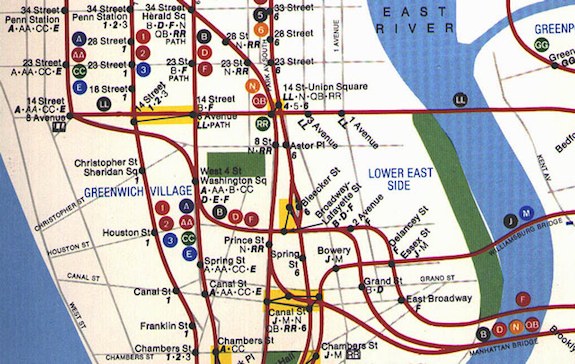
To clean up the background clutter, the newest subway map has eliminated some minor streets, Alphabet City.

Whenever I write about subway maps, my pieces or the comments that follow inevitably turn toward a debate on form vs. function. Should a subway map, I’ve wondered, aid riders navigate the city above or simply provide a more artistic schematic view of the train routes? Both views have their merits, and the best practical maps strike a balance between the two.

When the MTA issued a quiet revision to its map earlier this map, I noted how the MTA has moved toward a simplified map. As the authority said to me, “To continue to build on earlier clutter reduction, we’ve removed some streets and cemeteries that were not directly served by the subway.” It seems that the MTA’s approach is to overlay the subway routes on a rough outline of the city grid.

Earlier this week, Michael Grynbaum at The Times took a closer look at the map’s changes and found some interesting stories that illuminate the origins of the current map. Grynbaum picks Charlton St. in the West Village. I’ve lived in New York for my entire life, and I’d be hard-pressed to tell you where Charlton St. is. For some reason, though, it was, until recently, on the subway map.

Amusingly enough, not enough residents of Charlton St. noticed its presence on the subway map. “I never noticed that,” Richard Blodgett, president of the Charlton Street Block Association, said. “Maybe I’d seen it and not thought much about it. I’ve certainly never heard anybody in the neighborhood discuss that.” But now it’s gone, and Grynbaum recounts the story determining the streets that cracked the map:

Members of the design committee that created the map in the late 1970s recalled conversations with the tourism bureau and a survey of leading maps at the time. But the general approach was summed up by John Tauranac, the committee’s chairman: “A lot of it was seat of the pants.”

“The whole purpose of putting in what could be considered ancillary streets was to give people a hint of where they are in relation to subway stations,” Mr. Tauranac said. “My memory doesn’t serve me well enough to include whether there was discussion over whether to include Charlton, King or Vandam.”

Michael Hertz, who also sat on the committee, concurred. “Sometimes we put stuff down almost arbitrarily, if we thought we had room for it,” he said. As for Charlton, “We could have flipped a coin and put the next street in.” Personal preferences, Mr. Hertz said, had no bearing on the decision: “No one said, ‘I want that street in because my grandmother lives there.’”

As Grynbaum notes, Charlton St. isn’t the only one to draw the short straw in this redesign. As Grynbaum notes, in Manhattan, Greenwich St., Bank St., Madison St. and Avenues A, B and D are all a victim of the map cuts while Warren Ave., Laconia Ave. and Boston Road in the Bronx have met their demise. Brooklyn’s Third Ave. and Columbia St. are but a map memory, and 20th Ave. in Astoria and 59th St. in Queens are off the map.

On the latest version of the subway map, Astoria ends at Ditmas Boulevard.

The end result is something far easier to read. With fewer white lines distracting the viewer, the map draws more attention to the subway routes, and that, after all, is its primary purpose. At the same time, though, it becomes a less useful tool for those who want to use the map to navigate above ground as well. Does Astoria end with the subway map and the N and Q trains at Ditmars Boulevard? Is there even a New York Ave.? Is the next major street east of First Avenue simply the FDR Drive? Alphabet City, you are no more. Even Charlton St., the western part of Prince St. that once hosted exits from the IND’s Spring St. station, will fade from our cartographic memory.

The form vs. function battle is one the MTA has been waging with its subway maps since the days of Vingelli in 1972. Slowly, slowly, the authority is moving toward a representation with the outlines of the boroughs and only a handful of key streets. As the grid fades away, this new map is a-OK for subway navigation. Any use beyond that is sure to get the budding map-reader dazed and confused.

Categories : Subway Maps
Comments (14)

The MTA's Weekender map introduced a new generation of subway riders to the wonders of Massimo Vignelli's iconic subway map.

When the MTA debuted its Weekender map last month, it did so with a flourish. The new offering, a digital interpretation of the weekend’s service changes aimed at bringing visual information to the straphanging masses, brought Massimo Vignelli’s controversial and iconic subway map back into circulation.

Vignelli’s map, currently a part of MoMA’s permanent collection, had a decade-long run as the MTA’s official subway map in the 1970s, but it was a run not without constant controversy. Relying on a multitude of colors and some abstract geographic shapes that vaguely represented the boroughs of New York, the map had numerous detractors who found it hard to use and hard to read. Parks weren’t green; rivers weren’t blue; and due to the lines and angles, some stations weren’t even in the right place.

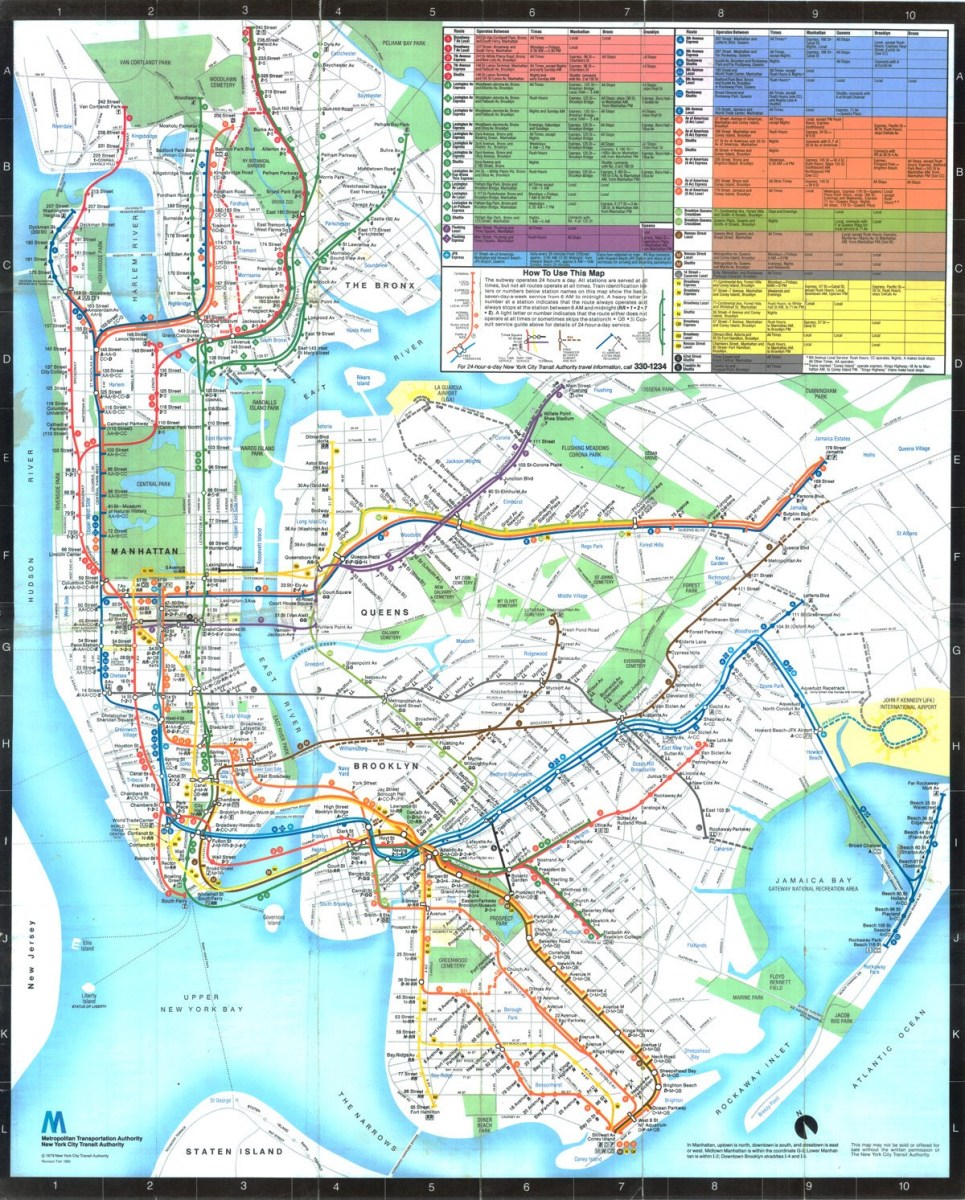
By the mid-1970s, the MTA had a plan in place to phase out the Vignelli map, and in 1979, the map designed by Michael Hertz Associates made its debut. With some modifications, that’s the map we know and begrudgingly love today. Yet, Vignelli’s map has always been a popular one. It’s appeared on sunglasses and dresses, and in 2008, Vignelli issued an update for Men’s Vogue.

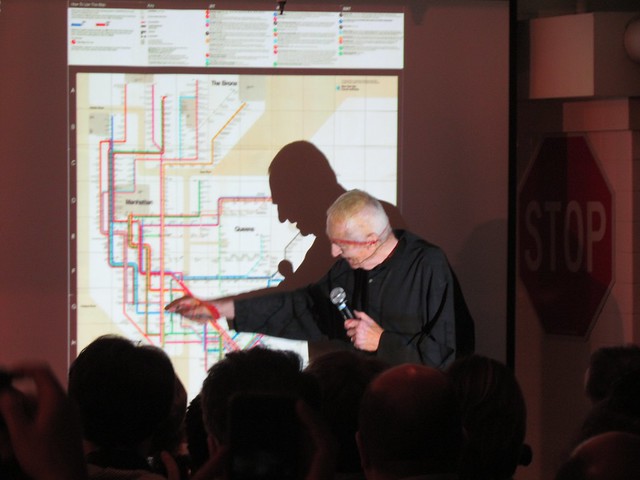
Now, Vignelli’s offering is back in action with the MTA but just don’t call it a map. Rather, the Weekener is a diagram of subway service. Vignelli’s map, with its straight lines that each represent one subway route, is ideal for the digital age. As Vignelli told The Times a few wees ago, his map was “created in B.C. (before computer) for the A.C. (after computer) era.”

So just how did Massimo Vignelli and the MTA work out the new diagram? A post by Steven Heller on The Times’ T Magazine blog delves into the detente. Heller writes:

he new digital iteration is the result of the combined efforts of Vignelli and two of his associates, Beatriz Cifuentes and Yoshiki Waterhouse. One of their first acts was to rename the map. It is now a diagram, which actually makes sense as it is not a literal representation, but a semantic one. They also agreed to add supplementary neighborhood map options — online versions of the proprietary maps already used in M.T.A. stations.

For The Weekender, the team rebuilt the diagram geometry from scratch using a new primary grid for Midtown. This grid is essentially a square bound by 14th and 59th Streets, and Park and Eighth Avenues, with Broadway running diagonally from corner to corner. Intervals between major cross streets like 14th or 42nd were placed equidistantly along the grid, with more minor stops, like 18th and 28th, placed in between. And, Waterhouse adds, “We introduced a hollow dot to represent stops, which were sometimes passed, depending on schedule, known as a ‘sometimes-stop.’”

Waterhouse explains that all critiques of the 1972 map — which had been dutifully retained by the M.T.A. — were addressed. But Vignelli’s biggest bugaboo was showing the parks. He believed that including them — particularly Central Park — was the downfall of the 1972 map, so the new iteration eliminates all parks. Issues of type size and legibility were addressed, and line colors, station names and connections were all updated.

With Vignelli’s map making headlines, design enthusiasts have again expressed their hopes that the MTA would reissue it in paper form. Clearly, the diagram has retained its allure of yesteryear while offering up something nicer to look at than the current map. As a tool for navigation though, it still relies on basic knowledge of New York City geography and the streets above.

As a subway map buff, I own more than a few Vignelli maps of various vintages. I love the design and the decidedly 1970s approach to subway route colors. I also recognize that it wasn’t the most practical design in the world. With the Weekender, the Vignelli diagram serves its purposes, and while the technology behind the MTA’s offering may need some refining, the design is just right.

Categories : Subway Maps
Comments (16)

When the MTA cut service last June, they took the opportunity to refresh the subway map as well. The changes were, by and large, cosmetic. The giant bus callouts were cut down in number and size while the colors were changed to better highlight the the subway lines. Yet, with parks turning light brown and a shadow tracking the route lines, the changes were not met with great acclaim.

Recently, though, the MTA has rolled back some of the changes to the old map. Without much fanfare, the latest iteration of the map returns the parks to their green color. While the route lines still feature that shadow and station names run off at odd angles, the colors are looking a little more vibrant and lifelike.

I got wind of the changes earlier in September and saw the excerpt you see above. I asked the authority if they had a comment on the redesign. This is their statement:

We reprint the map several times a year, and we are continuously trying to make it easier to use. In June 2010 we issued a fairly significant redesign aimed at reducing clutter. Most of the changes we made as part of that redesign were successful and remain in place for the September edition of the map. One exception to that is the background land color.

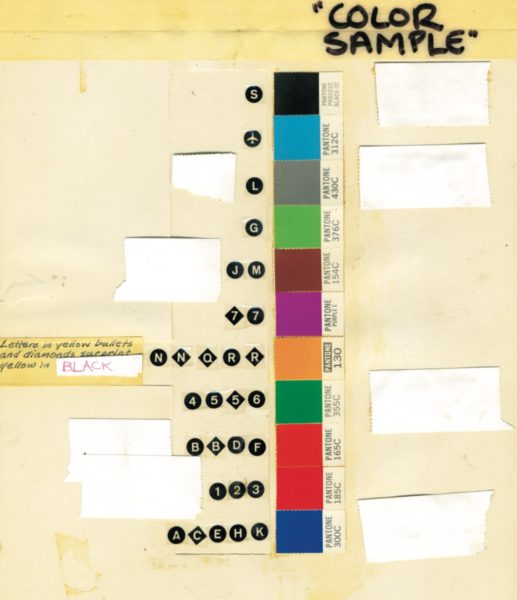
In response to feedback we received after the 2010 redesign, we’ve returned the background land color to the more traditional beige. (For those with a detailed interest in graphic design, the underlying land color in the new map is a slightly screened back Pantone 468. The green-shaded land color had been a Pantone 614 with extra black added.) The colors of water and parks have also been adjusted slightly in concert with the new background land color. Also to continue to build on earlier clutter reduction, we’ve removed some streets and cemeteries that were not directly served by the subway.

The September 2011 map is posted online in jpg and pdf formats, and is being distributed to station agents for individual distribution to customers. The maps posted in stations and trains are updated less frequently, and will not receive this version of the map.

Meanwhile, I have also seen a full-fledged PDF with the following in the upper right corner. I can’t share the whole thing, but take a peek here:

All I know about this map is that it is apparently based upon a few old ideas. Back in the mid-1990s when Manhattan Bridge service changes caused radically different peak and off-peak service patterns, the MTA printed a few maps that had featured both service offerings. In April of this year, one blogger offered up his own version of the night map. “It’s the MTA’s,” he said, “if they want it.”

The MTA would not confirm to me that this night map could become a reality. Oftentimes, the authority produces internal documents for testing that do not see the public light of day. Some projects — like the Weekender map – are launched; others are left as good ideas on the cutting room floor. Perhaps this is one of them. Still, it strikes me as a useful representation of the subway system late at night when some trains do not run and others run truncated routes. At least someone’s thinking about.

Categories : Subway Maps
Comments (30)

I’m away from my computer right now so I can’t give the MTA’s new online weekend map a ride, but you can. Check it out right here in all of it’s Vignelli glory. As you poke around with the map, I would love to hear your reactions. Leave a comment with your thoughts, criticisms and potential improvements, and we’ll soon find out just how useful this new offering is.

Comments (28)

Transit's new Weekender offering provides an interactive, online solution to charting weekend service changes.

Over 30 years after being unceremoniously dumped in the face of extreme public outrage, the Massimo Vignelli subway map is making its triumphant return to the MTA this weekend. This map, repurposed to solve a problem that has vexed the authority for years, won’t be hanging in stations or cars, and in fact, it won’t be available in any physical form. Rather, the MTA will use it as a weekend landing page to offer straphangers a visual, interactive glimpse at the complicated array of service changes that often leave riders more confused than they should be.

The idea is a simple one. In fact, it’s a service Subway Weekender has been offering for years. By providing a visual representation of service changes instead of the jumbled syntax of the weekly postings, Transit can better prepare its customers for weekend headaches. The service, termed the Weekender, will launch later today at approximately 3 p.m. and will be the landing page for MTA.info until shortly before Monday’s morning rush. It is, according to Transit, very much a work in progress, and the MTA will look for rider feedback as it improves this much-needed offering.

Michael Grynbaum of The Times got the scoop on this project, and he offered up a wealth of details:

The stylish digital map will be customized each weekend to reflect the myriad service changes that regularly bedevil straphangers on Saturdays and Sundays. Currently, rerouted lines and shut stations are noted only in stiffly written prose that sometimes compound riders’ confusion. The interactive map is searchable by line, borough and station, and it flags trouble spots with blinking lights. Click, and the site will reveal a rundown of what woe awaits, whether a closed platform or an unexpected station stop. …

The Weekender does not redraw the usual map so much as annotate it. The A train, for instance, has an irritating habit of running along part of the F line on weekends. But the map, rather than repositioning the A’s blue trail onto the orange F route, simply flags the bypassed stations and offers a written explanation. (Officials said a more dynamic map would be logistically difficult to execute.)

Still, the online map has appealing features, including a line-by-line view, which highlights, in vibrant colors, the entire length of an individual subway route while fading out the others, like pulling a strand of spaghetti from a knotty pasta. Riders can quickly find out about changes on their own route while ignoring the rest. The site also allows users to toggle between the subway diagram and detailed neighborhood maps, which list local attractions.

“The idea here,” Margarte Coffey, a Transit official said to The Times, “was: ‘How do you show people at a glance what’s really happening?’ You’ve got this comprehensive poster that says all that is happening this weekend, but you still have to stand there with a map to be able to figure it out.”

Recently, the MTA’s growing weekend ridership has dominated headlines, and with it, weekend travel has come under the microscope. The City and State Comptrollers released a largely clueless report on weekend work that did manage to highlight the MTA’s information deficiencies, and this is a start. Plus, it returns Vignelli’s map, with updated colors, to the public eye. That’s bound to be good for some long arguments over design and functionality.

For now, the situation underground isn’t going to improve. Service changes will come and go as work continues, but the MTA is trying to make it easier for us to know how to get around during the weekend. And knowing is half the battle.

Comments (48)

The London Tube map with distance grid lines. Click the image to enlarge.

I’ve always enjoyed discussing the way subway maps are designed. Schematic-based maps give away to geography which lead to the intersection of the two, and it seems as though there is no right answer in the quest to develop the most useful and visually appealing map.

The London Underground’s map enjoys its place amongst the iconography of world subway maps. Harry Beck’s map is one of the most instantly recognizable around, and it’s also one of the maps least tied to the surrounding geography. Stations in the London core are placed to fit on the map and not the corresponding street grid, and tourists who try to use the map to navigate become hopelessly lost.

One designer has tried to remedy the situation. It’s a map that’s been out there for a few years but recently made an appearance on Boing Boing, and it attempts to bring a sense of distance to the Underground map. It is, simply put, the London Tube Map with a Distance Grid. Take a look at this close-up:

Here’s how the designer explains it: “The only real difference is that it has a fine grid that shows how far apart the stations are in real life. It also illustrates what the real directions between the stations are. In Zone 1 (pink), the squares have 250m sides, and in the other zones they have 500m sides. If there are exactly 3 squares between a pair of stations in Zone 3, then they are 1.5km apart. If a grid line runs between two stations, then one is due North (or possibly due East) of the other.”

I like the idea as a static map, but as an on-the-go pocket tool, it’s not so practical. The lines are a bit too hard to read, and it requires more thought that a map should. But it’s a subtle way to impose distance over a schematic map without distorting the features too badly.

Categories : Subway Maps
Comments (7)
  • Extended Stay

    Featuring a wide range of sophisticated furnished apartments throughout the city and surrounding areas, ExecuStay can help you enjoy a New York extended stay that's both productive and relaxing.

  • Corporate Apartments

    As a resident of ExecuStay New York corporate apartments, you'll find that getting around is a snap, thanks to the many MTA subway lines, buses and yellow cabs.