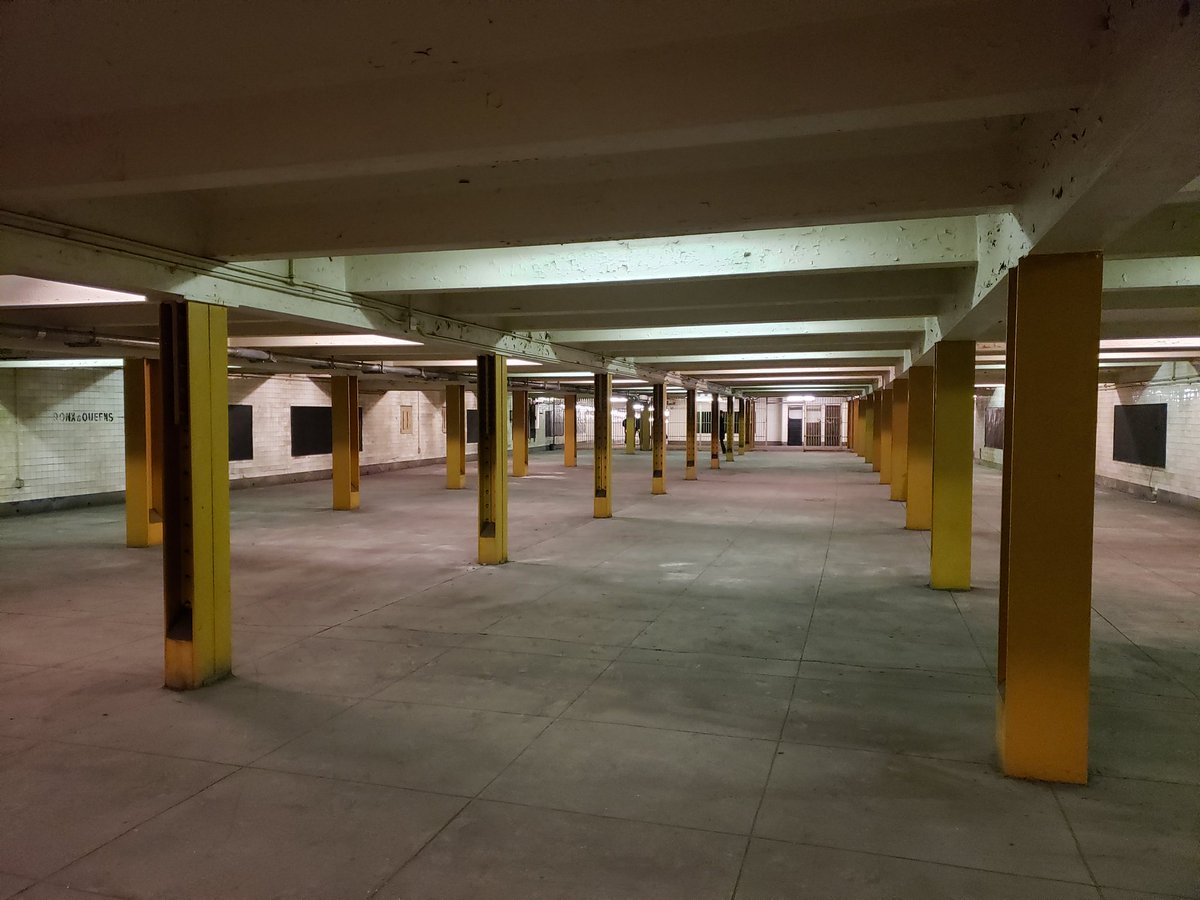
• Smith/9th Sts. set to reopen next Friday · After a delay of few centuries months, the MTA will reopen the Smith/9th Sts. F/G subway stop next Friday, April 26 at 10:30 a.m., agency spokesman Kevin Ortiz just announced via Twitter. The station closed in June of 2011 and was supposed to reopen mid-2012. But delays due to both the normal course of work and Superstorm Sandy pushed the opening back into 2013. Now, Red Hook and Carroll Gardens residents and business will get their subway station back.

    I’ll have more details on the reopening as they become available, but it seems likely that the work isn’t completed even as the station is ready for revenue service. Two weeks ago, I snapped a photo behind the construction fence of the entrance, and much work remained. Still, the MTA vowed to reopen the station before May Day, and they’ll finally meet a Culver Viaduct project deadline, albeit one pushed back countless times. · (6)
  • Appellate Division hears Payroll Mobility Tax case arguments · The MTA’s controversial payroll tax went back to court this week as an Appellate Division court in Brooklyn heard oral arguments from attorneys on both sides of the issue. The tax, which delivers $1.8 billion in badly needed revenue to the MTA’s coffers, was overturned by a Nassau County judge last summer in a deeply flawed ruling. The state has continued to collect the tax as the appeal has wound its way through the state court system, and now we’re awaiting a ruling once again on its constitutionality.

    Judy Rife of the Times Herald-Record filed a brief report from the court earlier this week. Although the initial ruling focused on home rule measures, lawyers wisely have opted not to pursue this line of reasoning as state precedence does not support the decision. Rather, as Rife writes, “Steven Cohn and Justin Adin, lawyers for the municipalities, now argue that the state is required to impose a tax throughout New York when it benefits an agency of statewide concern such as the MTA.”

    This argument is a bold but dangerous one for these lawyers to make. Attorneys for the state and MTA have said that the state “has the authority to enact the tax and to levy it selectively,” but if the court rules differently, the entire MTA funding scheme could collapse. Already, various taxes imposed only in New York City and the surrounding counties bolster the MTA’s bottom line, and denying the state the authority to levy these taxes could send the transit agency’s fragile budget into a tailspin. The odds of such a ruling though are remote, but I’ll feel better about it once the Appellate Division issues its ruling. The payroll tax is far from perfect, but without action from Albany, the alternatives are dire. · (1)
  • For the Hamptons, a new ‘Cannonball’ from Penn Station · A 94-minute, non-stop ride to the East End is in the offering for the looming summer beach season as the LIRR has announced plans to run its Cannonball train non-stop from Penn Station every Friday from May 24 through Labor Day. The one-seat ride will skip Jamaica and head straight to Westhampton with subsequent stops at Southampton East Hampton, Bridgehampton and Montauk. The Friday train will depart Penn Station at 4:07 p.m. with westbound service — including a stop at Jamaica — departing Montauk at 6:37 p.m. on Sunday nights.

    “There’s no better way to get from Manhattan to the Hamptons,” LIRR President Helena E. Williams said in a statement. “Our customers have long asked for a one-seat ride from Penn Station to the Hamptons and we are listening to them. This move eliminates the need to change trains with baggage at Jamaica.”

    With a 34 percent increase in summer ridership last year, the LIRR is hoping to boost service along the Montauk Branch. The speedy ride east will cost passengers $27, and passengers have the option to reserve a seat for an additional fee. Previously, such Cannonball service had originated at the Hunterspoint Avenue Terminal in Long Island City with many riders picking up the train at Jamaica, and the new service does away with the transfer. For Hamptons-bound travelers, the Cannonball train has been a mainstay since the 1890s, and it remains both the longest route and the only one with a name operated by the MTA. · (20)

Restoring passenger rail service to Staten Island's North Shore would improve transit in the neglected borough. (Click to enlarge)

As the Mayor’s idea to bring the 7 train to Secaucus has gained steam over the past few weeks, New Yorkers have raised a skeptical eyebrow toward this plan. As many have noted, why should the city look to expand its subway to New Jersey when parts of, say, eastern Queens are chomping at the bit for better transit? Nowhere have the cries been louder to ignore the Garden State in favor of city-focused expansion than from Staten Island.

Now, I’ve been skeptical of Staten Island and its politicians. As I explored last week, the elected official raising the most hell is also the one who has been the least willing to embrace transit. State Senator Diane Savino vowed to block any funding for a subway to New Jersey that may arise before Staten Island gets its subway, but she’s also been one of the worst transit detractors amongst the New York City constituency in Albany. The city should hardly reward such petulant behavior.

But if we put aside petty differences and an obsession with borders that trumps a focus on the regional economy, we have to ask a serious question: Does Staten Island and its demographics warrant a rail connection, and if so, where should that rail connection go? The Staten Island Advance earlier this week kinda, sorta made that argument. In a piece that focused more on feeling left out of the city’s place, the Advance’s editorial board opined:

It seems to us that New Jersey commuters already have multiple mass transit connections to Manhattan, including the PATH tubes from Jersey City and Hoboken into downtown Manhattan and the New Jersey Transit tunnel that brings trains on that line into Penn Station. (And don’t forget that New Jersey residents also have ample car and bus access into the city via the Lincoln and Holland tunnels and the George Washington Bridge.)

This is where we start jumping up and down and yelling, “Hey! Mayor Mike! We’re over here!” State Sen. Diane Savino responded to the news of this proposal with disbelief…She has warned that she will vote against any state funds for expanding the No. 7 train unless Staten Island gets a rail connection to Manhattan. A light rail line to connect to New Jersey Transit’s Hudson Bergen Light Rail station in Bayonne over the Bayonne Bridge will do fine — and it wouldn’t cost anywhere near what a tunnel under the Hudson will cost…

And, in any case, Mr. Bloomberg will be out of office by the end of the year, and will no doubt take this big idea with him. Still, it would nice if he thought about his fellow New Yorkers in this borough before worrying about easing the commute for people in northern New Jersey.

Here, we encounter two ideas for a Staten Island subway: a connection to Manhattan (either the slow way via 4th Ave. in Brooklyn or the fast way under the harbor to South Ferry) or a rail line over the Bayonne Bridge. There is no small irony in the Advance advocating for the latter while bemoaning Bloomberg’s “worrying about easing the commute for people in northern New Jersey” because that’s exactly what a connection to the Hudson Bergen Light Rail would do. Stil, Staten Island deserves something.

As it stands now, approximately 56,000 Staten Island residents commute to Manhattan every day. On the other hand, as of late last decade, over 70,000 Hudson County residents and over 65,000 Bergen County residents made the trip from New Jersey to Manhattan. According to research conducted by the Center for an Urban Future, approximately thirty percent of those New Jersey commuters drove alone into the city. The numbers for Staten Island weigh against a Manhattan connection in lieu of a Secaucus subway, but we run into a chicken/egg problem. A fast connection between Staten Island and Manhattan would likely boost the number of commuters, and New Jersey does indeed enjoy robust transit connections into Manhattan.

Meanwhile, the HBLR connection is likely a better one. The Center for an Urban Future has determined that, since 1990, the percent of Staten Island residents commuting to Manhattan grew by just four percent while trips within Staten Island grew by 32 percent and trips to adjacent counties — including New Jersey — increased by 22 percent.

So where does that leave us? The obvious candidates for Staten Island rail connections if we want to meet growing demand would involve an intra-island option — such as a reactivation of the North Shore Rail Line (and not a base lane) — and a rail link to the HBLR via the Bayonne Bridge. A subway to Manhattan would be superfluous with a cost that far exceeds its demand. Even still, Staten Island certainly could use the increased transit investments, and the options are on the table for all to see. They’re just not as sexy as a subway to New Jersey for an outgoing mayor looking to leave one final lasting mark on his city.

Categories : Staten Island
Comments (137)
  • Scientists: 7 line extension safe from electric eels · In what is possibly the weirdest MTA-related story in years, DNA Info reports today that the 7 line extension is safe from electric eels. Now, an astute reader may be wondering how this came about a year before the project is due to wrap and why anyone would be focusing on electric eels in the first place. Well, the story is quite strange.

    As Jill Colvin reports, MTA Board Member Charlie Moerdler raised the issue at a recent board member when he claimed to remember eels coming ashore and wreaking havoc on metal pipes during construction of the Javits Center. Moerdler helped the Javits Center secure an exemption to New York’s plumbing rules, and the convention center received permission to use plastic piping. “That’s the issue. Does it apply to the 7 line and does it apply to the area where the Hudson Yards is?” he asked.

    Colvin dug up the March 1980 Final Environmental Impact Statement for the Javits Center and could find no mention of electric eels raising any alarms. She also spoke with the eel project coordinator at the Hudson River Eel Project who said that electric eels do not live in New York Harbor or the Hudson River. “I don’t think you have to worry about electric eel damage,” Chris Bowser said. The MTA, meanwhile, has no plans to to eel-proof the West Side subway extension, and I for one am glad that’s settled. · (18)
You can take the A train if you want to see some New York income disparity. (With apologies to Billy Strayhorn and via The New Yorker)

You can take the A train if you want to see some New York income disparity. (With apologies to Billy Strayhorn and via The New Yorker)

In Washington, D.C, in London and in countless international cities, not all subway rides are created — or, more importantly, billed — equal. It costs more for subway riders to travel long distances and, similarly, less for shorter rides. In New York, zone fares are anathema to our very existence. It costs the same to go from the Rockaways to Washington Heights as it does from Times Square to Penn Station. But does that make sense?

As payment systems have become more flexible, zone fares have grown in use, but zone implementations can vary. In London, for instances, fares are based on distance from the central business district (or Zone 1) while in D.C., fares are based purely on distance traveled. But while advocates of such a fare structure fight for it because these longer subway routes cost more than shorter ones, New Yorkers have long resisted zone fares and seemingly with good reason. (And a good reason isn’t the MTA’s excuse that it would be hard or costly to retrofit MetroCard machinery. That technology will be on the way out soon enough, and its replacement should be capable of handling dynamic pricing.)

When I last delved into the issue, I discussed the city’s economic distribution of households. Zone fares work elsewhere because, by and large, the richer riders live farther away from the central business district. Many of the subways that use zone fares travel through inner cities to richer suburbs, but in New York, the richest people live closest to, if not entirely within, the central business district. In fact, many New Yorkers who don’t live close to Manhattan cannot afford to and may also have little say in their housing matters.

In arguing against zone fares two years ago, I explored these issues with a backdrop of an income distribution map:

If you were to overlay a subway map on top of this socioeconomic representation of the city, it becomes tougher to justify a zone fare. Suddenly, the richest folks in the city are the ones who are closest to work and can most afford to pay higher. In Brooklyn, the poorest residents down in the Coney Island area live furthest away, and in Queens, Astoria and its neighbors to the south are richer than those from Flushing who are further away from the city.

Only in the Bronx would a distance-based fare make sense because incomes rise as we head north, but even then, the folks in the South Bronx make around 18 percent of what those who live in the East and West 80s in Manhattan do. If the subway is supposed to be a public good that allows for people of any income bracket to get to their jobs in a cost-efficient way, New York’s socioeconomics seem to make a zone- or distance-based fare highly problematic.

Today, a similar graphical representation of the subway system is making the rounds. In a brief post meant to spur discussion, The New Yorker posted a graphical representation of income by and across individual subway lines. The visuals — intended to show income inequality in New York City — are striking. Subway routes cross the East River and jump by multiple tax brackets.

Let’s take a look at the N train:

NTrainIncome

Based on recent Census data, the median income around the N’s southern terminus is just $34,000. It doesn’t climb above $48,000 until the Atlantic Ave.-Barclays Center stop at the meeting point of three very well-off Brownstone Brooklyn neighborhoods. The media income around 59th St. of $171,000 is over five times higher than it is around Coney Island. The A train is even more dramatic seesaw as it runs from the Rockaways, where media income dips to as low as $18,000, to Tribeca where income peaks at $205,000 a year.

Now, it’s no secret that lower Manhattan is the land of the rich, and the outer boroughs see incomes decrease as one travels to the outer rings of the city. But these visuals are stark reminders of this reality. If the subway is designed partially as a public good that enables people to traverse the distance between work and home while living within their means, zone fares don’t work here. It doesn’t make sense and it isn’t fair to charge poorer people more to ride the subways and rich people less. Until we can reorganize where people can afford to live, the subway fare should remain a flat one.

Comments (162)

It’s been six weeks since the MTA raised fares and instituted a $1 fee for all new MetroCard purchases made at a vending machine, and already, straphangers may be starting to change their purchasing patterns. The MTA won’t release official numbers on fare media liability for a few months, but if our eyes are to be believed, the fee is having its intended impact.

Take a glance down around the fare control area during your next subway rider, and you will likely see the floor. By itself, this isn’t so strange, but just a few months ago that floor would often be littered with discarded MetroCards. New Yorkers in a hurry often didn’t take the time to toss their empty cards and would rather drop them than refill them. Today, the situation seems different, and my mom — a very long-time SAS reader — offered up this observation:

There is a noticeable lack on MetroCards being tossed on the ground as a result of the $1 charge. The other day Dad needed to a monthly MetroCard, and he had tossed his old one forgetting about the $1 charge. He scoured the 96th St. station and stairs and couldn’t find one. We looked when we got out of the subway and same thing — none on the ground.

I’ve noticed the same around the Grand Army Plaza and 7th Ave. B/Q stations in Brooklyn. MetroCard litter has all but disappeared lately. I’m still awaiting word from the MTA on their own numbers, but the fee may just be working. A $1 surcharge doesn’t sound like much, but for New Yorkers who refuse to give up any extra money to the MTA if they can help, it may be enough of a deterrent to refill and reuse. What have you seen?

Categories : MetroCard
Comments (36)
The 7 to Secaucus will require the two states on opposite sides of the Hudson to cooperate.

The 7 to Secaucus will require the two states on opposite sides of the Hudson to cooperate.

For the past few years or perhaps centuries, New York has displayed a wee bit of a paternalistic attitude toward New Jersey. We scoff at the swamps and industrial areas that mar the landscape on the other side of the Hudson and view the state as some traffic-infested suburban wasteland rather than as a strong economic partner in the region. Gov. Chris Christie’s decision to cancel the ARC Tunnel felt like the final straw. If New Jersey doesn’t care about its ease of access into New York City, then why should New Yorkers care if Garden State residents can get here?

For the past few years, though, Mayor Michael Bloomberg has tried to cut through this interstate rivalry, but he’s taking a very one-sided approach. Since Christie’s ARC move, Bloomberg has pushed the idea of sending the subway to Secaucus. It’s a New York-centric way of controlling cross-border travel, but it’s one that could see the light of day if the mayor can find money. Yet, much like ARC, it suffers from a lack of interstate cooperation. New York wasn’t putting much into ARC construction, and New Jersey is hardly chomping at the bit to fund a trans-Hudson rail tunnel, let alone an extension of New York City’s subway system.

Still, the 7 extension to Secaucus is the idea that just won’t die. Last week, New York City’s Economic Development Corporation termed it feasible, and Staten Island threw a fit. As the MTA remains skeptical and broke, Trenton has done little more than acknowledge this idea’s existence. The Garden State won’t complain if someone else wants to build a rail tunnel for them.

But what if New York can eke out more than just some cheerleading and a promise not to intervene from New Jersey? What if New Jersey could be a funding partner? Bringing in New York’s neighbors to the east would greatly improve the project’s odd, and yesterday, The Record of Bergen County endorsed the idea.

The ARC tunnel was an expensive proposition with limited benefits. The trains would run to a new subterranean station below 34th Street; it would not have given commuters access to Grand Central Terminal, as a similar project under the East River eventually will do for Long Island Rail Road commuters. Additionally, New Jersey was on the hook for all cost overruns. Christie killed the project citing those costs as the main reason.

As years pass, it seems more likely the governor wanted the state funds committed to ARC for other transportation projects. Christie has provided no leadership on a new tunnel project. He has publicly been open to all suggestions, but has not put his political muscle behind any – not the possibility of extending the subway to Secaucus or the Gateway project that would allow for more Amtrak trains to cross under the Hudson.

The Metropolitan Transportation Authority, which controls the New York subway, does not support Bloomberg’s plan. It does not see it as an economically viable project. There were no financial specifics in the report issued last week, so we are skeptical the MTA can make a valid judgment at this juncture. No doubt, Bloomberg sees the benefits for Westside development with an enhanced No. 7 subway. But the subway runs both ways and access to the Westside in Manhattan is access to North Jersey. The subway expansion would spur development around the Meadowlands and further support the proposed American Dream project…

The greater metropolitan region needs more than one trans-Hudson solution. None of these solutions will be inexpensive and all will take many years to complete. As superstorm Sandy showed us, our infrastructure is vulnerable. We need more transportation alternatives – traditional rail, light rail and subway. And we need them soon.

The most convincing argument in favor of the 7 line extension is in this editorial. It’s not just about development in New York City, and it’s not just about development in New Jersey. It’s about the potential to improve cross-Hudson travel while connecting New Jersey commuters and residents with Grand Central and spurring on development in the nearby Secaucus and Hoboken communities. It’s about realizing the economic power of the region rather than the isolationism of each state and the silo approach to transit planning.

I’d like to see The Record take its suggestions one step further. New Jersey should become a partner in the trans-Hudson efforts. Right now, Bloomberg is pushing his 7 line plan with no sure signs of success, and it’s not clear his successor would pick up the effort come January. Meanwhile, Amtrak is the only entity behind the Gateway Tunnel right now as New York and New Jersey have taken a step back there. Only through an interstate embrace will the region move forward with a new trans-Hudson rail tunnel. Otherwise, this is all just talk from lame-duck politicians and planners dreaming big but with no money to back it up.

Categories : 7 Line Extension
Comments (123)

The Broadway Line will be without overnight service this week. (Click to enlarge)

FASTRACK returned to the Broadway Line tonight at 10 p.m., and the service changes are the same as last time.

  • The N will run between Ditmars Boulevard and Queensboro Plaza and between Stillwell Ave. and Jay St.-Metrotech, making local stops north of 36th St.
  • The Q will run from 57th St./6th Ave. over the Manhattan Bridge via the 6th Ave. line. Q trains will make express stops along the D in Manhattan.
  • R service in Manhattan ends early, and the R shuttle between Bay Ridge and 36th St. will start earlier than normal.

That’s all she wrote until May when FASTRACK returns to shutter the Fourth Ave. line between 36th St. and Bay Ridge.

Categories : Service Advisories
Comments (11)

Word from Albany on Friday that, pending State Senate approval, Tom Prendergast would become the next MTA CEO and Chairman came as little surprise. Prendergast had been a runner-up during the previous search for an agency head, and he has the experience and respect within New York City to lead the MTA. He is unlikely to leave on his own before his term runs out but faces a number of looming challenges.

Sitting atop the list is the status of the contract with the TWU. The MTA’s largest union has been without an agreement for nearly a year and a half, and the MTA budget currently assumes a net-zero wage increase. Still, on Friday, John Samuelsen’s team issued kind words for Prendergast. “It’s a good move by Governor Cuomo. Prendergast has vast knowledge of the system, and that’s really what the MTA needs – not a bean counter like Walder or a person with big financial and political connections like Lhota,” union spokesman Jim Gannon said. “We’ve always had a good working relationship with Prendergast, despite a few flare-ups here and there. But on the whole, everyone on this side of the table respects him.”

Despite the TWU’s conciliatory tone, Prendergast will not easily bend or break for the MTA simply cannot afford him to. In today’s Daily News, the newly-appointed MTA CEO and Chair spoke at length with Pete Donohue about a variety of issues facing the MTA, and labor issues took up a chunk of the discussion. In a nod to a long-standing issue, Prendergast spoke about one-person train operations or OPTO.

“There are some lines that are more conducive to one person train operation than others,” he said to the News. “There are some that are more conducive to OPTO only at certain times of the day, and there are some lines where you may never use OPTO. It’s not always about savings. It may be the savings are reinvested in other parts of the system. So, if for argument’s sake, you save (a certain number of conductor positions) and put them on platforms that are extremely crowded, and you have fewer people falling to the tracks, that’s a better utility of resources.”

Interestingly enough, Prendergast has also called for a rapid expansion of automatic train operations in order to boost line capacity. The TWU has pushed back on this issue over concerns that it could lead to zero-person train operations. All of this, furthermore, is a lot more than recent MTA heads have said on this hot-button issue and provides a glimpse into the MTA’s labor future. Prendergast, according to the article, will try to get OPTO on lines with lower ridership totals at first. The overnight R shuttle service into Bay Ridge could be a prime spot for such a test.

Meanwhile, in a nod to the union, Prendergast spoke about the need to reallocate employees and encourage worker flexibility. Prendergast wants to restore customer service agents as many of those red-vested employees lost their jobs during the 2010 service cuts. Prendergast noted that moving to OPTO could give the MTA the ability to restore some of these positions. He also discussed the concept of platform conductors — MTA employees tasked with crowd control at some of the more popular stations. It’s a nascent idea at best.

That’s the good stuff with regards to labor, but Prendergast hit upon some other issues in the interview as well. We’re in for a lot of service changes as the agency copes with Sandy damage. Vital equipment will have to be replaced sooner rather than later due to saltwater corrosion, and Prendergast warned of the system “be[ing] out of service at a more impactful level.” That fare hike scheduled for 2015 is still firmly on the table, and Prendergast is skeptical of recent calls for mayoral control of the MTA. “If you’re going to take the responsibility,” he said, “you have to have the funding to go along with it.”

Categories : Transit Labor
Comments (15)
Page 6 of 430« First...45678...Last »