When the MTA unveils its next five-year capital plan later this fall, the biggest ticket item will likely be a significant investment in Phase 2 of the Second Ave. Subway. It likely won’t, as I’ll discuss later this week, include funding for Staten Island projects that have been on various planners’ and advocates’ wishlists for years, and it won’t include any money for Triboro RX, that circumferential line proposed nearly 20 years ago by the RPA and talked up extensively by Elliot Sander six years back. These are projects without the right champions, but what if we took the Second Ave. approach?
For better or worse, the Second Ave. Subway is a multi-phase project, broken into bite sized pieces due to the whims of politicians who couldn’t stomach a $20 billion price tag for the full line. Instead, we have four phases — only two of which are useful together. Phases 3 and 4, the southern extensions south of the connection to the 63rd St. Tunnel, wouldn’t work independently whereas Phase 1 on its own would be successful and Phase 2 an added and much needed northern bonus. The multi-phased approach leads to higher costs and redundant work, but it also means parts of the subway line will come into service much sooner than otherwise expected.
As New York City struggles to expand its high speed, high capacity transit network, I wonder if the phased approach could work elsewhere, and I’m not alone. Cap’n Transit has picked up in this thread, in a way, in some posts on the Triboro RX line. What, he asked in a recent post, could be done now with a minimum amount of newbuild? The answer is plenty.
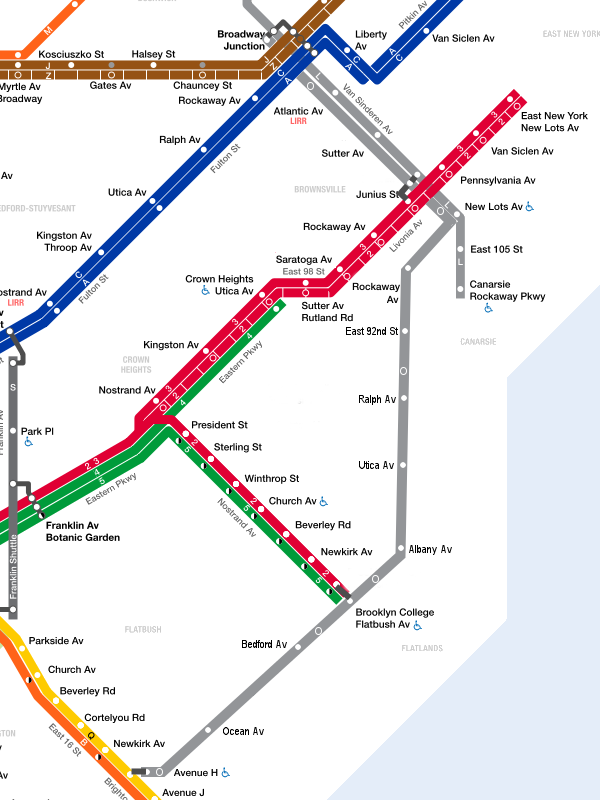
Reviving a 1969 plan the MTA put out during its infancy, the good Cap’n advocates for an O train that would use some of the Triboro RX right of way but would be a more feasible route. He writes:
Under this proposal, the L train would be split into two routes. At Broadway Junction (or maybe Halsey Street) they would diverge, with one continuing to the L current terminus in Canarsie. The other branch, which I’ll call the O train, would travel parallel to the L within the right-of-way of the Bay Ridge Branch, skipping a few stops but connecting to the 3 train at Junius Street. It would then follow the Bay Ridge Branch west through past Brooklyn College (with a transfer to the 2 train), terminating at the Brighton Line with a transfer to the Avenue H station.
This is only one possibility. Another way to handle it would be to run the B trains 24/7, turning them east on the Bay Ridge Branch to Broadway Junction – although riders in Brighton Beach and Sheepshead Bay would probably complain about losing express service. A third would be to have the O and B trains overlap, providing more frequent service.
That seems to be all that can reasonably be done with the existing trackage without sharing tracks with freight trains or pouring lots of concrete. There is a four-track section between Broadway Junction and Fresh Pond Yard, but there’s not much reason to send L (or J or C) trains up there. If you’ve ever taken the M to the end of the line you’ll understand why – it’s not much of a destination.
Running trains on this section would bring train service to a large section of Brooklyn that currently has none, and provide access to potential sites for new housing in these areas. There is no need to wait for a full build of the “TriboroRx” line – that was just somebody’s idea. It should be explored now.
Building out new stations and retrofitting existing ones for a parallel train service wouldn’t come cheap; you can take a look at the state of the ROW in an old Forgotten NY post. But then again, neither will building out the entire Triboro RX, and the political and economic barriers currently preventing any real planning work will exist into the foreseeable future.
But by chopping this project up into pieces, it’s easier for local champions to carry the torch, and it’s easier to find the money to make it one step closer to a reality. As Cap’n Transit noted, there’s no need to wait until some faraway time when Triboro RX becomes a priority (because that time is, more likely than not, never). Let’s start working on smaller pieces today.
Leave a Reply