Archive for 7 Line Extension
Lhota: Let’s send the 7 to Chelsea
Posted by: | Comments
Joe Lhota would one day like to see the 7 line head south past 26th Street. (Photo by Benjamin Kabak)
As the MTA nears the 20 (or perhaps 24-month) countdown to mark the days until the 7 line extension is put into revenue service, the future of the agency’s megaprojects continues to make headlines. Once the extension to the Hudson Yards area wraps, the Second Ave. Subway will surve as the MTA’s only subway expansion project, and many in New York are eying ways to keep the ball rolling. We heard one dreamer’s plan in January to send the L train to the United Nations, but what of the current MTA head?
During Friday’s Regional Assembly hosted the Regional Plan Associate, MTA Chairman and CEO Joe Lhota, the person whose voice may count the most over the next few years, spoke about his dreams for the 7 train. Specifically, he wants to send it south to Chelsea. “As far as big projects are concerned, I can actually see the extension of the No. 7 train to other parts of New York City’s west side,” he said. The 7 could “go all the way down to 23rd Street, and the West Side Highway, so we can incorporate that portion of the west side that’s not receiving a whole lot of coverage.”
Transportation Nation’s Jim O’Grady was on hand at the Regional Assembly, and he had more from Lhota:
Lhota told planners…that the first project on his “wish list” is extending the Number 7 subway train down 11th Avenue to 23rd Street. “It’s something that I think would make sense because if you look at the demographics of the West Side, we shouldn’t just make one stop,” he told reporters after taking part in a workshop at the Regional Plan Association’s annual assembly, which was held at the Waldorf-Astoria Hotel.
Lhota said, “It’s important to have plans, to have a wish list.” But he cautioned there was no active push to send the 7 train from Times Square past its planned terminus at W 34th Street. “I’m not sure it can be done,” he said. “I’m not sure about how close you can get to the Hudson River.”
Lhota’s reference to the Hudson River concerns the technical side of any southern expansion. Because the new terminal with the tail tracks extending south to the low 20s is so close to the West Side, future tunneling would have to cut east. It’s not technically impossible to envision a connection to 14th Street, and furthermore, with the way the tail tracks are built out now, the MTA could add a stop without much more tunneling. A stop in the 20s underneath 11th Ave., however, would destroy the capacity and storage needs the trail tracks address.
On another level, though, Lhota’s discussion seems to be missing something, and that’s something that’s been largely swept under the rug over the past few years. If the MTA wants to add another stop to what has become a one-station extension of the 7 train, the logical spot can be found in the original plans. Before the 7 heads further south or curves around through Chelsea or goes anywhere else, the authority should figure out a way to build the long lost station at 10th Ave. and 41st St.
Ever since the city failed to pony up the dough for the station and both parties agreed to axe it, the station has disappeared from the discussion. It’s out of sight, out of mind. Yet, its absence will be felt for years in the rapidly growing area in the 40s west of 9th Ave. With high rises, a boat terminal and nightlife destinations, that area was primed for a subway stop, and the planned one never materialized. Provisioning for the station is in place, but the money isn’t. We may never see that station, but we should see it before we see a stop further south.
Of course, this entire discussion may be for naught as MTA officials stressed that Lhota wants to get the MTA’s financial house of cards in order first. The 7 extension, Lhota said, “may not necessarily be in the very next capital plan,” and Adam Lisberg, chief MTA spokesperson, called it a “very long term” plan in a note to Capital New York. We have to start thinking toward the future somewhere though, and 41st and 10th should get the attention it deserves.
After a tragedy, crane inspections come under fire
Posted by: | CommentsA crane at Site J for the 7 line extension, shown above, collapsed in a fatal accident earlier this week. (Photo by Benjamin Kabak)
I was unexpectedly out of town earlier this week when news broke of a tragedy at the site of the 7 line extension. On Tuesday night, shortly before 7:30 p.m., a crane collapsed in Site J of the 7 line extension, killing one worker and injuring another. The Manitowoc 4100, located on the east side of 11th Ave. between 33rd and 34th Streets, snapped, and Michael Simmermeyer, a 30-year-old who worked the site with his father, passed away.
“The entire MTA family would like to extend our sincerest condolences to the family of the worker who lost his life as a result of this tragic accident,” the authority said in a statement. “We at the MTA grieve for this loss and vow to do everything we can to ensure that everyone working on projects to better the lives of all New Yorkers can do so as safely as possible.”
In the aftermath of the accident, MTA officials ordered a full stoppage of work at the site, and Michael Horodniceanu of MTA Capital Construction, ordered all MTA cranes inspected. The NYC DOB was called in, and OSHA, the NYPD and the Manhattan DA were looking into the matter as well. The City Council too voiced its concern.
Christine Quinn, currently the presumptive frontrunner in the 2013 race for mayor, raised her voice in concern. She has repeated over the last few years the point that as a state agency, the MTA may invite city inspectors into their sites but is under no legal duty to do so. She also posted a similar message to her Facebook page. As news outlets noted that the crane was due up for inspection this week, Quinn called upon the MTA to allow for oversight closer to home.
“We need the MTA and other state agencies to give the city oversight and authority at these construction sites,” said Quinn. “In fact, the MTA should follow the lead of the Port Authority, that has enters into a memorandum of understanding with the city around crane safety issues.”
The MTA acknowledged the City Council Speaker’s concerns but seemed defensive in doing so. It highlighted two previous inspections that found no deficiencies with its equipment. “The MTA shares City Council Speaker Christine Quinn’s concern for the safety of MTA construction sites,” the authority said in a statement. “As a state public authority, the MTA already is subject to state building codes. The MTA is examining the Speaker’s proposal to put all MTA construction activity under the inspection authority of the New York City Department of Buildings.”
Still, other City Council members voiced similar views. Jessica Lappin who represents the area surrounding the Second Ave. Subway construction and has fought for crane safety, echoed Quinn. “I do think the MTA should stop pointing fingers and should follow the rules that we have already set out,” she said to WNYC. The MTA downplayed a jurisdictional tussle with the City Council, but it’s clear the city wants a greater say in the matter.
Work on the site, meanwhile, will resume on Monday after a pause of nearly a week, and the construction crews will return with a heavy heart as they mourn one of their own, taken at far too young an age.
Thoughts on the death of another ambitious transit expansion
Posted by: | Comments
The 7 line will terminate only at 34th Street and 11th Avenue and not in New Jersey. (Via The Wall Street Journal)
When it comes to transit planning in 2012, not too many people in America are dreaming big. We can’t seem to get a national high-speed rail plan off the ground, and while some cities — notably Los Angeles and Washington, D.C. — are working hard to expand their subway systems, most urban areas are content with incremental improvements. In New York, it was a battle to get a four-station extension of the Second Ave. Subway built, and the East Side Access plan could be facing a two-year delay.
When Mayor Michael Bloomberg, then, announced in November 2010 his plans to extend the 7 line to Secaucus, New Jersey, he was met with both skepticism and enthusiasm. The skepticism arose from the fact that Bloomberg seemingly failed to notify even the MTA of his announcement, and enthusiasm because a leading New York politician had finally embraced an ambitious transit opportunity. It was, of course not to be.
The warning signs were in place early. Although the mayor continued to voice support for the 7 line last October, a promised engineering study that was due late last year has yet to materialized. Meanwhile, the MTA, under two different chairmen, never embraced the plan, and yesterday, Joe Lhota offered up a dose of reality in essentially canceling the plan. According to today’s reports, the authority had made the determination at least a month ago that the 7 extension to New Jersey was too costly, and the Mayor seemed to agree. “I know there’s an effort afoot to try to get the subway system to go to New Jersey,” Lhota said. “I told the mayor this, I told the deputy mayor this: I can’t see this happening in our lifetime.”
The Mayor, speaking yesterday afternoon, seemed resigned to Lhota’s reality. “It’s very hard to see the funding coming right now,” he said. Even the Mayor’s initial cost estimates of $5 billion seemed optimistic, and the MTA has other fish to fry. So even though, as The Wall Street Journal reported today, the Parsons Brinckerhoff preliminary study is still a few months away from seeing the light of day, it may just be an exercise in futility at this point.
As I pondered this development last night, I kept wondering whether or not we should mourn the death of the 7 line to Secaucus. I’ve long believed that we simply do not dream big anymore. Perhaps it’s a sign of the economic times; perhaps it’s a tendency to kowtow to loud NIMBY voices; perhaps it’s fallout from the Robert Moses Era, a period in planning with which New York has never come to terms. Likely, it’s a combination of all three factors, and rare are the politicians who have been the will to push through an ambitious plan and the political capital to do so as well. For better or worse, Mayor Bloomberg was one of those politicians, but his lasting legacies will be a meager extension of the 7 to Hudson Yards and a controversial arena in Brooklyn. Transit hasn’t been a top priority.
When Bloomberg announced the 7 extension to Secaucus, he seemed to be capitalizing on headlines concerning Gov. Chris Christie’s decision to cancel the ARC Tunnel, and he had hoped to secure federal dollars that would have gone to New Jersey. In that sense, it was a rather blatant move. Yet, it represented a sign that transit could command headlines, and with the Secaucus-bound subway dead for generations, plenty of other projects could grab the spotlight.
So let’s find a champion for a Second Ave. Subway that heads north. Let’s find someone willing to explore the Triboro RX plan. Let’s examine a connection to State Island for a rapid transit system. Let’s look into those Utica and Nostrand Avenue extension plans. Just because this grand idea died doesn’t mean we shouldn’t keep dreaming.
Lhota dashes dreams of a 7 train to Secaucus
Posted by: | CommentsThe Mayor Bloomberg-inspired plan to extend the 7 train underneath the Hudson River to Secaucus has captured transit dreamers’ imaginations over the past few years, but the odds have long been stacked against it. The subway expansion would require interstate cooperation and billions of dollars that aren’t readily available. Useful? Yes. Practical amidst the current political and economic climates? Probably not.
Today, while speaking at a meeting of the New York Building Congress, MTA Chairman Joe Lhota threw an ice cold bucket of water on those dreaming of such a subway plan, as Transportation Nation reported this morning. The extension, he said, not going to happen in our lifetime. It’s not going to happen in anybody’s lifetime…The expense is beyond anything we’re doing.”
From the cost of construction to the need to build railyards and shops in New Jersey to the more pressing needs within the city, Lhota was unequivocal in his stance. “I’ve told the mayor this, I can’t see that happening in our lifetime,” he said. The Mayor, in his response, seemed to accept the MTA head’s assessment. Calling Lhota a “realist,” Bloomberg said later that he hopes it “happens within someone’s lifetime. Those people may not have been born yet whose lifetime it would be.” Ain’t that aiming for the stars?
Photos: Inside the 7 line extension
Posted by: | CommentsThe Far West Side of Manhattan is a bit of a no-man’s land. Outside of the Javits Center and some barbecue at Daisy May’s, only storage units, the Intrepid and some boat decks provide reasons for a trip west. Yet in just over 22 months, Manhattan’s first new subway extension since the late 1980s will open, and the 7 line will head to 34th St. and 11th Ave. to an extensive deep cavern station that may one day, if all goes according to plan, serve over 30,000 passengers per hour. The Hudson Yards development will one day be a big destination.
The 7 line extension is the MTA’s under-the-radar $2.1 billion megaproject. The route goes through sparsely populated lands without a heavy residential or mixed-used presence as Second Ave. is. It’s a project that was spurred on by the idea of bringing the Olympics to New York but outlived the failed bid for the 2012 Games. It’s been fully funded, to an extent, by the city, but cost overruns shelved what would have been a very useful station at 41st St. and 10th Ave.
In a sense, this project is a throwback to another era in New York City’s history. Despite lofty projections and a three-block-long mezzanine that puts the IND’s overbuilt system to shame, when it opens, the new station will see far fewer than 30,000 passengers an hour. Rather, this station is meant to spur on development at the Hudson Yards area. With a subway stop, Manhattan’s last frontier will become a much more desirable area. “When we open,” Michael Horodniceanu, the MTA Capital Construction president, said during a tour of the extension, “the ridership will yet to be there. We expect this to spur ridership.”

The mezzanine at 34th Street and 11th Avenue stretches on for three city blocks. (Photo by Benjamin Kabak)
On Friday, I took a tour of the 7 line extension. At 34th St. and 11th Ave., across the street from the Javits Center, the new station is a deep cavern, over 100 feet underground, with a mezzanine that spans over three city blocks. It will have inclined escalators and elevators leading into immense entrances. As the new extension will require six additional trainsets for the 7 line, the new build will have tail tracks that will stretch to 25th St. Horodniceanu said future development could lead to a station near Chelsea Piers or a further extension to 14th St. if the money ever materializes. In fact, such work could have been a part of the current extension had someone wished to fund it.
After entering at 34th St., we walked the length of the station and took a stroll through the tunnel connecting the new extension with the current terminal of the 7 train at 41st and 8th Ave. We walked underneath the Lincoln Tunnel, the Port Authority Bus Terminal and active IND tracks at 8th Ave. Still, the lost station was on my mind as I’ve long believed it to be a very costly mistake not to build it. Contractors have flattened out the otherwise steep grade of the tunnel for a stretch at 41st and 10th Ave., and again, if the money materializes, the MTA could build two side platforms there, rectifying this wrong.

The 7 line cuts through the IND's abandoned lower level platform at 42nd Street and 8th Avenue. (Photo by Benjamin Kabak)
By the time we reached 8th Ave., the old and the new merged. We took a peek at the 7 trains waiting to head to Queens and saw the remnants of the lower level IND platform at 42nd and 8th Ave. This platform, long rumored to have been built to block a westward expansion of the 7 train, served as a set for the movie Ghost and has been bisected by the new construction. Today, it serves as a staging area and temporary rest room for the workers underground.
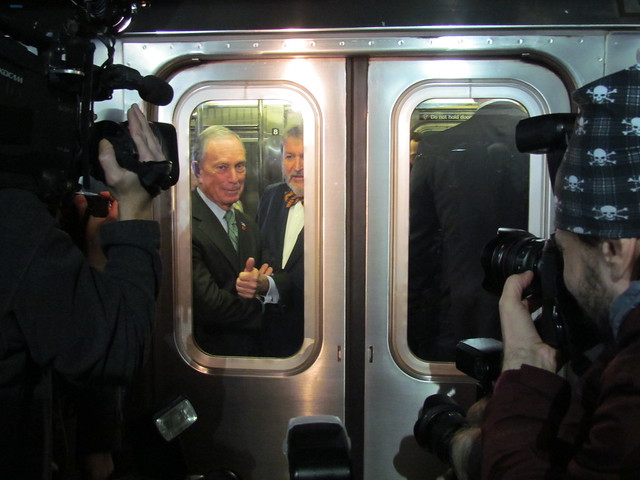
The MTA offers up the 7 line extension of a project that can be built under budget, and while Horodniceanu said it has an “agressive” delivery date of December 31, 2013, they think they can still make it on time. The last contract isn’t due for delivery until June of 2014, and real estate acquisition problems slowed down the overall time frame. But the MTA is offering up substantial bonuses if the contractor can deliver before Mayor Michael Bloomberg’s third term is over. The 7 line extension, omitted station and all, has long been Bloomberg’s pet project, and he wants to ride that train before his days are out.
After the jump, a full slideshow of my photos from the tour. Read More→
Archive: How the Olympics ruined the 7 line extension
Posted by: | CommentsOn Saturday afternoon, I walked the High Line, and as I stood at the fence at the northern end of the park’s reach, I pondered the Hudson Yards area. Had Mayor Bloomberg secured the 2012 Olympics, that expanse of future development would have been bustling with activity as crews would have been hard at work finishing up the stadium that would have played host to the Summer Games. Instead, we’re waiting on the future of the Javits Center, eventual mixed use development above the rail yards and a one-stop extension of the 7 line that won’t open until early 2014.
In London, the city is trying to finish various infrastructure improvements and Olympics-related construction projects. The city has spent $10 billion on transportation improvements, but they are still urging commuters to change their travel patterns during the games. The Olympics crowds across the pond will make the East Side IRT at 6 p.m. seem downright empty.
As London’s expenses for the games spiral well above budge, I wanted to revisit and revise an old post on the 7 line extension and how the failed Olympics bid changed the project. What would have happened, I asked, had the city secured the Olympics. Let’s find out.
The 7 line project — one now destined to serve residents of a real estate complex not yet built or even paid for — got its start in Bloomberg’s desires to see the Olympics come to New York. It was that same desire and the subsequent loss of the games to London that has led to the downfall of the station at 41st and 10th Ave.
We know the project’s recently history fairly well. The project’s design phase started in 2002 when Bloomberg launched his plan to develop Manhattan’s last great frontier, the Hudson Yards land. At the time, the Mayor hoped to lure the Jets from New Jersey with a stadium that would also serve as the home for the 2012 Summer Olympics. In June 2005, amidst massive public protest, the state legislature failed to guarantee financing for the stadium, and a few months later, the IOC, citing that failure, awarded the Olympics to London.
Still, the 7 line extension did not die with the Olympics. Originally, the project’s timetable was an aggressive one. Project Design Completion was due to be wrapped up by December 2006 with construction beginning that year and revenue service in time for the Olympics in 2012. Today, the MTA still lists TBD as the Project Design Completion date. Construction started on December 15, 2007, over a year later than originally anticipated, and revenue service is right now scheduled to start during December of 2013. The MTA will miss those Summer Olympics by a good 17 months.
Over the course of project’s history, the City and MTA have fought over nearly every aspect of it. The City, the primary funding partner for this extension, refused to fund cost overruns and an expensive station stop at 41st and 10th Ave. The MTA has had trouble securing a deal for the land rights to the Hudson Yards area, and the current $1 billion offer from Related is on borrowed time, already one month past the anticipated closing date.
What though would have happened if the Olympics had come to New York? For that, we hit the maps. Take a look at the map below. It is an excerpt from a special map the MTA printed in 2005 showing the potential locations for all of the Olympics events. (To view the map in full, click here.)

Any Olympics plan for the city included heavy usage of the Far West Side. The Javits Center would have hosted six key events, including weightlifting, fencing, wrestling and table tennis, and the planned West Side stadium would have featured some track-and-field contests and the soccer matches. To ensure capacity for those events, the city would have needed a subway stop at 34th St. and 11th Ave. and probably would have paid to build the one at 41st and 10th as well. Instead, the costs skyrocketed, and we’re left with REBNY’s protests, years too late.
Today, progress along the 7 line may be slightly delayed. MTA Capital Construction will release an update within the next few months, but revenue service may not start until the first quarter of 2014. Michael Horodniceanu, head of the unit, has said the Mayor will ride the subway he views as his legacy whether it is a test train or not. No one though is surprised at the delay. Meanwhile, we can remember when the Olympics nearly came to New York. Enthusiasm amongst city residents was decidedly mixed, but the subways would have benefited once the athletes all went home. The station at 41st St. would have been a reality instead of a lost opportunity.
Horodniceanu: 7 line extension may be delayed until early 2014
Posted by: | CommentsIf all goes according to plan, the 7 line extension to the Far West Side is set to enter revenue service in 23 months, long before the Hudson Yards development sees the light of day. Yet, as with many MTA construction projects, all does not often go according to plan, and the extension that was once promised as part of a 2012 Olympics bid may not be ready until early 2014, MTA Capital Construction chief Michael Horodniceanu said yesterday.
As amNew York reports, Horodniceanu spoke at yesterday’s MTA Board committee meetings and explained that a few undisclosed problems may delay the project two or three months into 2014. Instead of being revenue-ready by December 2013, the project could be ready only for testing by then. The full extent of the delays will be revealed at next month’s meeting, but Horodniceanu did promise that the project’s funding partner “will ride a train” to Hudson Yards.
For the MTA, these delays are old hat even as Horodniceanu has vowed to keep the megaprojects on target. For what it’s worth, though, the 7 line extension, despite this delay, is still under budget by “tens of millions” of dollars. It’s also short a station, but that is a well-beaten dead horse at this point.
Rendering: A mezzanine at 34th and 11th
Posted by: | Comments
The new Manhattan terminus for the 7 train will feature a lengthy mezzanine and a direct entrance into the Javits Center. (Click the image to enlarg)
During the one and only time I went into the construction site for the 7 line extension, I wasn’t allowed to bring a camera. It is, as any subway construction site is, a grandiose cavern with equipment everywhere. When I saw it this past summer, eventual platforms were under construction and the two-story cavern was receiving its finishing touches.
Today, The Architect’s Newspaper shares some photos and renderings from the site. Tom Stoelker had a chance to journey down to 34th ST. and 11th Ave. late last month, and today, he published his piece on the site. It has photos of the work in progress as well as the latest in renderings. The scene above shows the station mezzanine, complete with entrance to the seemingly doomed Javits Center, and his post also features a nifty cutaway of the 7 train’s new deep cavern station.
The 7 line extension is still set to open in December of 2013, less than two years from now. By then, hopefully, work will have started at the Hudson Yards site, and we’ll have a better sense of what the future holds for the Javits Center. The subway, which has long ushered in development to the city’s wilds, will be there waiting for it all to grow.
Photo: Art for Second Avenue
Posted by: | CommentsI’ve been sitting on this one for a couple of weeks, but it’s still timely. A few weeks ago in The Wall Street Journal, Jennifer Maloney profiled my favorite under-the-radar MTA department. She highlighted the upcoming plans for art installations at the MTA’s new stations. Along the 7 line extension and underneath Second Ave., the authority will soon have four blank canvases, and they’re planning new art for each station.
She writes:
As subway riders descend the escalator into a new 7 line station near 10th Avenue and 34th Street in 2013, they will be followed by a mosaic of brightly colored celestial orbs shining from a deep blue sky. At a planned Second Avenue subway stop at 63rd Street, the walls will display photographs evoking the elevated trains that once rumbled above. And a station at 96th Street will feature line drawings fired onto ceramic tiles, playing with perspectives as travelers move through the space.
The designs are part of the Metropolitan Transportation Authority’s plan to make each of its new subway stations on the extended 7 line and new Second Avenue line a massive work of public art. Building on the MTA’s nearly three-decade history of enlivening subway and commuter rail stations with mosaics and sculpture, the agency has commissioned art that accompanies riders from the sidewalk to the platform and helps shape spaces that haven’t yet been built.
The effort is ongoing: The MTA last week issued a call for artists for the Second Avenue line’s 72nd Street station. “It’s very exciting,” said Sandra Bloodworth, director of the MTA’s Arts for Transit and Urban Design program, who, along with the artists, discussed details of the projects for the first time. “It’s three New Yorkers, three visions. I think that reflects the subway; it reflects our ridership.”
As Maloney notes, the MTA allocates a small portion of the construction costs to artwork. The new installations are expected to cost between $900,000 and a $1 million each and are a part of projects that will cost a few billion dollars each. It’s a great program that livens up the subways, turning them into the city’s most extensive art gallery. Check out Maloney’s piece for more renderings of the upcoming art. Jean Shin’s work at 63rd St., which, according to Maloney, will “depict the 1942 dismantling of the Second Avenue elevated line and the opening of the sky over an area accustomed to rumbling and shadows,” sounds particularly intriguing.
A Hoboken-based idea for the 7 extension
Posted by: | CommentsIt’s been a few months since we’ve heard much about the city’s nascent plans to send the 7 line to Secaucus. In October, we heard reports that Mayor Bloomberg will push to get the $10 billion extension off the ground before he leaves office in 2013. It would be his shining transit moment and could transform cross-Hudson commuting.
But what if sending the train to Secaucus is only half of a good idea? Maybe the 7 should cross the Hudson, but maybe it should have a different destination. Last November, we heard rumblings of this thought as the region’s planners offered their opinions on the Secaucus extension. At the time, former Transit planner Bob Previdi suggested sending the subway to Newark Airport or even Hoboken, a major hub for New Jersey Transit service that is even closer than Secaucus.
This week, for Crain’s New York, Previdi trumpets a refined idea: The 7 should go to Hoboken instead of Secaucus. He writes:
There are three important reasons to consider Hoboken over Secaucus. First, extending the No. 7 to Secaucus would take 21,000 feet of construction, while Hoboken Terminal sits only 9,000 feet away, which would incur billions less in construction costs.
Second, Hoboken Terminal is a huge facility with plenty of spare capacity. It sits on 50 acres, has 17 platform tracks and is used by only 32,000 passengers a day. By comparison, New York’s Penn Station sits on two blocks, has 21 tracks and is used by over 500,000 passengers a day. It has no spare capacity. Third, the original ARC project was designed to double NJ Transit’s rail ridership—Secaucus is not capable of accomplishing this without major track changes. Only two tracks lead into Secaucus from Newark, which is why it is a major choke point on the Northeast Corridor.
Mr. Bloomberg’s initial response to the canceled ARC project would work brilliantly in Manhattan because it uses spare capacity on the No. 7 to avoid building a station under Macy’s. By the same token, Hoboken has spare terminal and track capacity and is much closer to the 7 than Secaucus. Marrying Hoboken Terminal and the 7 would cost half as much as the other projects, or less.
As the finer points of the engineering study for the plan to send the subway to Secaucus have yet to be released, it’s tough for me to pass judgment on Previdi’s idea. It’s worth noting too that Hoboken already has a subway system in PATH that connects to Manhattan. I can say however that Previdi presents an intriguing competing plan. He is very much in support of the mayor’s pet project, but he wants to see something realized that will help with New Jersey Transit’s capacity problems. Ultimately, that might be too tall an order for a subway extension, but if someone is going to sink $10 billion into a trans-Hudson tunnel, it must deliver returns.
It’s been 15 months since Gov. Chris Christie torpedoed the ARC Tunnel. At the time, as Previdi notes, he promised to “consider more reasonable solutions to meet NJ Transit’s goals.” Maybe throwing New Jersey’s support behind a subway extension will be considered a more reasonable solution, but maybe the 7 can’t do as much as the region wants and needs. Still, if this project is to move forward, we must consider all possibilities, and Hoboken is indeed out there, awaiting its attention and perhaps a subway stop too.