Archive for F Express Plan

The F line, much maligned and often overcrowded, is near and dear to my heart. I live nearby the stop at 7th Ave. in Brooklyn and often find myself relying on it for travel to and from home and parts of Brooklyn or Manhattan. A few years ago, securing F express service became a cause célèbre for me and a few Brooklyn transit advocates.

During our discussions about F express service, the MTA informed us that the option would not be available until after the Culver Viaduct rehabilitation is finished in 2013. We were prepared to wait, but our efforts aroused the attention of a State Senator from the area. With complaints mounting about the F service, Daniel Squadron asked the MTA to perform a comprehensive study of the 27-mile F long. The agency released report — available here as a PDF — on Friday, and it is a rather critical of the current conditions along the second longest subway line in the city.

Citing the fact that parts of the line are 90 years old, the report notes how prone to delays and problems the F is. “Reliability of the F, as on all other lines in the subway, is affected by infrastructure condition, maintenance and renewal; in the case of the F, the need to renew key assets in the coming years is becoming critical, due to their age and condition. As assets age, they become more prone to breakdown, thus adversely affecting reliability,” it reads. Simply put, the F line is falling apart.

The report features a lot of technical MTA-speak. It delves into a discussion on merges and diverges, shared trackage and component replacement plans. It discusses the mean distance between car failures and talks about who the F rolling stock features five different classes of cars — many of which are slated for retirement in 2010. It analyzes controllable on-time performance and absolute on-time performance. It examines ridership numbers and a passenger environment service.

In the end, though, the report boils down to a few main conclusions: The F is a patchwork line made out of parts of varying ages and varying quality. Its oldest sections — between Ditmas Ave. and Ave. X — are 90; its youngest piece — South of W. 8th St. to Coney Island — is just five years old. Because of these discrepancies, the F line is overtaxed and in need of maintenance, oversight and investment.

The report, however, doesn’t make too many out-of-the-box recommendations. In fact, many of the suggestions are in the process of being implemented and capital investment projects are already underway. It urges the following and notes the implementation timeline:

  • Reorganizing line management, to provide greater accountability over multiple disciplines (July 2009).
  • Establishing a task force of senior managers to review F line operations and develop strategies for improvements (Fall 2009).
  • Reviewing the schedules and service design of the F to assess potential operational and service changes, including modifications to Queens/Manhattan service (underway) and express service in Brooklyn (to be undertaken prior to the completion in 2013 of the ongoing Culver Viaduct project).
  • Undertaking a train load analysis to provide line management with critical information for evening out train loads (underway).
  • Assigning more reliable cars to the F (July 2009), reducing the number of separate car classes operating on the F from 5 to 2 (July 2009), assigning a dedicated car maintenance manager to the F (September 2009), and continuing to place new cars into F service (underway).
  • Modifying delay management strategies to reduce reliance on skipping stations (July 2009).
  • Renewing aging infrastructure, including, but not limited to, reconstructing the Culver Viaduct (underway), rehabilitating key stations like Jay Street (underway), and modernizing critical components of the signal system (planned for the 2010-14 Capital Program).
  • Developing strategies to reduce the impact of maintenance and infrastructure renewal work on operations (underway), including coordinating previously separate maintenance activities, establishing a “Scheduled Maintenance System” for signal repairs and heavy maintenance gangs for track repairs, and installing track barriers during long-term projects to reduce the need to slow down when passing work zones.

New York City Transit President Howard Roberts noted that many of the projects are already in place. “While we are already in the midst of several capital projects aimed at improving service for F Line riders, there are measures underway that will move our customers closer to the type of service that they pay for and that they deserve,” said Roberts.

To me, this report doesn’t say anything new. The MTA knows the F is a problem, and the authority already had measures in place to fix those problems. Why did they fulfill Squadron’s request for a report? How much did it cost them? Would we see similar results if this investigation were repeated on, say, the J or the R line? Is adding another layer of management going to solve these problem?

Transit should certainly be praised for a critical self-examination, but Straphanger Joe and Jane could just as easily evaluate the F line. We know it’s a subpar line. Now, we have to see if a report produced at the behest of a State Senator can improve these poor conditions.

Categories : F Express Plan
Comments (15)

When the MTA first announced plans for the Culver Viaduct, work was supposed to begin in the fall of 2008. Shockingly then, this project is already delayed, but after months of silence, the MTA is set to award a contract to Judlau Contraction for the rehabilitation work. Gary Reilly to a story in The Daily News about the project: In its board meeting today, the MTAwill officially award a contract to Judlau Contracting for the Culver Viaduct rehabilitation project.

According to the Daily News (via Gary Reilly), the MTA delayed this project to give the potential contractors more time to submit their bids. On the plus side, though is word that because so many contracts are looking for work in a depressed economy, the winning proposal will be for $62.5 million less than the original MTA estimates. Meanwhile, those who rely on the F and G at Smith-9th Sts. will now face station closures in 2011 instead of 2010. At least now the viaduct won’t look like it’s about to collapse every time a train rolls past it, and maybe, just maybe, when it’s all over, we’ll have that F Express service too.

Categories : Asides, F Express Plan
Comments (2)

In their year-end review of Brookly, The Gowanus Lounge named the F Express effort as the borough’s number two participatory democracy effort of 2007. While we depressingly know that the F Express option won’t be back on the table until the completion of the Culver Viaduct rehabilitation, the accolades for Gary Reilly’s project are much deserved. [The Gowanus Lounge]

Categories : Asides, F Express Plan
Comments (1)
Dec
14

A shuttle bus for Smith-9th Sts.

Posted by: Benjamin Kabak | Comments (3)

With the impending (in 2010) closure of the Smith-9th Sts. F/G stop due to work on the Culver Viaduct, pols in the area are already calling for shuttle bus service. Member of the NYC Assembly Joan Millman, as Brownstoner notes, is calling on the MTA to start this service now to alleviate chornic overcrowding on the F. The bus would run from Red Hook to Smith-9th Sts. and through the Brooklyn Battery Tunnel. Sounds good to me. [Brownstoner]

Categories : Asides, F Express Plan
Comments (3)

fourthaveviaduct.jpg

The designs for the Culver Viaduct work at 4th Ave. are a huge improvement over the current bombed-out shell of a subway station. (Source: New York City Transit)

The Culver Viaduct sure has been on our minds for the better part of 2007. A key component to the dreams of Brooklynites to enjoy the F as an express train, the Viaduct is in terrible shape and living seemingly on borrowed time.

Earlier this month, the MTA announced the details of their viaduct rehabilitation plans which will turn the Viaduct stations — one at Smith-9th Sts. and one at 4th Avenue — into crown jewels of the subway system. Recently, at a Community Board 6 meeting in Brooklyn, New York City Transit unveiled the architectural renderings and track work plans for the extensive renovations. There is, of course, good news and bad news.

4thavecurrentsmall.jpg The good news first: The renderings of the stations look fantastic. On top of this post is what the station at 4th Ave. will look like in a four years. At left is what the station looks like now. (Click to enlarge.) The difference is night and day. Gone are the boarded-up windows and grungy outside.

fourthplatsmall.jpg With views up and down Brooklyn’s admittedly less-than-scenic 4th Ave., the station will no longer be an isolated island in the subway system. Meanwhile, the stations will look just as nice on the inside (see left). Looks good. Too bad we have to wait so long for the finished product.

Finally, in the good news department, comes news of the G train. Beginning next year, the MTA will run the G out to Church Ave., and that service addition will be permanent. In an effort to alleviate F train overcrowding, Manhattan-bound passengers in Kensington and Park Slope can now take the G to Hoyt-Schermerhorn and transfer to the A or C. Otherwise, the G will now allow riders to take a one-seat ride from Greenpoint to Kensington. The good folks at Kensington (Brooklyn) are quite pleased with his news.

But — and this is a rather big but — the project comes with its fair share of bad news, both centered around things we already knew. As I’ve reported in the past, the F Express Plan won’t come to fruition until this viaduct work is completed, but that’s bad news only in the abstract. Worse is the news that the Smith-9th St. stop will be closed for the better part of 2010 with service changes (details available here in PDF form and below) affecting the line for the better part of four years.

This project will be divided into four phases, each with varying degrees of impact. Take a look:

Phase 1 – Set to kick off next fall, the first phase, lasting 15 months, will have only a minimal impact on the line. The center express tracks will be closed as crews will be conducting structural work on the viaduct. At this point, the G will begin running to Church Ave., and the F will run normally.

Phase 2A – During the second stage of work, things get dicey. For four months, the northbound local tracks will be out of service. The F and the G will run express from Church Ave. to Smith-9th Sts. with southbound trains providing service to 15th St.-Prospect Park and Ft. Hamilton Parkway. Northbound trains will service 4th Ave. via a temporary platform, and Smith-9th Sts. will be closed completely with shuttle bus service running along the path the train currently takes. Good thing that’s only four months in MTA time.

Phase 2B – The second part of Phase 2 will last 8 months, but service will slowly return to some semblance of normality. The F and G will run local on the northbound tracks except the trains will bypass Smith-9th Sts. for the first five months of this phase. Smith-9th Sts. will reopen after nine months of repairs and renovations in the middle of phase 2B, but at that point, northbound, only the G will stop there while southbound both the F and the G will service that station.

Phase 3A – This is, in effect, the opposite of Phase 2A. Southbound trains will run express from Smith-9th Sts. to Church Ave. with northbound service only to 15th St.-Prospect Park and Fort Hamilton Parkway. Temporary platforms will service southbound F and G riders at 4th Ave. and southbound G riders only at Smith-9th Sts. This phase will take around five months.

Phase 3B – The last ten months before things get back to normal constitute phase 3B. Here, F and G trains return to local service south of Smith-9th Sts., but Smith-9th Sts. will be service southbound by G trains on a temporary platform. Northbound service will be normal.

Phase 4 – For the last three months of work, riders along the newly-extended G line and F line won’t notice a thing. NYCT is installing new switches on the express tracks just north of 4th Ave. that should allow for that long-awaited F express service.

So there you have it. That is a 45-month project to completely renovate the Culver Viaduct. When all is said and done, the G train will be vastly improved, and if NYCT holds to its word, express service will start along the F line. But for now, as residents in Brooklyn face around four years of service delays and shuttle buses, it’s no wonder that many residents are not too happy.

Comments (26)

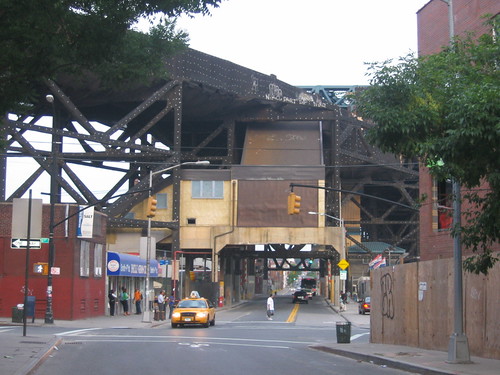
Look, mom, it’s a brand new photo of the oft blogged-about Viaduct on the F line. (Source: flickr user Betty Blade)

When last we saw the pesky Culver Viaduct, the MTA had just dropped a bombshell on residents of Red Hook and Carroll Gardens. That bombshell: In 2010, the Smith-9th Sts. subway stop on the F and G lines will be closed for nearly an entire year due to the Culver Viaduct Rehabiliation. For Brooklynites trying to get to the nearest subway and New Yorkers of all stripes angling to get to Ikea, this was decidedly bad news.

Today, we get some more details courtesy of The Brooklyn Paper. In an article in this week’s edition of the free Brooklyn weekly, Mike McLaughlin goes in depth on the MTA’s plans for the viaduct. The MTA, he reports, plans to turn this station, currently in terrible shape and wrapped in a protective black tarp, into one of the crown jewels of the city’s subway stations. Even better news for residents of the area is the time frame. The MTA now says the station will close for just nine months starting in February of 2010 instead of the original twelve. I’ll believe that one when I see it.

McLaughlin has more on the neighborhood’s reaction to the plans to reconstruct this 70-year-old viaduct:

The MTA is sure to hear complaints from Red Hook and Carroll Gardens riders at the CB6 meeting about the inconvenience it is going to cause them. To lessen this disruption, shuttle bus service will run between the Carroll Street and Fourth Avenue stations, which will stay open for the duration of the renovations on the elevated track, known as the Culver Viaduct to transit buffs.

One piece of good news is for G-train riders, whose train will make all stops between Smith–Ninth, where it currently terminates, and Church Avenue because the viaduct work will make it impossible for the G to turn around between Smith-Ninth and Fourth Avenue.

This short article tells us so much about planning at the MTA. Originally, the G train was set to hit Church Ave. by the end of this year. That date was eventually pushed back to 2008, and now, with work on the viaduct not set to begin until 2009, the G train probably won’t go out to Kensington for another year. Anyone still want to bet that the Smith-9th Sts. stop is closed for just nine months?

While some residents want to turn this station with views of New York Harbor, the Statue of Liberty, and, um, Lowe’s Home Improvement and the Gowanus Expressway/BQE into a grand destination complete with panoramic restaurant, I’m just happy to hear that F express service will probably come to Brooklyn once this viaduct rehabilitation is finished. Too bad we have to wait four more years.

Categories : F Express Plan
Comments (6)

Once the MTA starts work on the Culver viaduct rehabilitation plan, the F/G station at Smith-9th Sts. that serves Carroll Garden, Gowanus and Red Hook will be shuttered for a year. Metro guesses that the 12-month closure will take place in 2010. [Metro via The Gowanus Lounge]

Categories : Asides, F Express Plan
Comments (4)

Via Gary comes an update to the F Express Plan, seemingly the official pet project of Second Ave. Sagas.

As we’ve heard for some time now, due to work on the Culver Viaduct, the F Express train won’t be a feasible alternative until 2012 or thereabouts. While the MTA has noted that, should delays befall the rehabiliation, F express service could happen next year, that reality is slowly slipping away. As Michael Rundle reported in Metro this morning, the MTA has now said that the F express train won’t be on the table until mid-2012 at the earliest.

Rundle delivers the bad news:

In a presentation to an MTA committee yesterday, [Connie] Crawford, senior vice president of capital program management at NYC Transit, laid out all the hurdles…

“The deck has essentially failed,” said Crawford, who expects work to start late next year. “Water is streaming through the deck and destroying the steel underneath.”

Crawford said the project will not only include a full deck slab replacement — “pretty intense work” — but station rehabs on the F line, tunnel lighting and the installation of new tracks, switches and signals. One area will be set aside to test different vendors of automated Communications-Based Train Control equipment.

In addition to the poor state of the viaduct, the tracks, sitting unused since the 1970s, are in bad shape as well. “It’s never been upgraded in the elevated section,” she said. “You can barely run trains over that section. Very slowly can they go through, because the track is so old.” Anyone who’s ridden on some of the re-routed trains on the express tracks this fall can attest to that fact.

So what is the MTA to do? Right now, all they can do is sit back and study the problem. The population along the F train is booming, and with the development of Coney Island on tap, the train will continue to suffer from overcrowding.

If the MTA isn’t willing to – or simply cannot yet – run some combination of V local/F express service past Second Ave. and into Brooklyn, they should do the next best thing and increase capacity along the F and G trains. It’s far from ideal, but it sounds like those of us supporting this F Express plan should think in the short term. Even if we have to wait for the express service, the area along the Culver line needs more train service. That is a very realistic goal.

Categories : F Express Plan
Comments (8)

I always thought everyone supported the F Express Plan. Who wouldn’t want more train service and express train options for underserved and overcrowded parts of Brooklyn? It seemed like a no-brainer to me. Boy, was I naïve in this thinking.

Last week, Gersh Kuntzman’s Brooklyn weekly The Brooklyn Paper ran a scathing (and, in my opinion, very short-sighted) editorial entitled “Who needs an F express?” As you may have guessed from the non-too-subtle title, Kuntzman, supposedly a champion of Brooklyn, isn’t in favor of this added train service on tracks that have existed since these subway lines opened in the 1930s.

In response to this outrageous editorial, I wrote a letter to the editor. The letter, co-signed by the other two major proponents of the F Express Plan, Gary Reilly, the driving force behind the F Express and author of Brooklyn Streets, Carroll Gardens, and Jen from Kensington (Brooklyn), disputes every contention made by The Brooklyn Paper in its editorial. While we hope the letter will appear in an upcoming issue of the paper, here it is in its entirety:

We were dismayed, surprised and saddened by your Sept. 15 editorial entitled “Who needs an F express?” Chock-full of misconceptions, gross oversimplifications and simply wrong information, the editorial provides a disservice to residents of not just Carroll Gardens and Cobble Hill but to all Brooklynites who stand to benefit from express service along the F line and an overall increase of service along the Culver Line.

First among your charges is that due to a supposed bottleneck at York St., “there may not be enough capacity to add trains.” This is an unfounded claim. Elsewhere in the system – the 7 line comes to mind – where express and local tracks feed into one, express service and increased train capacity have led to a lessening of crowded trains. If our greatest concern is one focusing on a scheduling issue past Jay St./Borough Hall, the real location of the bottleneck, then we have nearly won the battle for express service.

Next up is your claim of “simple populism” levied against our local politicians. These politicians are signing on to the research we have conducted that shows our proposal is more than just “simple populism.” As we have stressed over and over again, we don’t need to build new subway tracks to increase service along the Culver Line. The express tracks – the only unused express tracks in the City – were built with the subway line in the 1920s. We don’t need the hard work, vision or money to build new subways; we just need an MTA willing to utilizing underused tracks.

With our plan encompassing V service into Brooklyn past its current Second Ave. terminus and F express service into Kensington and beyond, we fail to see how Brownstone Brooklynites won’t enjoy any benefits. The V will, in our plan, service the current F stops, and the F will service the express stations. Both trains will run frequently, and both will be less crowded.

Overall, it is true that Brooklyn – much like New York City on the whole – needs a bold vision to bring about the next generation of transit enhancements. But we can’t afford to ignore or dismiss the solution right under our noses. Brooklyn needs a restored F express and extended V local, and everyone will benefit from that service.

We like to hope that there’s no such thing as bad publicity. Even if Kuntzman is against the F Express Plan for reasons unknown — or at least, just plain wrong — to us, he’s keeping the issue on the forefront of public discourse in the fair borough of Brooklyn. But I can’t stress enough the F Express Plan as we propose it — with added V service past Second Ave. and the utilization of existing, unused express tracks — would be a boon for an undertaxed neighborhood. The MTA is willing to make it happen when they can; the rest of Brooklyn should cheer this news.

Categories : F Express Plan
Comments (11)

The Culver train, shown here at Bergen St., ran express in 1972. (Photo by Steve Zabel. Courtesy of Joe Testagrose/NYCSubway.org.)

When last we checked in on the F Express Plan at the end of August, we had assumed things were at a standstill. The MTA had finally explained the Culver Viaduct rehabilitation project in a way that highlighted exactly why Brooklyn wouldn’t be able to enjoy express service along the Culver line until 2012 at the earliest.

But yesterday, The Gowanus Lounge broke the news that now the MTA has changed its stance on this express service. According to Andrew Inglesby, assistant director of government and community relations at the MTA, who spoke on Monday the Carroll Gardens Neighborhood Association meeting, the MTA could grant express service to the F line next year if the rehabilitation project falls behind schedule. If the plan is on time, F express service is off the table until 2012 or early 2013.

The Gowanus Lounge has more:

Mr. Inglesby reiterated that work on the Culver Viaduct, which runs above-ground between the Carroll Street Station and the Fourth Avenue Station, is a critical capital project and that work must be completed before an F Express can be put in place… “F Express service just can’t happen until the end of that period.” He said the work will result in “an automatic elimination of any F Express.”

The transit official did offer possibility that if work on the viaduct project is “significantly delayed” by a year or more, then the Transit Authority “will go ahead and examine the possibility of putting in an F Express.” Express service would depend on the availability of cars and funding. So, an F Express could make an appearance for a year or 18 months, if there is a delay in the big repair project.

Wouldn’t that be a tantalizing tease from the Transportation Authority? Knowing their track record on major construction projects — Times Square BMT corridor or that Cortlandt St. project, anyone? — we have every reason to believe that they could fall behind. So for a few months, Brooklyn could end up with our coveted express service. But only for a short time before it has to be shut down again.

Inglesby also verified information about the express plans we had already assumed. The F trains running express would probably stop at Jay Street, 7th Avenue and Church Avenue. These trains would bypass the Bergen St. station (destroyed express tracks notwithstanding), Carroll St., Smith-9th Sts., 4th Ave.-9th St., 15th St., and Fort Hamilton Parkway.

At The Gowanus Lounge, one of the commenters was dismayed at the lack of express service in the Windsor Terrace and Carroll Gardens areas. Simply put, the express trains can stop only where there are express platforms, and those stops listed by Inglesby are the ones on the Culver Line with that option.

For those of us pushing the F Express Plan, this news comes as a pleasant surprise. While I doubt the MTA would fall an entire year behind on the F train, at least they are dangling this carrot. They know we want express service on the Culver Line; they want to give it to us. As soon as that service can become a reality, we’ll have express service on the F line. If that’s not a resounding victory, I don’t know what is.

Update (10:54 a.m.): Metro chimes in this morning with an article on the F express meetings. Of note are two statements from city officials. Councilman Bill de Blasio noted that the MTA wouldn’t acknowledge these plans if they didn’t have the resources to devote to express service on the F line.

But more vital is a quote from MTA spokesperson Jeremy Soffin: “You can’t operate express service while work on the F express is ongoing. But should that be delayed, on an interim basis, we would look at the express. This project was brought forward and supported at the grassroots level and we’ve responded.

I have to praise Soffin. He’s been very responsive in dealing with and addressing those of us heading up this grassroots movement. It’s good to see the MTA listens when its riders raise their concerns. It gives us hope that the MTA will respond to issues in the rider report cards as well.

Categories : F Express Plan
Comments (9)