Author: Benjamin Kabak

  • Great Moments in Other Mayoral Campaigns: 24-hour T service

    In case you were afraid that New York is the only city where current mayoral candidates are offering laughable transit proposals, worry no longer. Thanks to our neighbor to the north with the far inferior baseball franchise, we have company. As Bostonians convene to elect a new civic leader, those hoping to inherit Tom Menino’s mantle are starting to promise the sky when it comes to the T.

    As a variety of candidates take to the streets, transportation issues are front and center. This time, though, candidates are talking about money. They recognize the T’s limitations. It closes earlier; the MBTA is constantly scrounging around for state dollars; the city has little control over its own transit system. But the funding proposals are far more creative than anything we’ve seen in New York.

    In The Globe, Martine Powers summarized the campaign:

    Transportation is a frequent topic on the campaign trail, with candidates releasing detailed platforms coupled with gimmicky appeals to voters, such as three days of car-free campaigning.

    In a Boston Globe survey answered by eight of the 12 mayoral hopefuls, many of the candidates’ visions for Boston’s transportation future aligned: Most they said they plan to push for 24-hour T service, will embrace technology to reduce gridlock in the city, institute major changes in the city’s taxi industry, promote biking, and encourage car-free commuting.

    The differences in candidates’ platforms are in the details. Councilor Michael P. Ross said he would consider offering special late-night licenses to bars and restaurants that would allow them to stay open later, with the fees funding extended T hours, while Suffolk District Attorney Daniel F. Conley suggested that Boston sports teams and cultural institutions bundle CharlieCards with their season tickets and annual memberships, adding an influx of cash to the MBTA.

    Beyond these ideas, certain mayoral candidates have also suggested that the Massachusetts Bay Transportation Authority beg the region’s myriad universities for funding assistance or ask hospitals and corporations — those economic drivers with workers who need late-night transportation — to chip in. Of course, since the MBTA is a state-sponsored agency, these suggestions will be for naught, but they’re far better than the Triboro RX SBS route or Joe Lhota’s park-and-ride plans.

    But while we can nod knowingly in Boston’s direction, something is driving this push toward outlandishly inane or inanely outlandish transit ideas in mayoral campaigns. Is it because cities should have tighter control over their transit systems? Is it because states and the feds aren’t adequately funding transportation investment? Are these zany ideas simply a cover for an unwillingness to do anything serious? I’m sure the answer is somewhere betwixt and between all of these questions, and the answers are rather uncomfortable.

  • Link: Lhota the candidate vs. Lhota the MTA head

    When Gov. Andrew Cuomo nominated Joe Lhota to head up the MTA, transit advocates were surprised. Lhota was a behind-the-scenes numbers guy for Mayor Rudy Giuliani and an executive with Cablevision and Madison Square Garden with no real transportation experience to speak of. Yet in his brief tenure as MTA Chair and CEO, he become a vocal advocate for transit in New York City, conversant in the ins and outs of the MTA’s daily operations and its complex budget and a staunch supporter of its post-Sandy recovery efforts. I thought he could have been a very effective MTA head had he stayed, but the press coverage from the storm had him dreaming of Gracie Mansion.
    I had guardedly high hopes for Lhota’s campaign. Here, after all, was a mayoral candidate who saw first-hand what happened when the city’s transit system shutdown. He recognized the importance of both restoring service and keeping open lines of communication with the millions of New Yorkers who depend upon the trains each day. He fought for external dollars and internal efficiency. He understood it.

    As a mayoral candidate, though, transit and transportation have not been Lhota’s strong suits. It’s unclear if he’s simply playing to a base of Staten Island voters vital to his mayoral chances and other pockets of GOP voting blocs that aren’t as sympathetic to transit or the MTA, but one way or another, Lhota as MTA head was far more appealing that Lhota the mayoral candidate.

    Earlier this week at Capital New York, Dana Rubinstein took a look at Lhota’s move away from transit advocacy. Here’s her take:

    Months before Hurricane Sandy propelled Joe Lhota into the public eye, and then into a run for mayor, the then-M.T.A. chairman expressed hope that the subway system would be an issue in 2013. “I do believe that people are focused on this,” he said, in March of last year, referring to the M.T.A.’s precarious finances. “It’ll probably be a very big item during the mayoral race next year.”

    Now Joe Lhota is the Republican nominee. And he is not talking about the M.T.A.’s finances in any sort of serious way. Which is not to say that he’s not talking about it. He thinks the M.T.A. should drop billions on a subway extension from Republican-heavy Bay Ridge to Republican-heavy Staten Island. He’s also in favor of reinstituting the commuter tax, but to fill the city’s coffers, not the M.T.A.’s.

    The former Giuliani deputy who served for a year at the helm of the transit authority now wants the city to wrest control of the money-making Triborough Bridge and Tunnel Authority and reduce tolls for Staten Islanders, even though those tolls subsidize the hurricane-ravaged subway system. He used to think congestion pricing wasn’t such a radical idea. Now he finds the very prospect of congestion pricing “draconian,” even though the latest version to make the rounds of New York’s power circles includes a toll-equalization scheme that would benefit, among other constituencies, drivers on Staten Island.

    As others Rubinstein spoke with noted, some positions — such as congestion pricing — aren’t tenable for a mayoral candidate with serious hopes for a primary victory. Furthermore, with city control over the MTA somewhat limited, the mayor can speak until he’s blue in the face about transit advocacy and policies without actually being able to do much. Still, I’d rather see a candidate support a sensible approach toward transit investment and development than backtrack on a year’s worth of progress.

    There’s plenty of time for Lhota to change his tune, and I’m not convinced that Bill de Blasio is any stronger on rail and buses than Lhota could be. But as Rubinstein explores, this is as close to an about-face as one can imagine. Election Day is a week after the one-year anniversary of Sandy, and the Lhota who became a household name after the storm doesn’t yet appear to be the same Lhota as the one who will be on that ballot.

  • On the potential for future Sandy-related closures

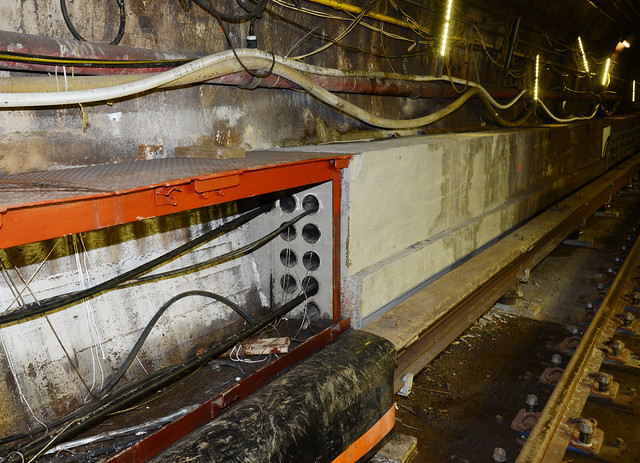
    There’s a whole lotta fixin’ and fortifyin’ going on in the Greenpoint Tube. (Photo: Marc A. Hermann / MTA New York City Transit)

    While traveling from Herald Square to Chinatown last night for dinner, I had the opportunity to ride the R train for the first time in this post-Sandy shutdown world. I enjoyed the R160s, but south of 14th St., the ride became something of a carnival trip. The conductor would flicker the lights while announcing repeatedly that the train would not be running south of Whitehall St. You’d have to be asleep to miss the ruckus.

    As the work on the Montague St. tube passes through its second month, subway riders seem to have adjusted. It’s too early to tell the overall impact of the shutdown, but I’ve definitely noticed larger crowds at Canal St. and more people waiting on the 4th Ave. platform at Atlantic Ave. for a Bay Ridge-bound train. It’s possible that rides are shorter as the trip over the bridge is faster than the R’s winding route through Lower Manhattan and Downtown Brooklyn, but multi-seat journeys just feel more annoying.

    The R train can sustain such a shutdown though because its ridership is relatively low. What about those other routes providing key connections between Brooklyn and Manhattan that were also damaged during Sandy? Earlier this week, reporters had an opportunity to grill MTA CEO and Chairman Tom Prendergast on future potential plans for Sandy-related shutdowns, and he hedged a bit. Prendergast was in charge of Transit during and after the storm, and he knows more about the state of the infrastructure that just about anyone. He wasn’t though in the mood to share much.

    During the back-and-forth, he discussed the state of the other East River train tunnels, noting that nine of the tubes were damaged “pretty substantially.” “We know,” he said, “there are problems in the other tubes.” Problems is never good word when talking about metal surfaces and electronic components exposed to saltwater.

    Still, Prendergast wouldn’t give much information out on the status of the various tubes. He said that the Clark St. (2/3), Montague (R) and Cranberry St. (A/C) Tunnels bore the brunt of the flood. We also know from first-hand reports last year that the 53rd St. tunnel sustained water damage and that the L train’s 14th St. tube was inundate, but Prendergast didn’t mentioned those two tunnels by name.

    He did say, however, that work won’t start in any other tubes until Montague is back up and running. “You really can’t deal with those [other tunnels] until you deal with these,” he said, referring to the ongoing R and G train work, “because you can’t close or limit capacity in too many tubes at one time or you actually reduce the level of service.”

    As reporters pressed him to explain the damage, Prendergast remained vague. “We don’t believe they’ll be the same order of magnitude, “he said, but the flooding occurred in nine out of 14 under-river tubes. Anything we can do on nightly closures is where the focus will be and then we look at weekend closures and then what we call an out-of-phase which is a permanent seven days ago for a number of months…Hopefully we can do it with nightly closures.

    If all of this reminds you of Donald Rumsfeld’s famous quote about the known knowns and known unknowns, well, I can see why. Something is coming, but we don’t know what. At some point, possibly in mid-to-late 2014 as the work on the Montague St. tunnel begins to wrap, we’ll hear more, but for now, the threat of future closures, to some degree or another, remains. Meanwhile, the MTA is racing against any future hurricane that could yet again bring floodwaters into the subways. Cross your fingers; hope for the best.

  • Carmen Bianco named New York City Transit President

    If the headline seems familiar, well, that’s because it is. Five months after inherting the role on an acting basis, Carmen Bianco was officially named President of the New York City Transit Authority today. MTA CEO and Chair Tom Prendergast opted to keep his right-hand man in the role after a nationwide search, the MTA said.

    “When I returned to New York City Transit, Carmen was my pick to head the Department of Subways because of his extensive background in safety, his management skills and his vision of guiding the system into the future,” Prendergast said in a statement. “Carmen is a leader with lengthy mass transit and railroad career experience. He understands the issues, is an advocate for the customer and will remain someone the employees can depend upon for support.”

    Bianco, a 30-year industry vet with extensive experience at Transit, Amtrak and New Jersey Transit, is largely credited with spearheading the subway’s recovery after Sandy. He has also played a key role in developing the FASTRACK maintenance program and various other technological innovations. His pick isn’t much of a surprise and should maintain the status quo and forward progress we’ve seen from Transit in recent years.

  • Underground cell service and New York exceptionalism

    For years, we’ve heard about plans to bring cell service to the New York City subway system, and after false starts and empty promises, only recently has a rather slow expansion of service begun to creep throughout the underground stations. Still, the system is not without flaws as the supposedly free wifi often isn’t free, and the service works about as often as it doesn’t. That won’t stop the MTA from expanding it, but should we applaud the effort or sigh exasperatedly at it?

    As Transit Wireless works to expand cell service to more underground stations in the coming months, the MTA has its sights set on something bigger. In yet another effort to attract Millennials — who already take the subway because they’re not buying cars — the agency has long-range plans to equip its subway tunnels with cellular service. It’s not clear when this will happen, how much it will cost or who will pay, but it’s on the radar. MTA CEO and Chair Tom Prendergast said as much at a Citizens Budget Commission breakfast yesterday, and Matt Flegenheimer of The Times was on hand for his comments:

    At a forum on Tuesday, the authority’s chairman, Thomas F. Prendergast, said that transit officials hoped to add Wi-Fi and possibly cellphone reception aboard moving trains — in what appeared to be the first public acknowledgment that the authority’s ambitions for wireless service went beyond stations.

    Mr. Prendergast said the push for expanded Wi-Fi and cellphone access was a reaction, in part, to the demands of the growing population of young riders. “It is one of the features that the X’ers and the Y’ers and the millennials consider an expectation or an entitlement, not a luxury,” Mr. Prendergast said at the gathering, which was hosted by the Citizens Budget Commission…

    The authority is also seeking to install Wi-Fi on the Metro-North Railroad and the Long Island Rail Road, issuing a request for proposals for a firm to provide service both on trains and inside stations. A spokesman said the authority was currently negotiating with a potential vendor. Service aboard subway trains was a logical evolution, Mr. Prendergast suggested. “Every time you provide Wi-Fi to a greater degree, they want to go to the next level,” he said. “That would be the next frontier. Exactly when, can’t say.”

    Matt’s article goes on to discuss the pluses and minuses of underground cell service. It’s a debate I’ve analyzed before and one that I think is overblown as it tends to forget that millions of riders on the elevated and at-grade sections of the subway deal with this reality on a daily basis. Most riders are respectful cell users, and loud, obnoxious conversations aren’t the norm even if they are the stereotype. But that’s neither here nor there.

    Rather, let’s talk about this idea of New York exceptionalism. Should we applaud the MTA for admitting that they want to install some sort of connectivity in between stations? Or should we wonder what is taking so long? There are subway systems that have had this feature for over a decade, and cell service in that regard isn’t the only deficiency. Countdown clocks, contactless fare payment systems, affordable construction costs — they’re all part of the same idea. It didn’t happen first in New York, and so it must be impossible or exceedingly painful for it to happen in New York.

    I know the excuses. The New York City subway system is too big; it operates all the time; it’s too old; it wasn’t built for these technologies. But they’re just excuses. At some point, we have to ask why these things take so long to arrive in New York. Is it because we’re still catching up on decades of neglect? Is it because it’s a fight to fund state-of-good-repair programs, let alone necessary capital enhancements? These aren’t easy questions to answer, but they are ones that should be asked. Subway cell service — and a contactless fare payment system — shouldn’t, in 2013, be some far-off promise.

  • The MTA’s overtime spending problem

    The MTA missed its overtime spending projects during the first half of 2013 by nearly $70 million, according to agency budget documents released yesterday. Thanks to a combination of employee vacancies, maintenance and weather emergencies largely driven by Transit’s response to the damage inflicted by Sandy, overtime spending hit $368.5 million from January-June, a variance of $68.9 million over what the MTA had originally budgeted for this year. It is unclear how this unanticipated expense will impact the year-end budget.

    According to the special report released yesterday [PDF], weather was a driving factor in this jump. Of the $68.9 million, $29 million stemmed from responses to weather issues, and $20 million of that is directly attributable to Sandy. “Work included, but was not limited to, supplemental bus and shuttle service for subway and train lines that were damaged, repair of signals in flooded areas that were immersed in salt water, station repairs, and extensive damaged track work.” Vacancies and employee availability contributed $10 million to the overtime expenditures as well, but these costs were partially offset by payroll savings.

    The report did not contain any clear cut steps to reduce these overtime expenses and urged agency leaders to reassess future budget projects. The report called for an aggressive attempt at filling vacancies and expanding the “pool of employees-in-training for critical operating positions,” but overall and despite a dip in 2010, overtime expenses, mired in the upper $500 million level annually, remain a big concern.

  • For $100 billion, the MTA’s next twenty years

    It’s full-court press time for the MTA’s next capital campaign. The agency unveiled its initial twenty-year assessment nearly two months ago, and last week, MTA CEO and Chairman Tom Prendergast began to defend his upcoming $29 billion request. After Monday’s MTA Board committee meetings, we have a better sense of what the MTA wants, and over the next twenty years, the agency wants to spend in excess of $100 billion to keep everything running.

    On its surface, $100 billion over twenty years is nearly inconceivable. This is $5 billion a year until I turn 50. This is $100 billion in capital funding. This is $100 billion with scant mentions of anything like future phases of the Second Ave. Subway, a rail connection for Staten Island or any other numerous subway expansion projects we dream up on these web pages. This is $100 billion.

    But despite the humongous nature of the number, it’s not inconceivable that the MTA will spend this much, and they seem to have a plan. It’s not, as officials continue to note, a sexy plan. It involves a lot of behind-the-scenes work that will replace early 20th century technology in 100-year-old tunnels with mid-21st century technology that will allow Transit run more trains in crowded tunnels. It is, as MTA officials discussed during a board presentation on Monday, part of the natural cycle of components. Acquire or build comes first followed by operating and maintenance followed by renew and replace. Call it the subway circle of life, and it moves us all.

    While the last few capital campaigns have been dominated by megaprojects — East Side Access, Fulton St., the 7 Line, the Second Ave. Subway and South Ferry — this expanded look forward at the next 20 years involves the ever-elusive state of good repair. The MTA, not assuming that the money will be there, has recognized the need to push toward that state of good repair while incorporating resiliency standards developed in the 11 months since Sandy hit to prepare the subway system for its next century.

    The bulk of this work will include over $18 billion invested in the signal system, and the MTA has taken great pains to stress how large of an undertaking this project will be. Replacing signals require massive system shutdowns, and the way the MTA plans to stagger the work over the next few decades will make the recent FASTRACK treatment seem like minor annoyances. The end result will be greater capacity throughout the preexisting system, and that is likely to be the best way to meet increased subway demand.

    As a benefit, the new signals will also lead to a robust countdown clock system, and here, we see another picture emerge. The public will get shiny new toys. The countdown clocks are possible because the MTA needs to know where trains are for safety and security reasons. The latter, in this case, drives the former. We’ll also get a contactless fare payment system sooner rather than later, circulation improvements at some key midtown stations, and eventually some shiny new rolling stock.

    So what’s missing? Keeping in mind that we haven’t seen the MTA’s big wishlist yet, it’s worth noting that megaprojects have disappeared. The MTA is not yet proposing Phase 2 of the Second Ave. Subway or any other rail expansion plans within the five boroughs. I expect to see funding for Penn Station Access arrive in the next set of documents to be released later this fall, but I’m bearish on the immediate future of the rest of the Second Ave. Subway. Prendergast wants it to be finished within the next 20 years; he said as much at the Crain’s New York Business breakfast last week. But so far, we’ve heard a lot about signals and not too much about system expansion.

  • Map: FASTRACK arrives on Central Park West

    CPWFastrack

    This week’s FASTRACK is no fun for anyone impacted by it. It’s a tough one with alternate service providing circuitous options that could involve significant walking or transfers. From 10 p.m. to 5 a.m. each night this week, there will be no train service underneath Central Park West. Here we go:

    There will be no A train service between 59th Street-Columbus Circle and 168th Street and no D service between 59th Street-Columbus Circle and 161st Street-Yankee Stadium. B and C trains will end early each night. Alternate routes include the 1, 2 and 4 trains, free shuttle buses in northern Manhattan or a special Bx19 bus. The 42nd St. Shuttle will operate all night to provide a connection for stranded riders.

    Despite these challenges, the MTA says this FASTRACK, the first to impact the Central Park West stations, has “been designed around the careful determination that there is adequate alternate means of transportation, including enhanced services along some bus lines during work periods.” Here are their alternate ideas:

    A trains will operate in two sections:

    • Between Inwood 207th Street and 168th Street
    • Between 59th Street-Columbus Circle and Lefferts Blvd/Far Rockaway

    D trains will operate in two sections:

    • Between 205th Street and 161st Street-Yankee Stadium
    • Between 59th Street-Columbus Circle and Coney Island-Stillwell Avenue

    Customers may take:

    • 1 trains for service between Midtown and Washington Heights
    • 2 and 4 trains for service between Midtown and the Bronx
    • Nearby 1 and 2 stations along Broadway as alternatives to closed stations along Central Park West

    The special Bx19 buses will operate between the A and D’s 145th Street/St. Nicholas Avenue stop and the 1 train’s 145th Street/Broadway every 15-20 minutes. Free shuttle buses will operate between Broadway at 168th Street and Broadway at 110th Street, traveling along Broadway, 155th Street, the Harlem River Drive, 135th Street, St. Nicholas Avenue, Frederick Douglass Boulevard and 110th Street back to Broadway.

    The next FASTRACK comes in October, and it will shutter the BMT Broadway line.

  • Thoughts on getting to, and around, Staten Island

    This Ferris wheel sure will look great surrounded by a mall, hotel and acres of parking lots.

    What do you do with Staten Island? What is its role in the future of New York City? How does the city develop accessible areas while opening up other parts of the island? And should these other parts even be opened? These are the perennial questions facing the city’s isolated borough, and with development plans on tap and a mayoral election in full swing, Staten Island is inching, perhaps reluctantly, into the spotlight.

    Over the next few years, for some reason or another, the St. George area in Staten Island may become a destination. Near the ferry terminal is a quaint minor league ballpark where some of the greenest prospects play, and in a few years, a 350,000 square foot outlet mall, a 200-room hotel and a 625-foot tall Ferris wheel are set to debut. These aren’t attractions for the natives; they are very much designed to attract tourist dollars to the area.

    The city is actually being blatant in their attempts at drawing people to Staten Island. NYC & Co. recently unveiled a new initiative promoting day trips to Staten Island. The campaign encourages visitors to check out the North Shore, and The Wall Street Journal recently urged its readers to look even further than that. Anne Kadet urged her readers to dig deeper, and Staten Island’s politicians hopped aboard the effort.

    “We welcome thousands of visitors who travel on the Staten Island Ferry every day, and we’re glad for this opportunity to show them a few more family-friendly reasons to visit with us,” Councilwoman Debi Rose said. “There’s no shortage of things to do, places to stay, and places to eat for visitors coming to Staten Island. We’re not ‘the forgotten borough’ but ‘the unforgettable borough.’”

    So that’s all well and good, but what about Staten Island’s problems? We can send a bunch of tourists to Staten Island on the ferry, but then they will find themselves stranded at the norther end of the borough trying to decipher a convoluted bus map or relying on expensive cabs to get anywhere else. Tourists, by and large, don’t rent cars when traveling through New York, and the car ride to Staten Island — via congested roads in Brooklyn — is hardly an easy or convenient trip. The Staten Island Rail Road serves some of the island, but large areas are without easy transit access. What can the city do?

    The easy solution is a North Shore rail line reactivation. Despite the glaringly obvious need, the MTA over a year ago issued a feasibility study promoting bus rapid transit instead. A subway connection, via the Narrows to Brooklyn or the harbor to Manhattan, is discussed only on message boards devoted to our transit dreams. Meanwhile, the plans for these St. George attractions call for a considerable amount of parking. Shocking, I know.

    There’s no easy solution to this problem, and many Staten Islanders are OK with that. They don’t necessarily want the density that comes with transit or the crowds that come with tourist attractions. The city though is intent on turning at least a part of Staten Island into a destination for better or worse, but they’re doing it without addressing fundamental problems of access and accessibility. We may not want a giant Ferris wheel sitting in the harbor, vulnerable to whatever weather may come its way, and we certainly don’t want a Ferris wheel, mall and hotel without a way to get there that doesn’t involve more cars on the road. But that’s what we’re on the verge of getting.

  • Weekend work impacting 14 subway lines

    Busy week, huh? Tom Prendergast began a year-long push for capital funding while, across the river, New Jersey seems primed to extend PATH to Newark airport. The MTA, meanwhile, wants to make buses sexier or at least more appealing to Millennials (and everyone else).

    Anyway, here are the weekend changes. Ride safely.


    From 11:30 p.m. Friday, September 13 to 5 a.m. Monday, September 16, there is no 1 train service between 14th Street and South Ferry due to Cortlandt Street reconstruction.

    • Free shuttle buses provide alternate service between Chambers Street and South Ferry.
    • 1 trains run express in both directions between 34th Street-Penn Station and 14th Street.
    • 2 and 3 trains run local in both directions between 34th Street-Penn Station and Chambers Street.

    Overnight note: Downtown 1 trains run local from Times Square-42nd Street to 14th Street during the overnight hours.


    From 11:30 p.m. Friday, September 13 to 5 a.m. Monday, September 16, 2 trains run local in both directions between 34th Street-Penn Station and Chambers Street due to Cortlandt Street reconstruction.


    From 6:30 a.m. to midnight, Saturday, September 14 and Sunday, September 15, 3 trains run local in both directions between 34th Street-Penn Station and Chambers Street due to Cortlandt Street reconstruction.


    From 12:01 a.m. Saturday, September 14 to 5 a.m. Monday, September 16, 4 trains run local in both directions between Grand Central-42nd Street and Brooklyn Bridge due to signal work between 14th Street-Union Square and 42nd Street-Grand Central.


    From 6 a.m. to 11:30 p.m., Saturday, September 14 and from 8 a.m. to 11:30 p.m., Sunday, September 15, 5 trains run local in both directions between Grand Central-42nd Street and Brooklyn Bridge, and every 20 minutes between Dyre Avenue and Bowling Green due to signal work between 14th Street-Union Square and 42nd Street-Grand Central.


    From 5:45 a.m. to 6 p.m., Saturday, September 14 and Sunday, September 15, Pelham Bay Park-bound 6 trains run express from Hunts Point Avenue to Parkchester due to rail work north of Whitlock Avenue.


    From 11:30 p.m. Friday, September 13 to 5 a.m. Monday, September 16, there are no D trains between Atlantic Avenue-Barclays Center and 34th Street-Herald Square due to New York State Department of Transportation Inspection of the Manhattan Bridge. Customers should take the F, N, Q, R or special shuttle train instead. D service operates as follows:

    1. Between Coney Island-Stillwell Avenue and Atlantic Avenue-Barclays Center (express between 36th Street and Atlantic Avenue-Barclays Center)
    2. Between 34th Street-Herald Square and 205th Street
    3. Special shuttle trains operate every 20 minutes between Grand Street and West 4th Street, stopping at Broadway-Lafayette.
    • For service between Manhattan and Brooklyn, customers may take the N, Q, or R. Transfer between the D and N, Q, R trains at 34th Street-Herald Square and /or Atlantic Avenue-Barclays Center.
    • For West 4th Street and Broadway-Lafayette Street, customers should take the F instead. Transfer between D and F trains is available at 34th Street-Herald Square.
    • For Grand Street, customers may take the shuttle train and transfer between trains at Broadway Lafayette. Or use the N, Q, or R at the nearby Canal Street station.


    From 11:30 p.m. Friday, September 13, to 5 a.m. September 16, E trains are rerouted via the F line in both directions between Roosevelt Avenue and West 4th Street due to a Sandy-related survey of the 53rd Street tube.

    • E trains travel via the 63rd Street and 6th Avenue corridors, stopping at F stations.
    • Free shuttle buses run between Court Square-23rd Street and 21st Street-Queensbridge, stopping at Queens Plaza.


    From 11:30 p.m. Friday, September 13 to 5 a.m. Monday, September 16, Coney Island-bound F trains run express from Jay Street-MetroTech to Church Avenue due to work on the Church Avenue Interlocking.


    From 11:30 p.m. Friday, September 13 to 5 a.m. Monday, September 16, there is no G train service between Church Avenue and Hoyt-Schermerhorn Sts due to work on the Church Avenue Interlocking. Customers should take the F instead. To connect between F and G service, customers should take the A or C between Hoyt-Schermerhorn Sts and Jay Street-MetroTech. G service operates in two sections:

    • Between Court Square and Bedford-Nostrand Avs.
    • Between Bedford-Nostrand Avs and Hoyt-Schermerhorn Sts, every 20 minutes.


    From 11:45 p.m. Friday, September 13 to 5 a.m. Monday, September 16, there is no L train service between Lorimer Street and Myrtle-Wyckoff Aves due to track tie renewal at Graham Avenue. L trains operate in two sections:

    • Between 8th Avenue and Lorimer Street
    • Between Myrtle-Wyckoff Avs and Rockaway Parkway

    Free shuttle buses provide alternate service between Lorimer Street and Myrtle-Wyckoff Avs.


    From 12:01 a.m. Saturday, September 14 and 5 a.m. Monday, September 16, N trains run local in both directions between DeKalb Avenue and 59th Street in Brooklyn due to New York State Department of Transportation Inspection of the Manhattan Bridge.


    From 10:45 p.m. Friday, September 13 to 5 a.m. Monday, September 16, 57th St-7th Ave-bound Q trains run express from Sheepshead Bay to Kings Highway due to track panel and roadbed work south of Kings Highway.


    12:01 a.m. to 6:30 a.m. Saturday, September 14 and Sunday, September 15, and from 12:01 a.m. to 5 a.m. Monday, September 16, there is no R train service between 59th Street and 36th Street in Brooklyn due to New York State Department of Transportation Inspection of the Manhattan Bridge. Customers should take the N instead. R trains run between Bay Ridge-95th Street and 59th Street.