Category: MTA Absurdity

  • The MTA responds to elevator accusations

    When the MTA elevator story broke in The Times yesterday, I was struck by the candor in the reporting. William Neuman spoke to some high-level MTA employees — including NYC Transit President Howard Roberts and the agency’s own elevator and escalator guru — as he pieced his story together.

    The MTA workers were generally candid in their critiques of their agency. “This organization is very, very good at subway car maintenance; it’s very good at bus maintenance. But maintaining auxiliary equipment it hasn’t done as well,” Roberts said. “I think that we are in the process of trying to create the same competence in elevator and escalator maintenance that we have in buses and subway cars.”

    Joseph Joyce, the general superintendent of elevators and escalators, was equally forthcoming.
    “I’m trying to get these guys to think that, you know what, that could be your mom that’s walking with a cane and needs that escalator,” he said to Neuman. “Nothing in this world is guaranteed. It could be one of us in a wheelchair next month. And if you want to enjoy the city, you want to be able to utilize our public transportation system. You need that elevator to work.”

    It’s tough to find fault with the MTA for their honesty. Instead of hiding behind a bunch of “no comments,” the people in charge responded to an obvious problem and are seemingly willing to confront it head-on. Later in the day on Monday, NYC Transit released an official statement on elevator and escalator service problems. It read, in part:

    To help better train our workforce, NYC Transit recently opened a specialized training annex aimed at teaching the maintenance and repair of elevators, escalators and moving walkways. The facility offers extensive hands-on training so employees will be as prepared as possible as they work to keep the subway system’s nearly 370 elevators and escalators in a state of good repair. Prior to the annex’s opening, all instruction was done in the field. The annex is now a vital tool in maintaining the reliability of the system’s elevator and escalator equipment. It should also be noted that in most instances, elevators are being installed in a system whose original designers never planned or provided for their installation.

    Modeled after the program that helped dramatically boost subway car reliability, we have also begun a program that forecasts the expected service lives of escalator and elevator parts, and then replacing them prior to the point of failure. The system that houses maintenance records has been upgraded and fully computerized for easy reference and retrieval. Early improvements in reliability figures indicate that the move to the Scheduled Maintenance System is already having a positive impact. To visually check elevator and escalator operation, personnel from the Division of Stations check the equipment in their stations three times a day. In yet another move forward, NYC Transit has installed a $1.3 million electronic monitoring system to alert maintainers when an elevator or escalator stops working…

    These aggressive shifts in our philosophy have earned some improvement in the reliability of escalators and elevators. Though we are still coming online with the training annex, escalator reliability rose from 97.1 percent to 98.1 percent from the first quarter of 2007 to the same period this year. Likewise, elevator reliability rose from 97.9 to 98.8 percent.

    Part excuse, part explanation, but from the sound of it, NYC Transit is working hard to ensure elevator and escalator reliability, and they should be working hard. These services go beyond simple measures of efficiency and wasteful spending. For many wheelchair-bound straphangers, these elevators — although sparse — are the only means of entry and exit from the train systems. An unreliable system is doing no one any good.

    In the end, it will be probably be a challenge for the MTA to keep these elevators running smoothly all the time. They are, after all, in use 24 hours a day, 7 days a week, 365 days a year. Some people use the privacy of the elevators for inappropriate bodily functions; some people use them as their own personal drawing boards or garbage cans. They’re trod upon and abused during all hours of the day.

    But as The Times story has drawn attention to a problem that is getting increasingly harder to ignore — someone think of the privately owned escalators! — it is comforting to know that the MTA is working to improve service. Hopefully, those measures will be successful.
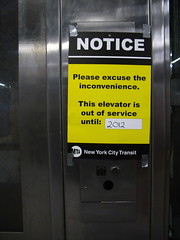
  • The MTA spent $1 billion, and all they got were some broken elevators

    One of my least favorite subway trips begins (or ends, really) at Clark St. in Brooklyn. Nestled just past the New York harbor in Brooklyn Heights, the Clark St. station is so far underground that one must use an elevator to reach the platform. While there is an 80-foot staircase in case of emergencies, the elevators — the creaky, lumbering, claustrophobic elevators — are the MTA’s recommended means of getting to and from the 100-foot deep platform.

    To residents of the area, the terrible conditions of this elevator are not a secret. Brooklyn Enthusiastic bemoaned the sorry state of the elevators over a year ago. The MTA’s problems with auxiliary equipment stretch well beyond one elevator in Brooklyn. As I’ve detailed over the last few weeks, the MTA’s escalators have garnered a lot of attention lately, and the Straphangers Campaign called upon the MTA to fix the system’s numerous broken escalators.

    But today, the dam broke. In a stunning indictment of the MTA’s non-rolling stock, non-track-related equipment, William Neuman in The Times explores the extent of the subway elevator and escalator problems. After $1 billion in investment since the mid-1990s and $1 billion more planned for the next 10 years, the MTA’s elevators are rife with problems. Neuman notes some of the issues:

    ¶One of every six elevators and escalators in the subway system was out of service for more than a month last year, according to the transit agency’s data.

    ¶The 169 escalators in the subway averaged 68 breakdowns or repair calls each last year, with the worst machines logging more than double that number. And some of the least reliable escalators in the system are also some of the newest, accumulating thousands of hours out of service for what officials described as a litany of mechanical flaws.

    ¶Two-thirds of the subway elevators — many of which travel all of 15 feet — had at least one breakdown last year in which passengers were trapped inside.

    “This organization is very, very good at subway car maintenance; it’s very good at bus maintenance. But maintaining auxiliary equipment it hasn’t done as well,” NYC Transit President Howard Roberts said to The Times. “I think that we are in the process of trying to create the same competence in elevator and escalator maintenance that we have in buses and subway cars.”

    The problems, however, go well beyond simple breakdowns. It is, according to Neuman’s sources, a problem of institutional inadequacies.

    The more than 200 mechanics who maintain and repair the subway’s elevators and escalators receive as little as four weeks of training, a fraction of what they would receive in other transit systems or in private industry. And transit officials concede the system is so inefficient that many elevator and escalator mechanics spend barely half of their shifts actually working on troubled machines.

    Managers often rush balky elevators and escalators back into service without identifying the underlying causes of mechanical problems, leading to more breakdowns.

    Many problems occur because of basic design flaws or mistakes made during the construction of the machines, when contractors worked with little or no oversight. Those conditions left many of the machines virtually broken from the outset.

    “They don’t have enough competent people with the proper training,” said Michele O’Toole, the president of J. Martin Associates, which the transit agency hired in 2006 to evaluate its elevator operations. “It all reflects back to qualifications, training, capabilities.”

    Transit officials offered the typical excuses: The subway system is too large with elevators at disparate corners of the city; the 24-hour-a-day nature makes it impossible to police public elevators-cum-restrooms; and so on.

    The rest of Neuman’s piece is anecdotal. He examines numerous elevators and escalator in various stages of decline. We have elevators at West 4th Street that don’t fit the space; escalators that fall apart when people step on them and start up again suddenly. We see inadequate training and subpar emergency response times.

    In the end, for those straphangers long used to relying on and avoiding the MTA’s elevators, these findings come as no surprise. For others, Neuman’s stellar piece will be a shocking reminder that the MTA can run subway cars but not a subway system too well. Hopefully, it will begin the process of change so badly needed as the MTA struggles to maintain its auxiliary equipment underground.

    Photo by flickr user fmsparis.

  • Beware the bedbug-infested subway benches

    The butterflies are fleeing the bed bugs. (Photo by flickr user NewYork808)

    While we’re know that the new subway fares aren’t deterring riders, the higher cost of a MetroCard swipe hasn’t stopped bedbugs from hanging out in the subways either.

    According to a typical sensationalistic piece in the New York Post, bedbugs are taking over benches in the subways. Run for the hills!

    Patrick Gallahue, John Mazor and Sylvia Harvey — how did it take three people to write a 143-word article? — write:

    At a recent Department of Housing, Preservation and Development forum on the subject, a city bedbug educator admitted to seeing the pests on benches in subway stations – in one case, catching a ride on an unsuspecting straphanger’s caboose at Brooklyn’s Hoyt-Schermerhorn station, according to people at the meeting.

    The official, identified as Edward Brownbear, also reported seeing the bugs on wooden benches at the Union Square and Fordham Road stations in Manhattan and The Bronx, respectively.

    Sharis Lugo, 20, of Brooklyn leaped off a bench at the Union Square station when she heard the news, saying, “Ewww! That’s nasty . . . They’ve got to take these benches out of here!”

    The bedbug news first broke a few days ago in this post on the bedbug meeting on Miss Heather’s New York Shitty blog, and now that the reputable Post and Yours Truly are picking up on the story, it’s bound to keep spreading.

    Stainless steel benches would be so much more hygienic for so many reasons. Maybe this disturbing and disgusting news will be just what the MTA needs to get the ball rolling on replacement benches.

    Continue on for a <i>New York Post</i>-produced video on the subway-bound bedbugs.

  • We now join in progress ‘As the Escalator Climbs’

    The soap opera of NYC Transit’s out-of-service escalator epidemic took another step forward this week. On Monday, I noted the recent spate of stories about the sorry state of many subway escalators. A few hours later, the Straphangers called upon NYC Transit to issue a public accounting of all its escalators, privately owned and maintained or not. Gene Russianoff, head of the Straphangers Campaign, hopes that a public list could help put pressure on delinquent operators who won’t fix their escalators. [AMNY Subway Tracker Blog]

  • ‘An escalator is never temporarily out order; it’s temporarily stairs’

    Borrowing a line from Mitch Hedberg, Gary Reilly at Brooklyn Streets, Carroll Gardens rants on the recent spate of broken escalators feeding into and out of subway stations around New York. Over the last few weeks, both amNew York and Cubed (via amNew York) have noted the sheer inanity of leaving escalators out of order for years at a time.

    Oftentimes, as is the case at Union Square, the maintenance responsibilities for these escalators are in the hands of the owners of the buildings that house subway entrances, and these landlords opt not to shell out the expenses. The MTA, meanwhile, doesn’t seem to pressure these landlords into keeping the terms of the real estate deals, and the escalators are allowed to languish unused and out of order. What a mess. [Brooklyn Streets, Carroll Gardens]

  • Riding the subways alone, but at what age?

    Long gone are the days when the New York City subways were overrun with graffiti as they were in the 1980s.

    I called my mom yesterday afternoon to quiz her on my childhood. “How old was I when you first let me ride the subways alone?” I asked.

    She paused, unable to come up with the answer off the top of her head. “Um, 12, maybe?” she said. I thought back to a few nights during the winter of 1995 when I would traipse off to my friends’ B’Nai Mitzvot parties on the subways all by myself. While I have no recollection of the first time I rode the subway alone — it was that monumental a part of my growing up in New York City — I was at most 12 years old.

    To me, riding the subways alone was a non-event. It was just another part of living in and growing up in New York City. We learn to cross the street alone; we learn to go to school alone; we learn to take the subways alone. We survive and thrive. A child of New York can tell you how to get from Bay Ridge to Bedford Ave., from TriBeCa to Tremont Ave. Sticking them in the woods with a map and a compass is another story altogether.

    But something happened two weeks ago that has been an utter surprise to me. It started when New York Sun Lenore Skenazy left her nine-year-old son — at his request, mind you — in Bloomingdale’s with a MetroCard, a subway map, a $20 bill and no cell phone. She told him to find his own way home. Lo and behold, he did it. By using his city smarts and taking the subway and bus, he managed to make his way home in the middle of a Sunday among some of the city’s most crowded transit corridors.

    Still, the backlash has been borderline ridiculous. Skenazy and her sonappeared on the Today Show (video in the link) seemingly to defend her actions when her New York City-based friends started calling her crazy and a bad mother. Their rationale? These parents were afraid that Izzy, now 10, would get abducted in the big, bad New York City subways.

    They told stories about Elizabeth Smart and some girl in Florida who took the back way home through vacant lots and found herself in some trouble. What if that happened to poor Izzy on a Sunday in New York City, one of the safest large cities in the world, and in the subways where crime is at a record low?

    Meanwhile, other bloggers started to weigh in. Louise Crawford of SmartMom fame wrote that she supports Skenazy but wouldn’t allow her daughter to do the same thing. Crawford blames parents today, and so do I. Parents who coddle their kids because they’re afraid of something that in the vast majority of cases doesn’t happen are engaging in urban behavior that is counterproductive to the surrounding environment.

    I grew up with my parents’ trust. They allowed me to ride the subways by myself, and I grew to love the subways because these underground trains shepherded me around the city. But at the same time, they also taught me how to ride the subway from an early age. They taught me how to read the subway map and where to wait for trains. They taught me to avoid empty cars and ride with the conductor. That’s still sound advice now that I’m far removed from my 12-year-old self. This type of urban education starts young, and it can’t happen until parents remember how they learned the city and remember that Bad Things do happen but now if you’re careful.

    Skenazy has continued to rail against the way parents shelter their children because of the way the media overplays one-off incidents. And she’s right. Her son proved that children today can fend for themselves, and even if he did it on a crowded Sunday afternoon along well-traveled routes, it’s refreshing to see some urban independence these days.

  • MTA service with a smile

    MTA employees never look this cheerful.

    MTA station employees do not enjoy a very good reputation on the Internet. As Chris has documented, people tend to notice them most when they’re literally falling asleep on the job. But what if the MTA had service with a smile?

    A group of young women calling themselves Boring, Inc., decided to find out recently. They’ve started a full-service group called MTA Service Specialists in an effort to promote hospitality on the subways, one of New York’s bastions of inhospitable behavior. Alex Nathanson at the Independent Media Center had more on their efforts to spruce spruce up the subways:

    Four women, members of Boring Inc., have taken it upon themselves to increase customer service on New York City subways. Dressed in matching uniforms complete with heels, pill box hats, and of course, a snack cart, this past Saturday, Kae Burke, Lauren Larken, Anya Sapozhnukova, and Kristine “Kiki” traveled around New York offering help, snacks, and smiles.

    “Commuters deserve helpful, courteous service with a smile while riding the erroneous MTA,” says Kae Burke, the organizer of the MTA Service Specialists project.

    The performance is a response to the MTA’s fair hikes. It has been more than a month since the fair hike and the MTA has yet to improve their overall service including extended evening hours and additional train routes.

    I’m not going to complain about this one. That’s for sure. If four women dressed as airline stewardesses for the subways want to pass out snacks and advice to subway riders in need, who are we to stop them? The subways could use a little more pizazz anyway.

    The Post had a few great quotes from those participating and those observing the young women in action. “The MTA should have some customer service,” Kae Burke, one of the service specialists, said. “People listen to humans a lot more than outdated messages, especially when we look this good.”

    “With these girls, I’d be on the train all day. You’d have 1000 percent ridership,” Steven Faria, a rider, said. Maybe attractive young women are the secrets to the MTA’s woes. As they say, sex sells, and the subways sure could be a whole lot sexier.

  • NYCT installing redundant signs on 7 trains

    7explclsigns.jpg

    The circle and diamond designations for local and express trains seem rather familiar. (Photos by M. Roberts for the Daily News)

    Ah, the good ol’ 7 line. More crowded that most U.S cities’ entire public transportation networks and long the testing ground for new MTA programs — how’s that project line working? — John Rocker’s favorite trains will again change the way it announces whether its trains are running express or local.

    In October, the MTA introduced an LED light pilot program to help differentiate trains. The test lights were fairly straightforward: Trains whose LEDs read LCL were going local, and those with LED lights that said EXP were, obviously, going express.

    Yesterday, the MTA unveiled the results of this LED light indicator test. As Pete Donohue reported, 7 trains will be equipped with red diamonds or green circles to indicate express or local service, respectively. Donohue writes:

    NYC Transit has begun rolling out subway trains with new digital signs brightly declaring if they are running express or local: a red diamond for express, a green circle for local. The first train fully loaded with the broadsides hit the rails during [Monday’s] rush. More subway cars will be rigged in the coming weeks and months.

    “It looks sharp,” No. 7 line General Manager Louis Brusati said of the markings. “It will immediately tell people what train it is.”

    NYC Transit President Howard Roberts said: “It is another step in making the ride on the No. 7 line as smooth and effortless as possible.”

    Transit officials hope to trim train delays by making it easier to identify express and local trains. Service announcements are made on trains and in stations, but riders often are puzzled.

    Now, I’m all for bringing in new technology for our subways, and that’s what New York City Transit is doing with these line manager programs on the L and 7. Donohue notes that digital communication signs on station mezzanines along these two lines will be rolled out in the next two months. These signs could give information about train delays or route changes. I’m not quite sure how the 7 and L trains can really change their route, but that’s neither here nor there. The fact that these technologies are on the way is a major achievement.

    I am still stumped though about this seemingly new way to indicate express or local service along the 7 line. Back in the day — and by “the day,” I mean the late 1990s — 7 trains used their rollover signs for this designation. Diamond 7’s always ran express while circle 7’s always ran local. But at some point in the last few years, NYCT employees decided that it was too hard to change a bunch of rollover signs during depot stops, and so passengers grew so confused that the MTA had to install something new over a system that was already in place.

    We don’t know how much this LED light program costs, but considering that the MTA is not really in a position to spend frivolously right now, I have to wonder if asking employees to take the time to turn the rollover signs would really be that inconvenient right now. There’s really no point in installing an unnecessary technology on top of something that isn’t yet obsolete.

  • Breaking: MTA announces plan to shutter subways at night

    This will soon be a familiar sight to New Yorkers. (Photo by flickr user graphicdefine)

    Is the City That Never Sleeps finally going to bed?

    After 104 years of life with a 24-hour subway, New York City may have to learn how to cope with a transit system that shuts down late at night. Due to the MTA’s budget crisis and looming cuts from Albany, MTA CEO and Executive Director Elliot “Lee” Sander announced today that the MTA will start shutting the entire subway system for a few hours each day.

    “I have reviewed our 2008 revenues to date and the projected contributions from Albany,” Sander said during an afternoon press conference, “and as a result, I will recommend to the Board that we move ahead with stopping the trains for a few hours each night.”

    According to preliminary plans, during the week, the subways will begin their last runs at 12:30 a.m. and resume service at 5:30 a.m. On the weekends, the last trains will run at 2:30 a.m. with service starting up again at 6:30 a.m.

    For decades, New York had resisted calls to close the subway system. In the mid 1990s, transit experts and city planners questioned the need for 24-hour service, and in 1981, an impassioned letter to the editor of The Times explained why the subways had operated 24 hours a day since the inaugural ride in 1904.

    But all good things must come to end. With capital construction costs on the rise and the revenues from congestion price no sure thing, the MTA has decided to cut back service in the short term until the economy and their finances recover. “If we implement these service cutbacks now,” Sander explained, “we can can speed up the time frame for our big-ticket capital projects such as the Second Ave. Subway and the Long Island Rail Road East Side Access plan.”

    Coming on the heels of yet another fare hike, the news has left New Yorkers, used to getting anywhere at any time, fairly shocked, the promise of 24-hour bus service that mirrors subway lines hasn’t mollified subway rider advocates. “We understand that the MTA is in a financial bind,” Straphangers Campaign guru Gene Russianoff said, “but we’re not prepared to give up our 24-hour subway service. Hundreds of thousands of New Yorkers rely on that subway service to get to work and to live their lives.”

    As far as I’m concerned, happy April Fools Day.

  • The MTA’s worst Monday ever

    As far as Mondays go, the MTA’s this week will be one the agency soon wishes to forget.

    The real bad news, of course, came yesterday afternoon when the agency announced that the service upgrades promised to the public following the fare hike will be shelved for now. Due to a revenue gap of over $20 million, the MTA is not prepared to extend service on the G, B and W lines as well as the IRT lines starting in June. While the agency says that, if their finances improve, they could implement these service improvements in the next three months, the odds of that happening are low.

    On the service, acknowledging this reality so soon after the fare hike is a terrible public relations move by the MTA. As Kevin pointed out on this site, this announcement hits the MTA at its weakest point. The agency, long viewed with skepticism by New Yorkers, has lost any shred of credibility when it needs it the most. Now, the public will not believe that the MTA ever planned to deliver the promised service upgrades. The authority simply used those upgrades to sell the public on a fare hike. And forget congestion pricing; if the MTA can’t make on good on simple service improvements, how are they ever expected to secure the revenue from the congestion pricing plan and ensure that it too goes to service upgrades that will probably never arrive?

    Meanwhile, the suspension of the service upgrades was but one piece of bad news for the MTA. A new Quinnipiac poll about congestion pricing revealed a deep-rooted public skepticism toward the agency. On the surface, the poll seems to bring good news to the MTA. After all, two-thirds of all New Yorkers support congestion pricing if the money goes toward transit.

    But beware the cloud behind this silver lining. Fifty percent of poll respondents say it is “not too likely” or “not likely at all” the the money would actual go to transit. Respondents don’t feel that politicians would actually deliver on their promises to send congestion pricing revenue to the MTA, and in light of today’s announcement, the other half probably now feel that the MTA would use that money to cover operating expenses and revenue shortfalls rather than investing in proper service increases.

    Finally, slipped into an amNew York story about the service changes came the even more bad news: The MTA is anticipating fewer on-time trains in 2008 by nearly five percent. According to Marlene Naanes, “The agency lowered the goal for on-time trains to 92 percent in 2008, down from the 97-percent level that’s been in place for the past two years. Transit officials did not say Monday why they lowered the goal, but said that reasons for delays include more track work on the line and customers holding doors.”

    So let me guess this straight: On the same day we find out we’re paying more for the same service, we actually find out that we’re paying more for less on-time service. Yikes. As the ghosts of the oft-delayed trains from the 1970s fill our heads, the MTA can look forward to Tuesday simply because it’s not Monday. The news can’t get any worse today, right?

    Photo of the old MTA logo by flickr user joelogon.